

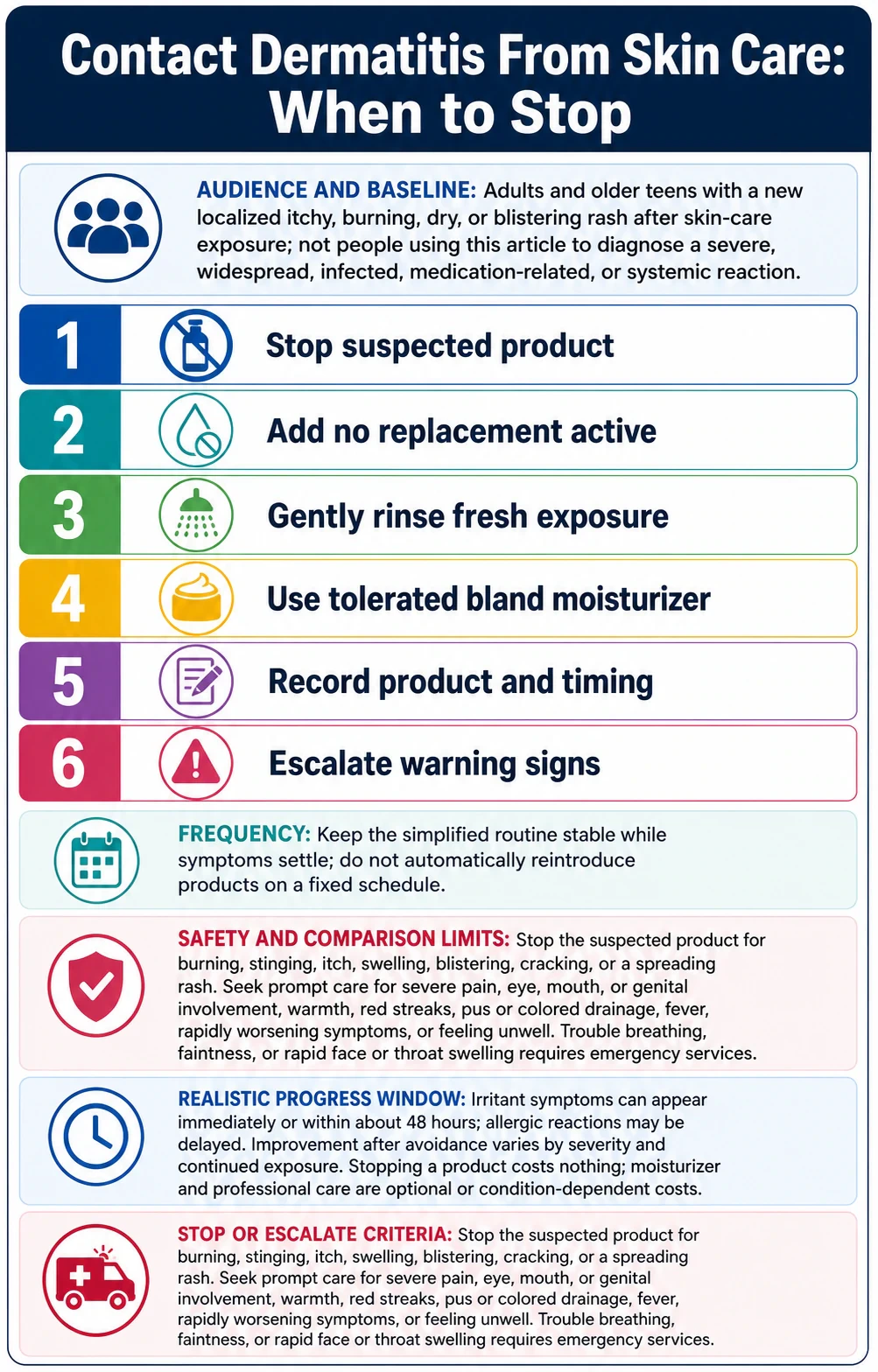
When a new cream, cleanser, serum, fragrance, or makeup product is followed by itching, burning, swelling, or a rash, the safest first move is usually subtraction. Stop the suspected nonessential product, simplify the routine, and watch for warning signs. Buying another active product before the skin settles can make both the reaction and the investigation harder.
This guide is general education, not diagnosis or individualized treatment. A photograph cannot prove contact dermatitis, identify an allergen, or rule out infection, eczema, a medicine reaction, or another condition.
Start with the exposure, not the appearance
Contact dermatitis can be irritant, where a substance directly damages the outer skin layer, or allergic, where the immune system reacts to a substance. Both can follow cosmetics and skin-care products. They can also look different across skin tones: red, brown, purple, gray, dry, cracked, bumpy, swollen, or blistered.
The useful baseline is a timeline. Record the product name, where it was applied, whether it was left on or rinsed off, when symptoms started, and what else touched the same area. Include hair products, makeup tools, fragrance, sunscreen, jewelry, laundry products, and occupational exposures.
Do not use timing as a diagnosis. NHS guidance notes that irritant symptoms may appear immediately or within about 48 hours, while allergic reactions can be delayed. The same product may also be tolerated for months before an allergy becomes apparent.
The reversible-first response
If the reaction is mild and localized, use a simple order:
- Stop the suspected nonessential product.
- Do not introduce a replacement active.
- If exposure was fresh, gently rinse with warm or lukewarm water rather than scrubbing.
- Use only a previously tolerated bland moisturizer if it feels comfortable.
- Keep a dated product and symptom note.
- Seek qualified advice if the rash persists, returns, spreads, or becomes painful.
AAD guidance suggests stopping the product thought to be causing the rash. When several products are involved, a simplified routine is easier to interpret than changing one item while continuing five others. Reintroducing products later should be conservative and may be inappropriate after a severe reaction.
Why labels do not settle the question
Words such as natural, clean, dermatologist-tested, or hypoallergenic do not guarantee that a particular person will tolerate a product. Fragrance, preservatives, botanical ingredients, metals, adhesives, and many other substances can matter, but a generic ingredient blacklist is not a diagnosis.
Allergic contact dermatitis can involve thousands of possible allergens. A dermatologist may use formal patch testing when the trigger remains uncertain. That is a clinician-directed diagnostic process, not the same as placing a full cosmetic product under an improvised home patch.

Barrier support should stay boring
NHS guidance supports avoiding the trigger and using emollients for dry or scaly skin. A tolerated moisturizer can reduce water loss, but even an emollient can irritate sensitive skin. If it stings persistently, worsens the rash, or creates new swelling, stop and ask a pharmacist or clinician for help.
Avoid scrubbing, exfoliating, fragrancing, steaming, or treating the area with multiple actives while it is inflamed. Discomfort is not evidence that a product is purging or working.
Track progress without close-up flaw hunting
Useful improvement means less itch, burning, spread, swelling, cracking, and drainage. Camera color processing and directional light can change apparent redness or pigmentation, so images are secondary to symptoms and function.
If you photograph the area for a clinician, use ordinary consistent light and include a wider context image as well as a closer view. Do not delay care to build a photo diary when symptoms are worsening.
Improvement after stopping a product strengthens the exposure clue, but it still does not prove the exact ingredient. A rash that returns with re-exposure can be important information, yet deliberately provoking a reaction is not a safe experiment after severe symptoms.
When to seek prompt care
NHS and MedlinePlus guidance identify rapidly worsening symptoms, discharge, increasing pain, warmth, red streaks, fever, and feeling unwell as reasons for prompt medical assessment. Severe pain, widespread blistering, or involvement around the eyes, mouth, or genitals also needs qualified review.
Trouble breathing, faintness, a sudden rapidly spreading rash, or fast swelling of the face or throat can be an emergency. Call emergency services rather than testing another product or waiting for the rash to settle.
Persistent, recurrent, severe, occupational, facial, or uncertain dermatitis deserves pharmacist, primary-care, or dermatology input. The goal is to identify the cause and choose treatment that matches the diagnosis, not to keep cycling through cosmetic products.
Time, cost, and commercial transparency
Symptoms can appear immediately or after a delay, and recovery varies with severity and whether exposure continues. Stopping a suspected nonessential product costs nothing. A tolerated moisturizer is an optional recurring cost; pharmacy, clinic, and formal patch-testing costs vary by insurance and region.
This article has no affiliate links, sponsor, free-product relationship, brand ranking, ingredient blacklist, or paid placement. Expensive packaging and reassuring marketing words are not evidence of tolerance.
Practical summary
- Stop the suspected nonessential product; 2. simplify the routine; 3. rinse a fresh exposure gently; 4. use only tolerated barrier support; 5. record timing and symptoms; 6. escalate persistent, infected-appearing, severe, or emergency symptoms
Frequency: Keep the simplified routine stable while symptoms settle; do not automatically reintroduce products on a fixed schedule.
The central decision is not which replacement to buy. It is whether the skin is improving after exposure stops and whether any warning sign makes self-care the wrong setting.
Decision checkpoint
At the next review, choose one path: if symptoms are clearly easing and no warning sign is present, keep the routine simple; if the rash is unchanged, recurrent, or the trigger is uncertain, contact a pharmacist or clinician; if pain, drainage, fever, rapid spread, breathing trouble, or facial swelling is present, escalate promptly or urgently instead of testing another product.

Sources
- S01: Itchy rash could be contact dermatitis - American Academy of Dermatology; accessed 2026-08-09.
- S02: Contact dermatitis - NHS; accessed 2026-08-09.
- S03: Contact dermatitis - Symptoms - NHS; accessed 2026-08-09.
- S04: Rash Evaluation - MedlinePlus, U.S. National Library of Medicine; accessed 2026-08-09.
FAQ
Common questions
Can a photo diagnose contact dermatitis?
No. Appearance alone cannot reliably distinguish irritation, allergy, infection, eczema, or another cause.
When is a skin-care reaction an emergency?
Trouble breathing, faintness, or rapid swelling of the face or throat requires emergency services.
Topic hubs
Tags

