

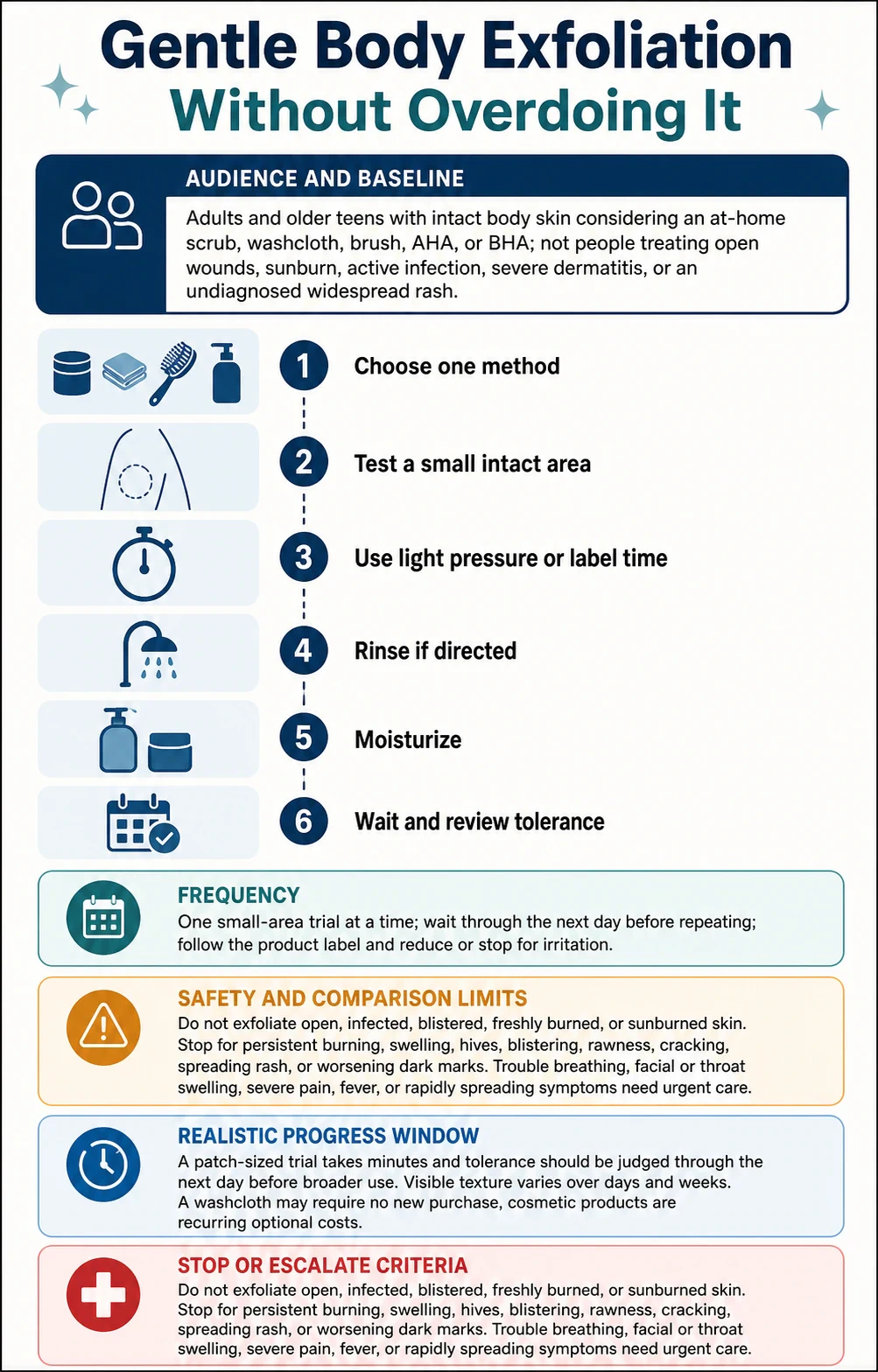
Exfoliation should be optional, gentle, and easy to stop. The practical goal is not perfectly smooth skin. It is deciding whether one low-risk method improves comfort or roughness without creating burning, rawness, breakouts, or darker marks.
This guide is general education, not diagnosis or individualized treatment. It does not prescribe a peel, concentration, medicine, or procedure, and it does not use photographs to diagnose a skin condition.
Start with your real baseline
Body skin naturally differs by site, season, age, friction, hair removal, pigmentation tendency, acne tendency, and sensitivity. Elbows and knees do not feel like the chest. Freshly shaved skin may react differently from untouched skin. Texture is normal and does not need to be erased.
This guide is for adults and older teens with intact body skin who are considering an at-home washcloth, scrub, brush, AHA, or BHA. Open wounds, sunburn, active infection, severe dermatitis, or an undiagnosed widespread rash are not exfoliation projects.
Before changing anything, note the area, current products, shaving or hair-removal timing, and whether the concern is rough feel, clogged pores, flaking, or appearance under close light. That baseline prevents a normal fluctuation from being mistaken for failure.
What exfoliation can and cannot do
Mechanical exfoliation uses a tool or particles to lift surface cells. Chemical exfoliation uses ingredients such as alpha or beta hydroxy acids. Neither category is automatically gentler. Pressure, concentration, contact time, frequency, and the rest of the routine all change tolerance.
Exfoliation can sometimes make surface texture feel temporarily smoother. It cannot permanently change pores, erase normal follicles, diagnose bumps, or guarantee an even tone. It is also not required for clean or healthy skin.
AAD guidance recommends matching the method to skin type. Dry, sensitive, or acne-prone skin may react badly to aggressive mechanical methods. People who develop dark marks after irritation should be especially cautious because the attempt to smooth texture can create a longer-lasting pigment problem.
The lowest-risk decision order
First, decide whether no exfoliation is a reasonable choice. Gentle cleansing and moisturizer may be enough, especially when dryness is driving the rough feel.
If you still want to try exfoliation, choose one method only:
- Keep the rest of the routine stable.
- Test a small area of intact skin.
- Use light pressure or the label-directed contact time.
- Rinse with lukewarm water when the product requires rinsing.
- Apply a tolerated moisturizer.
- Wait long enough to judge both immediate and delayed irritation before repeating.
Do not combine a scrub, brush, peel, and multiple acids in the same experiment. Product stacking makes it harder to identify what helped and what caused harm.
Check what is already in your routine
AAD guidance specifically warns that prescription retinoid creams and over-the-counter retinol or benzoyl peroxide can make skin more sensitive or prone to peeling. Adding exfoliation can worsen dryness or trigger irritation. Do not change a prescribed treatment without the prescriber; ask how exfoliation fits, if at all.
Hair removal matters too. Recently shaved, waxed, or otherwise irritated skin has a different tolerance baseline. Wait for comfort and intact skin rather than forcing a schedule copied from someone else.
Sun sensitivity is a real boundary
FDA guidance states that topical AHA cosmetics may increase sensitivity to ultraviolet radiation while they are used and for up to one week after stopping. The recommended warning includes sunscreen, protective clothing, and limiting sun exposure.
That does not mean every exfoliant has the same effect. It means an AHA user should read the actual label, protect exposed skin, and avoid treating more sting as more progress. FDA’s BHA summary likewise centers formulation that avoids irritation and increased sun sensitivity, not a universal stronger-is-better rule.
Frequency should follow tolerance
There is no universal daily or weekly target. AAD guidance says frequency depends on skin type and method, with more aggressive exfoliation generally needing less frequent use. Redness and irritation are signs to reduce or stop, not cues to push through.
A small-area trial takes minutes, but delayed discomfort can appear later. Reassess through the next day before expanding the area. Visible texture changes over days and weeks with humidity, clothing friction, bathing, and hair removal, so avoid grading the result under a magnifying mirror.
Stop and get help when needed
Do not exfoliate open, infected, blistered, freshly burned, or sunburned skin. Stop for persistent burning, swelling, hives, blistering, rawness, cracking, a spreading rash, or worsening dark marks.
Trouble breathing, facial or throat swelling, severe pain, fever, rapidly spreading redness, drainage, or feeling acutely unwell needs urgent medical help. Persistent rough bumps, recurrent discoloration, severe itch, or a rash that returns deserves qualified assessment rather than stronger cosmetic treatment.
Visual and commercial transparency
Directional light, water, lotion, camera sharpening, and close crops can exaggerate or conceal texture. A photograph cannot distinguish normal follicles from keratosis pilaris, eczema, acne, infection, or allergy.
This article has no affiliate links, sponsor, free-product relationship, product ranking, or paid placement. A soft washcloth may require no new purchase. Cosmetic exfoliants are optional recurring costs, and price is not evidence of safety or effectiveness.

Practical summary
- Decide whether exfoliation is needed at all; 2. choose one gentle method; 3. test a small intact area; 4. keep other products stable; 5. moisturize and protect from sun; 6. stop for irritation
Frequency: Repeat only after the skin remains comfortable and follow the product label; more aggressive methods should be less frequent, not more.
The useful result is not a perfect close-up. It is a small, interpretable change that leaves the skin comfortable, intact, and no harder to manage than before.
Decision checkpoint
After one small-area trial, ask three questions before repeating it: Was the skin comfortable through the next day? Did the method improve the specific concern you named? Can you maintain the same result without increasing pressure, strength, or frequency? If any answer is no, pause and return to gentle cleansing and moisturizer instead of escalating.

Sources
- S01: How to safely exfoliate at home - American Academy of Dermatology; accessed 2026-08-09.
- S02: Guidance for Industry: Labeling for Cosmetics Containing Alpha Hydroxy Acids - U.S. Food and Drug Administration; accessed 2026-08-09.
- S03: Beta Hydroxy Acids - U.S. Food and Drug Administration; accessed 2026-08-09.
- S04: Face washing 101 - American Academy of Dermatology; accessed 2026-08-09.
FAQ
Common questions
Is body exfoliation required for healthy skin?
No. Gentle cleansing and moisturizer may be enough; normal texture does not need to be erased.
When should I stop exfoliating?
Stop for persistent burning, swelling, hives, blistering, rawness, cracking, spreading rash, or worsening dark marks, and seek urgent care for breathing or facial-swelling symptoms.
Topic hubs
Tags


