

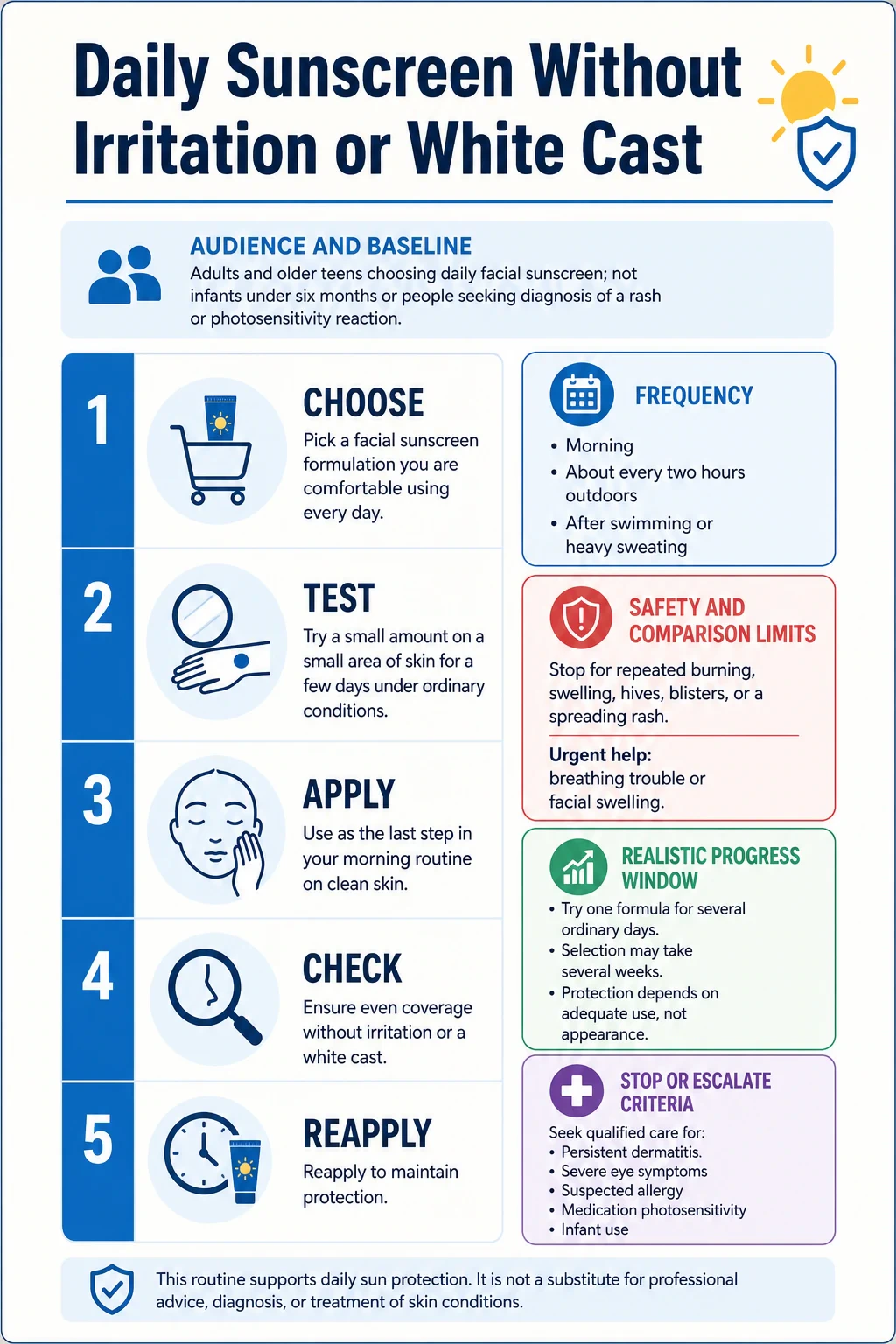
Build a daily sun-protection routine that is tolerable enough to use consistently without pretending one formula suits every skin tone, sensitivity pattern, climate, or finish preference. That is a practical grooming goal, not a verdict on attractiveness or personal value. Normal variation is expected, and the safest plan is the one that remains simple enough to follow without pain, shame, or a constant search for flaws.
This guide is general education, not diagnosis or individualized treatment. It does not prescribe a drug, device, or procedure, and it does not use photographs to diagnose a skin, hair, allergy, circulation, or other medical condition.
Start with your real baseline
Skin tone, oiliness, dryness, acne tendency, eye sensitivity, facial hair, and tolerance for tint or shine all change how the same sunscreen looks and feels. White cast is a formulation-and-tone mismatch, not a defect in the wearer.
Adults and older teens choosing a daily facial sunscreen, including people who notice stinging, pilling, shine, dryness, or a visible cast; not infants under six months or people seeking diagnosis of a rash or photosensitivity reaction.
Before changing anything, record the current routine, the exact symptom or appearance concern, and any recent product, medication, climate, or activity change. That short baseline is more useful than comparing yourself with a highly edited image. If checking has become repetitive or distressing, step away from close-up inspection and talk with someone you trust or a qualified clinician.
What is actually modifiable
Modifiable factors include formula type, tint match, fragrance exposure, amount, application timing, layering, reapplication plan, and use of shade or clothing. Less-modifiable factors include baseline skin tone, allergy history, rosacea or eczema tendency, medication-related photosensitivity, climate, and occupational sun exposure.
That distinction matters. A routine can reduce avoidable irritation or improve day-to-day presentation, but it cannot promise a new anatomy, erase normal texture, or guarantee a uniform result. The right target is a tolerable process and a meaningful symptom trend, not perfection.

What the evidence supports
SPF primarily communicates protection against sunburn-producing UVB under standardized testing; a broad-spectrum label adds UVA protection. Real-world protection also depends on applying enough, covering missed areas, and reapplying after time outdoors, swimming, or sweating. A pleasant finish cannot compensate for under-application, while a technically strong label is not useful if irritation makes someone stop using it.
AAD guidance recommends broad-spectrum, water-resistant SPF 30 or higher and notes that tinted products can reduce visible residue. Its application guidance emphasizes coverage, adequate quantity, and reapplication. FDA labeling rules explain what broad-spectrum and SPF claims mean, while a PubMed-indexed consumer study shows that shade range affects whether tinted products are acceptable across skin tones. These sources support a fit-and-use approach, not a single best ingredient list.
Evidence strength is not the same as marketing confidence. Official guidance is strong for safety boundaries and labeled use, while product-to-product claims are often thinner. Laboratory or short clinical studies can explain a mechanism without proving that every person will see the same visible result. When uncertainty is material, this guide says so.
A lower-risk routine
Start with one fragrance-free broad-spectrum SPF 30 or higher product intended for the face. Test a small area for several days when irritation is a concern. Apply over a simple moisturizer only if needed, let layers settle, and avoid adding several new actives at the same time. For cast, compare a tinted formula in ordinary daylight on the jaw and neck rather than relying on a filtered selfie. Add hat, shade, and clothing when practical; sunscreen is one layer, not permission for unlimited exposure.
Use this order:
- Define the single problem you are trying to solve.
- Remove avoidable irritation or pressure before buying more treatment.
- Introduce one reversible change and follow its label or professional instructions.
- Keep the rest of the routine stable long enough to interpret tolerance.
- Escalate to qualified care when the pattern is severe, persistent, unusual, or unsafe for self-treatment.
Doing less is sometimes the more evidence-based choice. Stacking products makes both benefit and harm harder to trace, and discomfort is not a useful proxy for effectiveness.
Time, cost, and realistic progress
Selection may take one or two small trials over several weeks. A basic drugstore face sunscreen is usually a recurring monthly-scale purchase, while tinted shade matching can cost more and may require samples. Judge wear in the same lighting and routine for at least several ordinary days; do not grade protection by appearance alone.
Keep the product where the morning routine happens, note eye sting and pilling rather than changing everything at once, and review expiration and storage. Reapply during sustained outdoor exposure and after swimming or heavy sweating. If a formula is intolerable, replace it rather than abandoning sun protection.
Progress should be judged by comfort, function, consistency, and the specific concern named at the start. Use the same lighting and ordinary viewing distance if you keep photographs. Daily close-ups mostly measure camera conditions and natural fluctuation.
Stop and get help when needed
Stop a product that repeatedly burns, stings, causes swelling, hives, blistering, or a spreading rash. Rinse accidental eye exposure and seek urgent help for breathing difficulty or facial swelling. Persistent dermatitis, severe eye symptoms, a suspected allergy, or medication-related photosensitivity needs clinician or dermatologist review. Infants and people with complex skin disease need individualized guidance.
A dermatologist or other qualified clinician should review persistent reactions, suspected contact allergy, severe acne or rosacea flares, unexplained photosensitivity, or a medication question. Minors should use conservative sun-protection guidance with a parent or guardian and avoid social-media-driven product stacking.
These boundaries are part of the routine, not an afterthought. A qualified professional can check whether the apparent cosmetic issue is actually dermatitis, infection, allergy, medication effect, inflammatory disease, circulation trouble, or another condition that needs a different plan.
Visual and commercial transparency
Lighting, white balance, camera exposure, foundation, powder, smoothing filters, and the angle of reflected light can hide or exaggerate white cast and shine. Images cannot verify SPF performance, diagnose irritation, or prove that one tint matches everyone.
This article has no affiliate links, sponsor, free-product relationship, product ranking, or paid placement. Brand packaging, high prices, salon photography, and social-media popularity are not evidence of safety or superiority. Any cost language is a broad planning range, not a live shopping recommendation.
Practical summary
- Choose broad-spectrum, water-resistant SPF 30 or higher; 2. Patch-test for tolerance; 3. Apply an adequate even layer; 4. Check finish in ordinary daylight; 5. Reapply outdoors and use shade or clothing
Frequency: Every morning on exposed skin; reapply about every two hours during sustained outdoor exposure and after swimming or heavy sweating.
The useful question is not whether a routine creates a perfect image. It is whether the smallest safe change is tolerable, supported, affordable to maintain, and producing a consistent improvement without crossing a stop boundary.
Decision checkpoint
A useful two-minute wear check asks four separate questions: Did it sting? Did it pill over the existing routine? Is the cast acceptable in window light? Can the intended amount be worn without wiping it away? A failure on one question suggests a formula or layering mismatch; it does not justify using less than the labeled protective amount.

Sources
- S01: How do I know if I’m using the right sunscreen? - American Academy of Dermatology; accessed 2026-08-09.
- S02: How to apply sunscreen - American Academy of Dermatology; accessed 2026-08-09.
- S03: Sunscreen: How to Help Protect Your Skin from the Sun - U.S. Food and Drug Administration; accessed 2026-08-09.
- S04: Tinted Sunscreens: Consumer Preferences Based on Light, Medium, and Dark Skin Tones - Journal of Drugs in Dermatology via PubMed; accessed 2026-08-09.


