

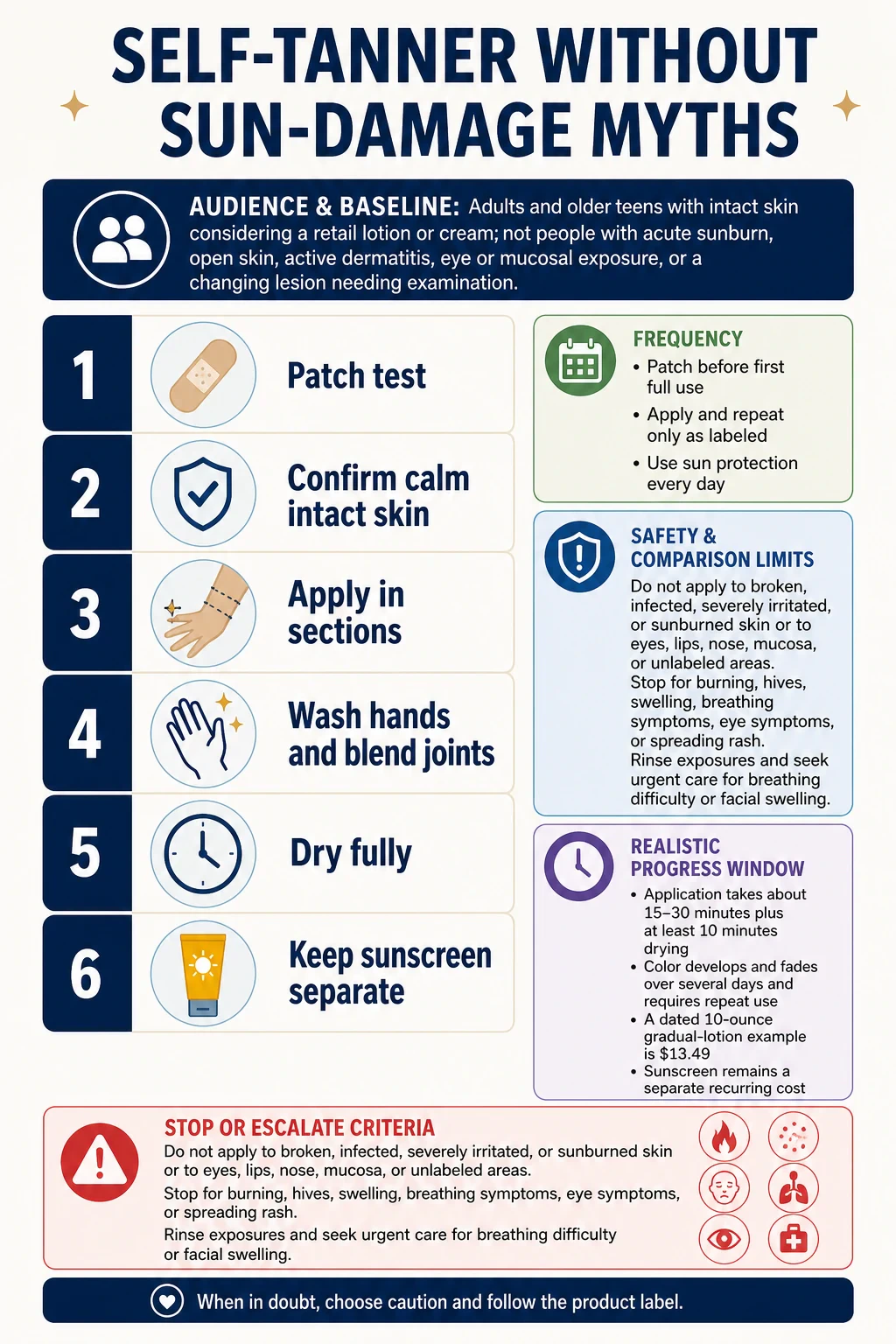
Self-tanner changes the color of the outermost skin. It does not make skin healthier, and it does not turn any skin tone into a better one. If you enjoy the effect, the safer goal is a temporary, even result without using ultraviolet radiation or pretending the color is sunscreen.
The key distinction is simple: sunless color and sun protection are separate jobs. Most self-tanners use dihydroxyacetone, or DHA, which reacts in the stratum corneum to create temporary color. Reviews find minimal or no meaningful photoprotection [S04, S06]. Keep broad-spectrum SPF 30 or higher, shade, clothing, and other sun-protection habits in place [S02, S03].
Choose the lowest-exposure form
Doing nothing is valid. A washable body bronzer is the easiest result to reverse. A gradual lotion or cream is easier to control than an airborne mist because you can keep it on intact external skin and away from eyes, lips, nose, and mucous membranes.
FDA permits DHA for external cosmetic use, not inhalation, ingestion, lips, mucosa, or the eye area [S01]. That makes a carefully applied lotion a more controllable starting point than a booth that fills the air with spray. “Professional” does not change the exposure route.
Patch-test any new product according to its label on a small hidden area. A patch cannot predict every reaction, but it can reveal obvious irritation or an unexpected color before a whole-body application. Do not apply over sunburn, cuts, infection, a severe rash, or freshly irritated skin.
The preflight card
Proceed only when all five answers are yes: Is the skin intact and calm? Is the product labeled for the body area? Can you prevent eye, lip, mucosal, and breathing exposure? Has the patch interval passed without a reaction? Is tomorrow’s sunscreen plan unchanged? One no means wait or choose washable color instead.
On July 19, 2026, a listed 10-ounce gradual self-tanner lotion cost $13.49 [S07]. This is a dated shelf fact, not a recommendation. Price, fragrance, “clean” wording, reviews, and influencer photos do not establish tolerance or a better result.
A controlled lotion routine
The day before
If you remove body hair, do it early enough for redness or tiny cuts to settle. Avoid combining a new self-tanner with an aggressive peel, scrub, or other new active. The aim is calm intact skin, not maximum exfoliation.
Before application
Shower and use a soft washcloth for gentle exfoliation, spending a little more time on thicker dry areas such as elbows, knees, and ankles [S02]. Do not scrub until skin burns or turns bright red. Dry completely.
Apply a little plain moisturizer to very dry joints if the product instructions allow it. Dry thick skin can take up more color and appear darker. Tie back hair and use good ventilation even with lotion.
During application
Work in sections—legs, torso, then arms—using a thin even amount and circular motions [S02]. Blend lightly from wrists to hands and ankles to feet. Use less over knees, elbows, and ankles. Wash hands with soap after each section, including between fingers and around nails.
Keep the product out of the entire eye area, lips, nostrils, genital mucosa, and any location excluded by the label. Do not transfer body lotion to the face unless it is specifically labeled for that use. More product does not reliably mean a better color; it often means darker joints, transfer, and harder troubleshooting.
After application
AAD advises at least ten minutes of drying before dressing and loose clothing with sweat avoidance for the next few hours [S02]. Follow the product’s longer rinse, shower, or development instructions if they differ. Protect fabrics and avoid close skin contact until transfer risk has passed.
Assess the result only after the full labeled development time in neutral daylight. Warm bathroom bulbs and phone auto-white-balance can exaggerate orange or red tones.
Fixing uneven color without escalating damage
Do not attack a dark patch with repeated acids or hard scrubbing. First wash normally, moisturize, and let routine shedding fade it. A damp washcloth used gently over several showers is safer than trying to erase it in one session. Cover temporarily with clothing or washable makeup if needed.
For the next application, use less product on the dark area, more careful blending, or a gradual formula. Change one variable at a time. If a product consistently causes irritation, odor you cannot tolerate, or an unwanted color, stop; there is no requirement to make it work.
Keep a one-line note after each trial: product and amount, preparation, drying time, comfort, and result after the full development window. That makes the next adjustment evidence from your own routine rather than a reaction to one misleading bathroom photo.
Color commonly fades over several days as surface cells shed, so maintenance means repeated application. That adds product cost, time, laundering, and exposure. A result that demands constant correction may not be worth maintaining.
Myths that create real risk
“The color is a base tan”
It is not. DHA color has insufficient photoprotection and does not prevent sunburn, photoaging, or skin cancer [S04, S06]. Apply sunscreen as if the self-tanner were invisible: broad-spectrum SPF 30 or higher, water resistant when appropriate, before outdoor exposure and reapplied as directed [S03].
“A spray booth is safer because someone else applies it”
External DHA use and whole-body mist exposure are not the same. FDA notes that booth use can make it difficult to protect the eye area, lips, mucosa, and airways [S01]. Before any spray service, ask whether goggles protect the full eye area, whether lips and mucosa are covered, and how inhalation and ingestion are prevented. If any answer is no, leave.
“A tanning pill avoids skin exposure”
There is no FDA-approved tanning pill. Canthaxanthin tanning products have been linked to crystal deposits in the retina as well as systemic adverse effects [S05]. Avoid pills, nasal sprays, injections, and other products sold as internal shortcuts.
“No proven harm means proven safe forever”
The 2026 systematic review found no demonstrated harm in the available studies but judged much of the evidence low quality and highlighted unresolved questions [S04]. A 2023 review notes reported irritant and allergic contact dermatitis [S06]. The honest conclusion is bounded: controlled external use has an established regulatory pathway, while long-term and unintended exposures are not fully answered.
Stop and escalation rules
Stop and rinse as the label directs for burning, hives, marked swelling, blistering, eye pain, or a spreading rash. Get urgent help for breathing difficulty, throat or facial swelling, faintness, or severe eye symptoms. Persistent eye pain, redness, light sensitivity, or vision change needs eye care.
A dermatologist should assess a severe or persistent reaction, active skin disease, or a spot that changes in size, shape, color, sensation, or bleeding. Self-tanner and photos can alter contrast; neither can diagnose a lesion. Do not cover a concerning change and postpone examination.
For minors, the conservative boundary is optional washable color or a parent-supervised labeled lotion patch test. Avoid spray booths, tanning pills, injected or nasal products, and UV tanning.
Visual honesty
Judge color in the same daylight, distance, white balance, clothing, and skin-moisture state. Flash, warm light, saturation, exposure, body makeup, filters, and retouching can manufacture a dramatic comparison. No before-and-after photograph proves UV protection or healthier skin.
A good result is optional, temporary, comfortable, and easy to maintain. If the routine makes sun protection harder or creates irritation, it has missed the point.


Sources
- S01 — FDA: Sunless Tanners & Bronzers
- S02 — American Academy of Dermatology: How to apply self-tanner
- S03 — American Academy of Dermatology: How to apply sunscreen
- S04 — PubMed: 2026 systematic review of self-tanner use and safety
- S05 — FDA: Tanning Pills
- S06 — PubMed: 2023 review of topical DHA properties and safety
- S07 — Target: dated self-tanner lotion listings
Sources and price were checked July 19, 2026. This is general education, not diagnosis or individualized medical advice.


