

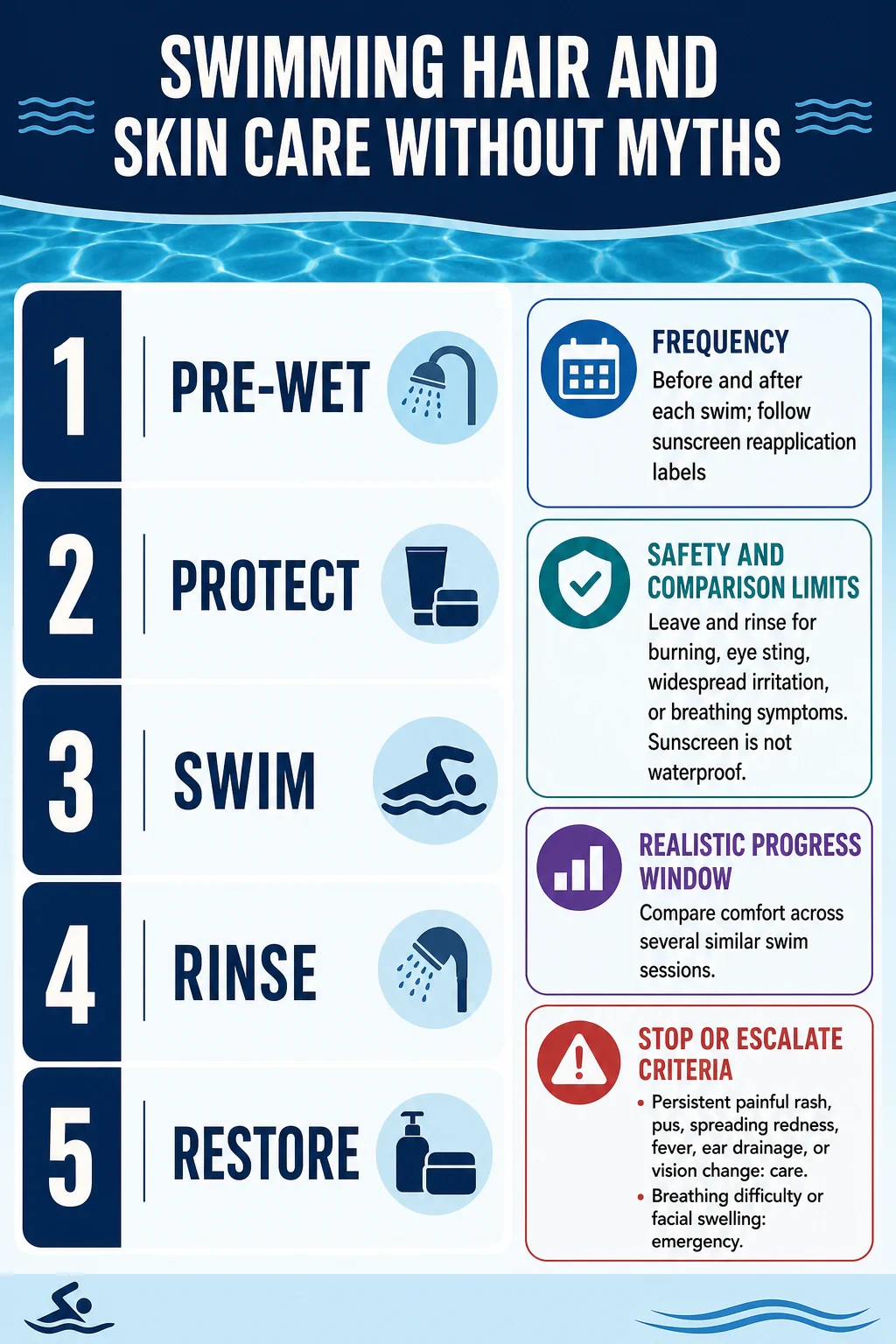
Make swimming easier on hair and skin with a short pre-swim and post-swim routine while rejecting waterproof-product claims, chlorine detox language, and promises to prevent every flare or color change. That is a practical care goal, not a verdict on attractiveness or personal value. Normal variation is expected, and the safest plan is the one that remains simple enough to follow without pain, shame, or constant flaw-checking.
This guide is general education, not diagnosis or individualized treatment. It does not prescribe a drug, device, or procedure, and it does not use photographs to diagnose a skin, hair, ear, nose, dental, allergy, infection, or other medical condition.
Start with your real baseline
Hair porosity, curl pattern, chemical processing, skin-barrier tendency, pool chemistry, water temperature, sun exposure, and session length all change how swimming feels. Some dryness or tangling can occur even in a well-maintained pool and does not prove that the swimmer cleaned incorrectly.
Adults and older teens who swim recreationally or for exercise and notice dryness, tangling, color shift, or irritation; not people with open or infected skin, a severe eczema flare, painful rash, eye injury, breathing symptoms, or a suspected waterborne infection.
Before changing anything, record the current routine, the exact practical concern, and any recent product, medication, climate, facility, or activity change. That baseline is more useful than comparison with an edited close-up. If checking has become repetitive or distressing, step away from magnification and discuss it with someone you trust or a qualified professional.
What is actually modifiable
Modifiable factors include swim-cap use, pre-wetting, leave-in barrier products, sunscreen selection and reapplication, time in wet swimwear, rinse timing, water temperature, cleanser strength, conditioner, and moisturizer. Less-modifiable factors include eczema, allergy, hair bleaching, scalp disease, medication-related sun sensitivity, and the pool or open-water environment.
This distinction keeps the goal realistic. A routine can reduce avoidable irritation and improve day-to-day grooming, but it cannot promise new anatomy, erase normal texture, or guarantee one uniform result. The target is a tolerable process and a meaningful comfort or function trend, not perfection.

What the evidence supports
Pool disinfectants reduce germs but can also contribute to skin, eye, and hair irritation when chemistry or exposure is unfavorable. Hair already lightened or damaged is more vulnerable to dryness and breakage. Sunscreen is not waterproof: water-resistant labels refer to a tested 40- or 80-minute interval, and label-directed reapplication still matters after swimming and towel drying.
AAD hair guidance recommends a swim cap, prompt fresh-water rinsing, swimmer shampoo when useful, and conditioner; its skin guidance recommends a mild wash and fragrance-free moisturizer after pool exposure. CDC guidance explains that poor disinfectant or pH control can irritate skin and eyes and advises showering before entry and drying ears after swimming. FDA guidance rejects waterproof claims and requires reapplication according to water-resistance labeling. These sources support exposure management, not a detox or total-damage-prevention promise.
Evidence strength is not the same as marketing confidence. Official guidance is useful for safety boundaries and ordinary technique, while brand-to-brand claims are often thinner. A mechanism does not prove that every person will see the same visible result. When uncertainty is material, this guide says so.
A lower-risk routine
Before the pool, shower briefly, wet hair with fresh water, apply a tolerated leave-in conditioner or oil if appropriate, and use a comfortable cap. Apply broad-spectrum water-resistant sunscreen to exposed skin as directed before outdoor exposure. After swimming, rinse hair and skin promptly with warm rather than hot fresh water, use a mild cleanser, shampoo when needed, condition the lengths, pat rather than scrub, and moisturize damp skin. Change out of wet swimwear and dry the outer ears gently.
Use this order:
- Define one practical problem rather than chasing a total transformation.
- Remove avoidable irritation, force, or exposure before buying more products.
- Introduce one reversible change and follow its label or professional instructions.
- Keep the rest of the routine stable long enough to interpret tolerance.
- Escalate when the pattern is painful, persistent, unusual, or unsafe for self-care.
Doing less is sometimes the more evidence-based choice. Stacking products or repeating a technique harder makes both benefit and harm difficult to trace, and discomfort is not a useful proxy for effectiveness.
Time, cost, and realistic progress
The routine adds several minutes before and after a swim. A cap, mild cleanser, conditioner, fragrance-free moisturizer, and water-resistant sunscreen create a modest recurring cost, but specialty detox sets are not required. Judge tolerance across several comparable sessions rather than one unusually long or badly maintained pool visit.
Keep the cap rinsed and dry, avoid sharing towels or hair tools, wash wet swimwear, and note which pool, session length, and products preceded irritation. Reapply sunscreen by its label and replace products that repeatedly sting. If symptoms track one facility, report the concern rather than trying to out-treat poor water management.
Progress should be judged by comfort, function, consistency, and the concern named at the start. If you keep photographs, use the same lighting and an ordinary viewing distance. Daily close-ups mostly measure camera conditions and normal fluctuation.
Stop and get help when needed
Do not enter the water with open, raw, oozing, or infected skin. Leave the pool and rinse for marked burning, severe eye sting, breathing symptoms, or sudden widespread irritation. Seek care for a persistent painful rash, pus-filled or tender bumps, spreading redness, fever, ear pain or drainage, vision change, chemical burn, or symptoms after contaminated open-water exposure. Breathing difficulty or facial swelling is an emergency.
A dermatologist or clinician should review recurrent dermatitis, severe eczema, suspected infection, painful follicular bumps, persistent scalp symptoms, or medication-related photosensitivity. Eye or ear symptoms need the appropriate qualified professional. Children and people with eczema need individualized boundaries and caregiver supervision.
These boundaries are part of the routine, not an afterthought. A qualified professional can determine whether an apparent grooming issue is actually an infection, allergy, inflammatory condition, structural problem, medication effect, or another condition that needs a different plan.
Visual and commercial transparency
Wet hair looks darker and smoother, while hard pool lighting, underwater color balance, towel rubbing, and close-up sharpening can exaggerate dryness, redness, and color change. A photograph cannot test pool chemistry, diagnose dermatitis or folliculitis, or establish that chlorine alone caused a symptom.
This article has no affiliate links, sponsor, free-product relationship, product ranking, retailer recommendation, or paid placement. Premium packaging, high prices, salon photography, and social-media popularity are not evidence of safety or superiority. Any cost language is a broad planning range, not a live shopping recommendation.
Practical summary
- Shower and pre-wet hair; 2. Use a cap and label-directed sun protection; 3. Rinse promptly after swimming; 4. Cleanse gently, condition, and moisturize; 5. Track persistent irritation
Frequency: Before and immediately after each swim; reapply sunscreen according to its water-resistance label and after towel drying.
The useful question is not whether a routine creates a perfect image. It is whether the smallest safe change is tolerable, supported, affordable to maintain, and producing a consistent improvement without crossing a stop boundary.
Decision checkpoint
Separate the exposure log from the product log. Record the pool, session length, outdoor sun, cap use, and rinse delay before blaming a cleanser or buying a detox treatment. If irritation appears only at one facility or after unusually long sessions, changing the exposure may be more informative than adding another product.

Sources
- S01: Must-try summer hair care - American Academy of Dermatology; accessed 2026-08-10.
- S02: 12 summer skin problems you can prevent - American Academy of Dermatology; accessed 2026-08-10.
- S03: Guidelines for Keeping Your Pool Safe and Healthy - Centers for Disease Control and Prevention; accessed 2026-08-10.
- S04: Sunscreen: How to Help Protect Your Skin from the Sun - U.S. Food and Drug Administration; accessed 2026-08-10.


