

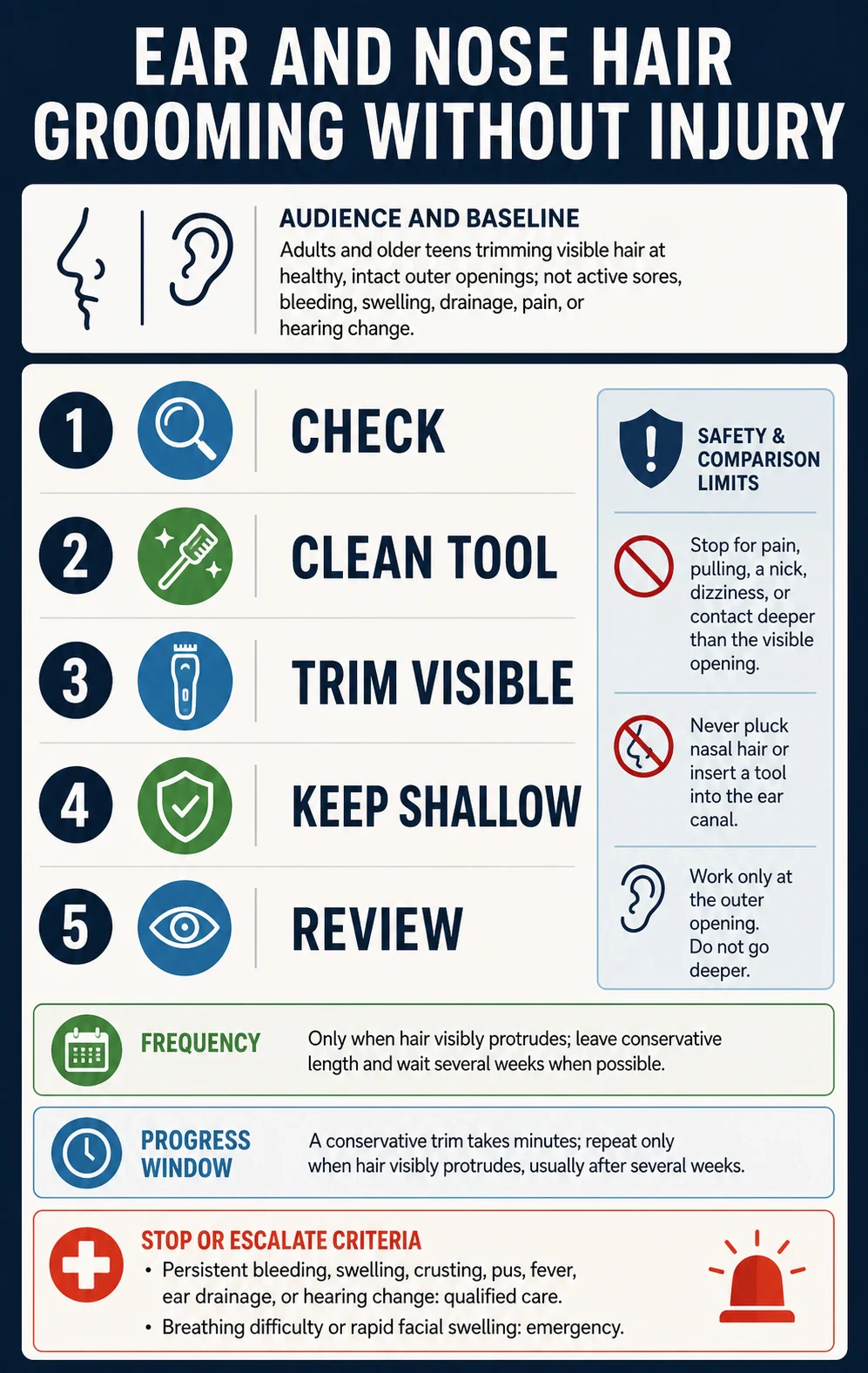
Keep visible ear and nose hair tidy with the smallest practical trim while preserving the protective role of hair and avoiding cuts, infection, or damage inside the ear canal. That is a practical care goal, not a verdict on attractiveness or personal value. Normal variation is expected, and the safest plan is the one that remains simple enough to follow without pain, shame, or constant flaw-checking.
This guide is general education, not diagnosis or individualized treatment. It does not prescribe a drug, device, or procedure, and it does not use photographs to diagnose a skin, hair, ear, nose, dental, allergy, infection, or other medical condition.
Start with your real baseline
Hair length, density, color, curl, and growth rate vary with age, hormones, genetics, and lighting. Visible hair is normal anatomy. A close macro photograph can make a few strands look more prominent than they appear at ordinary conversation distance.
Adults and older teens bothered by visible hair at the nostril or outer ear opening; not people with active sores, crusting, bleeding, swelling, drainage, significant pain, hearing change, immune suppression, or a tool or object lodged in the ear or nose.
Before changing anything, record the current routine, the exact practical concern, and any recent product, medication, climate, facility, or activity change. That baseline is more useful than comparison with an edited close-up. If checking has become repetitive or distressing, step away from magnification and discuss it with someone you trust or a qualified professional.
What is actually modifiable
Modifiable factors include how much is trimmed, lighting, tool design, blade condition, hygiene, and whether the hand is steady. Less-modifiable factors include follicle density, hair texture, age-related growth, narrow ear canals, skin conditions, tremor, anticoagulant use, and infection risk.
This distinction keeps the goal realistic. A routine can reduce avoidable irritation and improve day-to-day grooming, but it cannot promise new anatomy, erase normal texture, or guarantee one uniform result. The target is a tolerable process and a meaningful comfort or function trend, not perfection.

What the evidence supports
Nasal hairs help filter larger particles at the entrance of the nose. Pulling a hair removes it at the follicle and can leave inflammation or a route for infection; trimming shortens only the visible shaft. Earwax and the ear canal also provide protection and normally move debris outward, so a grooming tool belongs at the visible outer opening rather than inside the canal.
Cleveland Clinic guidance recommends rounded-tip scissors or a purpose-built trimmer and warns that plucking or waxing nasal hair can lead to ingrown hairs and infection. Its nasal-vestibulitis guidance lists plucking as a preventable risk and identifies sores, crusting, pain, swelling, and bleeding as review signals. NHS guidance says not to insert fingers or objects into the ear canal, while Chelsea and Westminster Hospital explains that objects can cause canal trauma and push wax inward. Together these sources support shallow visible trimming, not total removal.
Evidence strength is not the same as marketing confidence. Official guidance is useful for safety boundaries and ordinary technique, while brand-to-brand claims are often thinner. A mechanism does not prove that every person will see the same visible result. When uncertainty is material, this guide says so.
A lower-risk routine
Use bright, stable lighting and a clean mirror. Wash and dry the visible outer area, clean the trimmer according to its instructions, and trim only strands protruding beyond the nostril or outer-ear opening. Keep a guard on an electric trimmer or use small rounded-tip scissors, make short deliberate passes, and leave deeper hair alone. Never share the tool. If the angle is awkward or your hand is unsteady, ask a barber or qualified clinician to address only the visible exterior.
Use this order:
- Define one practical problem rather than chasing a total transformation.
- Remove avoidable irritation, force, or exposure before buying more products.
- Introduce one reversible change and follow its label or professional instructions.
- Keep the rest of the routine stable long enough to interpret tolerance.
- Escalate when the pattern is painful, persistent, unusual, or unsafe for self-care.
Doing less is sometimes the more evidence-based choice. Stacking products or repeating a technique harder makes both benefit and harm difficult to trace, and discomfort is not a useful proxy for effectiveness.
Time, cost, and realistic progress
A conservative trim usually takes a few minutes and may be repeated every few weeks as visible growth returns. A basic guarded trimmer or rounded-tip scissors is a low-to-moderate one-time grooming cost. Replacement heads, batteries, and cleaning matter more than luxury features; no tool makes deep insertion safe.
Clean and dry the tool after use, inspect the guard and blade before the next session, and store it where it will not be confused with a shared clipper. Review the result at ordinary distance. If repeated grooming causes soreness or ingrown hairs, increase the interval and reduce how closely you trim.
Progress should be judged by comfort, function, consistency, and the concern named at the start. If you keep photographs, use the same lighting and an ordinary viewing distance. Daily close-ups mostly measure camera conditions and normal fluctuation.
Stop and get help when needed
Stop immediately for a nick, pain, pulling, dizziness, or contact with tissue deeper than the opening. Apply gentle external pressure to a minor surface nick. Seek prompt care for bleeding that does not stop, increasing redness or swelling, severe tenderness, pus, yellow crusting, fever, a painful bump inside the nose, drainage from the ear, hearing change, or a retained object. Breathing difficulty or rapidly spreading facial swelling is an emergency.
A clinician should review recurrent nasal sores, crusting, follicle infections, persistent bleeding, ear-canal symptoms, hearing change, or grooming questions complicated by anticoagulants, immune suppression, diabetes, tremor, or prior ear surgery. Minors should use only guarded exterior trimming with adult supervision.
These boundaries are part of the routine, not an afterthought. A qualified professional can determine whether an apparent grooming issue is actually an infection, allergy, inflammatory condition, structural problem, medication effect, or another condition that needs a different plan.
Visual and commercial transparency
Macro lenses, hard side lighting, magnification mirrors, and high-contrast sharpening exaggerate hair density and pore texture. Images cannot diagnose infection, determine safe insertion depth, or prove that every visible strand should be removed.
This article has no affiliate links, sponsor, free-product relationship, product ranking, retailer recommendation, or paid placement. Premium packaging, high prices, salon photography, and social-media popularity are not evidence of safety or superiority. Any cost language is a broad planning range, not a live shopping recommendation.
Practical summary
- Check for soreness or infection; 2. Clean a guarded tool; 3. Trim only protruding strands; 4. Keep tools out of the ear canal and deep nostril; 5. Stop for pain or bleeding
Frequency: Only when hair is visibly protruding; leave a conservative length and space sessions by several weeks when possible.
The useful question is not whether a routine creates a perfect image. It is whether the smallest safe change is tolerable, supported, affordable to maintain, and producing a consistent improvement without crossing a stop boundary.
Decision checkpoint
Use an opening-only rule: if the hair cannot be seen without lifting, stretching, or inserting the tool, leave it alone. That single test separates visible grooming from canal or deep-nostril exploration. A closer result is not better when it trades a normal protective margin for pain, bleeding, or follicle injury.

Sources
- S01: Nose Hair: Why We Have Them and How to Get Rid of Them - Cleveland Clinic; accessed 2026-08-10.
- S02: Nasal Vestibulitis: Symptoms, Treatment and Outlook - Cleveland Clinic; accessed 2026-08-10.
- S03: Earwax build-up - National Health Service; accessed 2026-08-10.
- S04: Regular ear care - Chelsea and Westminster Hospital NHS Foundation Trust; accessed 2026-08-10.
FAQ
Common questions
Should I pluck nose hairs?
Plucking can inflame or injure the follicle and increase infection risk. Conservative visible trimming is the lower-risk grooming choice.
When should I stop grooming and seek care?
Stop for pain or bleeding and seek review for persistent bleeding, swelling, crusting, pus, severe tenderness, ear drainage, or hearing change.
Topic hubs
Tags


