

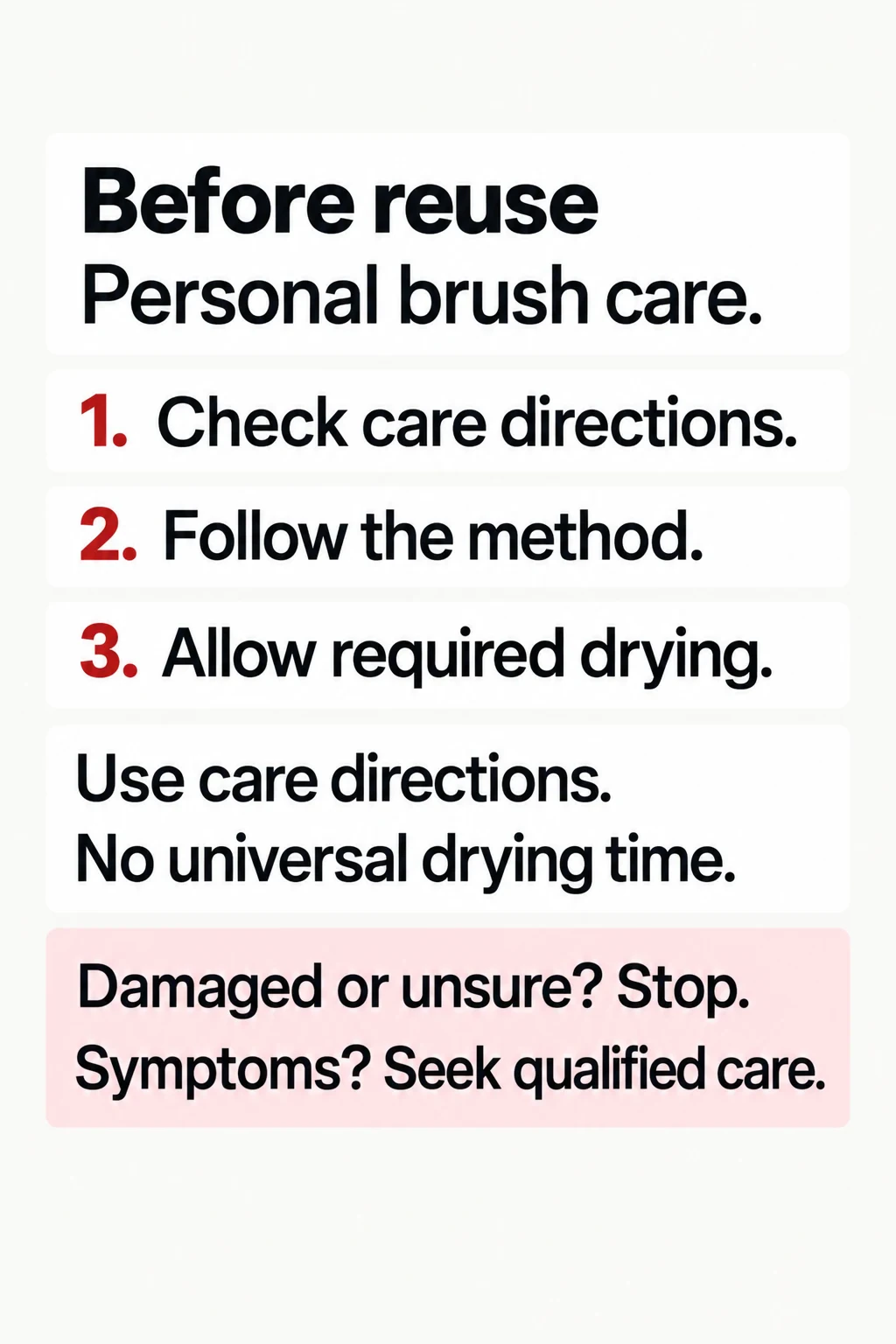
Start with the instructions for the brush and the cleaning product you actually have. A rinse-off cleanser, a towel-applied cleanser and a prepared wipe can involve different steps. Combining their directions into one universal recipe can leave you doing something none of the manufacturers intended.
The practical aim here is ordinary cosmetic-tool care: remove visible makeup residue using a compatible method, let the brush dry as directed and notice damage or unresolved residue before reuse. A brush looking clean does not establish that it is sterile, that it will suit every person’s skin or that cleaning has treated a skin condition.
Who this is for
This guide is for adults caring for ordinary personal makeup brushes. It is not a professional salon infection-control protocol, medical-device cleaning procedure or treatment for acne, irritation or infection. Shared professional tools and regulated settings can have additional requirements that this home-care guide does not assess.
You might be cleaning an existing set, checking why a brush remains coated after a quick wipe or deciding whether an unfamiliar cleaner is compatible with a particular tool. Those are useful questions without a requirement to buy a new kit. There is no appearance score, ideal complexion or promise that a tidier brush collection will improve your skin.
The sources have different roles. The American Academy of Dermatology offers general brush-washing advice. MAC gives directions for its named Brush Cleanser. Real Techniques describes a prepared wipe, and Beautyblender describes a routine using its Liquid Blendercleanser. The three brands sell related products; these documents are not four independent trials comparing cleaning efficacy or skin outcomes. AAD, MAC, Real Techniques, Beautyblender.
Before you start
Identify the actual tool. Bristles, the metal band around them and the handle are different parts; wetting the tips does not mean submerging the whole brush. An ordinary brush’s instructions also should not be transferred automatically to a sponge, puff, heated tool or motorised device. Check material and care information where it is available.
Read the current product packaging as well as any relevant manufacturer instructions. MAC explicitly notes that ingredient lists can change and directs customers to the package they receive. A familiar product name, online review or old ingredient list cannot confirm every detail of a current formulation or your own suitability. MAC Brush Cleanser.
Set up a clean work surface, access to the water required by the chosen method and an appropriate drying place. Keep cosmetics, electronics and other items out of the work area. This is an editorial preparation step, not a claim that a household surface has been disinfected or that a particular towel creates a sterile setup.
If you cannot establish whether a brush can be washed or which cleanser is compatible, pause and ask the manufacturer or a suitable professional. Do not use an unknown solvent, mix cleaning chemicals or improvise a stronger concentration because residue is stubborn. More product, heat or soaking time is not automatically a better answer.
Myth or Real?

Claim
Social paraphrase: Brush-cleaning directions can differ between products; one borrowed routine may not describe the product in hand.
Verdict
REAL
Facts
Identify the actual brush and cleaner, then read their applicable care directions.
Wash, towel-applied cleaner and prepared wipe directions are not a universal recipe; drying also needs its own instructions.
An archived discussion asks about brush damage and the difference between a quick cleaner and washing; a selected reply mentions following its product instructions. The graphic is an editorial paraphrase of the method question, not a quoted clinical claim or a claim that the author held a false belief. The AAD page gives general advice for washing ordinary brushes, including attention to the tips, connection and drying position. MAC’s named Brush Cleanser page gives a brush-or-towel application method and warns that current ingredient information belongs on the package received. These sources support checking the actual method rather than merging several products into a universal recipe. Neither source verifies an unknown brush, current package or personal skin suitability. The main article also distinguishes a named rinse-off example and an explicitly older prepared-wipe description whose direct URL is unavailable. No universal quantity, frequency, soak, heat or drying timer is supplied. Visible residue and required drying are practical observations, not measurements of germs or proof of sterility. Pause when compatibility, condition or instructions remain unclear; use appropriate manufacturer or qualified help. Concerning symptoms and professional infection-control settings exceed this guide. Social recipes, prices, endorsements and outcomes are excluded. The two main primary documents are reused, not additional independent approval.
Takeaway
Clarify the method with the manufacturer before continuing; do not add stronger chemicals or extra heat.
Sources
Claim discussion: Brush-cleaning discussion: choosing a method.
Evidence: AAD: How to clean your makeup brushes; MAC: Brush Cleanser directions.
Checked 2026-10-18. Scope: Ordinary personal cosmetic-tool care only, no clinical infection-control or skin treatment. Social recipes and outcomes excluded. General professional guidance and one named commercial cleaner are not interchangeable current pack instructions or independent product tests.
Actions in order
1. Decide which set of directions applies
For a washable ordinary brush, the AAD’s general method focuses on the tips, rinsing and drying flat. It warns about water reaching the bonded connection between brush head and handle. That provides a useful care boundary, without overriding specific instructions for an unusual material or tool. This article does not adopt a universal cleanser recipe or exact quantity for every product. AAD brush guidance.
The manufacturer examples show why the distinction matters. MAC’s named cleanser directions involve applying it to the brush or a towel and running the brush along the towel until makeup is no longer transferred. Beautyblender’s selected guide describes a water-based routine with its own cleanser, followed by rinsing and drying. Those are examples of different directions, not evidence that every product can be used interchangeably. MAC, Beautyblender.
A prepared wipe is another product category. The Real Techniques page describes gently rubbing bristles on its wipe to remove excess buildup. Its description does not authorise replacing the wipe with a homemade chemical mixture or assuming that wiping completes every other product’s wash instructions. The retrieved page is older and its direct address was unavailable during research, so it does not establish current availability or replace current packaging. Real Techniques wipe directions.
2. Work on the brush as directed
Follow the applicable product’s directions for wetting, applying cleanser and working through the bristles. Keep handling gentle and stop if the brush starts shedding unusually, changes shape or shows a loose connection. Do not pull bristles aggressively, grind the brush into a surface or assume that prolonged soaking is suitable.
For a compatible rinse-off method, focus on removing the makeup and cleanser as instructed rather than adding steps from a different bottle. The AAD describes repeated rinsing until the water runs clear; the selected Beautyblender guide also includes a rinse stage. This is a visible practical observation within those methods. It does not measure microorganisms or prove universal compatibility. AAD, Beautyblender.
Keep the process tied to the actual instructions. A method intended to be wiped along a towel should not silently become a soaking method. Equally, removing a little colour on a tissue does not show that you have completed a rinse-off product’s required steps.
3. Notice residue and condition before deciding what comes next
Look at the brush under ordinary useful light. Is makeup still transferring during the instructed step? Does cleanser appear to remain? Are bristles, the connection or the handle visibly damaged? Describe what you can observe instead of assigning a hygiene score from a photograph.
A persistent stain, remaining product and a damaged brush are different questions. Colour alone does not tell you which one you have. Ask the manufacturer for guidance if the result remains unclear, rather than escalating to harsher chemicals or repeated scrubbing. A “clean-looking” result should not be presented as laboratory proof of safety, and a stain should not automatically trigger a new purchase.
If the applicable instructions call for another rinse or cleaning pass, follow them within their limits. If they do not explain the problem, uncertainty is a reason to stop using that method and clarify the next step. This guide cannot verify an unknown cleaner, identify a chemical residue or certify a tool for reuse after a health concern.
4. Dry in the position and conditions the method requires
The AAD advises drying brushes flat, with tips extending beyond a counter edge, and cautions against upright drying while wet because water can run toward the connection. Beautyblender’s selected washing guide describes blotting and laying brushes on a clean dry towel. These care directions are not a reason to assume that every brush will dry in the same number of hours. AAD, Beautyblender.
Choose a stable location where the brush cannot fall into a sink or be disturbed. Allow the drying specified by the product and tool instructions; do not put a damp brush into a closed travel case simply because its outside feels less wet. Avoid adding a hairdryer, heater or other accelerated method unless the relevant manufacturer permits it.
The wipe page’s short drying claim belongs to that particular product description. It is not a general drying time for washed brushes. A routine becomes more workable when the next use leaves room for the actual drying requirement, rather than depending on an invented universal timer.
5. Put usable tools away and keep the next decision simple
Store the brush according to its instructions once it has dried as required. Keep the area and storage arrangement suitable for ordinary personal use. If a brush is damaged or you cannot resolve a cleaning concern, separate it from the tools you intend to use while asking for advice.
There is no compulsory number of brushes or replacement schedule in this article. Check the actual tool’s condition and directions. An optional private note can help with an unfamiliar item: brush model, cleaning product, relevant instruction and what remained unresolved. You do not need repeated close photographs or a large tracking system.
Costs, risks and stop criteria
Start with compatible items you already own where their instructions support the task. A specialised mat, wiping product or branded cleanser is not compulsory merely because a manufacturer sells it. If you consider a purchase, check its actual price, size and conditions. This guide does not supply current prices, discounts or a product ranking.
Marketing claims about clearer skin, flawless application, extended tool life or germ reduction are different from directions for applying and removing a product. This article does not reproduce those claims as independently demonstrated outcomes. It gives no disinfection concentration, guaranteed antimicrobial performance or promise that cleaning prevents or treats a condition.
Stop if the brush becomes damaged, the method is incompatible or the result is uncertain. Stop using a product or tool associated with concerning symptoms and seek appropriate qualified healthcare guidance for persistent irritation or other concerns. Repeated washing is not a treatment for a skin problem, and this guide cannot identify its cause.
Avoid turning ordinary care into repeated anxiety-driven checking or pressure to replace every item. If concern becomes persistent and interferes with daily life, seek suitable qualified support. A cosmetic-tool routine does not require a judgment about your face or cleanliness as a person.
How to assess the result
For an invented example, suppose an ordinary washable brush has a compatible rinse-off cleanser whose current directions require rinsing. A quick wipe removes some colour, but that does not complete the chosen cleanser’s method. The person follows its rinse stage, handles the brush gently and lays it down to dry in the permitted position. They leave time before the next intended use rather than borrowing the prepared wipe’s short drying claim.
Now suppose a second brush still has an unclear mark and its head feels loose. The completed decision is to set that brush aside and ask its manufacturer about the mark and connection. The person does not identify the mark as a microorganism, add a stronger chemical or assume that buying another cleaner will fix it. The first brush’s bounded care observation does not resolve the second brush’s condition. This is a fictional choice about following instructions and recognising uncertainty, without a customer trial, medical clearance or recommendation to buy either product.
A useful result is a brush cared for under its applicable instructions, with required drying complete and no unresolved visible damage or residue question. That remains a bounded practical observation. It is not a medical clearance, a sterile-tool certificate or a guarantee about future use.
If the result is unclear, “pause and ask” is an acceptable outcome. Clarify the actual brush, cleaner and observed issue. A product’s directions may differ from the general guidance, and an older online page may no longer describe what is sold now. You can leave an uncertain brush unused without immediately buying a replacement or experimenting with another chemical.
The best routine for this purpose is one you can follow accurately with the actual tools and instructions. Its success is completing a sensible care decision, including recognising when the question exceeds ordinary home maintenance. It does not require more products, stronger claims or an appearance transformation.


Sources
- American Academy of Dermatology: How to clean your makeup brushes. General professional brush-care guidance; clinical prevention claims and a universal recipe were not transferred.
- MAC: Brush Cleanser. Directions for a named commercial product and current-packaging ingredient caveat; not a general solvent recipe.
- Real Techniques: Miracle Quick Dry Brush Wipes. Older accessible manufacturer description; direct retrieval returned unavailable, so no current stock, formula or availability claim.
- Beautyblender: How to Clean Makeup Brushes the Right Way. Commercial washing example using its named cleanser; sponge-specific and skin-benefit claims are not general brush instructions.
FAQ
Common questions
Is there one cleaning method for every makeup brush?
No. Brush construction and product directions vary. Confirm the method for the actual compatible tool and cleaner; this guide cannot verify your brush material, adhesive or current product label.
Can I reuse a brush after a fixed drying time?
The sources do not establish a universal drying time. Follow the applicable directions and actual conditions; a quick-dry product claim does not supply a timer for every wash or tool.
What if residue, damage or symptoms remain?
Visible residue, a stain, damage and required drying are different questions. Pause an uncertain or incompatible method, clarify the tool question with the maker, and seek qualified care for concerning symptoms. More cleaning is not a treatment or a sterility test.
Topic hubs
Tags


