A useful wardrobe audit ends with a decision you can act on. It might show that an outfit already works, that a missing button is keeping a shirt out of use, or that you need one item for a specific activity. It does not need to end with a shopping list, a donation bag or a smaller clothing count.
Start with the clothes and activities you actually have. Check comfort, condition, care and whether pieces work together for the intended occasion. Then decide what needs attention before paying for more.
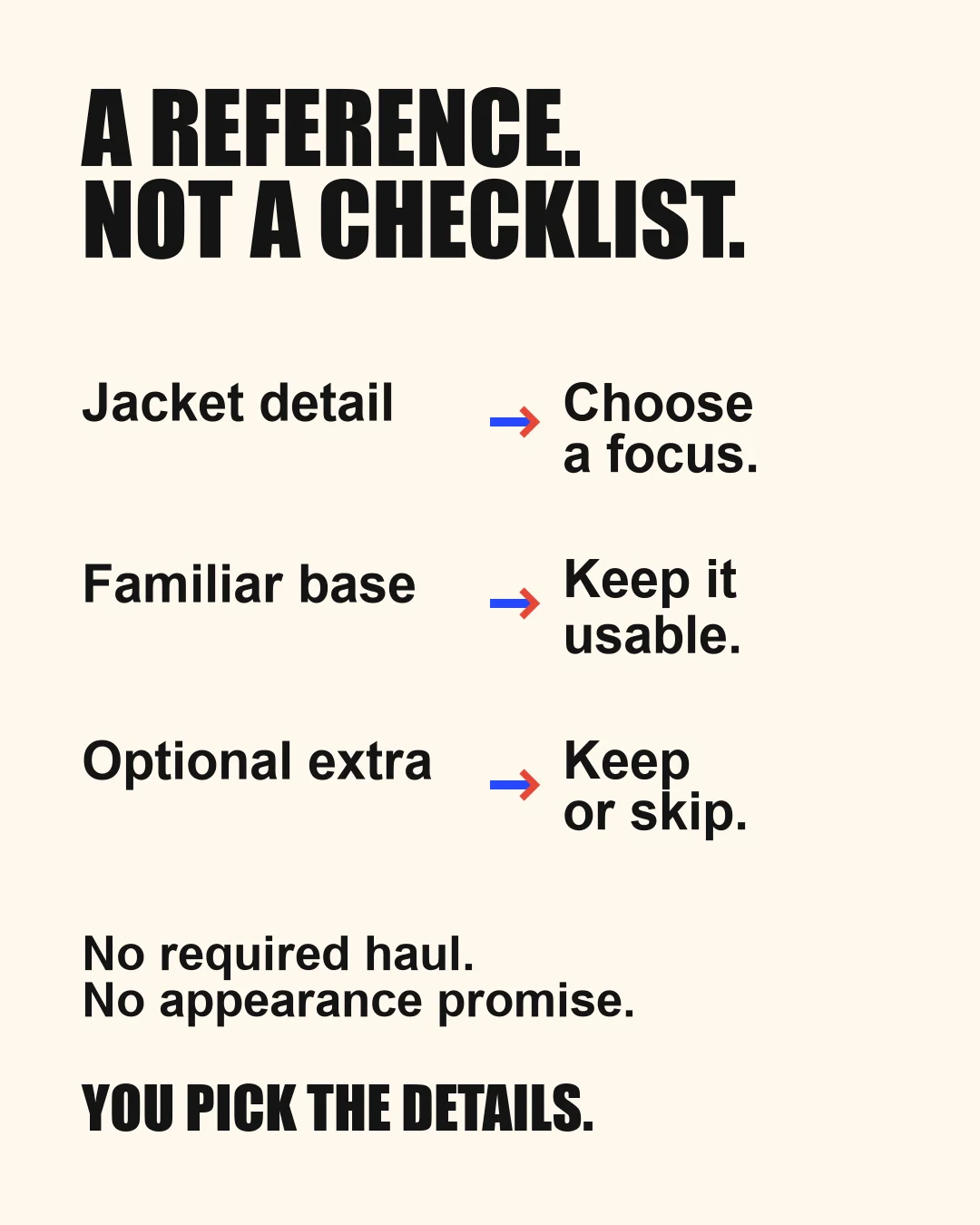
This approach concerns ordinary clothing and practical outfit planning. It does not assess protective equipment, prescribe a body change or promise a financial or environmental result. There is no ideal number of garments and no requirement to justify every sentimental item by how often you wear it.
Who this is for
Try a small audit if you have clothes but repeatedly struggle to assemble an outfit for a familiar situation. It can also help before an event, a change in routine or a discussion with a tailor. You do not have to empty every drawer to answer one question.
Choose the problem first: comfortable clothes for desk work, a workable outfit for an upcoming occasion or a set of layers you can use together. An inventory is easier to interpret when you know what it is meant to help with.
Alabama Cooperative Extension’s wardrobe worksheet separates what a person owns, what they need, condition and possible actions. That is a useful organising idea. Here, the emphasis is on use, comfort and preference rather than grading whether clothing “compliments” a body. The worksheet is a planning aid, not a trial demonstrating an appearance improvement. Alabama Extension inventory worksheet
Before you start
Pick a manageable group: the items you would consider for one activity or a few pieces you keep overlooking. Leave unrelated clothes in place. Use a chair or clear surface and a short paper note if that helps. An app, paid styling service or full photo catalogue is optional.
Include the things that affect how you wear an outfit, such as ordinary underlayers and the shoes you expect to use. Keep any work, cultural, access or personal requirements visible. A garment can be suitable for one situation and unsuitable for another without being a bad purchase or a problem with your body.
Know the question you want answered. “Can I make a comfortable outfit for this event?” gives the audit a stopping point. “Is everything in my wardrobe perfect?” invites a task that cannot be finished.
Check care labels before deciding that an item is ready to wear or that a change in washing will fix a fit problem. The FTC’s care-label guidance explains the purpose of cleaning instructions and warnings. It does not support guessing a more aggressive method for a garment you have not assessed. If instructions are missing or unclear, ask the maker or an appropriate cleaner about the actual item. FTC care-label guidance
Actions in order
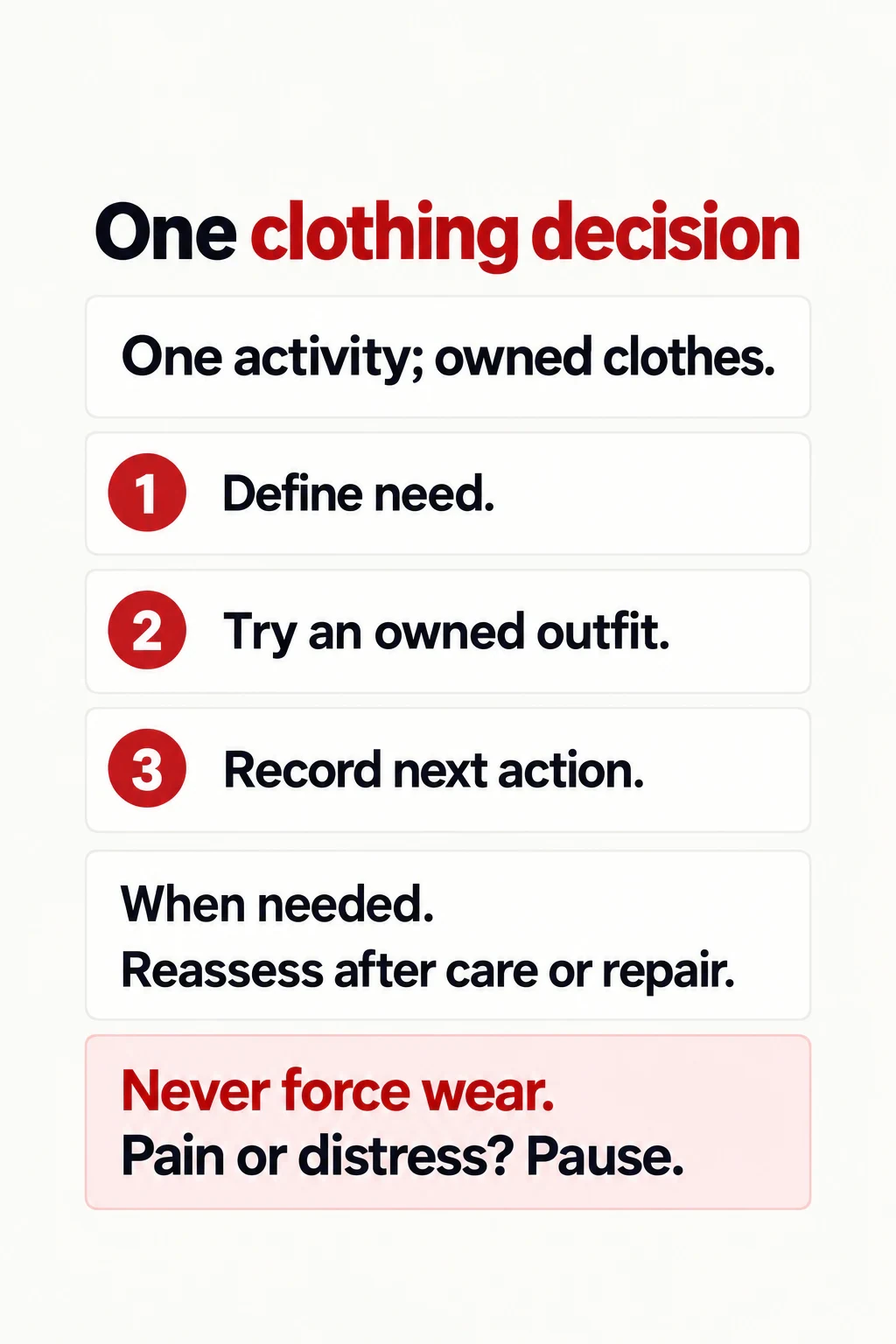
1. List what the activity requires
Write down the circumstances in plain terms: what you will be doing, any relevant clothing requirements and what you want to feel comfortable wearing. This is a practical brief, not a test of taste.
For desk work, you might need to sit comfortably and manage a changing indoor temperature. For an occasional event, you may have different expectations. Do not treat something worn infrequently as useless when it serves an infrequent but real need.
University of Georgia Extension’s closet-planning guidance asks readers to relate clothing to their activities and examine why items get worn or overlooked. That supports asking what a garment does in your life. Its older fashion and store-price generalisations are not a current shopping rule. Georgia Extension: quality and selection
2. Separate fit, condition and coordination
Try an item only if doing so is comfortable and useful. Make ordinary movements relevant to the activity: sitting, standing, walking or reaching as you normally would. Do not force a stretch, tolerate pain or repeatedly inspect yourself to find a flaw.
Describe the garment issue rather than giving your body a label. “The waistband feels restrictive when I sit” is actionable. “I need a different body to wear my clothes” does not tell you whether another size, cut or owned outfit would work.
Then look at condition and care. A loose fastening, an unclear care instruction and a garment that feels restrictive are different problems. Mark them separately. Do not assume that buying another item is the necessary response to all three.
Use a note like this, changing the categories to suit your own decision:
| Item or outfit | Intended use | What you observed | Next action |
|---|---|---|---|
| An owned shirt | Upcoming event | Comfortable, but a button is missing | Ask about a repair before deciding |
| A pair of trousers | Sitting at work | Restrictive during ordinary sitting | Compare another owned pair; ask about fit options |
| A jacket | Outdoor layer | Works with the outfit but needs care | Read the label and arrange appropriate care |
| An occasional outfit | Infrequent formal use | Ready and suitable for its purpose | Keep available for that occasion |
| A comfortable top | Everyday use | No outfit tried with it yet | Compare it with an owned bottom |
These are hypothetical examples, not diagnoses of particular garments or proof that a repair is feasible.
3. Try one useful combination
Before adding a supposed gap to a shopping list, try a relevant combination from the items already available. Change one component if that helps you understand the problem: a different owned shirt, another layer or the shoes you intend to use.
For example, imagine wanting to buy another top because you have no outfit ready for an event. The audit finds one comfortable owned shirt with a missing button and another that already works with your trousers. You have identified two possible next steps: ask about the repair, or use the existing combination. You have not established that a new top is necessary, that repairing is cheaper or that either outfit will suit every event.
If nothing works for the stated activity, write the gap specifically. “A layer I can comfortably wear over this outfit” is more useful than “a whole new wardrobe.” Include the requirements that matter to you, and compare any candidate against them rather than against a generic list of essentials.
4. Make care and repair tasks concrete
Put a possible repair on a short action list with an owner, question and next step. For instance: “Ask the repairer whether this fastening can be replaced, what it will cost and when the item could be ready.” An indefinite pile labelled “fix someday” gives you less information than an actual assessment.
For alterations, ask about the construction and the change you want. Do not assume every seam can be let out or every cut can be changed. Keep irreversible cutting or reshaping until you understand what is proposed. If the item is returnable, check the terms before changing it.
The EPA includes maintaining and repairing owned clothing among its general suggestions for avoiding unnecessary replacement. That is a reason to consider the option, not evidence that every repair is worthwhile or that this audit saves a particular amount of money or carbon. EPA: think before shopping
5. Choose an action without forcing disposal
Possible outcomes include wearing the item, arranging care, obtaining a repair assessment, comparing an alternative, keeping it for a specific later use or deciding it no longer serves you. Set aside an uncertain decision if you need more information.
An item can also have sentimental, cultural or practical value that a wear count misses. You may choose to keep it. The aim is to make the current clothing decision clearer, not to enforce a minimalist identity.
If you decide to pass something on, check the intended recipient’s requirements and describe its condition honestly. Do not assume that every organisation accepts every textile. A decision to let an item go can wait until you know where it can appropriately go.
Myth or Real?

Claim
Social paraphrase: Two garments with the same stated fibre content need not tolerate the same care routine.
Verdict
REAL
Facts
Components and construction of a finished garment can matter to its care. A fibre name alone does not establish a suitable method for that particular item.
The general principle is checked; the forum item, care advice, finishing theory and personal results are not verified or endorsed.
The selected comment makes a limited point about why a fibre description does not settle finished-garment care. The FTC guidance independently considers the garment and its components as a whole. That supports the principle while leaving the actual item and proposed process unassessed. The surrounding forum washing/coating/temperature advice is outside this check. The original four primary article documents remain the factual source count; this social link is claim discovery only.
Takeaway
Read this garment’s full care label; ask its maker or an appropriate cleaner about unclear instructions.
Sources
Claim discussion: Public comment: matching fibre content does not settle finished-garment care.
Evidence: FTC: Clothes Captioning—complete finished-garment and component care context.
Checked 2026-10-17. Scope: Ordinary clothing planning. U.S.FTC practical finished-garment/component guidance is evidence context, not a universal legal rule, compliance audit, diagnosis of the pictured/forum item or guarantee of safe cleaning. Matching fibre descriptions may still need different care; this does not say they always do.
Costs, risks and stop criteria
The initial check can use owned clothes and a simple note. A tailor, cleaner, repairer or replacement purchase may involve costs and waiting time; obtain the actual scope, quote and date. This guide does not give a universal repair-price range or promise a cheaper outcome.
Consider the work required to keep an item usable, including its care needs, as well as its purchase price. An inexpensive garment that does not work for the intended activity may leave the same gap unresolved. An owned item with a feasible repair may be useful, but the assessment still needs to happen.
Do not use uncontrolled shrinking, harsh cleaning or forced wear as a shortcut to a different fit. Follow the applicable care instructions and ask for help when uncertain. For specialist or protective clothing, keep its relevant requirements with the qualified provider rather than treating ordinary style advice as sufficient.
Pause if trying on clothes becomes painful or turns into repeated fault-finding about your appearance. Persistent pain, numbness or skin irritation deserves appropriate healthcare advice; this is not a diagnosis. You can finish the practical part with a short list and come back another time. No clothing decision requires distressing mirror checks.
How to assess the result
Check whether the audit answered the original question. Can you identify a suitable owned outfit? Is there a specific care or repair task to resolve? If a purchase is still needed, can you state what it must do and what you have already tried?
After a repair, alteration or relevant ordinary care, revisit the activity that exposed the concern. Tell the provider what changed and what remains difficult. A neat photograph or a completed checklist cannot replace how the garment works in use.
If comparison photos help, keep lighting, camera distance, angle, pose and outfit details similar. Use them to remember options, not to certify comfort, alteration feasibility or a transformation. Photos are optional; a sentence about the fit concern may be enough.
Stop when you have an actionable answer for the chosen activity. You can review other clothes when a real need arises. Success is a clearer next decision, not a perfect rail of clothing or a required number of items removed.


Sources
The four linked primary sources are extension and government planning or care guidance. The Alabama worksheet and Georgia material provide practical organising ideas; dated appearance judgments and broad retail claims are not adopted. The FTC source is used for care-instruction context, rather than a universal statement of clothing law. The EPA source supplies general reuse and repair context, without a quantified benefit claim. No clinical trial, wardrobe transformation, affiliate relationship, product ranking or personally tested saving is claimed.
FAQ
Common questions
Does an audit have to end with buying or discarding clothes?
No. A useful result can be an owned outfit ready to use, a concrete care or repair question, or a decision to keep an item for an occasional or sentimental purpose.
Does matching fibre content mean matching care instructions?
No. Components and construction can matter. Read the complete label and warnings for the actual garment; this general principle does not establish a safe cleaning method for a particular item.
Can a photo tell me whether an alteration will work?
A photo cannot establish comfort, construction or repair feasibility. Ask the relevant provider about the actual item, proposed change, cost and timing.
Topic hubs
Tags