By Mara Reed
A wide-leg trouser can fall beautifully over a boot and drag behind the heel when you put on your flats. Check the same trousers with both pairs before you shorten anything. Look for the fold you like over the front of the shoe, then look behind the heel for fabric on the floor. A small fold and a dragging hem call for different decisions.
Who this is for
Use this check if you already like the fit through the waist and hips and want to settle the length with the shoes you actually wear. It works for a favorite pair of wide-leg jeans or trousers you’re trying on at home. A break is the fold where the front of the leg meets the shoe. For this guide, rear clearance means the space you can see between the back edge of the hem and the floor. Decide what you like about the fold and check what the back edge is doing.

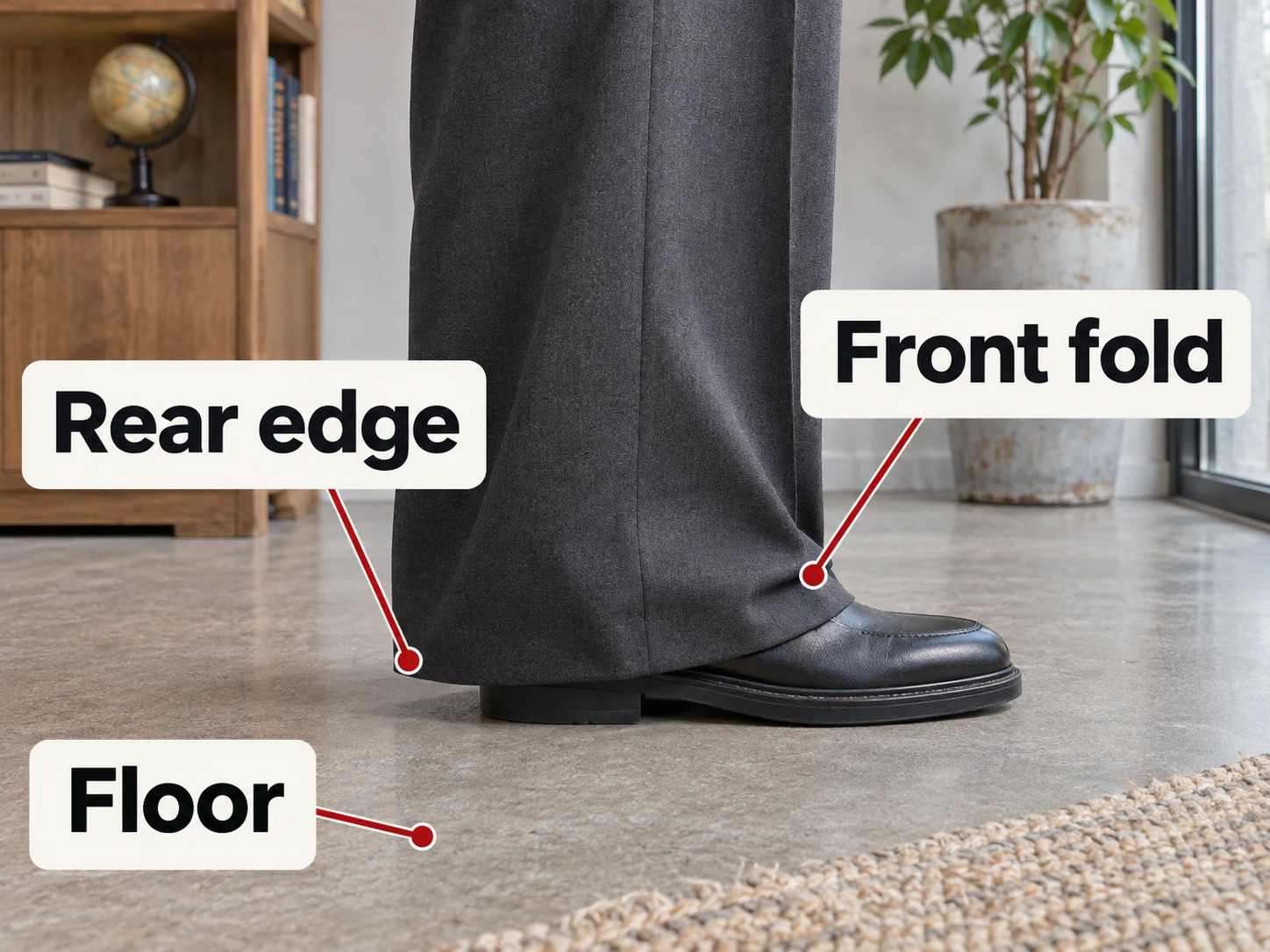
Look at the front fold and then check the space above the floor behind the shoe.
Front fold is the crease where the trouser touches the front of the shoe. Rear edge is the back of the pant leg. See whether it clears the floor.
Hamilton, Making Perfect Garment Hems · Clothing Care & Repair, Adjust the Length
A stiff jean can keep a visible crease. A softer trouser can fall over the shoe in a different shape. The shoe’s upper and sole, the fabric and where the waistband sits all belong to the pairing you’re looking at. New Mexico State University’s extension guide recommends marking a hem in the shoes and foundation garments you’ll wear with it. Its guidance also treats an even hang and the fabric’s behavior as part of the finish. New Mexico State University Extension
Before you start
Set out the two pairs you’re deciding between. Use a dry, level floor, a mirror that shows your shoes and a phone or a scrap of paper to make a note. Wear your normal socks and belt if you use one. Settle the waistband where you wear it. Give a previously folded hem a chance to hang in its usual shape before comparing.
For photos, use the same lens, light, distance, camera height and relaxed stance for each pair. Take the same front and side views without filters or edits. Ask a helper or position the camera while the trousers are out of the way. A view from near the floor helps you see the rear edge. Keep the shoe shape and the floor in the frame.
Actions in order
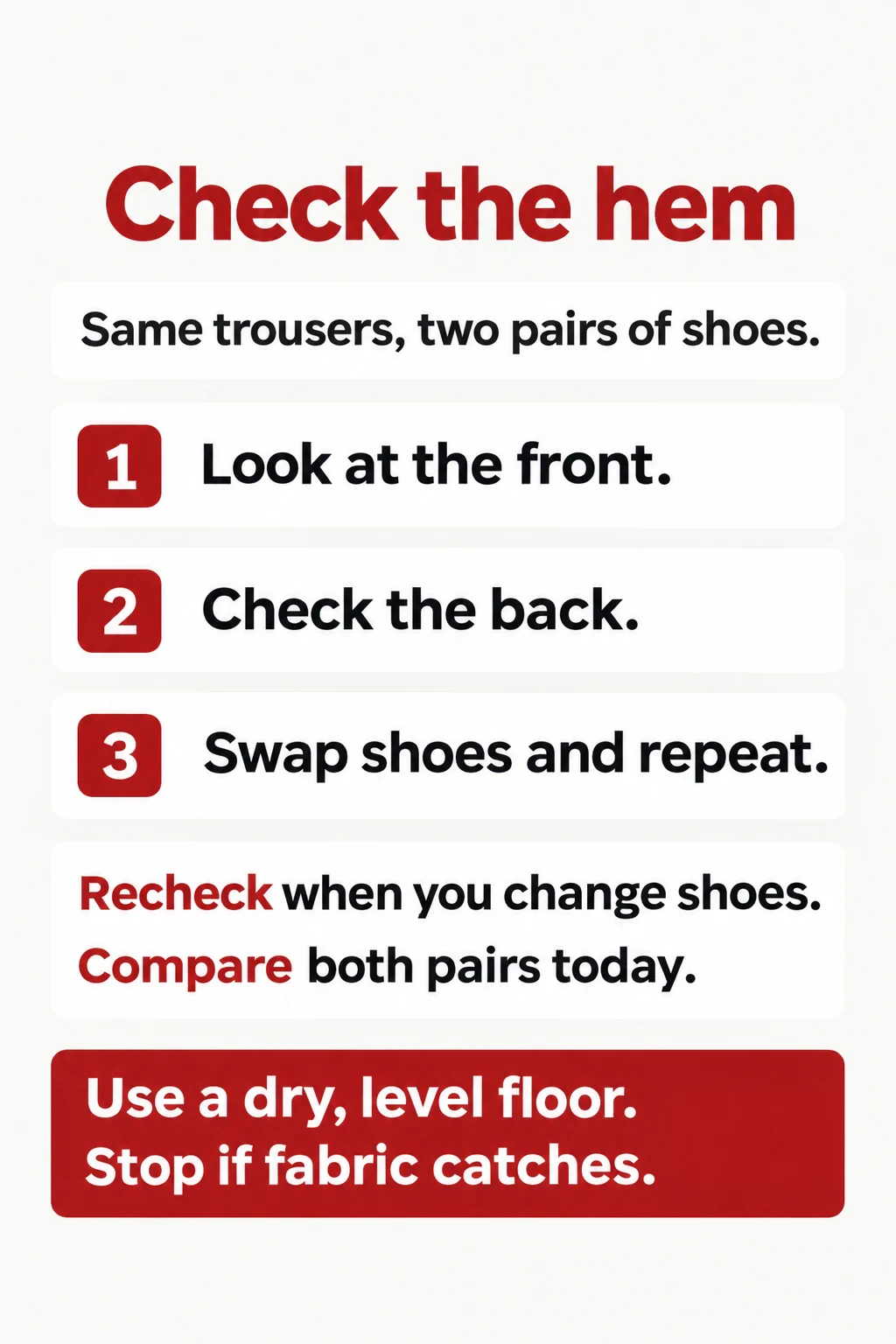
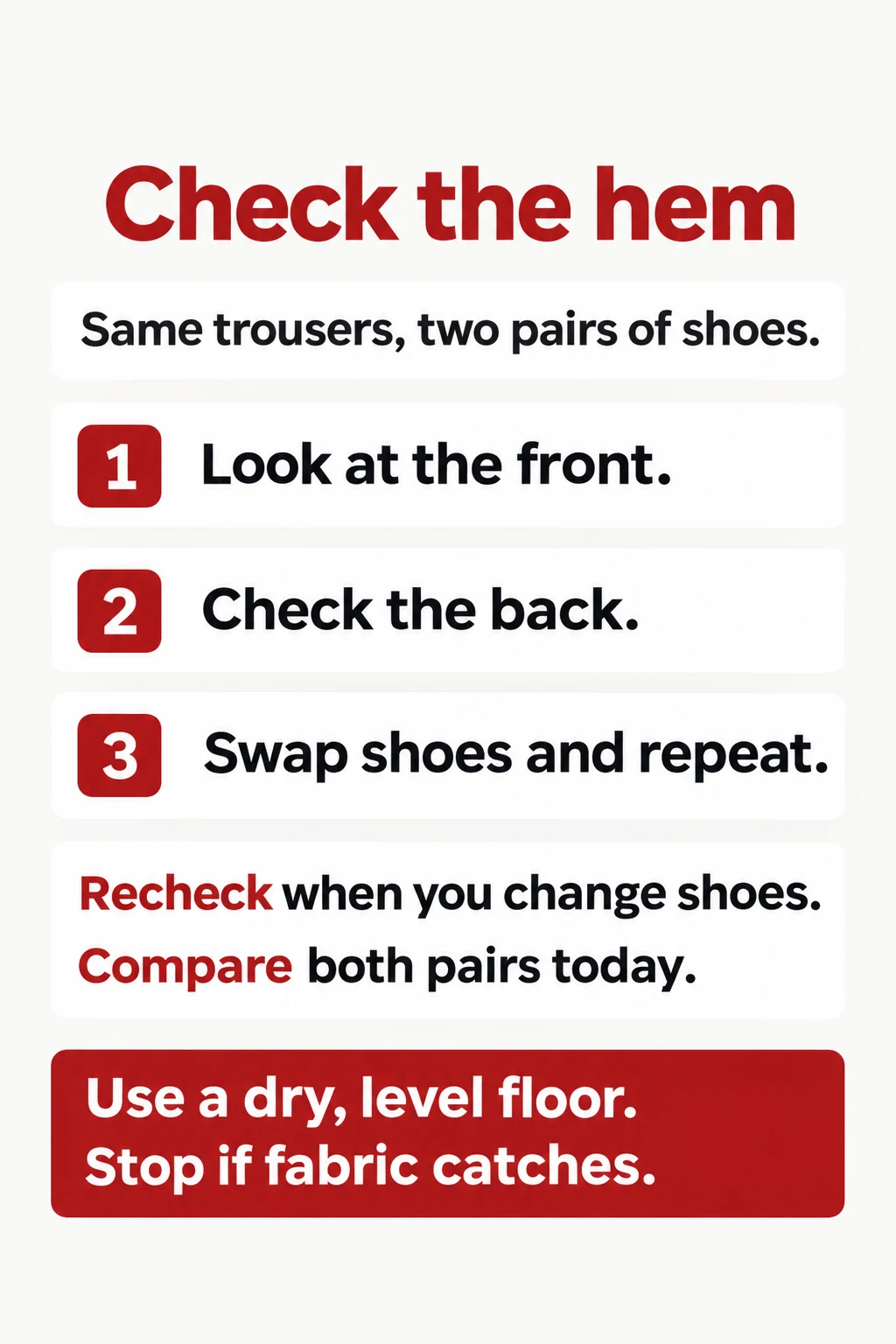
Check the same trousers with both shoe pairs.
Look at the front, check the back and swap shoes to repeat. Compare both pairs today. Use a dry, level floor. Stop if fabric catches.
Hamilton, Making Perfect Garment Hems · Clothing Care & Repair, Adjust the Length
- Check the first pair while standing still. Look straight on and decide whether you want the fabric to brush the shoe, fall in a small fold or show more of the upper. Look sideways and check the back of both legs for visible space above the floor. Record your preferred front and what you see at the back.
- Change shoes and keep the waistband in the same place. Repeat those two observations for each leg. If the front changes but the rear edges still clear, choose the silhouette you like with each pair. If a back edge rests on the floor, reserve that combination for the stationary comparison and change shoes before walking.
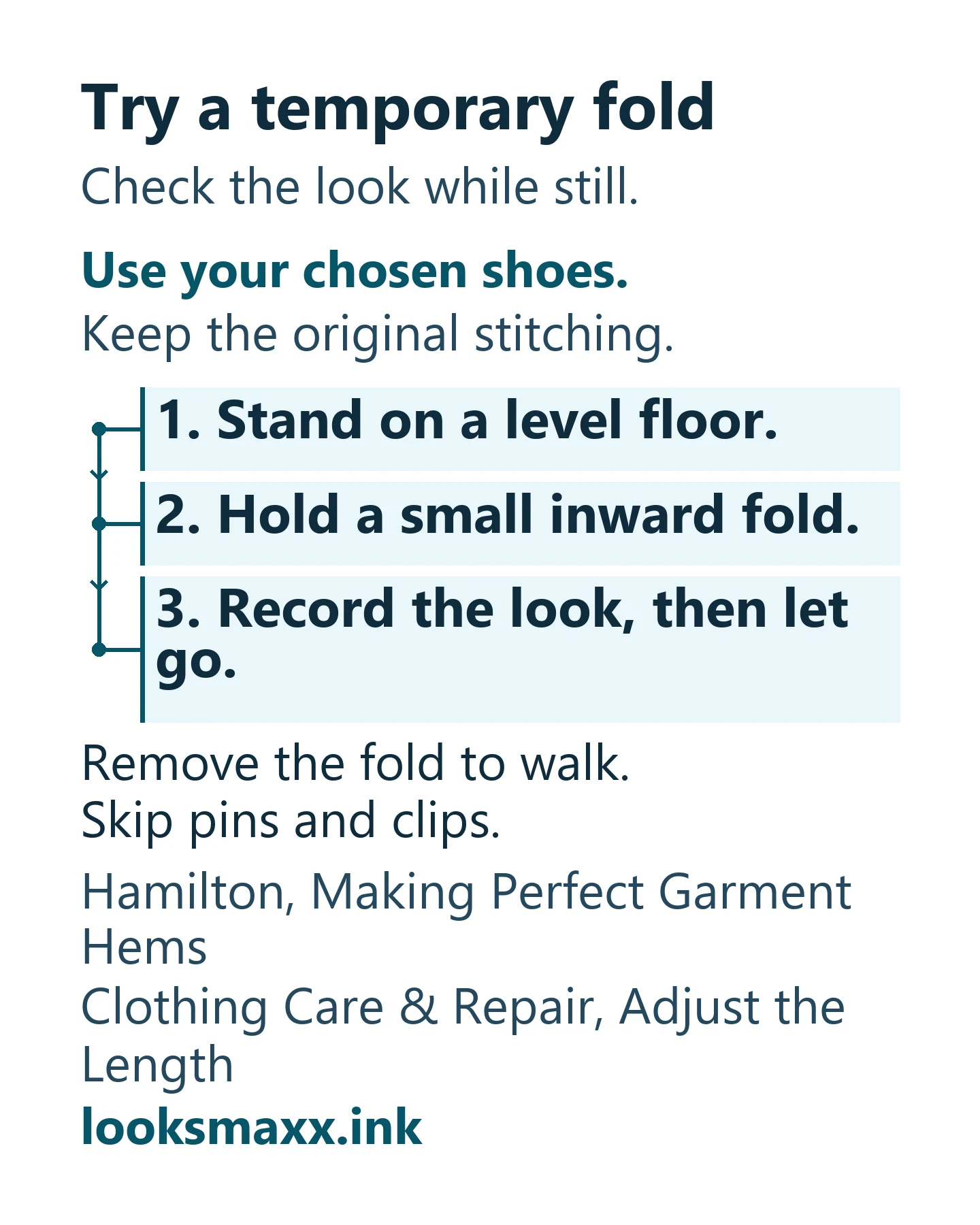
- Try a temporary fold while stationary. With the shoes you most want to wear, turn the existing hem inward a little and hold it only long enough to look. You can ask a helper to hold it and take a photo while you stand on the floor. If you want a record, note the depth of the fold at the outside seam after you’ve taken the trousers off. Leave the original stitching in place. Arkansas Extension also starts with the intended shoes and a trial fold, before its separate cutting or pressing steps. University of Arkansas System Division of Agriculture Cooperative Extension
- Check the wearable pairing. Let the original hem down and remove anything used to hold the fold. If the back clears while standing, use a few ordinary steps on the same dry, level floor. A helper can watch the back edge. Stop if a shoe catches the fabric or you start to step on it. Keep the shoe combination that passes the standing and walking checks, or save the fold photo as a reference for a later alteration.

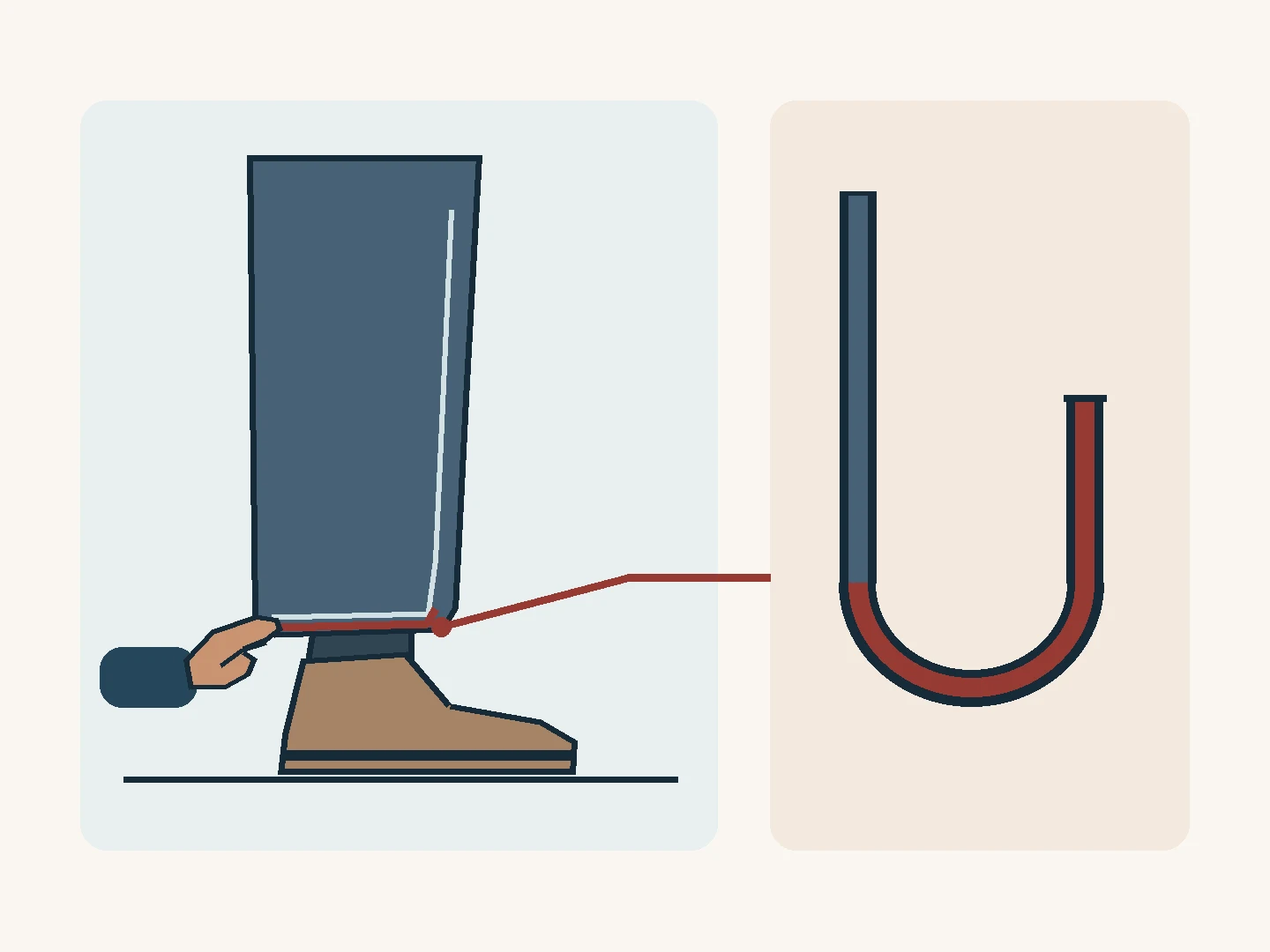
Hold an inward fold briefly to check the proposed length.
Stay still on a dry level floor. Record the look, let the fold down and remove anything used to hold it before stepping.
Hamilton, Making Perfect Garment Hems · Clothing Care & Repair, Adjust the Length

See what a temporary fold changes before you alter the hem.
With your chosen shoes on, stand on a dry level floor, hold a small fold inward and record the look. Leave the stitching in place. Let the hem down before a walking check.
Hamilton, Making Perfect Garment Hems · Clothing Care & Repair, Adjust the Length
Costs, risks and stop criteria
Allow roughly ten minutes with shoes and a mirror you already own. That’s a planning estimate. The check itself needs no purchase. Leave pins, loose clips, cutting and heat out of this try-on. Do the walk in a combination that already clears at rest. Keep stairs, wet ground and escalators out of the trial. If a hem folds under the heel or brushes the floor while you’re moving, stop and change the pairing before wearing it out.
A small temporary fold can show you a direction for the length. Look at how the fabric falls as well as the gap under the back edge. Utah State University’s sewing standards discuss choosing a hem depth for the fabric and style and keeping a finished hem smooth and even. The standards give no clearance number for wide-leg trousers. Utah State University Extension
How to assess the result
Say the boot gives you the soft front fold you want, with space behind both heels. The flat makes a similar fold in front, but the rear of one leg sits on the floor. Keep the trousers with the boot if they also clear in motion. If flats win for daily wear, make your stationary reference with the flats. Save a side photo showing the front and back of the temporary fold. You have a preliminary length to compare with the boot. Before altering the trousers, check and mark the final length around each leg in the shoes you plan to wear.

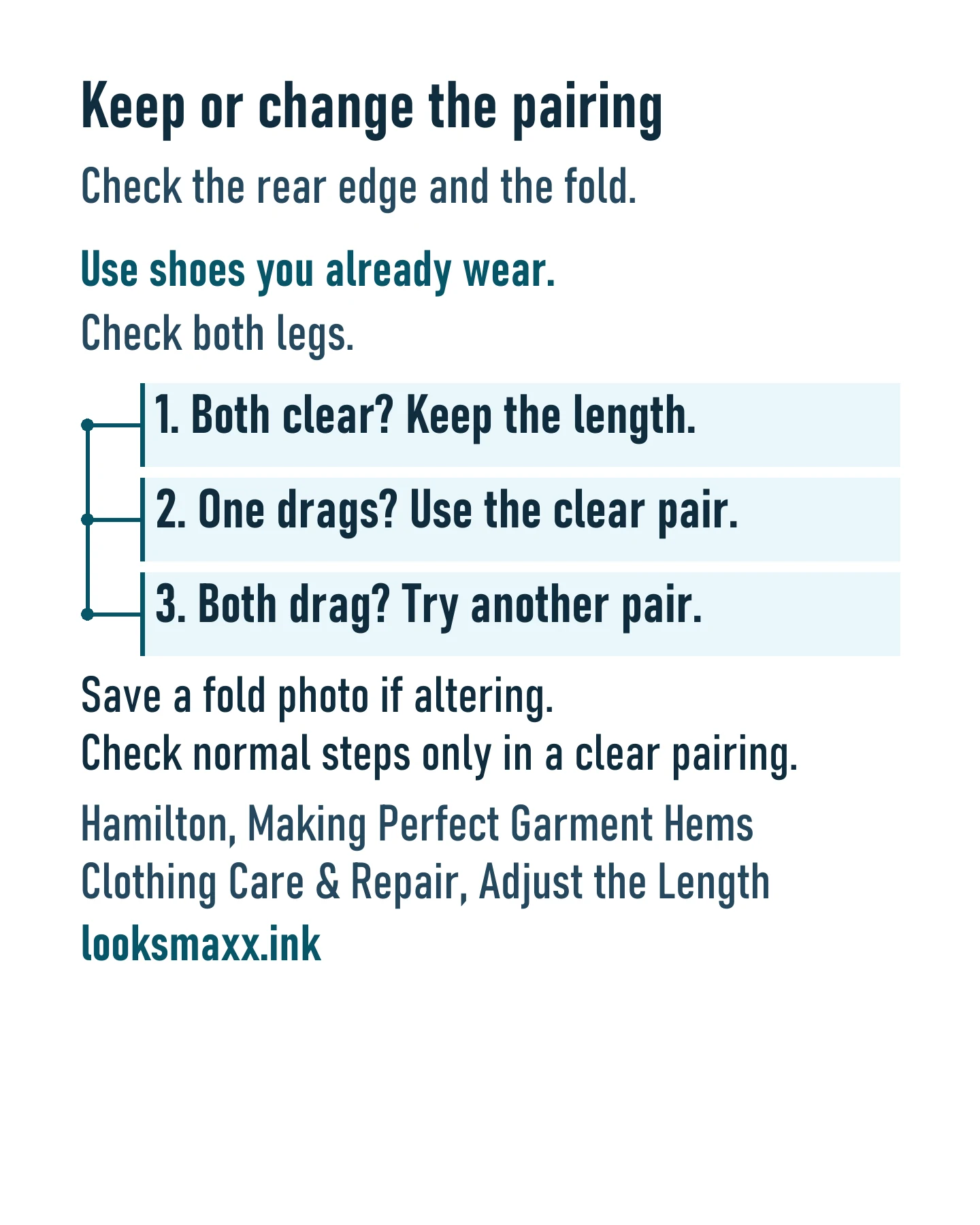
Choose the shoes with the back hem clear and the front drape you want.
If both shoe pairings clear in ordinary steps, keep the length if you like it. If only one pairing clears, use it. If both drag, try other shoes you already own. Save a stationary fold photo if you decide to alter the hem.
Hamilton, Making Perfect Garment Hems · Clothing Care & Repair, Adjust the Length
If both combinations clear in the checks, keep the original length and style them both ways. If both drag, try another pair of shoes you already wear. When you’ve decided to shorten the trousers but the mock fold changes the leg shape, bring both shoe pairs to an alterations specialist. Show a side photo of the original hem and a side photo of your preferred temporary fold, both taken with the shoes you want to wear. Ask how much of the current opening can be kept. The Sewing & Craft Alliance notes that substantial shortening may call for reshaping the hem area to preserve the original look. Recheck the finished garment with both shoe pairs and after a laundry cycle if the hang changes. Sewing & Craft Alliance
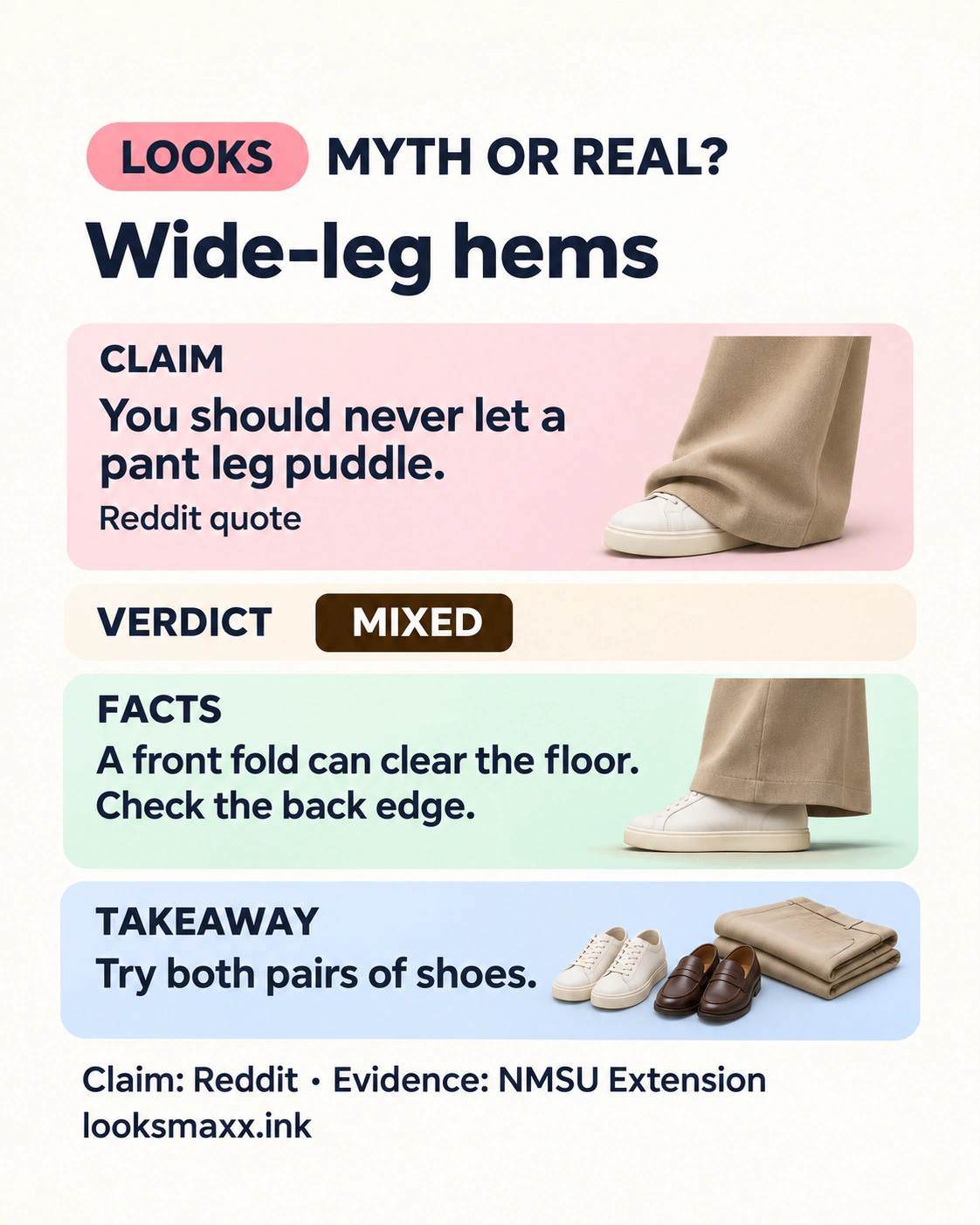
Myth or Real?

Claim
Social quotation: You should never let a pant leg puddle.
Verdict
MIXED
Facts
A small front fold is a style preference. Cloth dragging behind the shoe is a reason to change the pairing.
The original commenter narrowed their opinion after the questioner clarified that the rear edge stayed off the floor. The illustration has no universal clearance target.
A Reddit commenter gave broad advice and revised it after the questioner clarified that the example had a front fold with no ground contact. Independent sewing guidance uses the shoes actually worn when checking a hem. Questioner clarification · Same commenter follow-up
Takeaway
Compare the front fold and rear edge while standing still in both pairs.
Sources
Claim discussion: Reddit wide-leg trouser discussion, original comment and documented narrowing.
Evidence: Hamilton, Making Perfect Garment Hems; Clothing Care & Repair, Adjust the Length.
Checked 2026-11-19. Scope: The original commenter narrowed their opinion after the questioner clarified that the rear edge stayed off the floor. The illustration has no universal clearance target.
Sources
The extension publications and sewing guidance describe marking, construction and hang. The two-shoe check is an editorial application. The photographic illustrations are AI-generated. The diagrams illustrate the fitting checks. This guide has no sponsorship or affiliate links. The Sewing & Craft Alliance is an industry source.
- New Mexico State University Cooperative Extension Service, Wendy Hamilton, Making Perfect Garment Hems, Guide C-314. Read the guide
- University of Arkansas System Division of Agriculture Cooperative Extension, Clothing Care & Repair, FSFCS244, “Adjust the Length.” Read the guide
- Sewing & Craft Alliance, Shortening Pants and Sleeves, Guideline 14.120. Read the guide
- Utah State University Extension, Sewing Skills, “Basic Hem,” Machine Stitch, Beg MS Tech 1. Read the standards
FAQ
Common questions
Does a front fold mean my trousers need hemming?
A front fold is a style choice if the rear hems clear. Check both legs while standing and take a few ordinary steps on a dry, level floor in a clear pairing.
What if a hem clears in boots but drags in flats?
Wear the combination that clears. If flats are your usual choice, compare a small temporary fold while standing still and save a side photo before changing the hem.
Topic hubs
Tags