By Noah Vale
The coat looks sharp in the hallway. Then you put on the sweater you wear to work, zip up and reach for your keys. The whole coat comes with you. Try it over the thickest layer you actually wear with it. Close it, reach for something and sit. Do the same three moves over a lighter layer you already own. The difference tells you which combination earns a place by the door.
Who this is for
Use this for a coat you own or can try on and for ordinary trips you already take. A long coat can tug around the hips when you sit. A short one can tug at the cuffs when you reach. A wide shoulder seam can be an intentional part of the cut. Use what you feel while moving in the coat alongside what you see in the mirror.

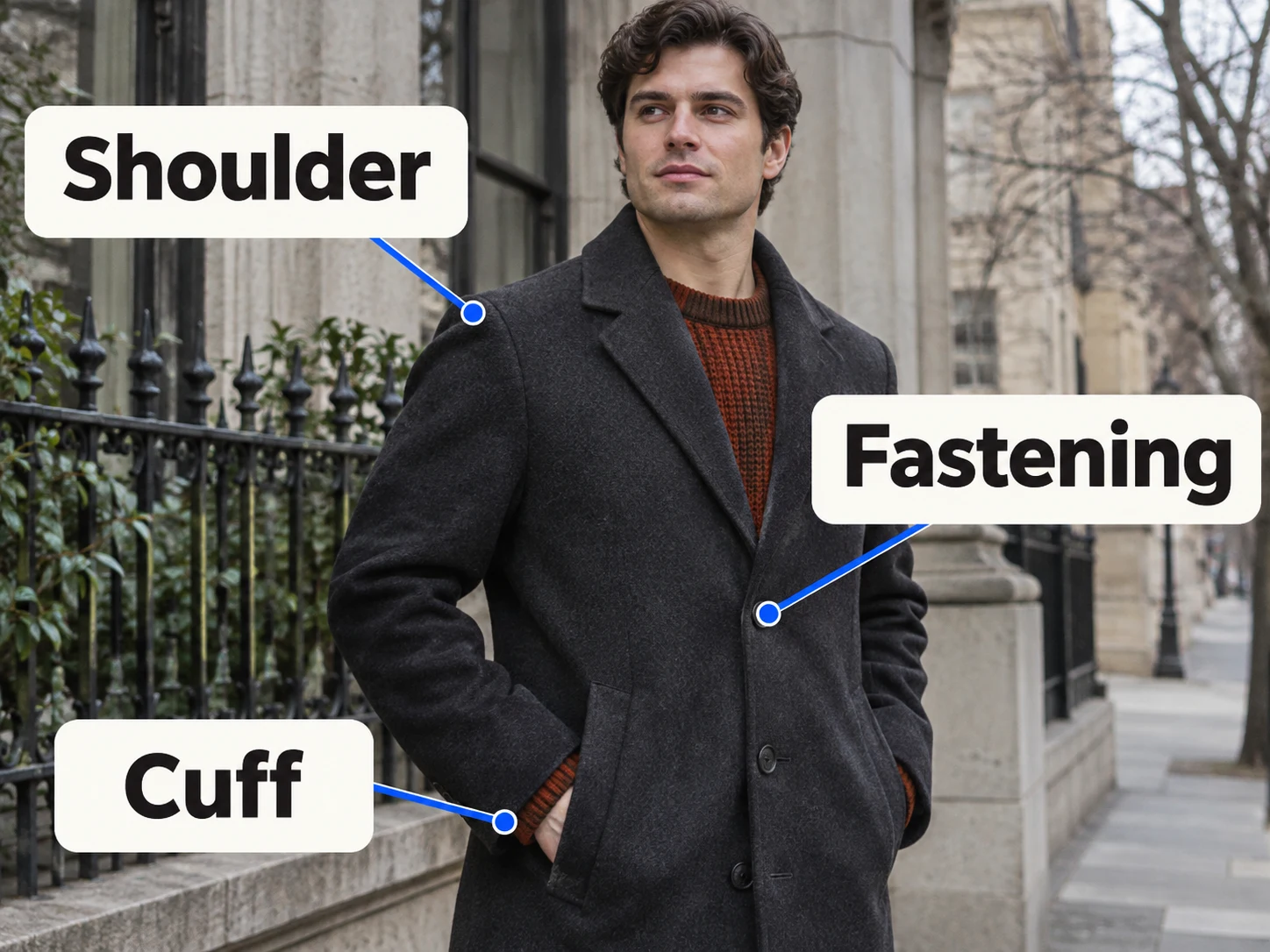
Check the shoulder, cuff and fastening during an ordinary movement.
As you reach, see where the shoulder seam and cuff move and whether the front pulls. Compare those points on the same coat over each layer.
Adams and Keyserling (1995) · Zhang, Ni and Zhou (2022)
Garment size affected most movements in a small lab study of ten men wearing work coveralls in several sizes and fabric weights. The study tested coveralls, so it supplies no measurement for a winter coat. It gives you a reason to put on the clothes and move before choosing. Adams and Keyserling, 1995
Before you start
Get the coat, the layers you really wear under it, and a place to sit. Pick one ordinary action you need on a cold day. Use your keys, a bag you carry, or the motion of reaching for a door handle. Start indoors on dry ground. Keep the same base layer and the same coat settings for both passes. If you already use the coat over just one layer, test that combination first.

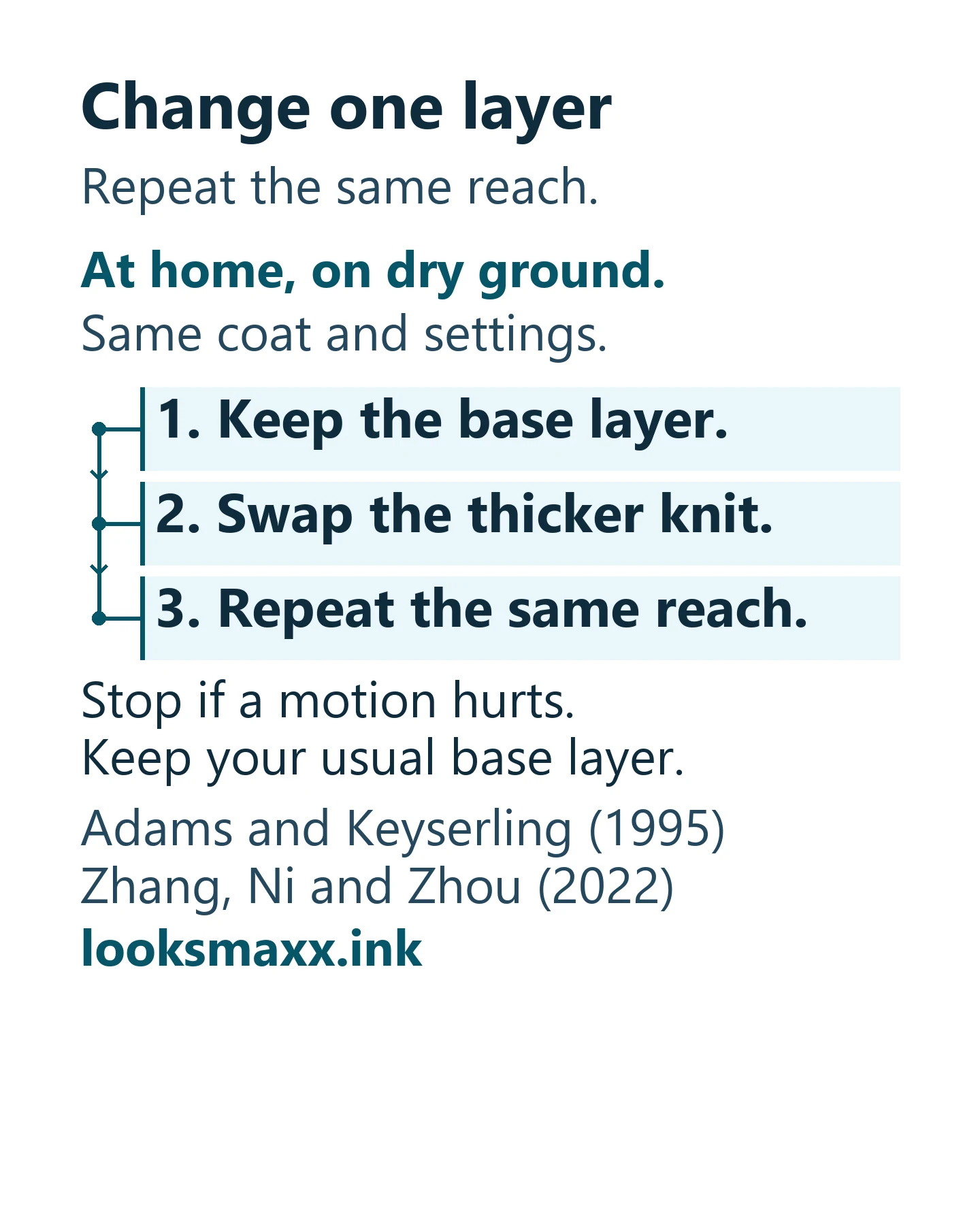
Repeat one everyday movement while changing the knit.
Compare one familiar reach with a lighter and a thicker layer. Keep the same coat, base layer and fastener settings. Stop if the movement hurts.
Adams and Keyserling (1995) · Zhang, Ni and Zhou (2022)
Actions in order
- Close it the way you normally do. Stand at ease and fasten the buttons or zipper. If the fastening strains or the front feels uncomfortable, note where, open it and try the lighter layer. If the coat closes comfortably, finish all three checks before you change layers.
- Do the reach you picked. Keep it gentle and within your usual movement. Watch what happens to the cuff, upper back and shoulder. Check whether the sleeve still sits where you want it and you can finish the move without pulling the coat back into place.
- Sit as you normally would. If you would wear it closed on the bus or at a café, try it that way in the chair. Check for pressure across the lap and whether you can reach your pocket. Standing up should feel easy. Repeat the same actions with your usual thinner layer.
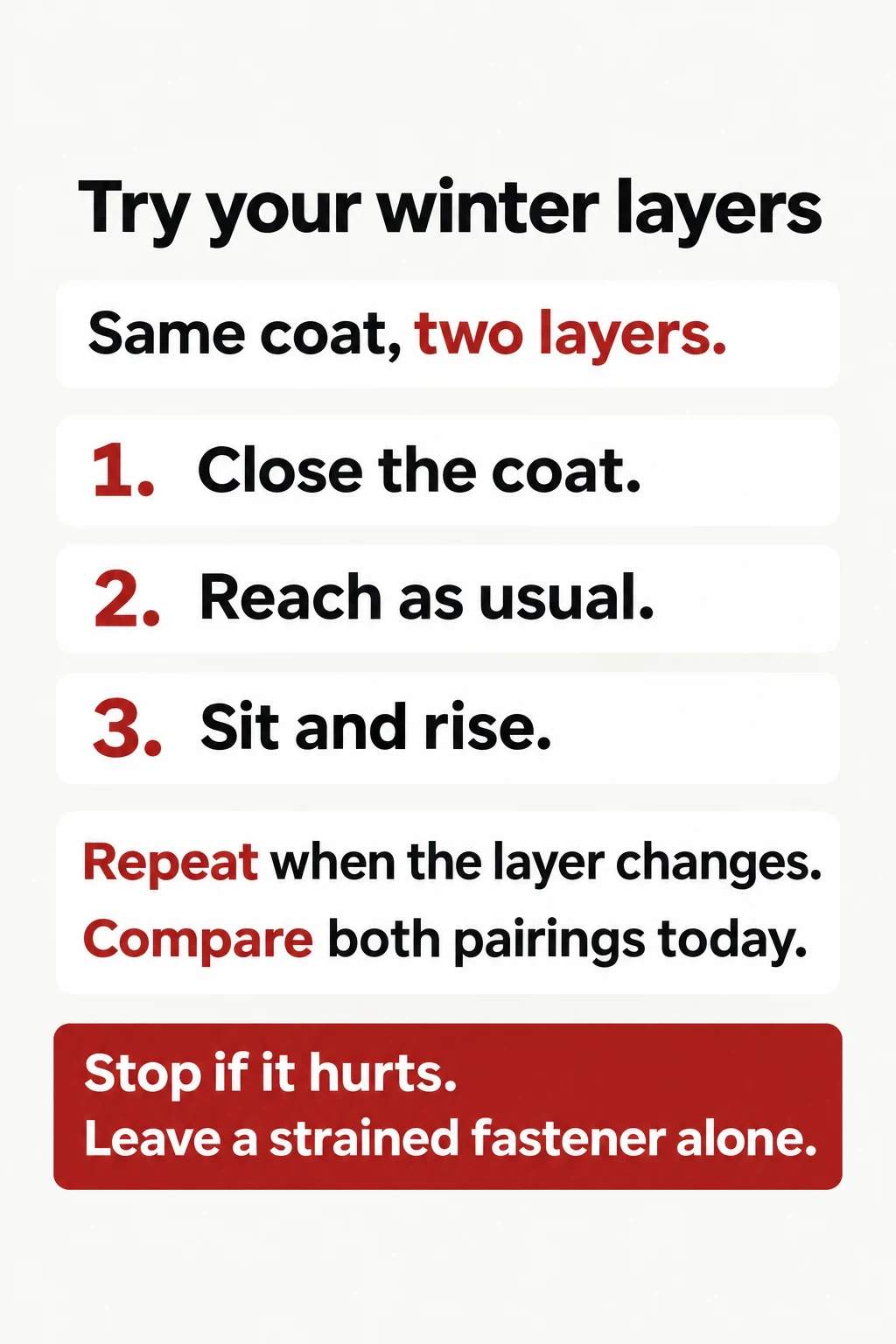
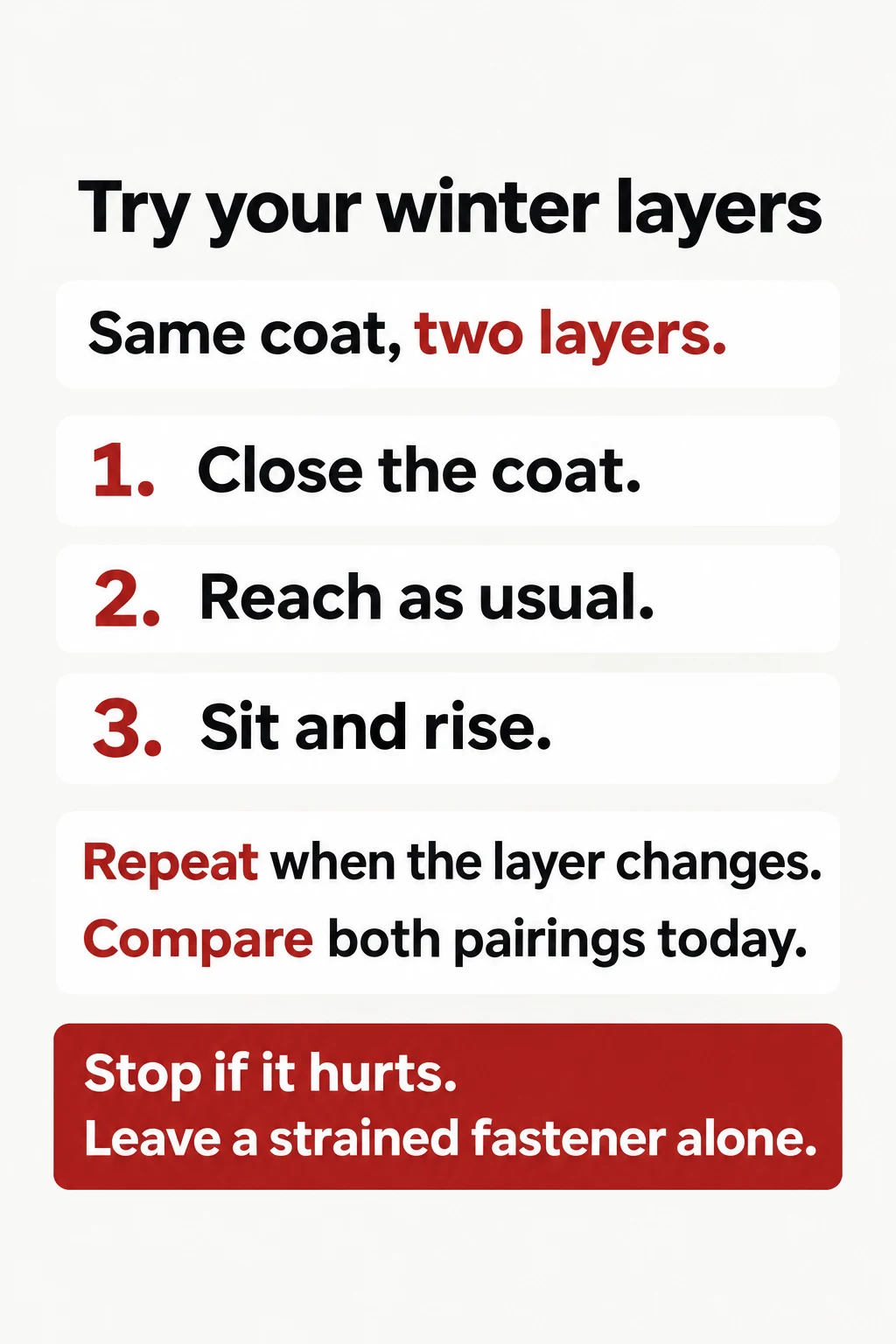
Repeat the same three moves when you change the layer.
Close it comfortably, make one familiar reach, then sit and rise as usual. Compare both combinations. Stop if a motion hurts and leave a strained fastener alone.
Adams and Keyserling (1995) · Zhang, Ni and Zhou (2022)
When you compare, blame the combination first. In a small study with eight male college students, an experimental uniform shirt with back pleats and underarm gussets allowed greater arm movement than the ordinary shirt. Both features changed together. That tells you why a garment with similar basic measurements can move differently, without giving you a rule for choosing an unlabeled coat. Zhang, Ni and Zhou, 2022
Costs, risks and stop criteria
Allow about five minutes and use what you own. Stop any move that hurts, and leave a strained zipper alone. Keep any layers or protection you need for the weather or your work. This indoor check answers a fit question. Keep using weather protection you already know suits the trip.
If you change which layer you use most, follow the care instructions on each item as it needs cleaning. In the U.S., covered textile garments come with regular care instructions under the FTC rule. Some wool garments take a machine cycle, and others have a different limit. Read the label on the one in front of you. Use a professional cleaner when its instructions call for one. FTC Care Labeling Rule, Woolmark care labels
How to assess the result
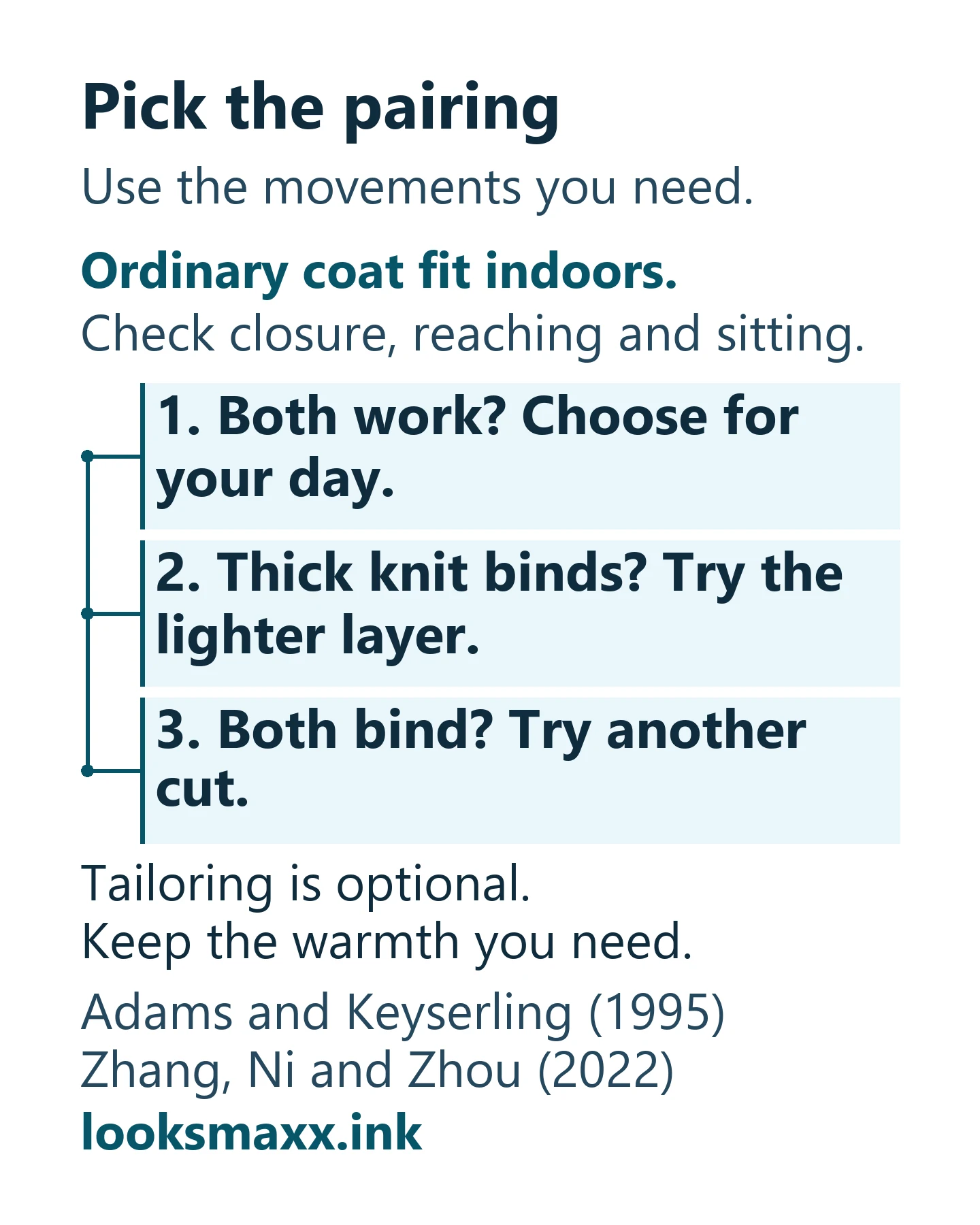
Keep the thick-layer pairing if you can close, reach and sit comfortably without adjusting the coat every time. If the lighter one passes and the thick one binds, use the lighter combination for conditions where it already works. For the other days, try a different coat or a less bulky layer you already trust for that weather. If the same spot pulls with both layers, take note of it when you try another cut. A professional tailor can assess that specific spot if you already own the coat and want to keep it. Bring the layer you wore in the test.

Choose the pairing that works for the places you actually go.
If both pairings let you close, reach and sit, choose the one that suits your plans. If only the thick one binds, use the light pairing when you already know it suits the weather. If both bind in the same place, try another cut. Optional tailoring is for a specific fit problem.
Adams and Keyserling (1995) · Zhang, Ni and Zhou (2022)
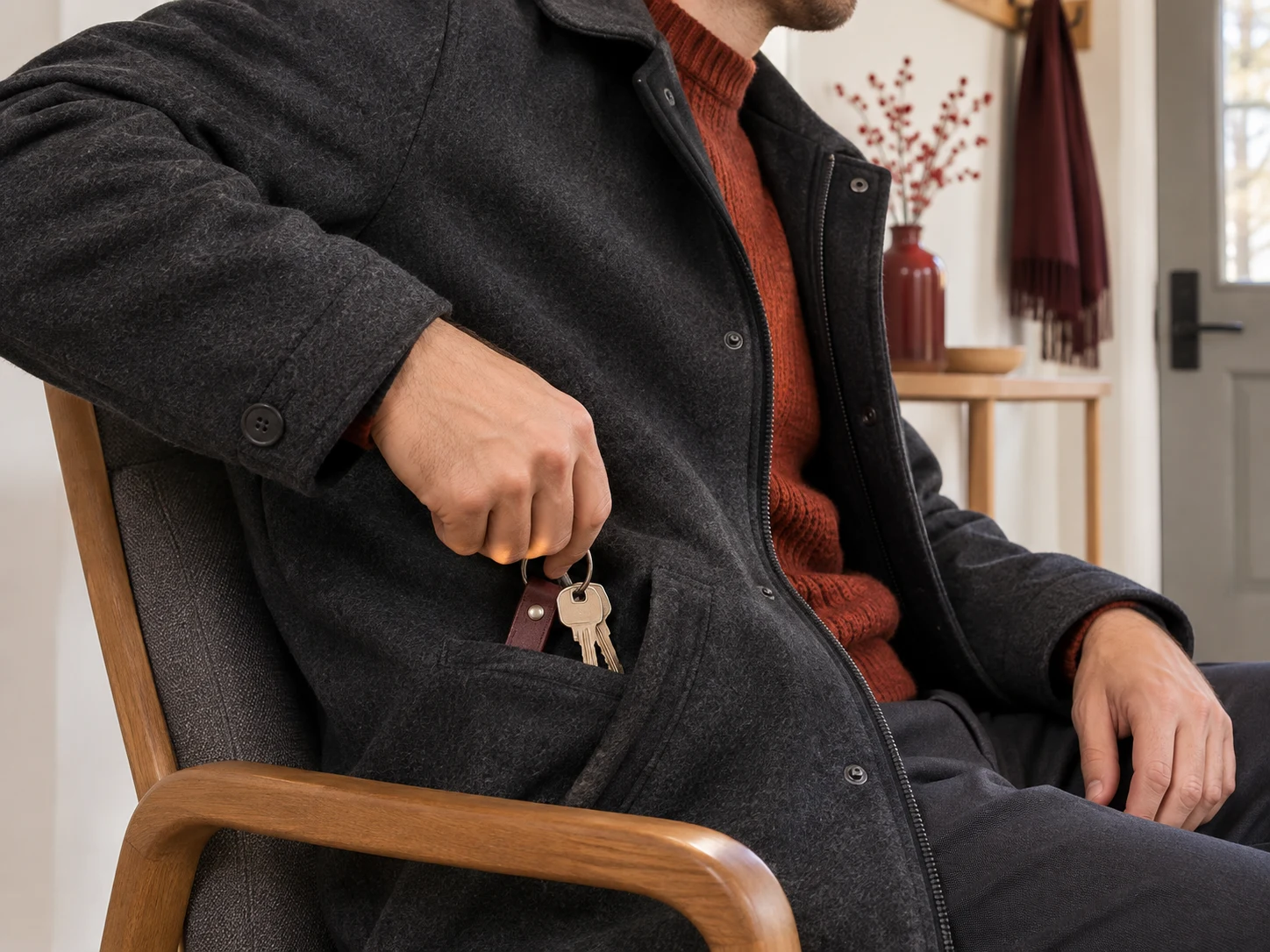
Imagine a long coat that zips easily over a heavy knit. It feels fine when you reach but pulls across your lap when you sit. With the lighter knit, you can sit and get your keys out of your pocket. You’ve found one workable pairing for the indoor-to-bus trip if you already know it gives you enough coverage outside. Save the heavy knit for another coat or another day.

Use a pocket you need while you sit.
While seated, see if you can take your keys out without the coat binding or needing adjustment.
Adams and Keyserling (1995) · Zhang, Ni and Zhou (2022)
If you use a photo to compare the look, match the light, lens, distance and pose, and leave filters off. A photo cannot diagnose pain or establish how a garment feels in motion. The pairing that earns the hook by the door is the one you can actually wear through the day you planned.
Myth or Real?

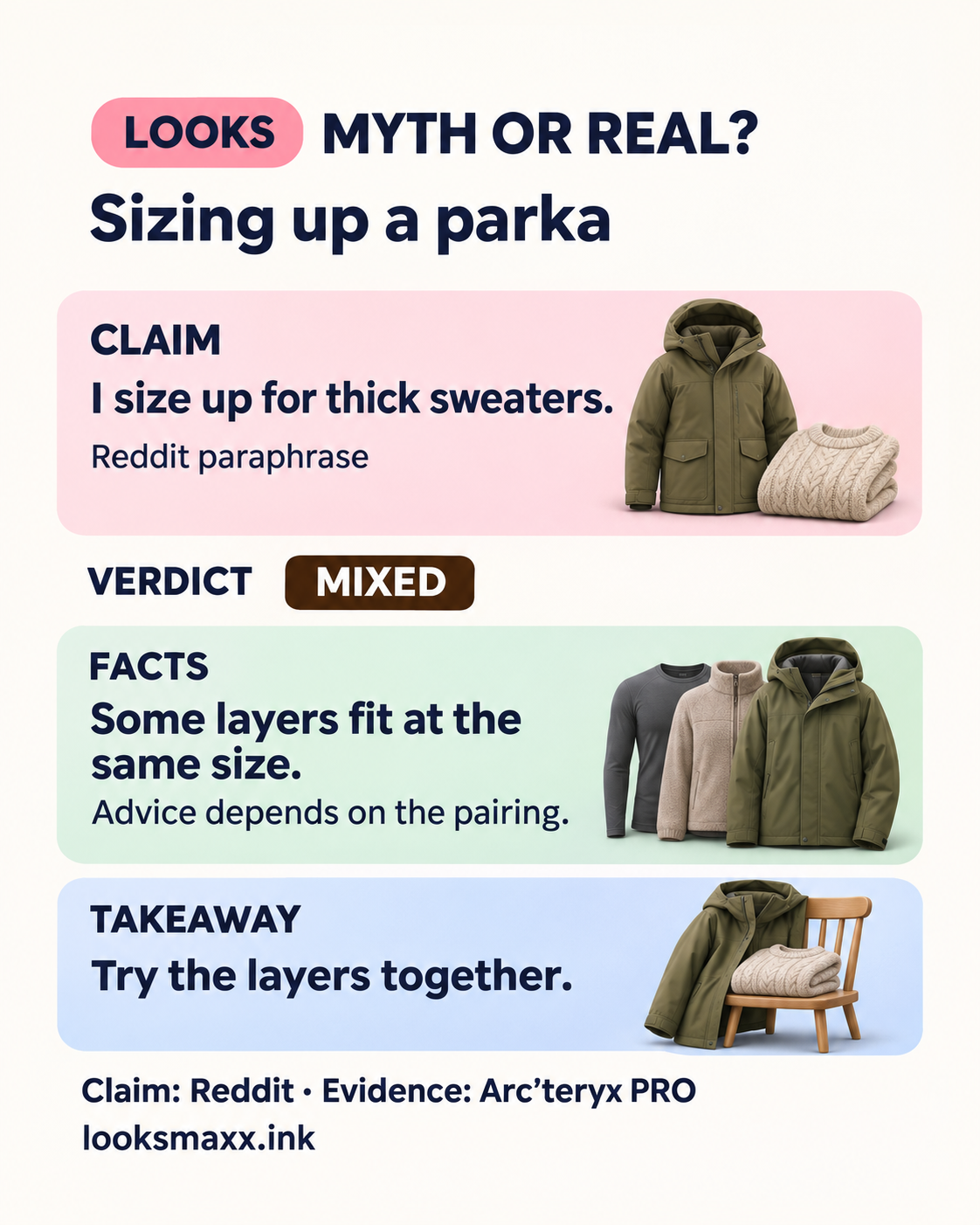
Claim
Social paraphrase: I always size up in a parka to fit a thick sweater.
Verdict
MIXED
Facts
A larger size can work for a particular coat and sweater. Arc’teryx PRO gives a same-labeled-size example for its compatible base, middle and outer layers.
The maker describes its own system. The Reddit comment does not identify a coat or provide a controlled comparison.
One reader always sizes up. The article checks whether that practice generalizes by considering a documented compatible layering system.
Takeaway
Try the actual layers together. Close, reach and sit before changing sizes.
Sources
Claim discussion: Reddit parka discussion — selected personal practice.
Evidence: Arc’teryx PRO sizing.
Checked 2026-11-19. Scope: The maker describes its own system. The Reddit comment does not identify a coat or provide a controlled comparison.
Sources
FAQ
Common questions
Do I always need a bigger coat size for a thick sweater?
Some coats and layers are designed to fit together in the same labeled size. Try the exact pairing and check closure, reach and sitting.
What if the coat pulls only when seated?
Try the same seated movement with a lighter layer you already wear. If both pull in the same place, try another coat cut or show a tailor where the fabric pulls.
Topic hubs
Tags