
A blazer you rarely reach for. A jumper that already feels like you. The bag that carries your actual day. Those pieces are a better starting point for Poetcore than a checkout full of clothes labelled with the same aesthetic.
The quick answer: keep a comfortable outfit as your base, borrow one literary-looking detail, then test the combination in ordinary life. You can stop there. A new wardrobe, a particular body, expensive fabric and a staged reading habit are not entry requirements.
Poetcore is a useful search term for inspiration. It is not a dress code with an examiner. The aim here is an outfit you enjoy wearing, using what you already have, rather than a convincing costume for a life you do not lead.
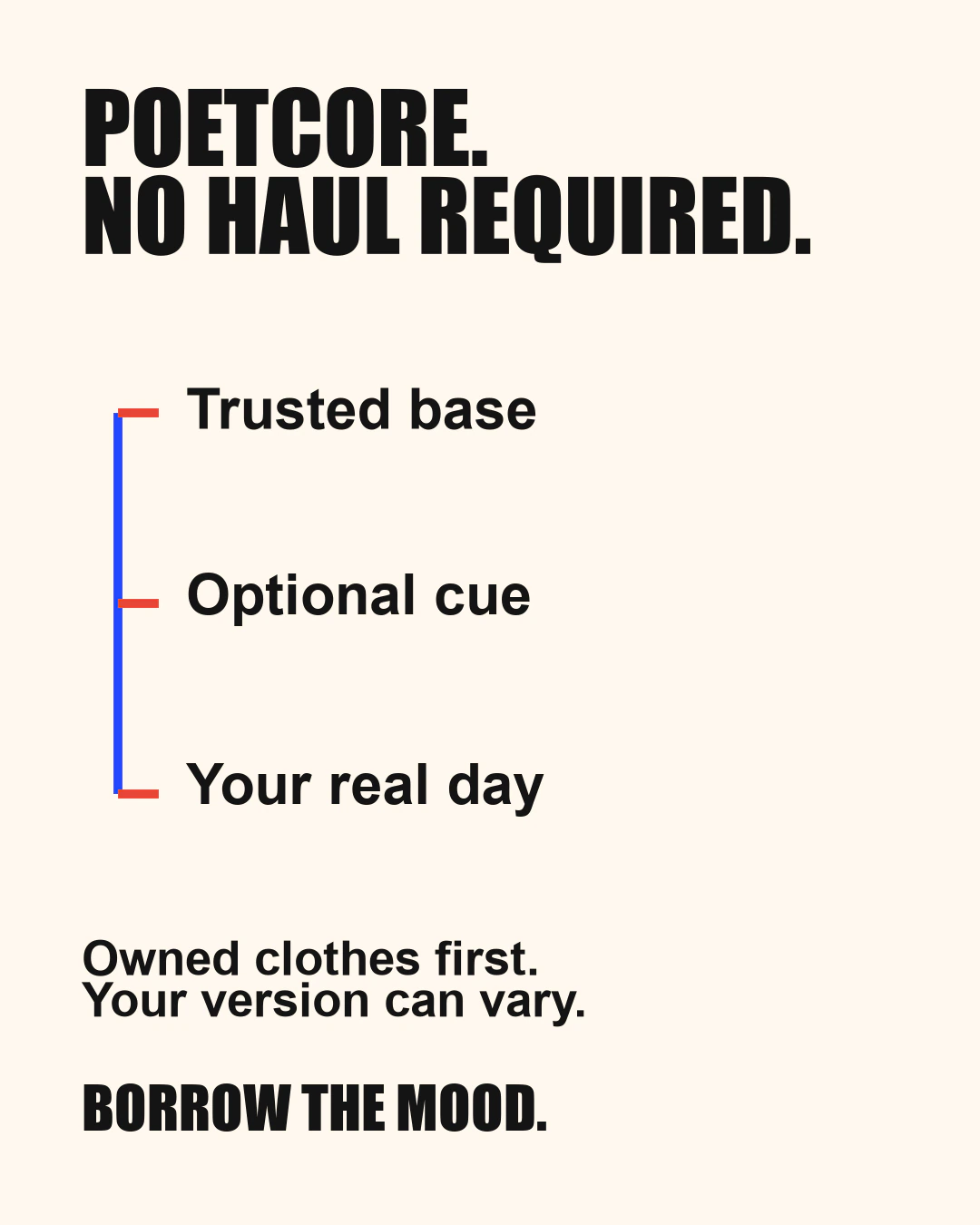
Graphic context — 01-article-hero: Poetcore is Pinterest’s attributed2026forecast vocabulary, not a current popularity result. This original editorial diagram connects an owned base, an optional detail and the actual day; it does not prescribe a purchase or an ideal body.
Text equivalent: POETCORE. NO HAUL REQUIRED. A linked sequence reads Trusted base, Optional cue, Your real day. The qualifier says Owned clothes first. Your version can vary. The punchline says BORROW THE MOOD. Connections show an optional styling order, not a causal effect or measured improvement. Keep climate, comfort, work/uniform, faith, protective and access requirements first. Pinterest’s forecast was published December9,2025; no fresh October search growth, demographic identity requirement, universal wardrobe sufficiency or social outcome follows. Sources and dates are in the adjoining article Sources section.
Who this is for
This guide is for someone curious about the bookish mood who wants to try it without a shopping haul. You might have a jacket, cardigan, shirt, comfortable trousers, skirt or dress that could do another job in your wardrobe. There is no required starting inventory.
Pinterest included Poetcore in its forecast for 2026, published on December 9, 2025. Its description connects the mood with roomy turtlenecks, vintage blazers and messenger-style bags. That is the platform’s forecast and vocabulary, not evidence that everyone is wearing those things now. This guide was checked on October 26, 2026; it does not present the forecast’s older search figures as fresh October growth. Pinterest’s original forecast.
There is a current seasonal connection too: ASOS’s October 1, 2026 knitwear editorial features argyle and funnel-neck styles. ASOS sells clothing, so this is retailer styling opinion, not an independent measure of popularity or proof that buying a particular jumper improves an outfit. Treat those terms as things to notice in clothes you own. ASOS’s autumn editorial.
Neither source establishes a universal flattering shape, a gender requirement or a better kind of person. You do not need to look scholarly, wealthy or deliberately dishevelled. Your climate, sensory preferences, mobility, work requirements and existing clothes are legitimate starting conditions.
Before you start
Choose a real occasion: a workday, an afternoon out, studying at home or a short errand. What will you carry? Will you sit for a long time, walk in rain, use public transport or move between warm and cold rooms? An attractive arrangement on a bed still has to work on that day.
Then pull out a base outfit you already trust. Keep the footwear that works for the journey and any clothing or equipment you need for comfort, access, faith, work or safety. Styling happens around those requirements. There is no need to replace them to resemble an inspiration picture.
If your school or workplace requires a uniform or restricts accessories, follow those rules and keep protective kit exactly as required. An optional detail can wait for another setting, or you can skip the experiment. You also do not owe anyone a photograph: keep any outfit notes private if you prefer, and leave other people out of a picture unless they agree.
Look for one optional cue in your wardrobe. It could be a soft cardigan over a familiar shirt, an old blazer, a checked scarf, a textured knit or an everyday crossbody bag. These are editorial suggestions, not a scientifically validated Poetcore formula. The connection is a mood you recognise and enjoy. A garment can be useful even if it has none of the forecast’s exact names.
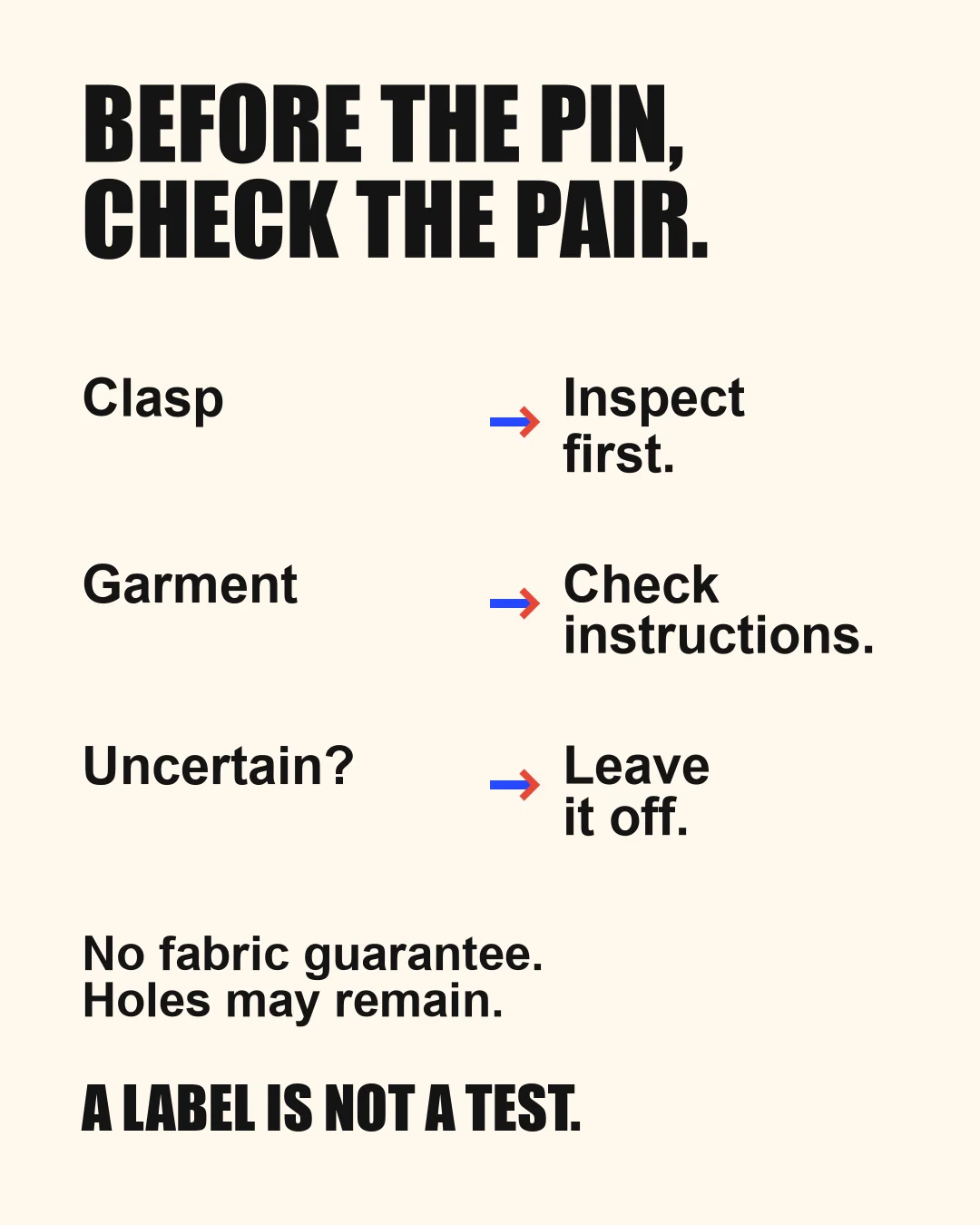
Check the item’s condition and care information before using it. A favourite layer with a loose fastening may need attention before an outing. The FTC’s apparel overview explains that care instructions tell consumers how to clean garments; use the instructions on your actual item rather than a styling photograph as a cleaning guide. This article supplies no wash, iron or steam settings. FTC apparel information.
Starting with owned clothes also has an established practical precedent: WRAP’s Love Your Clothes campaign aimed to help people value and use what they already had. WRAP says the campaign was archived in March 2023. Its archived page supports that wardrobe-first principle; it does not measure the environmental impact of the outfit exercise below, and no numerical saving is promised here. WRAP’s archived campaign overview.
Myth or Real?

Claim
Social paraphrase: A styling exercise can start with clothing already owned rather than a compulsory new shopping list.
Verdict
REAL
Facts
Use a familiar base and an optional detail; available pieces, actual needs and preferences vary.
A possible starting point, not a promise that every wardrobe is sufficient or that any outfit improves appearance or saves money.
An original social post asks how to build useful combinations from clothes already owned. It supplies a question, not a survey or verified account of savings. The graphic reframes that question as a limited possibility to check; it is not a quotation or an assertion that every wardrobe is complete. WRAP describes the aim of its Love Your Clothes campaign as valuing and using existing clothing, and explicitly says the campaign was archived in March2023. Pinterest’s December2025forecast supplies Poetcore vocabulary, not a new-clothing requirement or fresh October2026growth measurement. Those two primary publisher roles are not independent outfit trials. The familiar-base and optional-detail method is an original editorial application. It may be possible to try a mood with available pieces, but suitable ownership, climate, task, sensory/access needs, uniforms and required protection differ. A particular garment can be unsuitable, and removing a detail or skipping the exercise is valid. No body, gender, attractiveness, intelligence, price, spending, environmental or health outcome is established. No commenter percentages, app recommendations or discarding rules are adopted. Check actual item condition and care instructions; ask an appropriate garment professional about uncertain repairs. No qualified clinical review is claimed because this is clothing-only content.
Takeaway
Try existing combinations before deciding whether there is an actual practical gap; adapting or skipping is valid.
Sources
Claim discussion: Original question about using existing clothes.
Evidence: Pinterest Predicts: 21 trends for 2026; Love Your Clothes.
Checked 2026-10-26. Scope: Optional nonclinical wardrobe styling. Social question discovers the problem; primary publisher context and original editorial reasoning support a limited possibility, not an experiment, universal wardrobe requirement, observed result, current trend growth, social effect or financial/environmental guarantee.
Actions in order
1. Keep the base, choose one cue
Put on the dependable outfit first. Add the single piece that best expresses the mood for you. Keeping the rest familiar makes it easier to tell whether you like the change. This is a practical comparison method, not a claim that one accessory produces a measured improvement.
For example, ordinary trousers and a shirt can stay exactly as they are while a cardigan replaces your usual outer layer. A dress and comfortable shoes could keep their usual role while an already-owned jacket adds structure. Jeans and a simple top can carry the idea through a scarf instead of a whole new silhouette.
You need not add every cue at once. A tie, a high collar, a blazer, a scarf and a heavy bag might be individually appealing yet awkward together for your day. Remove a piece if the outfit feels busy, warm or inconvenient. More references do not make it more correct.
2. Translate the reference into a job
Ask what the inspiration piece is doing. Is it adding a visible collar, a relaxed outer layer, a little pattern, a soft texture or useful carrying space? Look for something you own that can do that job without copying the exact item.
An open shirt may give you a layer when a turtleneck would feel too warm. Your usual bag may cover the practical role of a satchel without looking like one. A cardigan can provide the relaxed layer you liked in a blazer picture. These are possible substitutions, not claims that different garments have identical warmth, durability or meaning.
Colour is optional vocabulary too. If a muted combination appeals to you, try colours already in your wardrobe that you enjoy together. If you prefer bright clothing, keep it. There is no evidence here that brown, grey or cream is inherently more intelligent, attractive or authentic.
Do not use a reference picture to decide that your body needs changing. A jacket’s length, a raised camera, a pose and studio lighting all affect the photograph. Borrow an outfit idea you can adapt; leave behind any supposed human template.
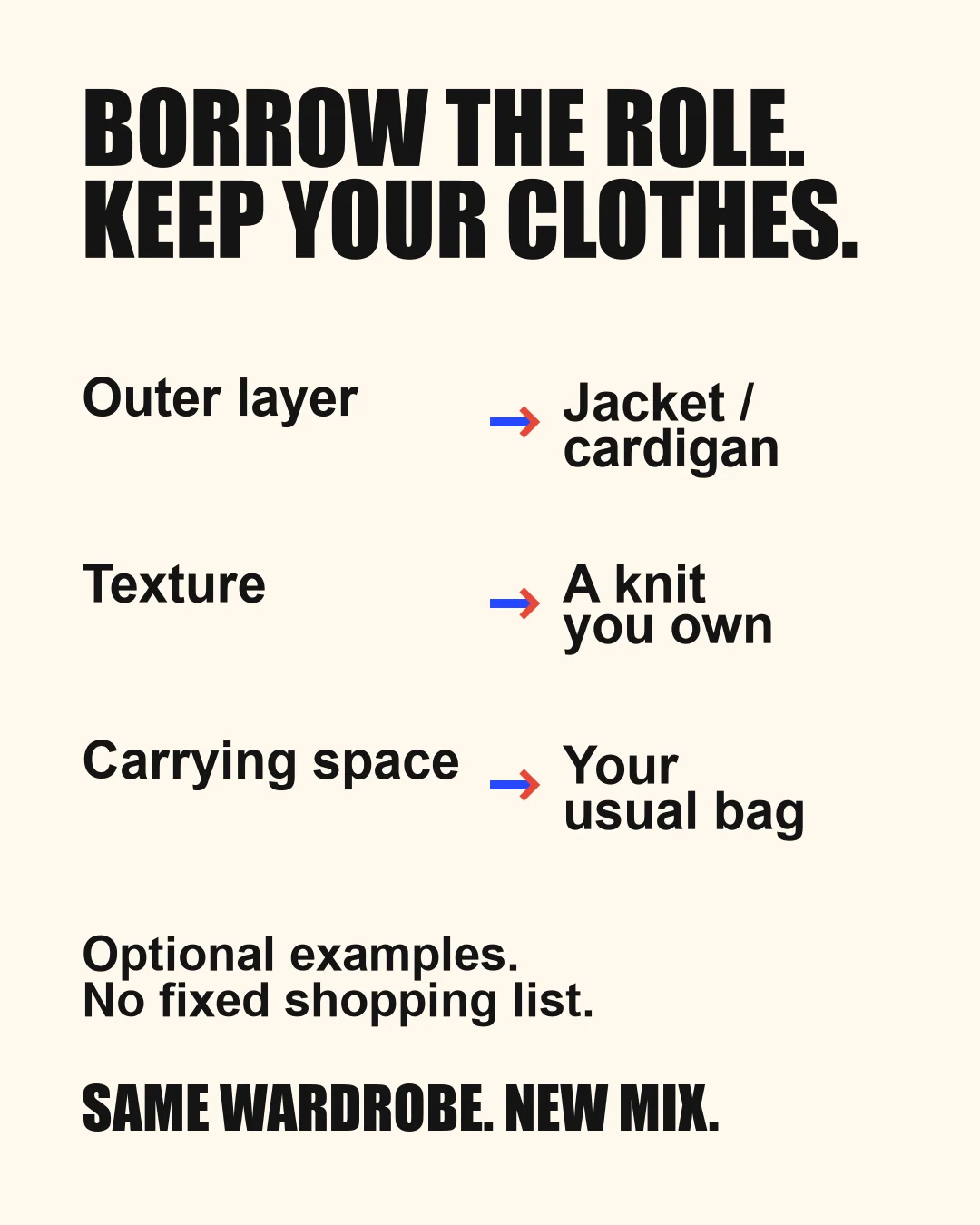
Graphic context — 02-feature-explainer: These are original garment-role suggestions, not source-tested substitutions or a required Poetcore inventory. Pinterest names a mood; ASOS supplies commercial autumn vocabulary. The reader can use different pieces, adapt the idea or skip it.
Text equivalent: BORROW THE ROLE. KEEP YOUR CLOTHES. Three separate arrows map Outer layer to Jacket / cardigan, Texture to A knit you own, and Carrying space to Your usual bag. Optional examples. No fixed shopping list. SAME WARDROBE. NEW MIX. The arrows express possible practical roles, not identical fabric warmth, durability, appearance or proven aesthetic effects. They do not rank bodies, genders or garment brands. Existing clothes and personal needs differ. ASOS’s October1,2026editorial is retailer opinion with product links, not independent prevalence or product-performance evidence. No linked product or current price is endorsed.
3. Try a day-specific version
Here are three invented outfit scenarios to show the decisions. They are styling examples, not photographs of tested participants or verified shopping lists.
For a cool, dry day, start with trousers, a familiar top and shoes you already walk in. Try a cardigan or jacket you own as the optional cue. Check whether you can reach comfortably and whether a layer can come off indoors. The example does not establish a temperature rating or make those pieces sufficient for every cold day.
For a wet commute, keep the outerwear and footwear you rely on for the actual weather. A visible shirt collar or an indoor cardigan can carry the mood after you arrive. Do not swap useful weather protection for an untested vintage coat because the picture looks more convincing.
For a warm day, leave heavy layering out. A familiar shirt, comfortable bottom and ordinary bag can be enough; a favourite small detail is optional. If high necklines or wool feel unpleasant, they do not belong in your version. The forecast is inspiration, not a requirement to tolerate discomfort.
The useful link between these examples is a decision sequence: real conditions first, trusted base second, optional cue third. They are alternatives for different days, not a ranking from basic to advanced.
Graphic context — 04-practical-support: Three invented day scenarios show alternatives rather than levels of style. The graphic does not test garments, assign temperature ratings or promise weather protection. Use actual conditions, comfort, task and required equipment to decide what stays.
Text equivalent: SAME MOOD. DIFFERENT DAY. Separate arrows map Cool + dry to Try a layer; Wet commute to Keep rain kit; Warm day to Skip heavy knits. Illustrative options. Real conditions decide. DRESS FOR YOUR DAY. These examples are original editorial choices, not observed people or source-supplied outfits. Keeping existing protective or access-related items takes priority over visual similarity to a forecast. A layer can come off or the experiment can be skipped. Neither Pinterest nor ASOS verifies the suitability, warmth, strength or weatherproofing of an owned garment; no photo can establish those properties.
4. Test the whole outfit in motion
Sit, reach, walk a little and handle the bag as you normally would. Check that sleeves, layers and straps do not interfere with what you need to do. Adjust or remove the optional piece if it catches, restricts movement, overheats you or needs constant rearranging. Keep any essential protective or access-related item in place.
Look at carrying space as a practical question. Can the bag hold your real essentials without becoming awkward for you? A notebook or book is optional. You do not need to carry a prop, wear non-prescription glasses or buy stationery to make the clothes count.
If you like making a private outfit note, record the pieces and what worked. A simple description is enough: shirt plus cardigan, comfortable indoors, bag strap needs a different position. You can also skip recording entirely. The aim is a repeatable choice, not another obligation to photograph yourself.
Graphic context — 03-routine-infographic: This original reversible outfit sequence applies the wardrobe-first principle described by WRAP’s archived campaign. It is an editorial exercise with no fixed time, compulsory spending or measured transformation; care information and practical needs still govern.
Text equivalent: TRY THE LOOK. KEEP WHAT WORKS. The ordered rail reads Pick a real day. Keep the base. Try one detail. Move. Keep or skip. Optional. Comfort first. Keep required protection. REPEAT WHAT WORKS. Removing or skipping the optional detail is a valid result. Do not interfere with access equipment, uniforms or protective kit, tolerate discomfort, or use a picture as cleaning instructions. Check the actual garment label and ask an appropriate garment professional when uncertain. WRAP’s page dates from2020and says the campaign was archived March2023; it is not a current trial or a quantified environmental result.
5. Repeat before making a shopping list
Wear a version when it suits your life, then decide whether any practical gap remains. Perhaps the jacket was enjoyable but unnecessary, or the shirt already supplied the part you liked. Repeating the outfit may lead to no purchase at all.
If something genuinely needs replacing, define its job before searching: a layer that works with particular clothes, carrying space for particular essentials, or a fastening you can use easily. Check the actual measurements, care needs, condition, total price and return terms of any candidate. This guide has no tested products, current price recommendations or affiliate shopping links.
Borrowing or repairing can be options when suitable and agreed, but neither is automatically free or appropriate. A repair professional can assess an uncertain alteration; a maker or garment-care professional can help with unclear item instructions. Do not cut, dye, heat or reshape a valued garment merely to chase this look.
Costs, risks and stop criteria
An initial try-on using suitable clothes you own can involve no new spending. That is a condition of this exercise, not a claim that clothing, laundry or your time has no cost. A purchased item, service or borrowed item’s travel and care needs may add expense. Get real terms and quotes rather than relying on a generic price band.
There is no research-backed number of minutes you must spend or weeks before this aesthetic works. Give yourself enough time to check the actual combination; stop when you have an acceptable option. Revisit it when your plans, weather, preferences or clothing condition change. Daily outfit scoring and a compulsory capsule size are unnecessary.
Stop a particular combination if it causes discomfort, limits a needed movement, catches on equipment or makes ordinary tasks harder. Choose a workable alternative rather than forcing the detail. Questions about a garment’s strength or a repair belong with an appropriate garment professional; this guide cannot assess those from an image.
For younger readers, this remains a conservative clothing exercise. A responsible adult should handle unfamiliar repairs, sharp tools, heavy wardrobe tasks and any purchase that needs their permission. No change to your body or health routine is part of this guide, and no qualified medical assessment is claimed or needed for its clothing-only scope.
How to assess the result
Use three plain questions. Did it work for the day? Was it comfortable enough for the tasks you needed? Would you choose to wear some version again? A yes can be enough even if nobody recognises the word Poetcore.
If you compare photographs, keep the light, camera distance, lens, pose and clothing placement as similar as practical. Filters and editing can change colour, texture and apparent proportions. A picture can help you remember an outfit; it cannot establish attractiveness, diagnose fit-related health problems or prove that a purchase improved your life.
Keep the part that worked and drop the part that did not. An old jacket can become a useful choice again. A scarf may be too much for your usual day. A familiar outfit may need no changes. The result is a wardrobe decision you can use, not a pass or fail on belonging to an aesthetic.


Sources
Checked October 26, 2026. Pinterest’s 2026 forecast supplies the named mood and examples; ASOS supplies current commercial seasonal vocabulary. WRAP’s archived campaign supplies the existing-clothes principle, and the FTC overview explains the purpose of garment care instructions. These four publisher documents are not four independent outfit studies. The combinations, decision sequence and fictional day scenarios are original editorial suggestions, with no measured transformation, popularity or environmental outcome claimed.
- Pinterest Predicts, December 9, 2025.
- ASOS autumn knitwear editorial, October 1, 2026. Retailer opinion and product promotion; linked items are not recommendations here.
- WRAP, Love Your Clothes. Published August 18, 2020; campaign archived March 31, 2023. Historical figures are not adopted.
- FTC, Apparel and Labeling. Explanatory overview; this article gives no legal conclusion or cleaning treatment.
No sponsorship, paid placement, affiliate relationship, tested product ranking or endorsement is presented in this guide.
FAQ
Common questions
Do Poetcore outfits require a new wardrobe?
This optional exercise starts with owned clothing and a familiar base. Useful pieces vary; you can adapt the idea or skip it. A forecast description is not a compulsory shopping list.
Is Poetcore measured as growing right now?
The guide uses Pinterest’s December2025forecast for2026and ASOS’s October2026commercial editorial as styling context. It does not claim fresh October search growth, universal appeal or measured effectiveness.
Do I need a turtleneck, blazer or satchel?
Those are forecast vocabulary, not requirements. Think about the role you liked, such as an outer layer or carrying space, and consider comfortable pieces you already own.
Topic hubs
Tags