

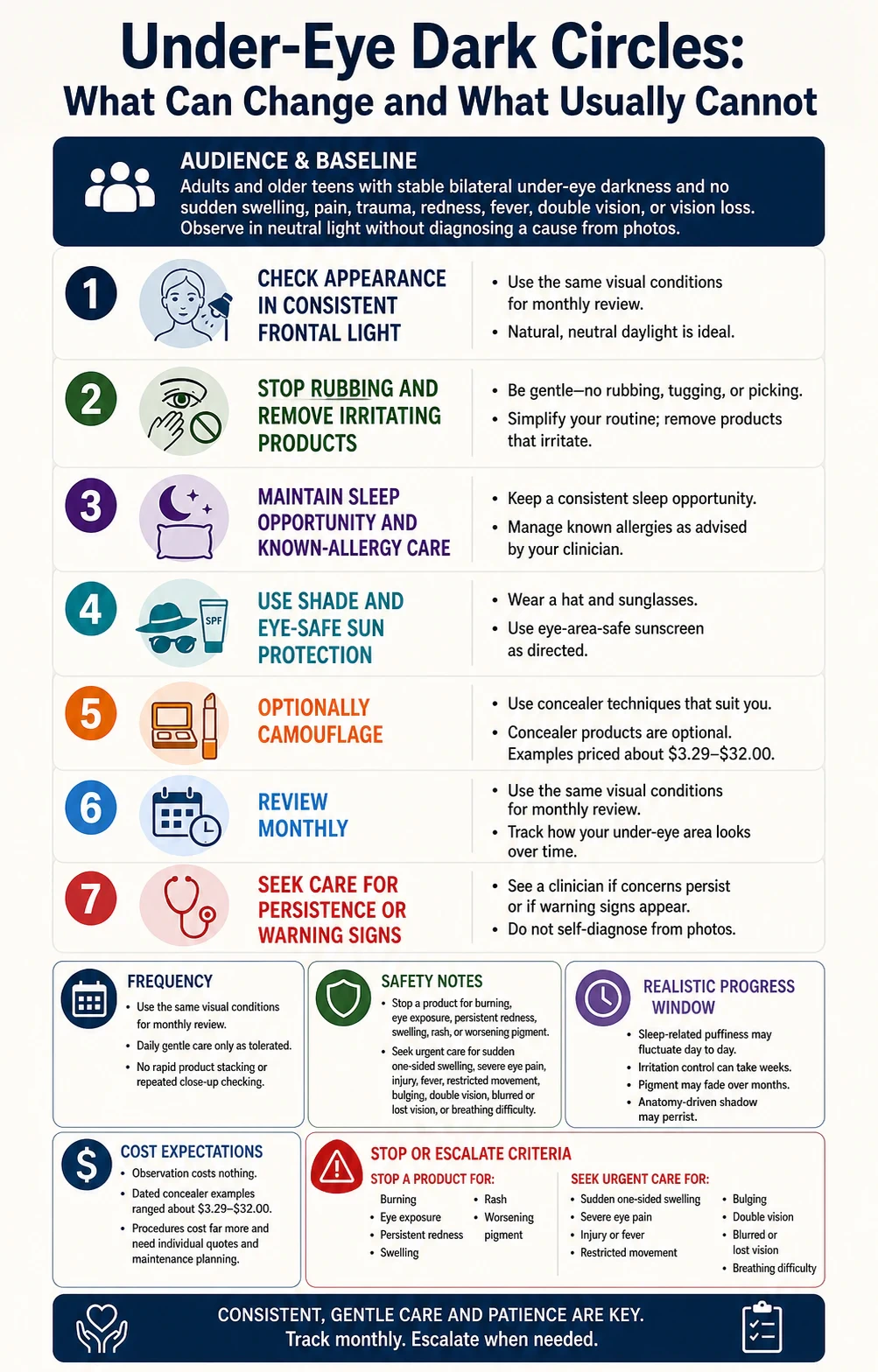
Under-eye darkness is a description, not a diagnosis. What looks like one “dark circle” in a mirror may be pigment, visible vessels through thin skin, puffiness, a hollow casting shadow, or several of those at once. Genetics, age, facial anatomy, skin tone, allergies, sleep, and lighting all matter [S01, S02]. None of them ranks your health, discipline, or worth.
That mixed origin explains why a cream can help one person a little and do nothing for another. The useful goal is not to erase normal anatomy. It is to identify low-risk contributors you can change, set a realistic visual target, and recognize when the eye area needs professional review.
Start with lighting, not a diagnosis
Look in soft frontal daylight, then under overhead light. A tear-trough shadow often deepens when light comes from above and softens when light is frontal. Pigment changes less. That is not a home diagnostic test; it is a reminder that photos are unstable evidence.
If you track appearance, keep the same room, time, camera, distance, head angle, expression, exposure, makeup, and sleep-to-photo interval. Turn off beauty mode, HDR changes, filters, and sharpening. A close phone lens can enlarge the central face and deepen peripheral shadow.
Sudden one-sided darkness with swelling, pain, redness, trauma, fever, double vision, bulging, restricted eye movement, blurred vision, or vision loss is not a cosmetic experiment. Get prompt eye or medical care; injury with pain or vision change warrants urgent evaluation [S05].
What may be contributing
- Pigment: inherited color, sun exposure, or post-inflammatory change after eczema, allergy, rubbing, or irritating products.
- Visible vessels and thin skin: normal eyelid skin is thin, and age or genetics can make underlying color more apparent.
- Puffiness: allergy, irritation, fluid shifts, and sleep timing can change eyelid volume and the shadow below it.
- Hollow or contour: orbital shape, tear-trough depth, facial fat distribution, and age-related tissue change can cast a structural shadow.
- Mixed causes: common in real life and one reason single-ingredient marketing overpromises.
DermNet and clinical reviews describe this as a multifactorial, sometimes difficult-to-treat appearance [S01, S02]. A 2024 systematic review focused on treatment studies in darker skin types, an important population boundary, but the field still does not provide one broadly proven solution for every cause [S03].
A reversible-first plan
| Main contributor | Lower-risk first step | Honest limit |
|---|---|---|
| Irritation or rubbing | Remove the trigger, stop rubbing, use bland tolerated care | Does not treat allergy or dermatitis by itself |
| Variable puffiness | Review sleep opportunity and known-allergy care | Cannot reshape inherited anatomy |
| Pigment contrast | Sun protection and dermatologist-guided pigment care when appropriate | Fading is slow and not guaranteed |
| Anatomy-driven shadow | Consistent lighting or reversible cosmetic camouflage | A topical cannot fill a hollow |
| Mixed or unclear | In-person professional assessment | A selfie cannot separate the causes |
1. Stop rubbing and simplify the eye area
Rubbing can worsen irritation and post-inflammatory pigment. If the skin is itchy, flaky, burning, or rash-like, stop newly introduced cosmetics and use only previously tolerated bland care until it settles. Do not put liquid bleach, strong acids, fragranced oils, or unreviewed lightening creams near the eye.
Known allergy treatment should follow your clinician’s or product label’s direction. Do not start or stop prescription allergy or eye medicine based on a cosmetic article. Persistent itch, watery eyes, dermatitis, or swelling deserves review because treating the actual problem matters more than concealing it.
2. Protect from sun without irritating the eyes
Shade, a brimmed hat, and sunglasses are low-risk. Use a broad-spectrum sunscreen appropriate for your skin and keep it out of the eyes; stop or switch if it stings. AAD guidance for hyperpigmentation emphasizes controlling irritation and daily sun protection, while also warning that fading can take months and some pigment lies deeper [S04]. That guidance is not proof that every dark circle is pigment.
3. Give sleep a fair but limited role
Sleep loss and fatigue can make puffiness or shadow more noticeable, but “sleep more” is not a cure for inherited pigment or anatomy. Aim for a consistent sleep opportunity that fits your health and life rather than chasing an appearance target. If snoring, insomnia, daytime sleepiness, or other symptoms are persistent, discuss sleep health with a clinician for health reasons—not because dark circles diagnose a sleep disorder.
4. Use camouflage if you want an immediate reversible change
A thin layer of color corrector or concealer can reduce visible contrast without altering tissue. Patch-test cosmetic products away from the eye first, keep them out of the eye and lash line, remove gently, and stop for burning, swelling, rash, or persistent redness.
On July 19, 2026, visible U.S. concealer examples on one retailer page ranged from $3.29 to $32.00 [S06]. That is a price snapshot, not a product ranking. Shade match, tolerance, and technique matter more than prestige, and customer ratings do not prove safety or treatment.
5. Treat products as cause-specific, not magic
Moisturizer can improve dryness and makeup texture but cannot fill a structural hollow. Pigment-directed ingredients may help selected hyperpigmentation, yet eyelid skin is sensitive and the evidence is not interchangeable across causes or skin types. A company-affiliated 2024 topical study exists, but its commercial ties and product-specific design make it unsuitable as proof that an “eye cream” category works broadly.
Do not use prescription hydroquinone, retinoids, steroid combinations, or high-strength acids near the eyes without qualified dermatology guidance. Pregnancy, breastfeeding, eczema, contact allergy, and existing eye disease change the safety discussion.
6. Put procedures last
Peels and lasers target selected pigment or texture; fillers target contour; fat transfer and blepharoplasty alter tissue. They are not interchangeable. Risks can include pigment change, burns, swelling, lumps, vascular injury, visual complications, scarring, asymmetry, and maintenance or revision needs. Under-eye filler carries rare but serious vascular risks and should never be treated as a casual salon service.
If considering a procedure, ask the clinician to name the suspected contributor, show how it was assessed in person, explain alternatives, disclose product and referral conflicts, give total cost and maintenance, and describe emergency handling. A photograph-only sales consultation is not enough.
Realistic timelines and outcomes
Puffiness related to a short-term trigger may vary over hours or days. Irritation control often takes weeks. Post-inflammatory pigment can take months; AAD notes that some general dark spots fade over six to twelve months after the cause stops, while deeper discoloration can take longer [S04]. That range is not a promise for the eyelid.
Anatomy-driven shadow may persist despite excellent sleep and skincare. Camouflage works immediately but lasts only while worn. Procedures may create a larger change but add cost, risk, downtime, and maintenance. A reasonable progress signal is less itch or rubbing, steadier puffiness, or lower contrast in consistent light—not a filtered “bright eye” transformation.
Stop and escalation rules
Stop the newest eye-area product for burning, persistent redness, swelling, a rash, crusting, eye irritation, or worsening pigment. Rinse accidental eye exposure as the label directs and contact poison control or medical care when appropriate.
Seek urgent care for sudden one-sided swelling, severe eye pain, fever, trauma, a bulging eye, restricted movement, double vision, blurred or lost vision, or breathing difficulty. See a dermatologist, optometrist, ophthalmologist, or primary-care clinician for persistent asymmetry, recurrent dermatitis, substantial allergy symptoms, or uncertainty about the cause.
For minors, keep choices conservative: sleep opportunity, no rubbing, simple tolerated care, shade, sunglasses, and optional age-appropriate makeup with adult help. Prescription lighteners and procedures need a parent or guardian and qualified clinician.
A healthier finish line
Under-eye darkness is common, variable, and often partly structural. If the safest changes improve comfort but leave a familiar shadow, that can be a truthful success. Step away from repeated close-up checking or comparison feeds if they amplify distress. No feature determines human value, and a procedure should never be the price of feeling allowed to appear in ordinary light.


Sources
- S01 — DermNet: Dark circles under the eyes
- S02 — PubMed: Infraorbital Dark Circles review
- S03 — PubMed: 2024 systematic review in Fitzpatrick skin types IV–VI
- S04 — American Academy of Dermatology: Fading dark spots in darker skin tones
- S05 — American Optometric Association: Eye emergency guidance
- S06 — Target: dated concealer listings
Sources and prices were checked July 19, 2026. This article is general education, not diagnosis or individualized treatment.


