

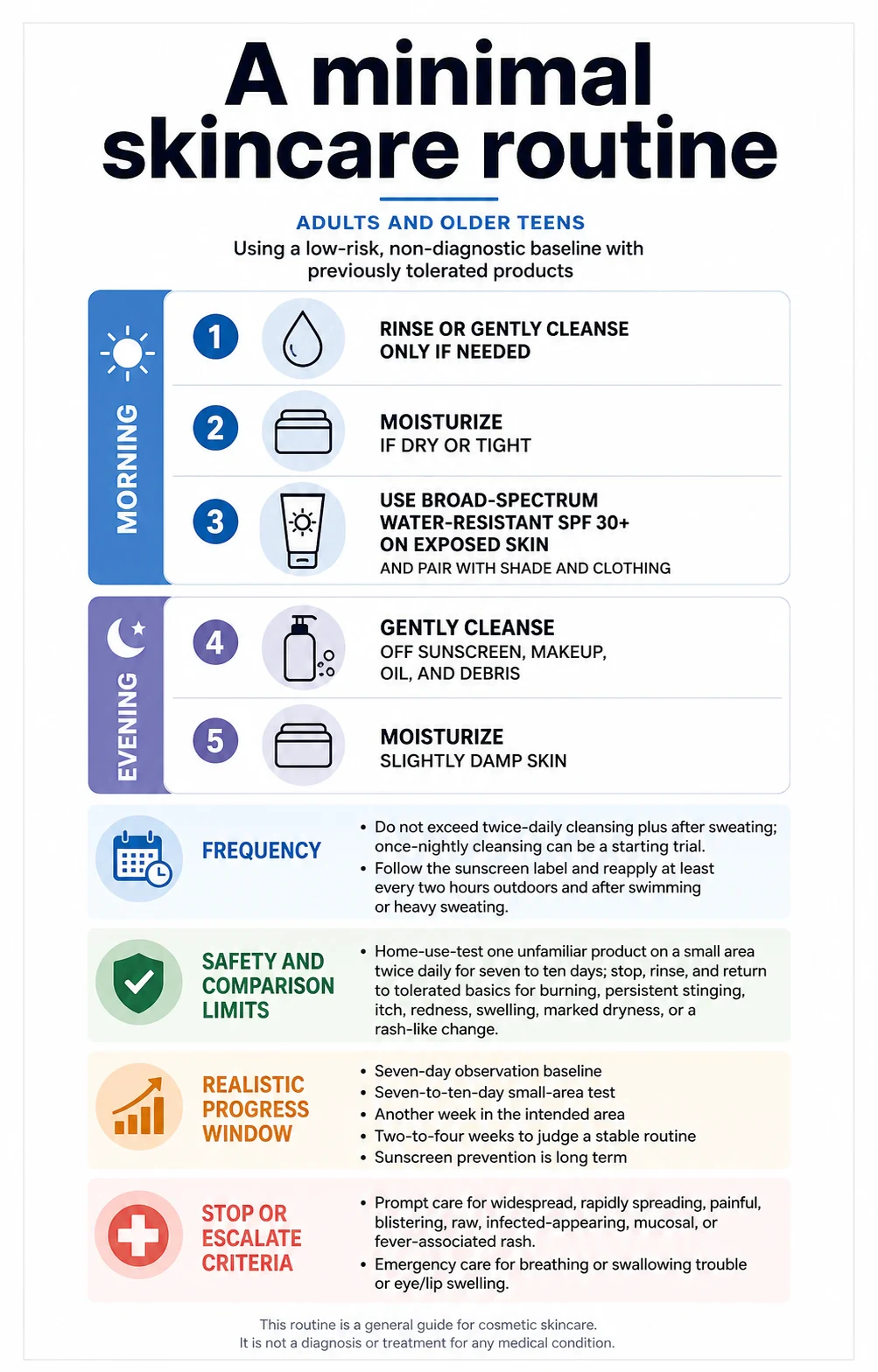
A basic skincare routine should make your skin easier to live in, not turn your face into a daily experiment. For most people, the useful starting point is three roles: remove what needs removing, replace some of the water and lipids skin loses, and limit ultraviolet exposure. That usually means a gentle cleanser, a moisturizer, and sunscreen—not a shelf full of acids, toners, serums, scrubs, or “corrective” steps.
This guide is for adults and older teens who want a low-risk baseline. It does not diagnose dry skin, acne, eczema, rosacea, contact allergy, or any other condition. If you already have a diagnosed skin condition, a prescription routine, a history of serious allergy, or persistent symptoms, use your clinician’s plan instead of treating this as a substitute.
The routine at a glance
| When | Do | Skip for now |
|---|---|---|
| Morning | Rinse or gently cleanse only if needed; moisturize if dry or tight; use broad-spectrum water-resistant SPF 30+ on exposed skin | Scrubs, acids, retinoids, and stacks of new serums |
| Evening | Gently remove sunscreen, makeup, excess oil, and debris; moisturize slightly damp skin | Hot water, cleansing brushes, and the idea that skin must feel squeaky clean |
| One change at a time | Home-use-test one unfamiliar product for seven to ten days, then trial it in the intended area for a week | Starting several products together or pushing through burning and persistent stinging |
If those steps are comfortable, you already have a functional routine. Optional treatment products should answer a specific need and come later, ideally with qualified guidance when symptoms are persistent.
Start with normal variation, not a flaw hunt
Healthy skin is not one fixed texture. Oiliness, dryness, visible pores, tone, fine lines, occasional blemishes, and sensitivity can vary with age, hormones, climate, sleep, stress, menstrual cycles, shaving, and how recently you washed. A phone photo adds more variation: lighting direction, lens distance, makeup, filters, sharpening, and retouching can change how texture or redness appears. A picture cannot measure “barrier health,” and a close-up is not a diagnosis.
Before buying anything, spend seven ordinary days observing comfort rather than scoring appearance. Once in the morning and once in the evening, note only what you can actually feel or see:
- tightness, stinging, burning, itch, or flaking;
- oiliness and when it appears;
- new blemishes or a rash-like change;
- what touched the skin that day, including makeup, shaving products, hair products, fragrance, and sunscreen;
- unusually hot water, scrubbing, sweating, dry air, or heavy sun exposure.
This log is a baseline, not a home diagnostic test. Its job is to reveal simple patterns—such as stinging after a fragranced wash—not to name a disease. Inherited sensitivity tendencies, age, baseline oil production, and some medical conditions are not things a routine can “fix.” Cleansing frequency, friction, water temperature, fragrance exposure, moisturizer timing, and sun habits are more adjustable.
The minimum routine
Morning
- Rinse, or cleanse only if you need to. If your skin feels comfortable and there is nothing you need to remove, lukewarm water may be enough. If it is oily, sweaty, or carrying a product you want off, use a gentle cleanser with your fingertips.
- Moisturize if skin feels dry or tight. Apply to slightly damp skin. A cream or ointment usually feels more protective on drier skin; a lotion may feel lighter. “Fragrance-free” is more useful than “unscented,” which can still contain ingredients that mask odor [S02, S03].
- Use broad-spectrum, water-resistant sunscreen labeled SPF 30 or higher on exposed skin. Apply before sun exposure and follow the label for quantity and timing. Reapply at least every two hours outdoors and after swimming or heavy sweating. Shade, clothing, a hat, and sunglasses still matter [S01, S04].
Evening
- Cleanse gently. Use lukewarm water, fingertips, and enough cleanser to remove sunscreen, makeup, excess oil, and ordinary debris. Do not scrub. Pat dry.
- Moisturize while skin is still slightly damp. Use the smallest amount that leaves skin comfortable rather than greasy or itchy.
That is a complete baseline. Toner, essence, eye cream, face oil, exfoliant, retinoid, vitamin C, benzoyl peroxide, salicylic acid, and other treatment products can have specific uses, but none is required to establish a basic routine. Adding several at once raises the chance of irritation and makes the cause harder to identify [S10].
What each product is—and is not—doing
Cleanser: removal with as little friction as practical
A cleanser helps lift sunscreen, makeup, oil, and debris so they can rinse away. It does not need to leave skin “squeaky” to work. That tight feeling may simply mean the wash was too harsh, the water too hot, or the routine too frequent for you.
The American Academy of Dermatology advises limiting face washing to twice daily and after sweating [S01]. Treat that as a ceiling for a gentle baseline, not a requirement to cleanse twice. One evening cleanse can be a reasonable first trial if morning cleansing makes you tight or stingy. Persistent oiliness, acne, scale, or rash deserves condition-specific advice rather than progressively harsher washing.
Useful label cues include “gentle,” “fragrance-free,” and a format intended for facial skin. Those words do not guarantee tolerance. Price, foam level, “clean beauty,” and a long ingredient story do not prove that a cleanser is better.
Moisturizer: comfort and water-loss support
Moisturizers combine ingredients that attract water, smooth the spaces between skin cells, or form a film that slows water loss. Applying one to damp skin can help trap water [S01, S03]. Choose texture by comfort: an ointment is heavier and more occlusive, a cream is intermediate, and a lotion is lighter.
The evidence needs a boundary. A Cochrane review of 77 randomized trials involving 6,603 people with eczema found that moisturizers generally improved several disease outcomes, but studies were short on average, products varied, and no single moisturizer was reliably best [S05]. A 2023 American Academy of Dermatology guideline also strongly recommends nonprescription moisturizers for adults with atopic dermatitis [S06]. That supports the role of moisturization in a diagnosed disease; it does not prove that one brand is best for healthy skin or that a moisturizer will transform appearance.
Sunscreen: prevention, not a filter in a bottle
Broad-spectrum sunscreen reduces exposure to ultraviolet A and B when used as directed. In a randomized Australian community trial, 903 adults younger than 55 were followed for 4.5 years; the daily-sunscreen group had 24% lower odds of increased skin aging than the discretionary-use group (relative odds 0.76, 95% CI 0.59–0.98) [S07]. The trial took place in a sunny Australian setting, and product sponsors contributed sunscreen or funding, so it should not be turned into a promise about a specific bottle or every population.
Sunscreen is one part of sun protection. Current FDA guidance says to apply before exposure, reapply at least every two hours, and pair it with shade and protective clothing [S04]. The AAD’s practical recommendation is broad-spectrum, water-resistant SPF 30 or higher [S01]. Infants younger than six months should generally be kept in shade and protective clothing rather than routinely given sunscreen; ask a pediatric clinician about unavoidable exposure [S04].
Introduce one product at a time
“Patch test” is often used casually online, but a home use test is not the same as diagnostic patch testing performed by a dermatologist. The AAD suggests applying an unfamiliar product to a small test area twice daily for seven to ten days. For a wash-off product, leave it on only as long as the label normally directs—about five minutes in the AAD example—then rinse [S02].
Use that cautious sequence:
- Keep the rest of your routine stable.
- Test one product on a small, repeatable area twice daily for seven to ten days.
- If there is no reaction, add it to the intended facial area for another week.
- Record comfort, not microscopic appearance changes.
- Only then consider changing another product.
If the product causes redness, itch, swelling, burning, or a rash-like change, wash it off and stop. A home test cannot rule out allergy, and passing it does not guarantee that a product will never irritate you. If you need sunscreen while testing a new formula, do not spend a week unprotected: use a previously tolerated sunscreen, shade, clothing, and a hat.
A realistic timeline
Some effects are quick: a moisturizer can reduce a tight feeling the same day, and a cleanser should remove what it is meant to remove immediately. Tolerance takes longer to judge.
- Days 1–7: observe your existing baseline.
- Days 8–17: home-use-test one new product for seven to ten days.
- Next 1–2 weeks: use that product in the intended area while holding everything else steady.
- By weeks 2–4 of a stable routine: decide whether comfort, tightness, flaking, or stinging is better, worse, or unchanged.
- Long term: sunscreen is preventive maintenance; it is not expected to create a dramatic weekly visual change.
These are decision windows, not guaranteed biological deadlines. If symptoms are worsening, do not wait for a calendar milestone. If nothing is wrong and the routine is comfortable, “no dramatic change” can be a successful outcome.
What a basic routine costs
On July 17, 2026, ordinary U.S. retail examples included an 8-ounce fragrance-free cleanser at $9.99, a 3-ounce moisturizer at $13.99, and a fragrance-free SPF 30 sunscreen at $11.97 [S11–S13]. That is about $35.95 before tax for three example products.
Those listings are price and label snapshots, not endorsements or efficacy rankings. LooksMaxx has no affiliate relationship with the retailers or manufacturers named in the source manifest. Prices, sizes, availability, and formulations can change. Ongoing monthly cost depends mostly on how much sunscreen you use and reapply, package size, and whether one moisturizer serves face and body. More expensive is not inherently gentler or more effective [S01].
If money is tight, prioritize roles rather than marketing categories: one tolerated cleanser, one tolerated moisturizer, and one sunscreen you will actually wear correctly. Samples or return policies can reduce the cost of a failed tolerance test, but check store rules before buying.
Stop criteria and when to get medical help
Stop the newest product, rinse it off, and return to previously tolerated basics if you develop new burning, persistent stinging, itch, redness, swelling, marked dryness, or a rash-like change. Do not “push through” irritation from a cosmetic product. The FDA advises stopping a cosmetic associated with an adverse reaction and contacting a healthcare provider; serious events can also be reported through FDA channels [S08].
Seek prompt medical care for a rash that is widespread, painful, rapidly spreading, blistering, raw, involves the eyes, lips, mouth, or genitals, occurs with fever or illness, or shows possible infection such as pus, warmth, swelling, or crusting [S09]. Trouble breathing or swallowing, or swelling of the eyes or lips, is an emergency [S09].
Arrange qualified dermatology or primary-care help when:
- symptoms persist despite stopping the suspected product;
- repeated products trigger reactions;
- acne, scaling, flushing, pigment change, itch, or pain is persistent or affecting daily life;
- you suspect eczema, rosacea, contact allergy, infection, or another condition;
- you want to add treatment actives while using prescriptions, during pregnancy or nursing, or with a significant allergy history.
Treatment actives, prescription medicines, devices, peels, injections, and procedures are outside this baseline. Older teens should involve a parent or guardian and a qualified clinician when symptoms persist or treatment products are being considered. A minimal routine is not a reason to delay care.
Maintain the routine without turning it into a project
Once the routine is comfortable, keep the products and timing stable. Review it when the season, climate, medication list, shaving routine, or sun exposure changes. In dry weather you may prefer a cream; in humid weather a lotion may feel better. Reassess one variable at a time.
A useful maintenance check is simple:
- Does washing leave skin comfortable rather than tight or burning?
- Does moisturizer reduce discomfort without causing persistent itch or congestion?
- Can you use sunscreen in the amount and frequency its label requires?
- Are you free from a new rash, swelling, or escalating symptoms?
If yes, the routine is doing its job. You do not need to optimize it every week. Good skincare is often deliberately boring: a few tolerated products, realistic expectations, sun protection, and a clear rule to stop when skin objects.
Evidence note
This article was reviewed against current AAD and FDA guidance, a Cochrane systematic review, a disease-specific AAD guideline, and a randomized sunscreen trial. Evidence from eczema or atopic-dermatitis populations is labeled as disease-specific, retail facts are separated from efficacy claims, and no product is ranked. This is general education, not diagnosis or individualized treatment.


