

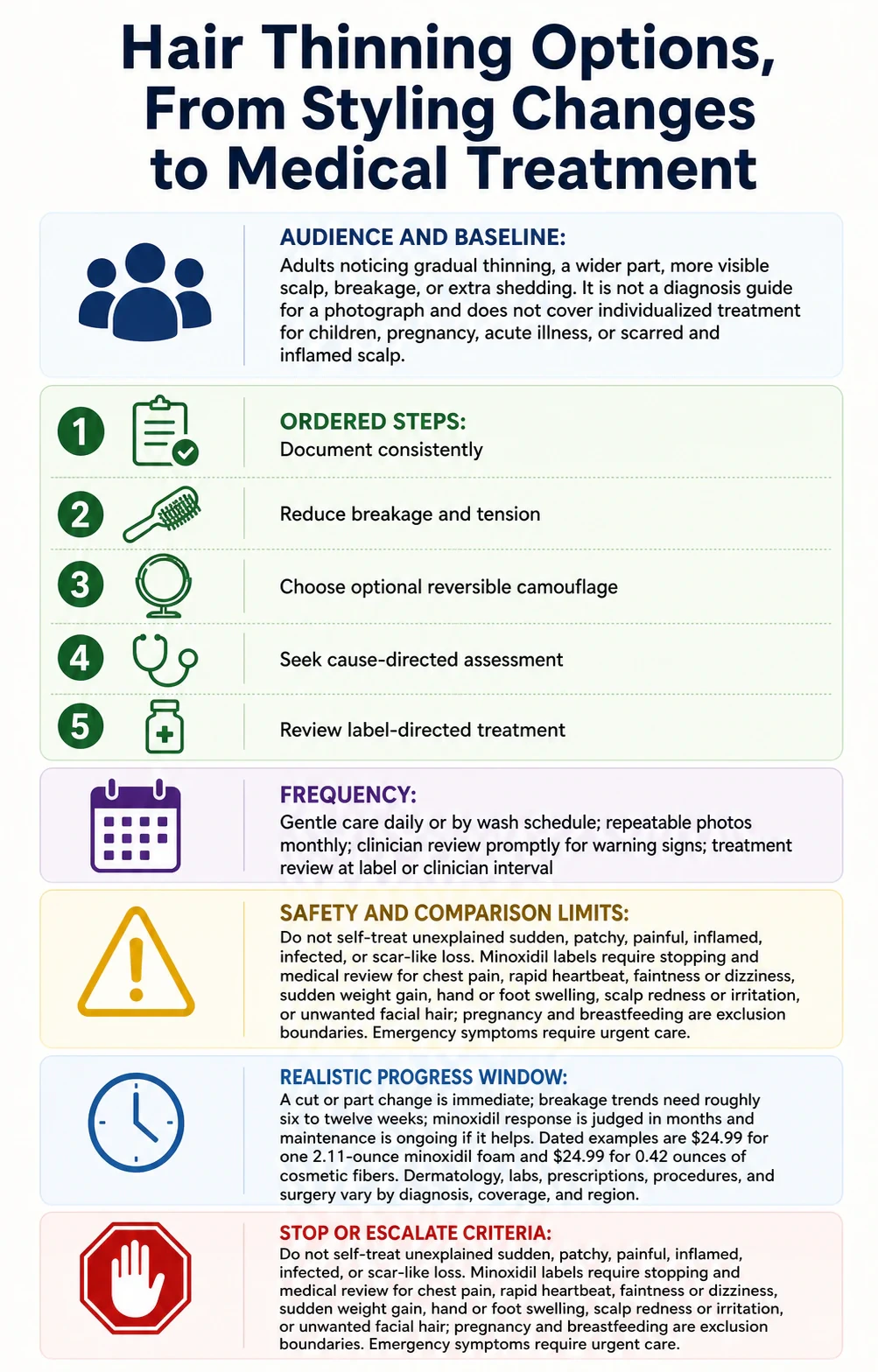
Seeing more scalp can feel urgent. The honest first step is slower: visible thinning is a description, not a diagnosis. A wider part, shorter broken hairs, a receding hairline, diffuse shedding after illness, and a painful scaly patch can come from different processes and need different responses [S01, S03].
Hair density also varies normally. Strand diameter, curl pattern, hairline shape, age, gray-hair contrast, wash timing, oil, and styling all affect fullness. None of them measures health, discipline, attractiveness, or human worth. The useful goal is to protect the hair you have, make presentation choices you enjoy, and investigate change that is sudden, symptomatic, or persistent.
Start with observations, not a mirror verdict
For one month, make notes rather than daily judgments. Once every four weeks, photograph the same part lines with dry hair, the same styling, distance, camera height, and diffuse light. Record recent fever, surgery, childbirth, major weight change, new medicines, restrictive eating, tight hairstyles, bleach or relaxer overlap, scalp itch or pain, and whether short fibers appear snapped or full-length hairs are shedding.
The images still cannot diagnose anything. Wetness, oil, overhead light, focal length, head tilt, part width, fibers, color contrast, sharpening, and retouching can expose or hide scalp. A bathroom-light comparison is documentation for a clinician, not proof of follicle loss or regrowth.
Seek a dermatologist promptly for sudden patches, rapid progression, a smooth completely bare area, pain, burning, marked itch, pus, crust, heavy scale, eyebrow or eyelash loss, or skin that looks shiny or scar-like. Seek medical review when shedding follows a new medicine or systemic symptoms. Do not abruptly stop a prescribed drug because you suspect it; ask the prescriber [S03].
Match the next step to what changed
- Mostly short snapped fibers after heat, tension, or chemicals: remove the likely damage source and review again after six to twelve weeks.
- A gradual patterned change without scalp symptoms: book a non-urgent cause check; reversible styling is fine while you wait.
- Diffuse shedding after illness, surgery, childbirth, major weight change, or a medicine change: give the timeline to a clinician instead of guessing from a drain count.
- A patch, rapid change, pain, inflammation, scale, or scar-like skin: skip product experiments and arrange prompt dermatology review.
More than one pattern can exist at once [S01, S03]. This map chooses urgency; it does not name the condition.
First tier: reduce breakage and traction
Fragile hair benefits from an unglamorous routine:
- Clean the scalp gently and condition after shampoo.
- Blot or wrap instead of rubbing with a towel.
- Detangle with slip, supporting the section above a knot.
- Reduce hot-tool temperature and frequency.
- Loosen braids, extensions, ponytails, or coverings that cause pain, bumps, or broken hairs.
- Avoid overlapping bleach, relaxer, permanent color, or smoothing chemicals on already fragile sections.
These steps can reduce split ends and snapping [S02]. They cannot reverse hereditary pattern loss or restore a scarred follicle. That distinction prevents a common trap: mistaking smoother fibers for medical regrowth, or buying more supplements when the problem needs an examination.
Do not take high-dose hair vitamins by default. Deficiency can contribute to loss, but extra nutrients do not become extra hair when intake is already adequate, and excessive vitamin A, vitamin E, or selenium may worsen loss [S02]. A clinician can decide whether history, diet, examination, or testing supports iron, thyroid, protein, or another work-up.
Second tier: reversible presentation choices
A cut with less length-weight, a different part, gentle root lift, lower-contrast color, a scarf, a topper, or a wig can change presentation immediately. Temporary fibers can reduce scalp contrast where existing hair gives them something to hold. They wash out; they do not stimulate follicles.
Choose the option that reduces effort rather than creating a new inspection ritual. If a monthly photo is becoming a daily search for defects, pause the tracking, step away from appearance forums, and discuss the distress with a trusted clinician or mental-health professional. Hair care should serve daily life, not take it over.
Patch-test cosmetic products when feasible and keep powders away from eyes and broken or inflamed skin. Stop if itching, redness, cough, or eye irritation develops. A cosmetic option is not a surrender and treatment is not an obligation. Some people want coverage today while they investigate; others prefer no concealment.
On July 19, 2026, one 0.42-ounce fiber product was listed at $24.99 [S07]. That is a price snapshot, not a recommendation or proof of the seller’s claims. Haircuts, toppers, and wigs vary from modest to substantial recurring costs, so ask for the full maintenance and replacement price.
Third tier: diagnose before choosing treatment
Dermatologists distinguish shedding from breakage and from several forms of alopecia using history, scalp and hair examination, a pull test, and sometimes blood tests or biopsy [S01]. Some shedding can recover when its trigger resolves. Pattern loss may continue without treatment. Inflammatory or scarring loss can require timely treatment to protect remaining follicles.
No single treatment works for every cause [S01]. That is why a viral regimen combining minoxidil, biotin, microneedling, oils, and a laser device is not an evidence-based starting point: it obscures which element helps, raises cost and irritation risk, and may delay the right diagnosis.
Where topical minoxidil fits
Topical minoxidil is an over-the-counter drug for specific labeled patterns and populations, not a general tonic for every kind of shedding. AAD guidance says it can help some early hair loss, but it cannot regrow an entire head of hair. Results vary and a fair assessment commonly takes six to twelve months; benefit is generally lost after stopping [S01]. A systematic review supports efficacy of several treatments for diagnosed androgenetic alopecia, while study differences and indirect comparisons limit personal predictions [S05].
Before buying it, read the exact Drug Facts label and ask a pharmacist or clinician whether the pattern and your health history fit. Different products have sex-specific indications, concentrations, schedules, and age limits. Do not copy a dose from social media or apply it to other body areas.
The cited 5% solution label warns against use in pregnancy or breastfeeding and says to stop and ask a doctor for chest pain, rapid heartbeat, faintness or dizziness, sudden unexplained weight gain, hand or foot swelling, scalp irritation or redness, or unwanted facial hair [S04]. Accidental swallowing needs poison-control or emergency guidance. Avoid eye contact and use only on an intact scalp as labeled.
One 2.11-ounce 5% foam was listed at $24.99 on July 19, 2026 [S06]. That is not the total cost: ongoing benefit commonly means ongoing purchase, and a cheaper correctly labeled generic may exist. Retailer ratings and manufacturer before-and-after images are not independent evidence.
Prescriptions, devices, injections, and surgery
Finasteride and other prescription medicines can be appropriate for selected diagnoses, but pregnancy potential, sexual and reproductive effects, mood, blood pressure, other medicines, and the actual cause change the risk-benefit discussion. This article cannot select or prescribe one. A qualified clinician should explain expected response, monitoring, maintenance, and what happens after stopping.
At-home light devices require repeated sessions for months, and evidence and long-term certainty vary [S01]. Microneedling adds wound and infection risk; do not improvise scalp needling or combine it with a topical drug without professional direction. Platelet-rich plasma involves blood processing and injections with recurring sessions. Transplant surgery moves suitable donor follicles; it does not create unlimited density and depends on diagnosis, donor supply, surgeon skill, future loss, cost, and aftercare.
These options belong after diagnosis, not before it. Ask who is licensed, which evidence applies to your condition, the realistic responder range, total first-year and maintenance cost, adverse effects, conflict or referral fees, and what plan protects untreated hair.
A realistic timeline
- Today: change the part or cut, stop painful tension, and use optional temporary camouflage.
- Two to six weeks: judge scalp comfort and whether a gentler routine reduces new snapping.
- Six to twelve weeks: compare breakage trends and review trigger history; do not call this follicle regrowth.
- Several months: assess a diagnosed, consistently followed treatment at the interval set by its label and clinician.
- Long term: continue only if benefit, burden, cost, and adverse effects remain acceptable.
Hair grows slowly, so daily photos amplify noise. Monthly repeatable documentation is more useful. A stable result, slower progression, easier styling, or reduced breakage may be a meaningful outcome even without dramatic regrowth.
Stop rules and professional boundaries
Stop a cosmetic or drug product for a serious reaction and follow its label. Seek urgent care for chest pain, fainting, breathing difficulty, facial or throat swelling, or severe systemic symptoms. Arrange dermatology care for fast change, patchy loss, inflammation, pain, scarring signs, or no plausible explanation.
Minors should stay with gentle handling, non-painful styles, and parent or guardian-supported medical assessment. Pregnant or breastfeeding people should not use the cited minoxidil product and need individualized guidance. Procedures, prescription drugs, and devices always require qualified review.
This guide provides general education, not diagnosis. The best plan is not the one with the most products. It is the smallest cause-appropriate set of actions you can evaluate honestly and safely.


Sources
- S01 — American Academy of Dermatology: Hair loss diagnosis and treatment
- S02 — American Academy of Dermatology: Tips for managing hair loss
- S03 — American Academy of Dermatology: Hair loss or shedding?
- S04 — DailyMed: Minoxidil Topical Solution USP, 5% Drug Facts
- S05 — PubMed: Hair-regrowth treatment network meta-analysis
- S06 — Target: dated 5% minoxidil foam listing
- S07 — Target: dated temporary hair-fiber listing
Sources and prices were checked July 19, 2026. No source or retailer paid for inclusion.


