
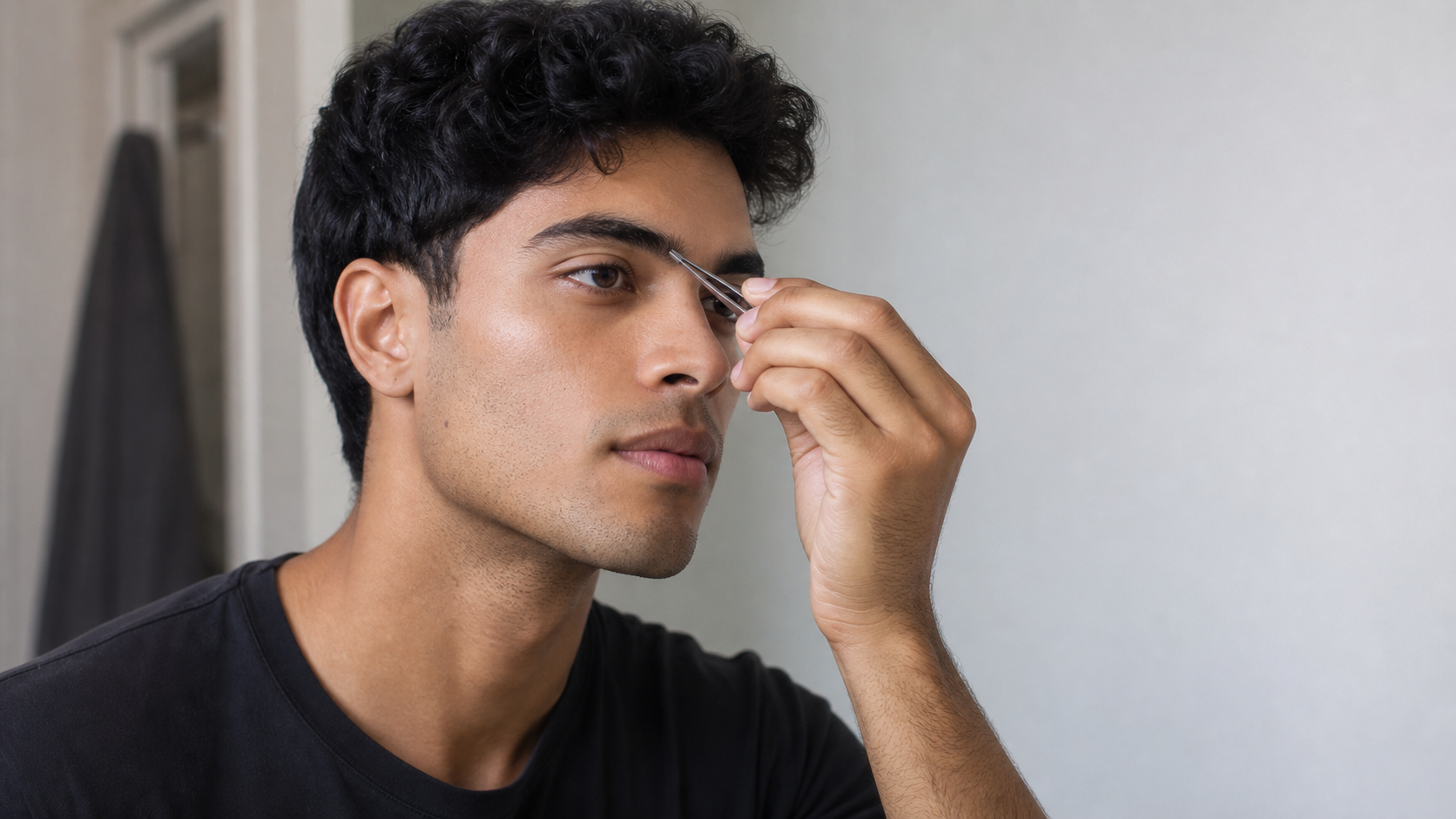
Eyebrows are sisters, not stamped copies. Height, arch, direction, density, tail length, and color commonly differ from one side to the other. Expression and facial anatomy add more movement. The goal of grooming is not to force perfect symmetry; it is to make a few reversible choices that suit your face without turning every stray hair into a defect.
That matters because a pencil washes off tonight. A hair removed repeatedly may take months to cycle back, and some sparse areas may not return. Start with the option that is easiest to undo.
See the brow you actually have
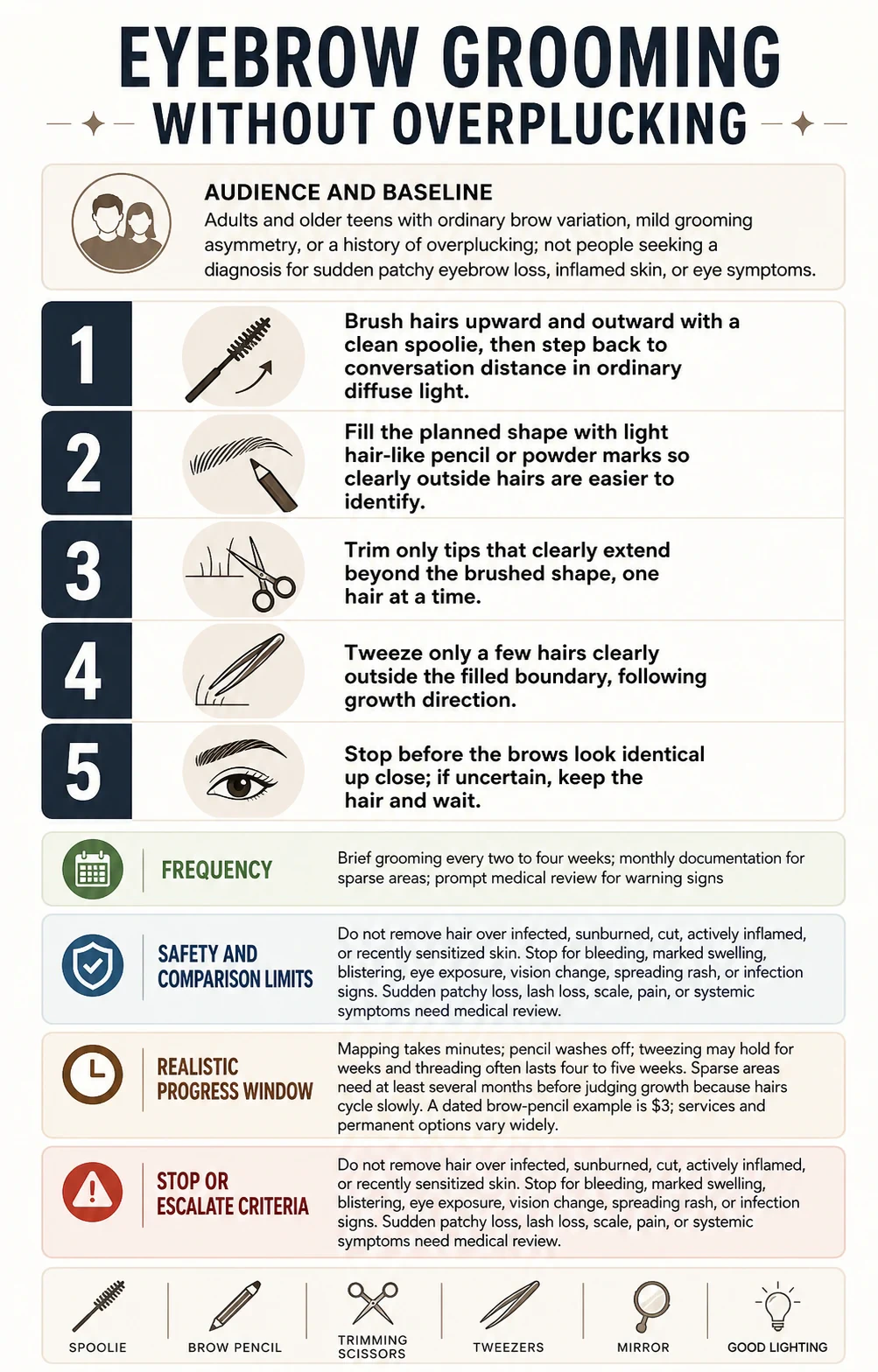
Brush hairs upward and outward with a clean spoolie. Step back to conversation distance in ordinary diffuse light. Look at the full face rather than magnifying one brow. Mark only three broad zones: where the dense body begins, where direction changes, and where the natural tail fades.
Do not map from a filtered selfie. Head tilt, raised eyebrows, camera height, wide-angle perspective, hard side light, concealer, gel, pencil, mirroring, sharpening, and editing can create or erase asymmetry. A picture cannot diagnose damaged follicles or prove regrowth.
If you keep switching sides because each close-up looks wrong, stop. Wait a day and look again from farther away. Grooming should reduce effort, not create an inspection loop or attach worth to millimeters of hair.
Fill before you remove
Use pencil or powder to sketch the shape you think you want. Make light hair-like marks or a soft shadow rather than drawing a rigid border. Filling first shows whether apparent gaps are simply lighter or differently directed hairs. It also makes the truly outside hairs easier to identify.
A dated U.S. example cost $3 on July 19, 2026 [S06]. That is a price snapshot, not an endorsement. An existing matte eye-area-approved shadow and clean angled brush may work too. Check the product’s intended-use label; the FDA treats the eyebrow as part of the eye area, and a color approved elsewhere is not automatically allowed there [S04].
Remove the product gently at night. Stop for burning, swelling, a spreading rash, eye redness, discharge, or vision change. Rinse accidental eye exposure as the label directs; persistent pain or visual symptoms need prompt eye care.
The minimum-removal routine
- Wash your hands and clean the spoolie, small scissors, and tweezers.
- Brush the hairs into their natural direction.
- Fill the planned shape.
- Trim only tips that clearly extend beyond the brushed shape, one hair at a time.
- Tweeze only a few hairs clearly outside the filled boundary, following growth direction.
- Stop before the brows look identical up close.
- Wipe tools clean and leave the skin alone.
Do not tweeze over cuts, infection, sunburn, active dermatitis, or very irritated skin. Avoid a major reshaping immediately before an event: redness, swelling, a nick, or an ingrown hair needs time to settle.
Give yourself a removal budget—perhaps two or three hairs per side—then put the tweezers away. The exact number is not anatomy; it is a brake on momentum. If uncertain, keep the hair. You can remove it later.
Use a ten-second gate before every removal: Is this hair clearly outside the filled shape in ordinary light? Can I explain why it should go without using “perfect” or “even”? Would leaving it for two weeks cause any real problem? If any answer is no, leave it.
Tweezing, threading, and waxing are not interchangeable
Tweezing is slow and selective, which is useful for preserving a baseline. Threading removes multiple hairs with twisted thread. AAD guidance describes it as precise, often low-irritation, and capable of lasting four to five weeks, while noting that inexperienced technique can produce uneven brows or ingrown hairs [S01]. Ask a trusted person for a trained provider and request conservative cleanup, not a new shape, on the first visit.
Waxing removes a broader strip and can take skin with it when technique or skin condition is wrong. Avoid waxing on broken or inflamed skin and disclose topical retinoids, recent peels, isotretinoin history, or other sensitizing treatments to a qualified professional. Do not improvise with a product whose eye-area use is unclear.
Chemical depilatories are a poor default near brows because placement errors can reach the eye. AAD advises patch testing these products and rinsing at the instructed time or first burning or stinging [S01], but eyebrow use still depends on the exact label. If the label does not permit the eye area, do not use it there.
What to do after overplucking
Stop removing hairs from the sparse zone. Photograph once a month under the same lighting, expression, distance, and makeup-free conditions. Use pencil, powder, tinted gel, or a fringe while you wait. Judge new hairs over several months, not a week; growth cycles are slow and recovery is not guaranteed.
There is no oil proven to resurrect a destroyed follicle. Avoid placing essential oils, scalp minoxidil, or improvised drug mixtures close to the eyes. One small randomized trial in 60 adults with eyebrow hypotrichosis found improvement with studied topical minoxidil and bimatoprost formulations [S05]. That is evidence for further clinical decision-making, not permission to copy the formulations or dose. Eye exposure, the true cause, contraindications, and off-label status require clinician review.
Seek dermatology care when loss is sudden, sharply patchy, progressing, painful, scaly, inflamed, scar-like, or accompanied by eyelash or scalp loss. Alopecia areata can involve eyebrows, but a photo cannot establish it [S03]. Thyroid disease, dermatitis, infection, inflammatory or scarring disorders, nutritional problems, pulling behavior, and other causes require different approaches [S02].
Higher-risk and longer-lasting options
Tinting and lamination expose eye-area skin and hairs to chemicals. Ask exactly which products and color additives are used, whether they are authorized for that intended use, how patch testing works, and what happens after a reaction. FDA rules permit only specifically approved color additives in the eye area and describe silver nitrate for professional eyebrow and eyelash coloring under restrictions [S04]. “Natural” is not a safety guarantee.
Before booking, also ask who performs the service, whether single-use applicators are used, how the provider keeps product out of the eye, what aftercare costs, how often maintenance repeats, and whether they will refuse service on irritated skin. A vague answer is a reason to postpone, not a reason to lower the safety bar.
Microblading and other permanent makeup create repeated skin punctures and add infection, allergy, pigment migration, color-change, and scarring risks. Results fade unevenly and correction can be difficult. Verify licensing, sterile single-use needles, pigment documentation, aftercare, and referral pathways. Do not proceed over active skin disease.
Eyebrow transplantation is surgery. Donor hairs may keep scalp-hair growth behavior and need trimming; angle, scarring, anesthesia, cost, and future loss matter. It belongs after a dermatologist establishes the cause and a qualified surgeon explains realistic density and maintenance.
Time, maintenance, and stop rules
Pencil changes appearance in minutes and washes off. Tweezing and threading can last weeks. A conservative reshape should be reassessed after two to four weeks, and sparse-zone growth only monthly over several months. Services add repeating costs; permanent options add larger upfront cost plus correction and maintenance.
Stop grooming for bleeding, blistering, marked swelling, or a spreading rash. Seek prompt eye care for chemical exposure with persistent pain, discharge, light sensitivity, or vision change. Seek medical review for infection signs or unexplained loss. Minors should stay with temporary filling, light trimming, and adult-supervised conservative cleanup rather than drugs, dyes, tattoos, or surgery.
The best endpoint is not a mathematically perfect pair. It is a brow routine you can leave alone between brief, safe sessions.


Sources
- S01 — American Academy of Dermatology: Six ways to remove unwanted hair
- S02 — American Academy of Dermatology: Hair loss diagnosis and treatment
- S03 — British Association of Dermatologists: Alopecia areata patient leaflet
- S04 — FDA: Color Additives and Cosmetics Fact Sheet
- S05 — PubMed: Randomized trial of treatments for eyebrow hypotrichosis
- S06 — Target: dated brow-pencil listing
Sources and price were checked July 19, 2026. This is general education, not diagnosis or individualized treatment.


