

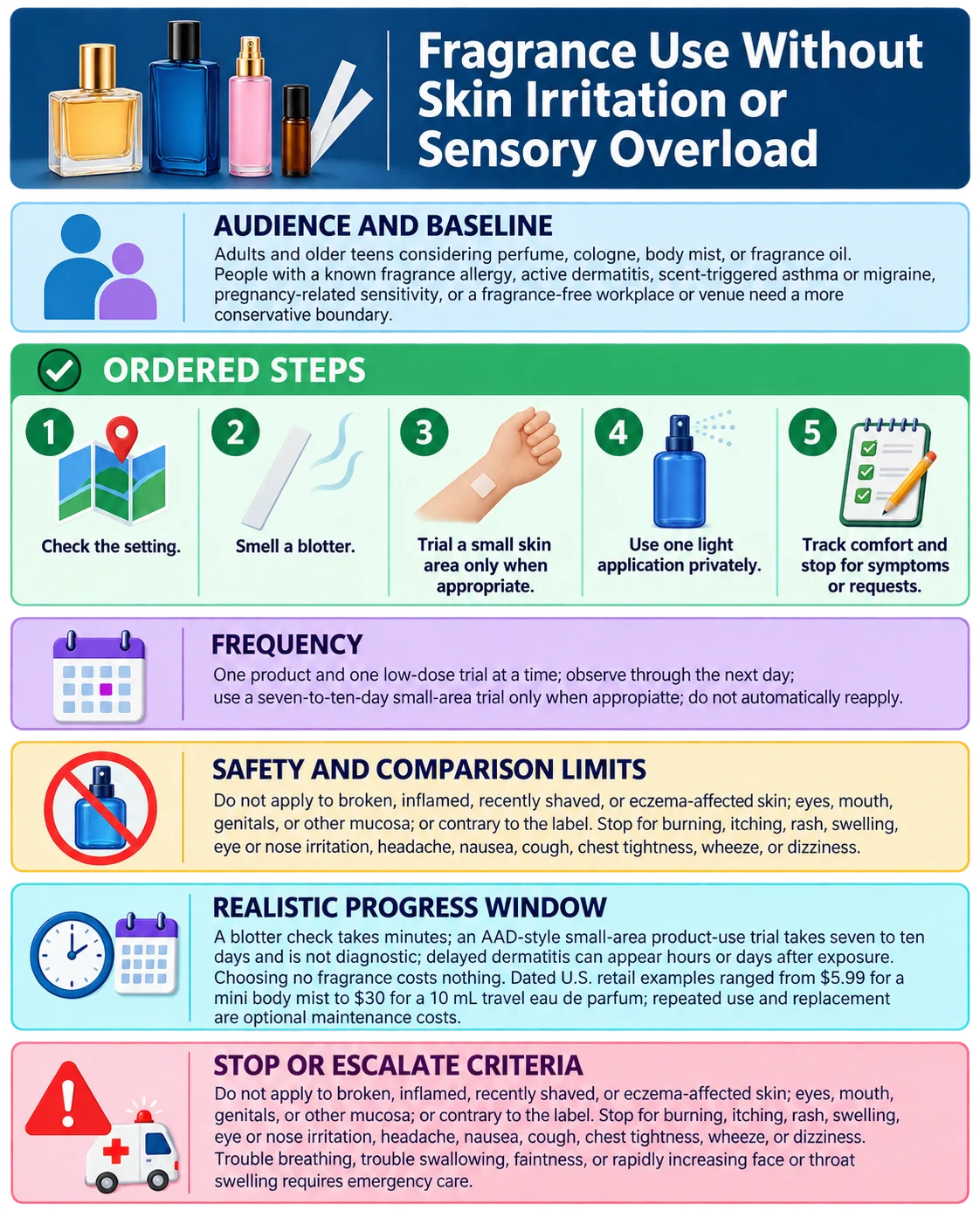
Personal fragrance is optional. It can be a small aesthetic pleasure, a memory cue, or part of a grooming ritual. It is not hygiene, treatment, proof of maturity, or a shortcut to attractiveness. Wearing none is a complete choice.
The useful goal is narrower: if you enjoy perfume, cologne, body mist, or fragrance oil, can you use it without irritating your skin, provoking symptoms, or taking over someone else’s air? Usually that means learning more from a small, quiet trial than from projection claims, compliment counts, or a crowded shelf.
Start with variation, not a spray count
People differ in odor perception, preference, skin tolerance, sweating, migraine susceptibility, airway sensitivity, culture, and how much scent belongs in a setting. Weather, ventilation, skin products, fabric, and time change how a fragrance behaves. Someone else may notice your fragrance after you stop noticing it because perception adapts.
That is why there is no evidence-based universal number of sprays. One atomizer, oil roller, and body mist can deliver very different amounts. “Eau de parfum” or a higher price does not tell you the safe dose for your skin or the comfortable dose for a room.
Fragrance also does not cover a health or hygiene problem in a reliable way. Ordinary body odor varies. Gentle washing, clean clothing, breathable fabrics, and antiperspirant or deodorant if wanted address a different job. A sudden or persistent odor change with other symptoms deserves appropriate healthcare, not heavier perfume.
What the evidence can—and cannot—tell you
The strongest practical facts here come from regulators and dermatology guidance.
The FDA treats perfume, cologne, and aftershave used for appearance as cosmetics. Cosmetic ingredients generally are not preapproved by the FDA before sale, although companies remain legally responsible for safety under labeled or customary use. A complex formula may appear on a U.S. ingredient list simply as “fragrance,” and even a product labeled “unscented” can use fragrance to mask another odor [S01, S02]. A label therefore helps with avoidance, but may not reveal every constituent.
Fragrance is a recognized cosmetic-allergen category. Allergic contact dermatitis can appear as itching, redness, scaling, swelling, or a rash where a product touched the skin. Delayed reactions can take hours or days. Irritation can look similar without being an allergy, and skin symptoms have many other possible causes. A photo cannot separate them [S02, S05].
Airborne exposure is less simple. FDA consumer guidance lists possible eye, nose, mouth, headache, cough, chest-tightness, wheeze, and breathing symptoms in sensitive people [S02]. A U.S. cross-sectional survey found that some respondents reporting asthma also reported problems around fragranced products, including exposure near another person wearing fragrance [S06]. That survey is a reason for consideration, not a universal risk estimate: it used self-report, grouped many products together, and cannot prove a mechanism or causal threshold.
IFRA publishes restrictions and prohibitions for some fragrance materials by product-use category. That can be one formulation control, but IFRA is the fragrance industry’s own association. Conformity is not independent clinical proof, does not identify your allergens, and cannot guarantee that you or someone nearby will tolerate a finished product [S07]. “Natural,” “essential oil,” “clean,” “luxury,” and “hypoallergenic” are not automatic safety certificates either.
Keep the evidence hierarchy visible. There is higher-confidence guidance for U.S. labeling limits, known allergy symptoms, stopping a suspected product, and clinician-directed patch testing [S01–S05]. There is useful but indirect guidance for a cautious small-area trial of a new topical product [S03]. There is limited, context-dependent evidence about how often fragranced air causes particular symptoms or what amount will be comfortable: the available survey cannot supply a universal threshold [S06]. Product reviews, influencer reactions, compliment stories, “pheromone” claims, and industry conformity do not close those gaps.
Sort the next step before testing
This is a safety map, not a diagnosis.
- No prior reaction and no relevant condition: start with the setting and a blotter; consider a small-area trial only if the label permits topical use.
- A prior mild localized rash from this product: do not retry it to prove the cause. Save the ingredient list and ask a dermatologist or allergist whether avoidance or patch testing is appropriate.
- Known asthma, migraine, eczema, or recurring scent-triggered symptoms: avoid known triggers and use a clinician-reviewed plan. A fragrance-free choice is not a failed experiment.
- Prior wheeze, breathing or swallowing trouble, faintness, widespread hives, or face or throat swelling: do not run a home exposure challenge. Seek individualized medical guidance; use emergency care if severe symptoms are happening now.
A lower-exposure routine
Move through these steps in order. Each step is reversible, and stopping is a valid outcome.
1. Decide whether the setting welcomes scent
Check school, workplace, clinic, gym, studio, faith-community, and event rules. Skip fragrance in a fragrance-free space. In a car, small office, shared changing area, bedside visit, or other close setting, ask before applying or choose none. Do not spray into shared air to test it.
Consent is not an insult to your taste. It is ordinary exposure control when another person cannot easily leave.
2. Use a blotter before skin
Smell a paper blotter or manufacturer test strip once, in ventilation, without putting your nose directly over wet spray. Leave and return after several minutes. This can tell you whether you like the opening and dry-down. It cannot test skin allergy, migraine risk, airway response, or all-day comfort.
If a blotter immediately brings headache, nausea, eye or nose irritation, cough, chest tightness, or dizziness, do not challenge yourself with a skin application. If you have a history of serious scent-triggered asthma or another severe reaction, avoidance and a clinician-reviewed plan are safer than a home exposure experiment.
3. Test skin use only when it is appropriate
For a new topical product, AAD guidance suggests applying the usual amount to a small area twice daily for seven to ten days and watching for redness, itching, or swelling [S03]. For fragrance, follow the product label and use only a tiny amount on intact skin. Do not perform this trial on the face, neck, recently shaved skin, active eczema, a current rash, broken skin, or mucosa.
This is a cautious product-use trial, not medical patch testing. It can miss a delayed or later reaction. Do not deliberately retry a product that previously caused hives, swelling, wheeze, breathing trouble, or another serious response. Do not apply undiluted fragrance ingredients or essential oils as a home allergy test.
4. Make the first wear deliberately small
If the skin trial and blotter are comfortable, try one light application at home or in another private, ventilated place. Use intact skin, or clothing only when the label allows it; perfume can spot or damage fabric. Never spray toward the face. Avoid eyes, mouth, genitals, and inhaling the wet mist.
Do not layer scented wash, lotion, hair mist, laundry products, deodorant, and perfume during the first trials. One product makes any reaction easier to interpret. Wait through the expected wear period rather than reapplying when your own nose adapts.
5. Let context set the ceiling
If you can clearly smell the fragrance at arm’s length for hours, adding more is unlikely to make the experience more considerate. In close contact, ask. If someone says the scent is causing symptoms or asks for a fragrance-free interaction, move away, improve ventilation if possible, and skip it next time. The right response is not to debate whether the fragrance is objectively “strong.”
What results are realistic?
A blotter impression takes minutes. A small-area topical trial takes seven to ten days under the AAD’s general approach, while delayed dermatitis can emerge after repeated use [S03–S05]. Several low-dose wears in different ordinary conditions may show whether a product is comfortable and context-appropriate. No trial guarantees permanent tolerance; allergy can develop after prior exposure.
Realistic success is modest: you enjoy the scent, your skin and breathing remain comfortable, and people sharing the space are not burdened. Projection, longevity, and compliments are inconsistent outcomes, not health or worth metrics. Fragrance will not change bone structure, facial features, social status, or the quality of a relationship.
Maintenance means storing the product as directed, keeping the cap and atomizer clean, avoiding heat or flame warnings on alcohol-based products, not sharing a roller directly on skin, and reassessing after a formulation or health change. More bottles add cost and make reaction tracking harder.
Cost: sample before collecting
The lowest-cost option is $0: use no fragrance, or use less of one you already tolerate. On July 19, 2026, dated U.S. listings showed a 2.5-ounce mini body mist at $5.99, an 11 mL travel perfume at $14, and a 10 mL travel eau de parfum at $30 [S08, S09]. Those are price snapshots, not recommendations. Stock, formula, and price can change.
Buying a small format can reduce waste, but size and price do not prove safety, concentration, quality, or longevity. Avoid buying several products during a reaction investigation. There are no affiliate links or sponsored brands in this guide.
Stop and escalate
Stop using the product, leave the exposure, and gently wash contacted skin when appropriate if you develop burning, persistent itching, rash, hives, swelling, eye or nose irritation, headache, nausea, coughing, chest tightness, wheeze, shortness of breath, or dizziness. Do not mask the reaction with another scented product and continue.
Trouble breathing, trouble swallowing, faintness, a rapid weak pulse, or rapidly increasing face, lip, tongue, or throat swelling can signal an emergency. Seek emergency care immediately [S02]. People with an asthma action plan should follow their clinician’s plan; this article cannot replace it.
Recurring or persistent rash deserves a dermatologist or allergist. Medical patch testing uses standardized allergens, clinician-selected panels, timed readings, and exposure history. It is different from a skin-prick test and from trying perfume on your arm. Even formal screening may need extension or repeat evaluation because no small panel catches every fragrance allergy [S04, S05]. Recurrent migraine, airway symptoms, or systemic symptoms also need qualified review.
For minors, keep the choice conservative and follow household and school rules. Adults should not frame fragrance as a route to popularity, romance, maturity, or a “fixed” body. A young person with eczema, asthma, migraine, or a previous reaction needs adult and clinical guidance rather than an online challenge.
How to judge progress without chasing projection
For the first several wears, write down the product, amount, application site, venue, time, ventilation, and any skin, eye, nose, breathing, headache, or nausea response. Also record whether anyone asked for distance or less scent. Change only one variable at a time.
After a week, ask four plain questions:
- Did I enjoy it after the first few minutes?
- Did my skin and body remain comfortable through the next day?
- Was the amount appropriate for the people and place?
- Would no fragrance have worked just as well?
If those answers are unclear, do not increase the dose. Reduce it, change the setting, pause, or seek professional review.
Visuals cannot prove scent performance or safety
A bottle photo cannot show concentration, diffusion, longevity, skin tolerance, airway response, or another person’s comfort. Atomizer clouds can be composited or backlit; condensation and luxury props can imply freshness or quality; posed reactions can be staged; editing can exaggerate visible mist. Skin images cannot diagnose allergy, and before-and-after portraits cannot demonstrate that fragrance changed attractiveness or confidence.
Judge a fragrance by a cautious, source-aware process and by real-world comfort—not by a cinematic cloud or a promise that other people will respond in a guaranteed way.
Bottom line
Fragrance is an optional shared-air choice. Begin with the setting, use a blotter, test skin cautiously only when appropriate, make the first wear light and private, and treat symptoms or requests as reasons to stop. If recurring dermatitis, asthma, migraine, or systemic symptoms enter the picture, the next useful tool is qualified care—not another spray.


Sources
- [S01] U.S. Food and Drug Administration, “Fragrances in Cosmetics,” checked July 19, 2026.
- [S02] U.S. Food and Drug Administration, “Allergens in Cosmetics,” checked July 19, 2026.
- [S03] American Academy of Dermatology, “How to test skin care products,” checked July 19, 2026.
- [S04] American Academy of Dermatology, “Patch testing can find what’s causing your rash,” checked July 19, 2026.
- [S05] Acta Dermato-Venereologica, “Fragrance Contact Allergy—A Review Focusing on Patch Testing” (2024), via PubMed Central.
- [S06] Air Quality, Atmosphere & Health, “Fragranced consumer products: effects on asthmatics,” via PubMed.
- [S07] International Fragrance Association, IFRA Standards documentation, checked July 19, 2026; industry conflict disclosed above.
- [S08] Target U.S. fragrance listings, price and size snapshot checked July 19, 2026.
- [S09] Sephora U.S., 10 mL travel eau de parfum listing, price and size snapshot checked July 19, 2026.
FAQ
Common questions
Is spraying fragrance on clothing always safer?
It can reduce direct skin contact but may stain fabrics and still creates airborne exposure. It does not make a product universally safe or appropriate.
When do fragrance symptoms need urgent care?
Seek urgent help for trouble breathing, facial or throat swelling, faintness, or a severe widespread reaction. Stop exposure and follow local emergency guidance.
Topic hubs
Tags


