

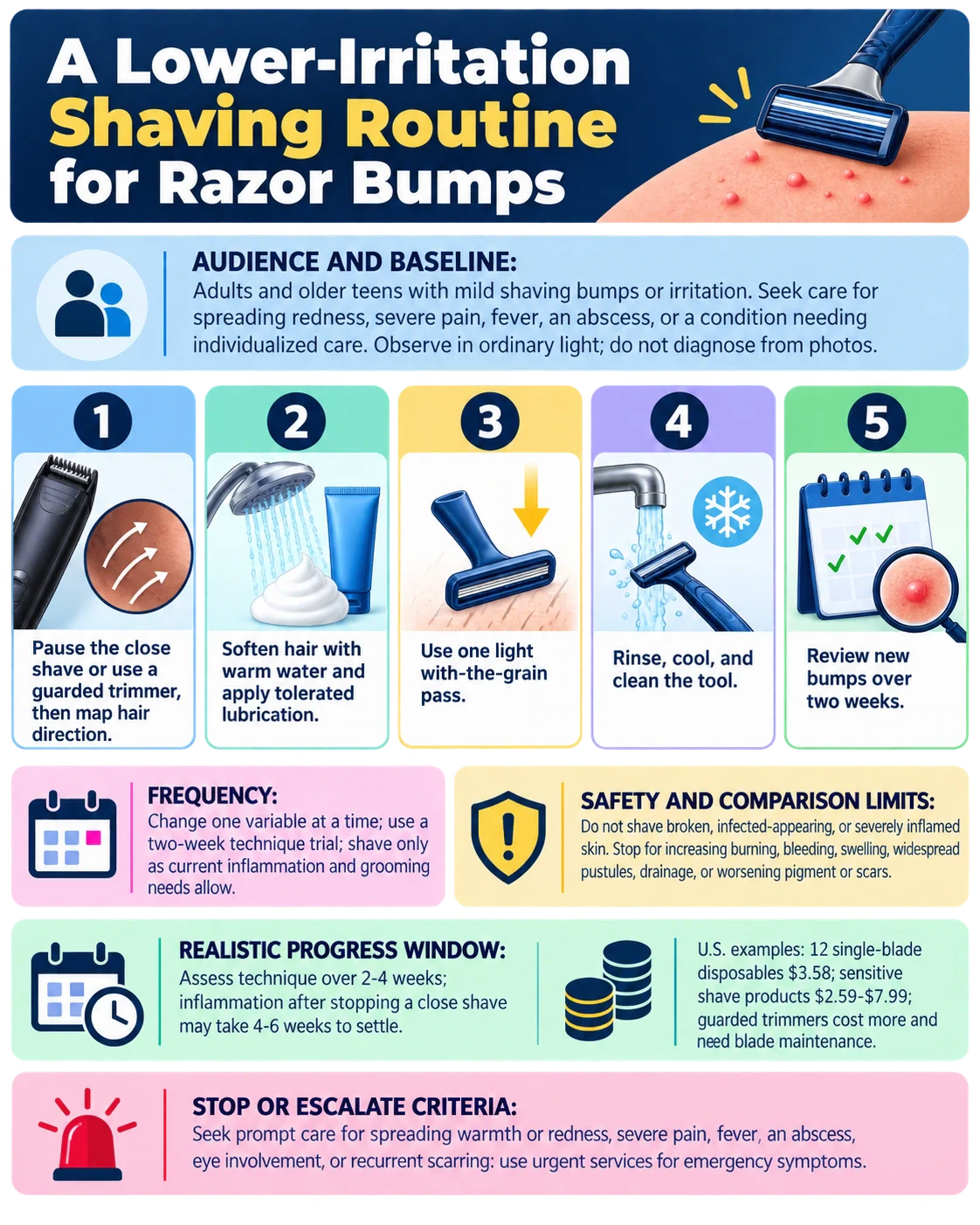
Razor bumps are not evidence that you are dirty, careless, or doing appearance “wrong.” They are often a mechanical problem: a freshly cut hair curves back into the skin or gets trapped as it grows, which can trigger inflammation. Hair curl, diameter, follicle angle, skin sensitivity, and the direction hair grows all vary normally. That is why two people can use the same razor and get very different results.
The goal here is not a perfectly smooth, poreless finish. It is a shave or trim you can maintain with fewer painful or itchy bumps, fewer cuts, and less pressure to keep escalating. Start with the most reversible change—leaving a little more hair—before considering products, prescriptions, or procedures.
One-glance decision card: If the skin is mildly irritated, pause the closest shave, leave guarded stubble, and change one technique variable for two weeks. If the area is broken, draining, rapidly worsening, severely painful, or accompanied by fever, do not shave it—get medical care. If careful technique still produces recurring bumps or scars, stop cycling through products and ask a dermatologist to identify the cause and discuss options.
What razor bumps are, and what they are not
Pseudofolliculitis barbae is an inflammatory reaction to hair that re-enters the skin after cutting or hair removal. It is especially common where coarse or tightly curled hair is shaved closely, but it can affect any hair-bearing area and any skin tone [S02, S03]. It may look like folliculitis, acne, eczema, or another condition. True folliculitis can involve infection and can coexist with razor bumps [S04].
That distinction matters because a photograph cannot reliably tell you which process is present. Do not use an online image, magnifying mirror, or AI assessment to diagnose yourself. Lighting, camera sharpening, white balance, recent shaving, and how tightly the skin is stretched can all exaggerate redness, pigment, and texture.
Normal variation also affects what “success” looks like. Some people can shave daily with little irritation. Others do better with guarded stubble, less frequent shaving, or a beard. Dark marks after inflammation may remain after a bump settles, especially in deeper skin tones. That does not mean the technique failed overnight, and it is not a reason to pick, scrape, or repeatedly shave the spot.
The reversible-first decision ladder
1. Pause the close shave
If your grooming rules allow it, stop close shaving for two to four weeks and use clean scissors or a guarded electric trimmer only as needed. Leaving about a millimeter of stubble reduces the chance that a sharpened hair tip retracts below the surface or immediately curves back into skin [S02]. If you can stop the causative technique entirely, DermNet reports that inflammation may take roughly four to six weeks to settle [S02]. That is an estimate, not a deadline.
This is the lowest-cost experiment if you already own a trimmer. It also gives you useful information: fewer new bumps while stubble remains makes a mechanical trigger more plausible, but it still does not diagnose the condition.
2. Map the grain instead of chasing closeness
Hair rarely grows in one neat direction, especially under the jaw, on the neck, in the groin, or around scars. Before the next shave, let short stubble grow and gently feel or observe its direction in ordinary light. Make a simple mental map. Do not pull the skin tight while inspecting it.
When you shave, follow each zone’s growth direction. Avoid going against the grain for a second polishing pass. A closer result can come at the cost of a shorter, sharper hair tip and more irritation [S01, S02].
3. Soften hair and reduce friction
Shave after a warm shower or hold a warm, damp cloth on the area. Apply a simple shaving cream or gel you already tolerate and give it time to coat the hair. Use short strokes and very light pressure. Let the tool cut; do not press it into the skin.
One careful pass is a sensible starting rule. Rinse the blade frequently. When finished, rinse away the cream and use a cool, damp cloth. If an after-shave product stings, burns, or adds fragrance your skin does not tolerate, it is optional—not a test of toughness.
4. Change the tool, not your worth
If a multi-blade cartridge repeatedly cuts too close, trial a guarded electric shaver or a simple single-blade option. That is a reversible comparison, not proof that one design is universally superior. A guarded trimmer may leave visible stubble; a single exposed blade requires careful handling and may still irritate.
Keep the tool clean and dry. AAD guidance says to replace a disposable razor after roughly five to seven shaves and clean an electric razor regularly [S01]. Treat that as practical guidance rather than an exact biological threshold. Replace a blade sooner if it drags, rusts, is contaminated, or causes nicks. Never share a razor.
5. Adjust frequency based on your pattern
There is no single schedule for everyone. AAD guidance notes that more frequent shaving can sometimes give a curved hair less time to grow long enough to re-enter, while DermNet recommends reducing shaving frequency for some people so inflamed skin is disturbed less often [S01, S02]. The advice targets different parts of the cycle, and neither schedule has been proven universally best. Hair curl, cut height, technique, required closeness, and current inflammation all change the tradeoff.
Run only one schedule experiment at a time. For example, keep tool and technique stable while comparing every-other-day trimming with your prior routine for two weeks. Stop the experiment if inflammation is clearly worsening.

A practical two-week trial
For mild, non-infected-looking bumps, use this conservative sequence:
- Photographing is optional. If you do it, use the same room, distance, lens, light, expression, and time since shaving. Do not use beauty mode or close-up distortion.
- Pause close shaving for several days if possible. Do not pick, squeeze, or dig for trapped hairs [S05].
- Resume with a guarded trimmer or one with-the-grain pass after softening the hair.
- Use a tolerated, lubricating shave cream. Introduce no other new product that week.
- Rinse, cool the skin, and leave it alone. Avoid tight collars or repeated rubbing over the area.
- Record only useful signals: new tender bumps, pustules, cuts, burning, itch, and whether the result meets your real grooming needs.
At the end of two weeks, keep the version that caused fewer new inflamed bumps and less discomfort. If neither version is tolerable, pause close shaving and seek qualified advice rather than adding multiple acids, scrubs, antibiotics, or “ingrown hair” treatments at once.
Evidence strength and realistic outcomes
The strongest support for the home routine is convergent dermatologist and public-health guidance about the mechanism, avoiding the closest cut, hair softening, shaving direction, and not picking [S01, S02, S05]. A 2023 clinical review describes the condition and available treatments, but its abstract does not provide a pooled effect size or establish one best intervention [S03].
That means the routine is reasonable and low risk, not guaranteed. A realistic early outcome is fewer new sore or itchy bumps over two to four weeks. Existing dark marks and scars can take longer and may not fully resolve with shaving changes alone. If infection, acne, eczema, keloid scarring, or another condition is involved, the timeline and treatment can be different.
Cost and maintenance
You do not need a luxury grooming system. On July 19, 2026, one U.S. retail listing showed a 12-pack of single-blade disposable razors at $3.58 [S06]. A checked Target category page showed common sensitive shave products around $2.59 to $7.99 [S07]. These are price snapshots, not recommendations. Prices, inventory, package size, and formulas can change, and “sensitive” on a label does not prove a product will suit you.
A guarded electric trimmer costs more upfront and needs cleaning and eventual blade or foil replacement. Compare cost per comfortable use, not the number of blades, prestige of the brand, or promises on the box. LooksMaxx has no affiliate relationship with any source or product named here.
Maintenance is ongoing because a close cut can recreate the trigger. Recheck grain direction as hair length changes, keep tools dry and clean, and avoid turning a good week into a five-product experiment. If your workplace requires a very close shave, ask whether a medical grooming accommodation or alternative standard exists; a clinician can document a diagnosed condition when appropriate.
What not to do
- Do not pick, squeeze, scrape, or use a needle to release a hair.
- Do not shave repeatedly over a bump until it bleeds.
- Do not use someone else’s razor.
- Do not stack scrubs, strong acids, retinoids, antiseptics, and fragranced after-shaves on inflamed skin.
- Do not start leftover antibiotics or prescription creams.
- Do not treat social-media before-and-after images as evidence; light, shaving timing, concealer, editing, and selective framing can manufacture a dramatic difference.
Chemical depilatories may prevent a cut hair from retracting in the same way, but they can irritate or burn skin. Laser hair reduction can help selected patients but is not a casual upgrade: operator skill, device and skin type, cost, multiple sessions, pigment risks, maintenance, and the possibility of incomplete reduction matter [S02, S03]. Both belong after careful label review or consultation rather than ahead of basic technique.
Stop criteria and when to seek care
Stop shaving the area and stop the newest product if you develop increasing burning, bleeding, swelling, widespread pustules, drainage, or rapidly worsening pigment or scarring. Seek prompt medical care for spreading warmth or redness, severe or escalating pain, fever, a large tender lump or abscess, eye involvement, or signs of a significant allergic reaction. Use urgent or emergency services for breathing or swallowing trouble, facial swelling, faintness, or other emergency symptoms.
See a dermatologist or qualified clinician when bumps persist despite a careful technique trial, recur with scarring, or you cannot stop close shaving. A clinician can distinguish pseudofolliculitis from bacterial or fungal folliculitis, acne, eczema, and other conditions; discuss work accommodations; and decide whether a prescription or procedure is appropriate [S04]. This article cannot do that from a description or image.
For minors, keep the plan conservative: trimming, gentle technique, clean tools, and an adult’s help. Prescription products, chemical depilatories on sensitive areas, and laser procedures should involve a parent or guardian and a qualified professional.
The useful standard
A good shaving routine is not the one that removes every visible hair at any cost. It is the one that meets your practical needs without repeatedly injuring your skin. Fewer new inflamed bumps, less pain or itch, fewer cuts, and a routine you can sustain are meaningful outcomes—even when normal stubble, texture, or old pigment remains visible.

Sources
- S01 — American Academy of Dermatology: 6 razor bump prevention tips
- S02 — DermNet: Pseudofolliculitis barbae
- S03 — PubMed: Review of treatments for pseudofolliculitis barbae
- S04 — American Academy of Dermatology: Folliculitis
- S05 — NHS: Ingrown hairs
- S06 — Walmart: dated single-blade razor listing
- S07 — Target: dated sensitive shave product listings
Evidence and retail facts were checked on July 19, 2026. This guide is general education, not diagnosis or individualized treatment.


