
A neat nail does not require a missing cuticle. The thin seal at the base and sides of the nail is part of the barrier that keeps germs away from the nail root. Cutting it for a cleaner-looking outline trades a temporary visual effect for inflammation and infection risk [S01–S03].
Nails also vary normally. Thickness, curve, growth speed, surface ridges, color, and visible half-moons differ across people and fingers. A close-up under flash can make a harmless ridge look dramatic. The practical goal is comfortable, clean nails with intact surrounding skin—not one ideal length, shape, or finish.
The basic 15-minute routine
1. Start clean and soften the nail
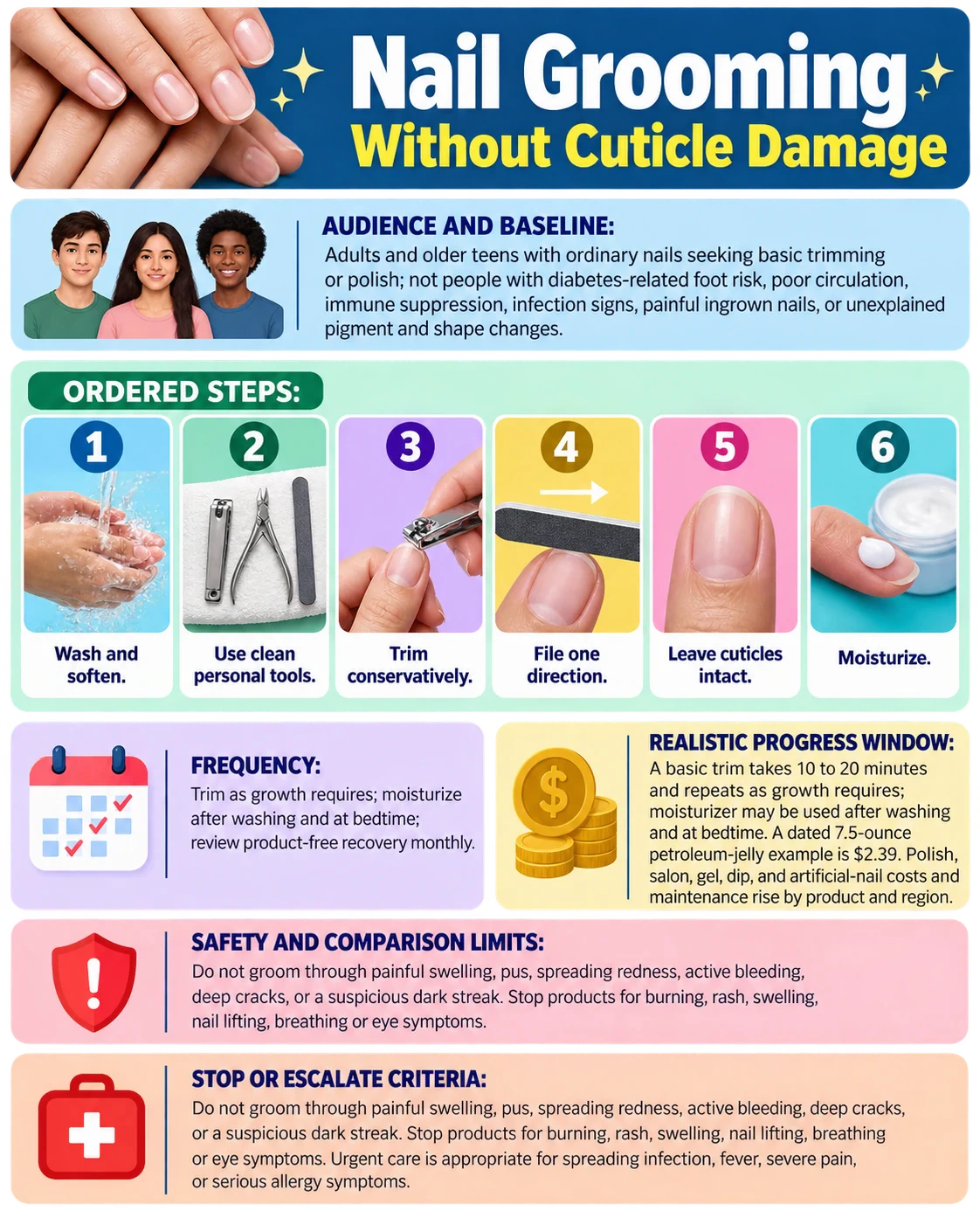
Wash hands or feet and dry them. Trim after a bath or shower, or soften nails briefly in lukewarm water [S01]. Use your own clipper or scissors. AAD advises cleaning tools monthly with a brush and 70% to 90% isopropyl alcohol, then rinsing and drying them [S01]. Clean sooner after contamination and never share a visibly dirty tool.
In a salon, shared reusable instruments need the sterilization or disinfection required for that tool and jurisdiction. CDC says commercial shared grooming tools should be sterilized before use [S02]. A sealed-looking pouch is not proof by itself; ask how instruments are processed.
2. Trim the nail, not living skin
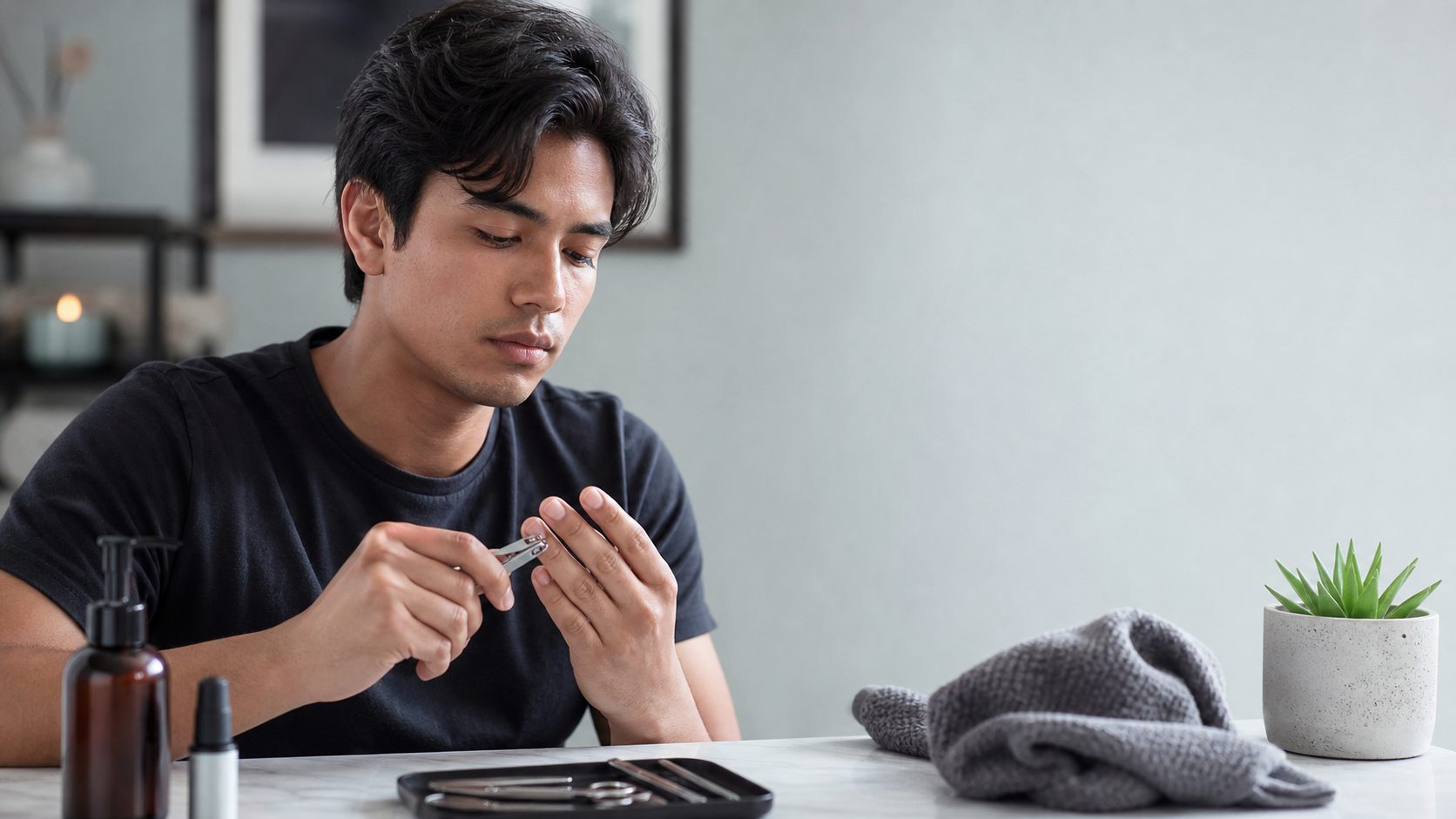
Cut fingernails almost straight across, then softly round corners with a file. Cut toenails straight across to reduce ingrown-nail risk [S01]. Take small clips instead of digging deep into corners. File rough edges in one direction rather than sawing back and forth.
Do not cut or forcefully push back cuticles. If skin is dry or rough, moisturize it rather than removing it. AAD suggests petroleum jelly as a budget option [S06]. On July 19, 2026, one 7.5-ounce plain example was $2.39 [S07]. That is a dated price, not a brand recommendation.
For a hangnail, wash hands and clip only the loose dead flap with a clean tool. Do not bite, rip, or pull it into living skin [S02]. If the area is already red, swollen, throbbing, or draining, stop grooming.
3. Moisturize and protect
Rub a small amount of fragrance-free cream or ointment over the nails and folds after washing and at bedtime. Gloves can reduce repeated water, detergent, and solvent exposure during wet work, but damp gloves need changing. Moisturizer improves flexibility; it does not treat fungus or another disease.
Repeat trimming only as growth and function require. Toenails grow more slowly than fingernails. Longer is not inherently better or worse, but a length that repeatedly catches, bends, or collects debris is not serving you.
Ordinary polish is a separate choice
Bare nails are the lowest-maintenance option. Ordinary removable polish changes color without adding length. Apply only to intact nails and avoid painting onto skin. Use ventilation, follow the label, close containers, keep products away from children, and stop for burning, swelling, rash, eye exposure, or breathing symptoms [S04].
Use a three-level decision card. Green: intact, comfortable nails—basic trim, file, moisturizer, or optional ordinary polish. Yellow: dryness, recent damage, or a mild product reaction that has stopped—pause cosmetics and watch the product-free nail grow. Red: pain, pus, spreading redness, separation, dark pigment, or systemic symptoms—skip the manicure and seek qualified assessment. The colors sort urgency; they do not diagnose a condition.
Removers can dry the nail and surrounding skin, so moisturize afterward [S03]. Do not scrape polish off or peel layers of nail plate with it. A one-to-two-week product-free interval can make it easier to see whether splitting, lifting, or irritation is improving.
Measure recovery by function: less tenderness, no new swelling, intact surrounding skin, and a stable new band growing from the base. Surface damage must grow out, so meaningful nail change takes months rather than days. Daily close-up photos mostly record light and moisture; a monthly image under the same conditions is more useful.
“Free from” lists can be useful ingredient information but do not mean allergy-free. FDA notes that formaldehyde-related ingredients and methacrylate monomers can cause irritation or allergy in susceptible people [S04]. A review of home nail cosmetics identifies allergic contact dermatitis—especially from (meth)acrylates in gel, glue, and acrylic systems—as a leading adverse event [S05]. Rash may appear around nails or at the face and neck after transfer.
Gel, dip, acrylic, and press-on systems
These durable systems add exposure and removal burdens. Ask what touches the natural nail and skin, how uncured material is controlled, how ventilation works, how removal avoids scraping and overfiling, and what the full maintenance cycle costs.
For dip powder, never place a finger into a communal container used by other clients. AAD warns that double dipping can spread germs and suggests product be poured onto the nail or placed in an individual container [S06]. Try one nail first before committing all ten, and stop if skin or nail changes after removal.
Gel systems must cure with the compatible lamp and exact timing; undercured material can leave more reactive monomer, while repeated UV exposure adds a separate skin consideration. Do not improvise by mixing brands or lamp specifications. AAD advises applying broad-spectrum, water-resistant SPF 30 or higher to exposed hand skin before a gel manicure or using opaque fingerless protective gloves [S08]. That is harm reduction, not a claim that repeated gel use is risk-free.
Do not use artificial nails to cover pain, separation, pigment, or infection signs. Covering the problem can worsen it or delay diagnosis [S03]. Removal should be planned before application; ripping or prying extensions off can remove layers of natural nail.
A salon checklist that protects the barrier
Before service, ask:
- Is the technician licensed where required?
- Are hands washed between clients and stations cleaned?
- How are metal tools processed and stored?
- Are single-use files and buffers discarded?
- Will the technician leave cuticles uncut and unpushed?
- For dip, will powder be poured or individually portioned?
- Can you see product labels and warning information?
- How will the product be removed, and what does maintenance cost?
If the technician dismisses the cuticle request, leave. A cosmetic service is optional; an intact barrier is useful.
When to stop and get help
Stop nail products and arrange medical review for persistent redness, swelling, pain, pus, nail lifting, a spreading rash, or thickening and color change that do not grow out normally. Seek urgent care for rapidly spreading redness, fever, severe pain, red streaks, facial swelling, breathing difficulty, or a serious chemical or eye exposure.
A new dark streak, pigment extending onto surrounding skin, bleeding, a nonhealing area, or unexplained shape change needs prompt dermatology assessment. Images cannot diagnose fungus, psoriasis, melanoma, allergy, or infection. Lighting, polish, oil, wetness, white balance, magnification, filters, and retouching alter what a nail looks like.
People with diabetes-related foot risk, poor circulation, neuropathy, immune suppression, or previous serious foot infection should ask their clinician or podiatrist how toenails should be managed. Do not dig out a painful ingrown nail at home.
For minors, keep care basic: clean tools, conservative clipping, filed edges, intact cuticles, and moisturizer with adult oversight. Glue, gel, dip, acrylic, and artificial extensions add avoidable exposure and removal risk.
The strongest nail routine is mostly restraint: clean tools, small trims, intact skin, moisture, and enough product-free time to notice a real change.


Sources
- S01 — American Academy of Dermatology: How to trim your nails
- S02 — CDC: Healthy Habits — Nail Hygiene
- S03 — American Academy of Dermatology: Manicure and pedicure safety
- S04 — FDA: Nail Care Products
- S05 — PubMed: Adverse Effects of Do-It-Yourself Nail Cosmetics
- S06 — American Academy of Dermatology: Dip powder manicure safety
- S07 — Target: dated plain petroleum-jelly listing
- S08 — American Academy of Dermatology: Gel manicure safety
Sources and price were checked July 19, 2026. This is general education, not diagnosis or individualized medical care.


