The jacket is already doing a lot. Its shoulders have a clear outline, the lapels catch your eye and the front looks deliberate even over an ordinary top. Then the inspiration board adds a high collar, an enormous belt, bright jewellery and a second statement layer. Suddenly, trying a look starts to resemble ordering an entirely different wardrobe.
You can stop before the shopping list. If an existing jacket gives you the part of Glamoratti you enjoy, let that be the starting point. The useful question is whether you want to wear this particular combination, rather than whether you have reproduced every item in somebody else’s forecast.
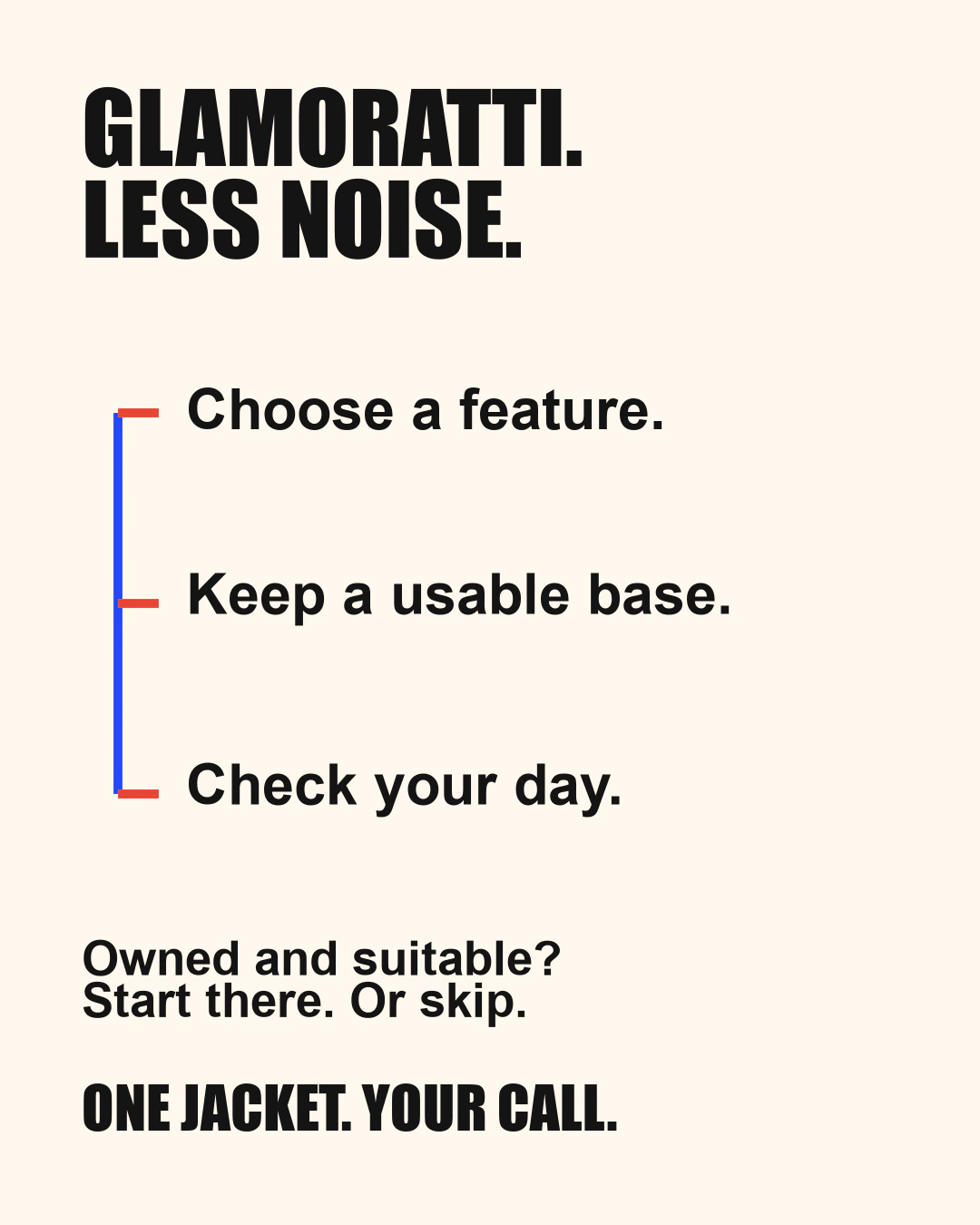
Graphic context — 01-article-hero: This original editorial sequence links one feature of a suitable owned jacket, a functional familiar base and the actual day. Pinterest provides dated forecast vocabulary; it does not require a shopping list or establish an appearance, confidence or career result.
Text equivalent: GLAMORATTI. LESS NOISE. Choose a feature. Keep a usable base. Check your day. Owned and suitable? Start there. Or skip. ONE JACKET. YOUR CALL. The rail organises choices, not a measured effect or a ranking of people. A jacket can already contain several strong details; one focus describes attention rather than a compulsory garment change. If no suitable owned jacket is available, skipping is valid. Keep essential uniform, protection, coverage, access, movement and fastening functions. No alteration, padding, purchase or photograph is needed. Four complete primary publisher documents, not independent outfit studies. Pinterest December9,2025 published/December15 modified platform forecast; undated LondonMuseum history of a1987 commissioned photography project; WRAP August18,2020 page/campaign archived March31,2023; undated FTC cleaning-information overview. No current measured growth, tested routine benefit, clinical confidence, career outcome, legal guidance, saving or environmental result. Underlying archives, full forecast dataset and linked legal pages were not independently read.
Who this is for
This guide is for someone curious about a bold, structured outfit who wants to begin with clothes they already own. You might have a blazer, a jacket with a noticeable collar or another suitable outer layer. You do not need a particular shoulder width, body shape, gender expression, income or job to consider the idea.
Pinterest included Glamoratti in its December 9, 2025 forecast for 2026. Its description emphasizes sculpted shoulders, funnel necks and substantial accessories. Those are styling cues from a commercial platform forecast. They are not an instruction to buy a larger size or evidence that the look is universally popular now. [S1]
Here, Glamoratti is shorthand for choosing a bold focal feature. It does not mean pretending to be wealthy, dressing for a promotion or correcting your body. This article promises no increase in confidence, attractiveness, authority or professional success. The sequence below is an original practical suggestion, not an outfit experiment tested by the sources.
If you do not own a suitable item, you can leave the idea for another day. A trend does not create a missing essential. Nor must an ordinary jacket qualify for a label before you are allowed to enjoy it. There is no purchase, tailoring appointment, photograph or public post required to use this guide.
Before you start
Choose the actual occasion first. A short indoor visit, a commute and a day involving repeated reaching or carrying can place different demands on a jacket. Consider the weather, any relevant dress requirements and what you need to do while wearing it. The outfit needs to serve that situation before it serves an aesthetic.
Take the jacket out with the top and lower half you would normally wear underneath it. Start with a familiar, usable combination. If you change every piece at once, it becomes harder to tell whether the jacket is the feature you like or whether another change is distracting you.
Notice the existing construction without treating it as a repair project. The shoulder line might be firm, softly extended or quite relaxed. A lapel might be broad, narrow or absent. These are garment descriptions, not targets for changing the shape of your shoulders or instructions to add padding.
Read the actual item’s care and maker information when you need it. The FTC’s apparel overview explains care instructions in relation to cleaning products. That scope matters: a cleaning instruction does not tell you whether a jacket is comfortable for your commute, suitable for a task or compatible with every accessory. This guide supplies no new washing, pressing, alteration or fastening method. [S4]
Borrow a cue, not a social promise
The historical reference deserves a little care. London Museum’s story about Anna Fox’s Work Stations describes a photography series commissioned in 1987. Its discussion of power dressing mentions shoulder pads and trouser suits alongside continuing workplace inequalities. The story provides context for how a style appeared in a particular place and period. It does not demonstrate that wearing similar clothes creates power or changes a person’s working conditions. [S2]
You can borrow the visual idea of a strong jacket without adopting that whole historical setting. You do not need to dress as a particular character, perform an identity or imagine that a garment will earn respect from other people. The museum’s account is not a present-day workplace dress code.
Pinterest’s forecast also combines several cues in one maximalist description. Your version can use one of them rather than all of them. A clear shoulder line with an otherwise familiar outfit is a different choice from combining a dramatic collar, large jewellery and a belt. Neither is a score for doing the trend correctly.
WRAP’s archived Love Your Clothes campaign aimed to encourage people to value and make use of clothes they already had. Its page was published in August 2020, and it says the campaign was archived on March 31, 2023. That is useful context for looking in the wardrobe first; it does not establish that this particular outfit saves money or produces a measured environmental benefit. [S3]
Actions in order
1. Choose the feature you actually want
Look at the jacket as an object. Is it the outline of the shoulders, the shape of the lapels, a high collar or the way the whole layer sits over a simple top that interests you? Name the feature in ordinary words. You might decide that you like the broad lapels, without needing to describe yourself as a particular type of person.
Choose one feature to lead the first attempt. This is a way to make the decision concrete, not a rule that all outfits require a single focal point. If you enjoy several strong features together, that remains an option. Starting with one simply gives you a smaller question to answer.
If the jacket is uncomfortable, damaged or unsuitable for the occasion, do not promote it to a focal layer just because it resembles a reference. Try a different suitable piece you already have or leave the look alone. Similarity to an image does not overrule the garment’s condition or your ordinary needs.
2. Keep the rest of the outfit familiar
Use a top, lower half and shoes that already work for the day. They need not be plain, neutral or expensive. The purpose is to give the jacket a setting you understand, rather than to create a new uniform of quiet pieces around it.
For example, a familiar shirt might make the lapels easy to notice. A patterned top might make the whole outfit busier, which you may prefer. Describe the difference as a choice within the clothes: clearer jacket outline, more competing detail or a repeated shape. There is no need to turn it into a verdict about your face or body.
Do not discard a useful item because it seems insufficiently glamorous. If the outfit already serves your day and you like the result, it does not need another element. If you dislike the combination, changing the familiar base or returning to your usual outfit can both be reasonable outcomes.
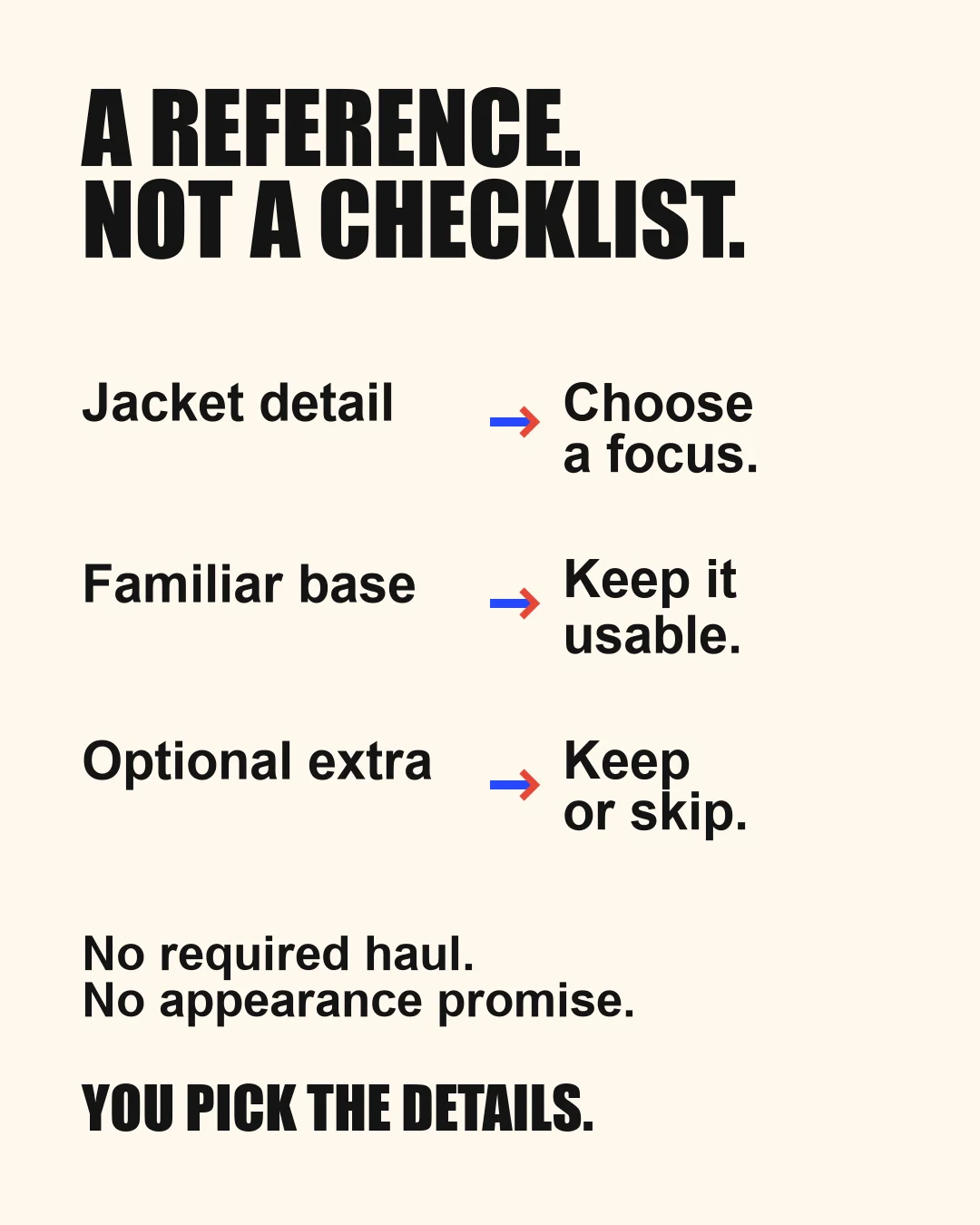
Graphic context — 02-feature-explainer: These original paired choices separate an inspiration reference from compulsory additions. The jacket detail, familiar base and optional extra are editorial roles, not validated components of a successful outfit or instructions to reproduce every part of a forecast.
Text equivalent: A REFERENCE. NOT A CHECKLIST. Jacket detail Choose a focus. Familiar base Keep it usable. Optional extra Keep or skip. No required haul. No appearance promise. YOU PICK THE DETAILS. Arrows mean choices, not equivalent benefits, tested combinations or universal wardrobe sufficiency. Pinterest forecast styling terms are a dated commercial editorial frame; WRAP supplies an archived existing-clothes campaign aim. Neither tests this sequence or establishes this reader owns suitable clothes. An essential belt, fastening, uniform or protective layer is not an optional styling extra. Keep practical requirements even when the reference looks different. Four complete primary publisher documents, not independent outfit studies. Pinterest December9,2025 published/December15 modified platform forecast; undated LondonMuseum history of a1987 commissioned photography project; WRAP August18,2020 page/campaign archived March31,2023; undated FTC cleaning-information overview. No current measured growth, tested routine benefit, clinical confidence, career outcome, legal guidance, saving or environmental result. Underlying archives, full forecast dataset and linked legal pages were not independently read.
3. Decide whether an extra detail adds anything
An accessory is optional. Before adding one, ask what you want it to do. Perhaps you want a small repeated colour, another substantial shape or nothing more at all. The answer can be to keep the jacket as the only feature you are actively emphasizing.
If you use an existing accessory, follow its actual instructions and consider the pairing with the garment and activity. This article does not recommend pinning, clipping, tightening or modifying anything to force a silhouette. It does not certify a particular fabric, piece of jewellery or fastening as safe for every combination.
Compare the outfit with and without the optional detail if that helps. You are choosing between two descriptions of a look, not running a validated attractiveness test. You may prefer the version with less detail, prefer the more elaborate version or decide that the difference does not matter enough to keep checking.
4. Check the outfit through the day it needs to serve
Consider ordinary actions relevant to the occasion: sitting, reaching for a bag, walking and putting on the outer layer you actually need. You do not have to perform a fixed set of movements or keep trying until you obtain a perfect result. Notice a practical conflict if one appears.
For example, a collar that looks striking while standing still may be inconvenient with the scarf or other layer you need. A jacket that works indoors may not be the right outer garment for the weather. Keep the functional item and change the styling idea if necessary; this is not a reason to tolerate discomfort.
If a garment needs repair or alteration, treat that as a separate decision. Follow the maker’s information or ask an appropriate garment professional about the actual item rather than improvising a structural change from a trend reference. An outfit guide cannot inspect construction or replace an item-specific assessment.
Treat the styling feature as optional. Do not remove a required uniform layer or protective garment to make the silhouette clearer, and do not loosen an essential fastening for the sake of a photograph. If the visual idea conflicts with coverage, access, movement or the actual setting, keep the practical requirement and skip the detail.
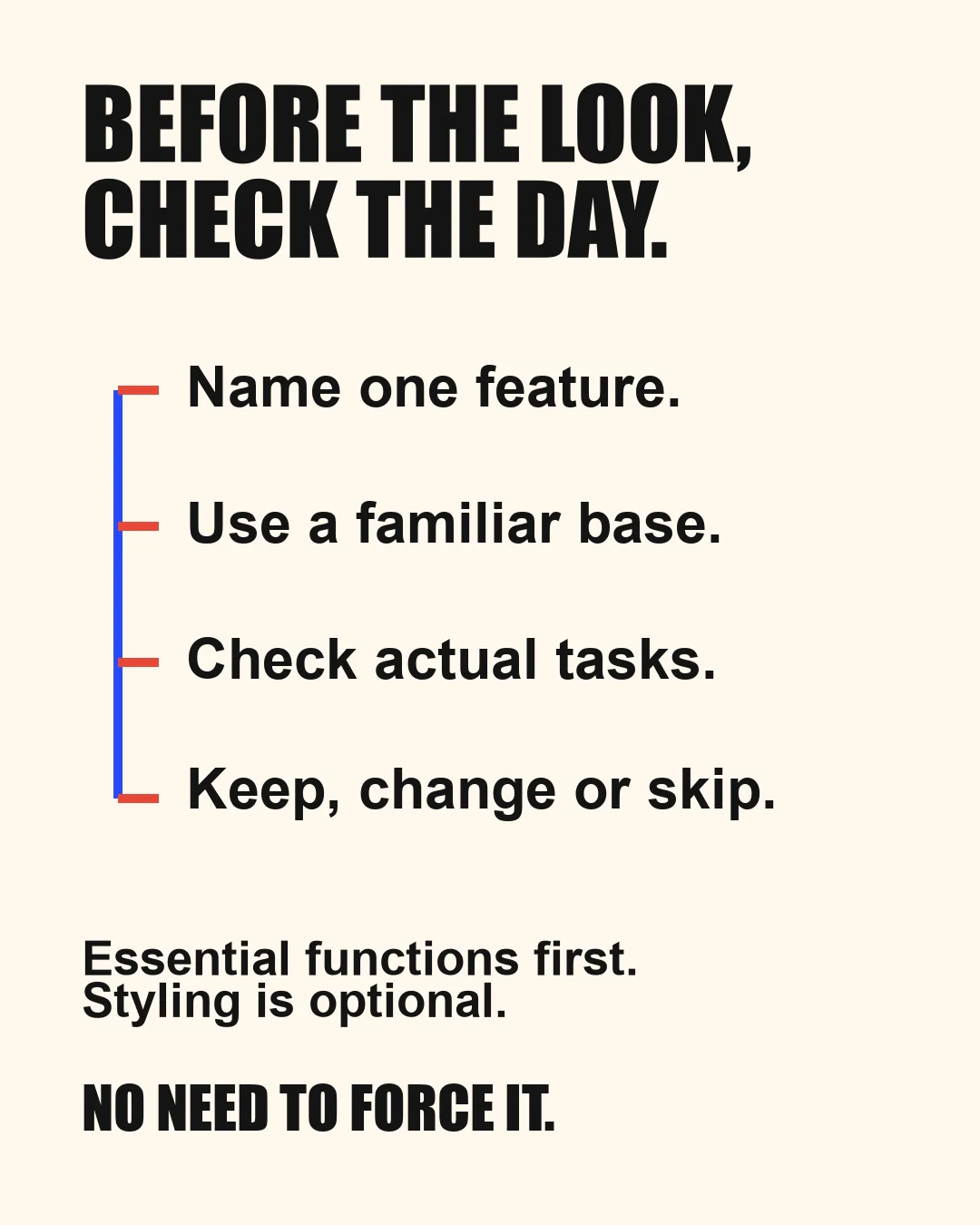
Graphic context — 03-routine-infographic: This original rail orders optional decisions: name a feature, use an already functional base, consider actual tasks and decide descriptively. It is not a garment safety test, a body assessment or a measured method for increasing confidence or improving outcomes.
Text equivalent: BEFORE THE LOOK, CHECK THE DAY. Name one feature. Use a familiar base. Check actual tasks. Keep, change or skip. Essential functions first. Styling is optional. NO NEED TO FORCE IT. Tasks, mobility, weather, coverage, access, uniform and protection requirements come before a silhouette. Do not loosen needed fastenings, remove required clothing or reshape a jacket for the diagram. FTC provides cleaning-information context only, not approval of construction, comfort or suitability. Unknown instructions, damage or needed alteration are reasons to stop and seek appropriate item-specific help rather than improvise. Four complete primary publisher documents, not independent outfit studies. Pinterest December9,2025 published/December15 modified platform forecast; undated LondonMuseum history of a1987 commissioned photography project; WRAP August18,2020 page/campaign archived March31,2023; undated FTC cleaning-information overview. No current measured growth, tested routine benefit, clinical confidence, career outcome, legal guidance, saving or environmental result. Underlying archives, full forecast dataset and linked legal pages were not independently read.
5. Stop when you have a usable answer
Choose the combination you want to wear, keep more than one option or return to an ordinary outfit. A useful decision can be small: this jacket with my familiar top, without the extra accessory. It can also be that the jacket is not suitable for this particular day.
A short note may help you remember the combination, but recording it is optional. There is no required daily routine, trend deadline or number of wears that establishes success. Your preference can change without making the earlier choice a mistake.
A jacket that does enough
Imagine a fictional reader, Sam, who owns a structured jacket with broad lapels. Sam sees a Glamoratti reference and initially considers adding a high-neck top, a large belt and several accessories. Before buying anything, Sam tries the jacket over a familiar shirt and trousers suitable for an indoor gathering.
Sam likes the lapels most when the shirt stays familiar and the extra belt is left out. On considering the journey, Sam realizes a separate weather layer will still be needed. The outfit is adjusted around that practical requirement, rather than around keeping the jacket visible at every moment.
The result is an outfit Sam chooses to use, not a demonstrated improvement in appearance or confidence. Sam, the wardrobe and the occasion are invented to illustrate a decision. None of the sources observed this case or tested its outcome.
For a counterexample, someone else might already enjoy several bold pieces together and find them suitable for the occasion. This guide does not establish that reducing detail is always better. Equally, a person with no suitable jacket can skip the idea without buying a substitute or failing a style test.
Graphic context — 04-practical-support: These invented day alternatives describe questions to ask, not observed wardrobes or ranked levels of style. A familiar jacket may fit one setting and be unsuitable for another. Actual clothing condition, activities, weather and setting requirements determine the choice.
Text equivalent: SAME JACKET. ACTUAL NEEDS. Indoor visit Check comfort. Travel + weather Keep layers. Uniform + tasks Keep requirements. Illustrative choices. Your setting decides. YOUR DAY COMES FIRST. Separate arrows do not imply a proven benefit, identical needs or permission to remove required layers. An indoor visit still involves actual comfort and access. Travel or weather can require additional functional layers. Work and activity retain uniform, equipment and protection requirements. Keeping several details, changing the optional choice or skipping the idea are all valid. No job status, gender, body ideal, purchase or universal appearance outcome is implied. Four complete primary publisher documents, not independent outfit studies. Pinterest December9,2025 published/December15 modified platform forecast; undated LondonMuseum history of a1987 commissioned photography project; WRAP August18,2020 page/campaign archived March31,2023; undated FTC cleaning-information overview. No current measured growth, tested routine benefit, clinical confidence, career outcome, legal guidance, saving or environmental result. Underlying archives, full forecast dataset and linked legal pages were not independently read.
Costs, risks and stop criteria
Using existing serviceable clothes can involve no purchase. It can still take attention, space and effort, and not every wardrobe contains an item that fits the idea. A new item, repair, alteration or paid consultation has its own actual terms and charges. No universal price, time range or guaranteed saving is supplied here.
Keep reversible choices first: try the existing combination, remove an optional extra or choose a different outfit. Do not cut, reshape, add structural padding or change a fastening to imitate a photograph on the strength of this guide. A reference image is not a construction plan.
If you use a private outfit photo, treat it as a reminder rather than an objective result. Lighting, pose, camera position and editing can change how the clothes appear. No before-and-after image, professional fitting or garment test was performed for this article. You can make the decision without taking or sharing a photograph.
Stop if the process becomes repetitive appearance checking, pressure to correct normal variation or a demand to buy the rest of a look. Use a comfortable familiar outfit instead. Persistent distress that interferes with daily life deserves suitable qualified support. This is a nonclinical styling guide, not a diagnosis or treatment.
The sources have different roles. Pinterest is a commercial platform presenting a forecast and shopping partnerships. London Museum interprets historical material. WRAP’s campaign page is archived, and the FTC page explains apparel information. They are not four studies of styling effectiveness. This article endorses no retailer, product or paid service.
How to assess the result
Ask whether you have an outfit you want to use for its actual purpose. Can you describe the jacket feature you enjoyed, the pieces you kept and any practical limit that changed the plan? A descriptive answer is enough; there is no body score or proof of social success to obtain.
For Sam, that might be: broad lapels, familiar shirt, no extra belt, proper weather layer for the journey. Another valid note could be that the collar conflicted with the needed outer layer and a different jacket was easier. Neither requires an explanation about the reader’s worth or identity.
You may find that the trend name becomes less important once the combination is clear. Keep it as a reference if it helps, or drop it and wear the clothes you like. An inspiration board can suggest a feature without becoming an obligation to own everything in the picture.
Myth or Real?

Claim
Social paraphrase: Using a Glamoratti trend reference requires reproducing every pictured or described detail.
Verdict
FALSE
Facts
A reference can inform an optional choice with suitable clothes already owned; it is not a compulsory shopping checklist.
FALSE rejects the requirement, not multiple details or the forecast description. Suitable owned clothes vary; skip if unavailable.
An archived original social question asks about inspiration without shopping and styling items already owned. It discovers a practical concern. The card explicitly reframes that concern as an editorial claim that a trend reference requires every detail; the questioner is not quoted or represented as holding that belief. Pinterest’s original December9,2025 forecast, modified December15, describes Glamoratti styling vocabulary. That dated commercial reference supplies neither a personal obligation nor a tested rule that every detail is necessary. WRAP’s August18,2020 page describes an existing-clothes campaign aim and explicitly says the campaign was archived on March31,2023. It is not a current active programme or evidence of savings, environmental benefits or effectiveness of this guide. These source scopes and the article’s editorial distinction support rejecting a compulsory checklist. FALSE does not mean that several details are wrong, that the forecast is false, that all readers own a suitable jacket or that an outfit will produce a particular appearance or social result. If no suitable owned clothes are available, skip the idea. Keep essential uniform, protection, coverage, access, movement and fastening functions. No buying, body ranking, garment reshaping, new padding, attachment method, photo or professional approval is required or claimed. Forum comments, app and influencer recommendations, styling anecdotes, votes and usage figures are excluded from verdict evidence.
Takeaway
Keep essential clothing functions and actual setting needs first. Choose an optional detail, change the idea or skip it.
Sources
Claim discussion: Archived original question about inspiration with clothes already owned.
Evidence: Pinterest Predicts: trends for 2026; Love Your Clothes.
Checked 2026-10-26. Scope: Nonclinical ordinary styling. Editorial reference-versus-requirement distinction, not a validated outfit intervention, universal wardrobe sufficiency, savings, current growth or professional clothing approval.


Sources
- S1 — Pinterest: Pinterest Predicts: trends for 2026, December 9, 2025. Commercial forecast vocabulary for Glamoratti; no current growth figures, demographic prescription, promotion or measured styling benefit adopted.
- S2 — London Museum: Office life in the 1980s, undated story accessed October 26, 2026. Museum interpretation of Anna Fox’s 1987 commissioned photography and historical power-dressing context; not a current workplace prescription or causal career finding. The underlying archive and book were not independently studied.
- S3 — WRAP: Love Your Clothes, August 18, 2020; campaign archived March 31, 2023. Archived aim to value and use existing clothes, not a measured saving or environmental result from this outfit.
- S4 — FTC: Apparel and Labeling, undated overview accessed October 26, 2026. Cleaning-information context only; no legal advice, garment-specific certification or new care and alteration protocol.
Four original publisher groups supply different kinds of context. The optional sequence and fictional example are original editorial applications. No independent outfit study, qualified garment assessment or clinical review was performed.
FAQ
Common questions
Do I need to buy clothes for Glamoratti?
This optional exercise starts with suitable clothes already owned. No purchase is required; if you do not have a suitable jacket or the idea does not fit your day, skip it.
Must I reproduce every detail in a trend reference?
A reference is inspiration, not a requirement to copy every detail. You can choose one feature, keep several details you like or skip the idea. Suitability and practical clothing needs remain first.
Does a structured jacket improve career outcomes?
This guide makes no career or confidence outcome claim. The museum material is historical interpretation, and the platform forecast is dated styling context. Neither tests a benefit of this routine.
Topic hubs
Tags