The vest has enough pockets to suggest an expedition. Your actual plan is an ordinary day, and the bag you already use is doing its job. You can like the look without inventing a new purpose for every flap.
Khaki Coded is useful as styling vocabulary, not a challenge to carry everything on your clothes. Begin with a suitable item already owned, keep the clothing and carrying arrangements you actually need, and decide whether the detail belongs in today’s combination. No expedition, shopping list or pocket-loading exercise is required.
Pinterest included Khaki Coded in its forecast for 2026, published in December 2025. Its reference combines khaki clothing, utility-inspired streetwear and pocketed vests. Those are ideas to consider, rather than evidence that a particular garment can carry a particular object, protect its contents or replace a bag. This guide makes an ordinary wardrobe decision; it does not assess outdoor equipment or test a trend’s benefits. [S1]
Who this is for
This guide is for someone interested in a pocketed shirt, vest, trousers or another familiar utility-inspired detail. You may already own something suitable. You may not. Either way, you do not need a particular body, gender, age, occupation or destination to consider the reference or leave it alone.
The starting point is your actual day and the clothes that serve it. Ownership, garment construction, condition, climate, preferences and access needs vary. A pocket-heavy reference is not a standard every wardrobe should meet. A simpler combination, a different liked detail or no change can be a complete answer.
Keep essential coverage, movement, access, weather protection, uniform, protective clothing and fastenings intact. Keep established arrangements for necessary items as well. A decorative exercise does not replace an existing safety, care, workplace or personal procedure, and it is not a reason to relocate something important.
This is a nonclinical clothing guide. It does not diagnose an appearance concern, inspect a garment professionally or offer a body intervention. Its practical result is a choice you can describe, rather than a score for toughness, attractiveness, organisation or independence.
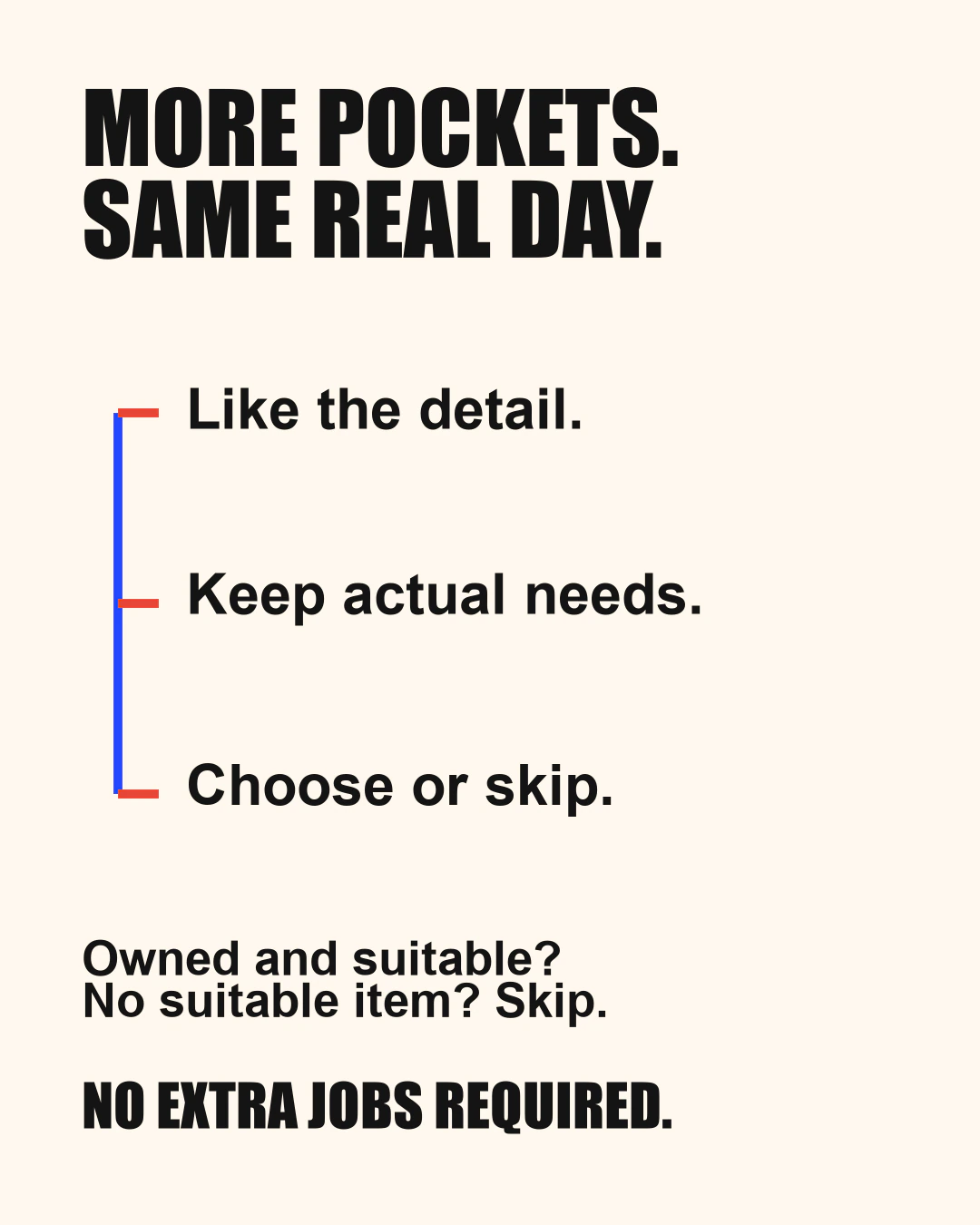
Graphic context — 01-article-hero: This original sequence separates liking an existing pocketed detail from changing what the garment needs to do. A suitable owned item is optional, and a style reference does not establish extra carrying capacity or require a new job for every pocket.
Text equivalent: MORE POCKETS. SAME REAL DAY. Like the detail. Keep actual needs. Choose or skip. Owned and suitable? No suitable item? Skip. NO EXTRA JOBS REQUIRED. The rail orders ordinary clothing choices, not measured improvements or a ranking of bodies. Essential coverage, movement, access, weather protection, uniform, protective clothing, fastenings and established arrangements for needed items remain intact. A bag can stay. Ordinary understood use is not forbidden, but this diagram neither assesses that use nor introduces a new loading pattern. No purchase, public photograph, contact, carry test or garment alteration is required. Four complete primary publisher documents, not independent outfit studies. Pinterest 9 December 2025 published/15 December modified commercial Khaki Coded forecast; V&A historical pocket interpretation, last updated 17 April 2024, with limited surviving records and exhibition dates distinct; WRAP 18 August 2020 page/campaign archived 31 March 2023 existing-clothes aim; undated FTC cleaning-information overview. Whole new retained native bodies read, not underlying books, archives, physical objects, full report/data, laws or cases. No current measured growth, percentages, demographic prescription, tested routine, clinical, career, saving, environmental or legal outcome. No modern capacity, load, security, protection or garment certificate, universal gender norm or wardrobe sufficiency.
Before you start
Separate appearance, information about the actual item, and the needs of the day. A reference can suggest a shape or colour. It cannot establish all the properties of a garment you own.
Pinterest’s dated forecast supplies the Khaki Coded label and utility-inspired vocabulary. This article does not adopt its search percentages, demographic framing, promotional material or language about desert conditions as a real-world equipment assessment. It makes no claim about measured October 2026 growth. The linked full forecast report and underlying data were not independently examined here. [S1]
History also complicates the idea that more pockets should automatically eliminate a bag. In its article on women’s tie-on pockets, the V&A describes historical examples in which pockets and bags coexisted and served different purposes. The page was last updated in April 2024. This is the museum’s historical interpretation, not a present-day carrying trial or a prescription for what any gender should wear. The underlying book, archives and physical objects were not independently inspected for this guide. [S2]
That account offers a useful question: what job are you actually trying to change? You might discover that you are not trying to change one at all. A familiar bag can remain part of the outfit while the pocketed garment supplies a visual detail. There is no need to manufacture a storage problem to justify liking the clothes.
For an existing-clothes starting point, WRAP’s Love Your Clothes page describes a campaign aim of valuing and making use of clothes already owned. The page is dated August 2020 and states that the campaign was archived in March 2023. An aim is not an observed outcome: this guide does not claim a current active programme, universal wardrobe sufficiency, measured saving or environmental benefit. [S3]
Information about the actual item remains separate from a historical account or photograph. The FTC apparel overview describes care information in relation to cleaning products. It does not inspect your garment, certify pocket capacity or decide how it suits your day. This guide draws no legal rule, right, deadline or refund promise from that overview and supplies no new cleaning or alteration method. [S4]
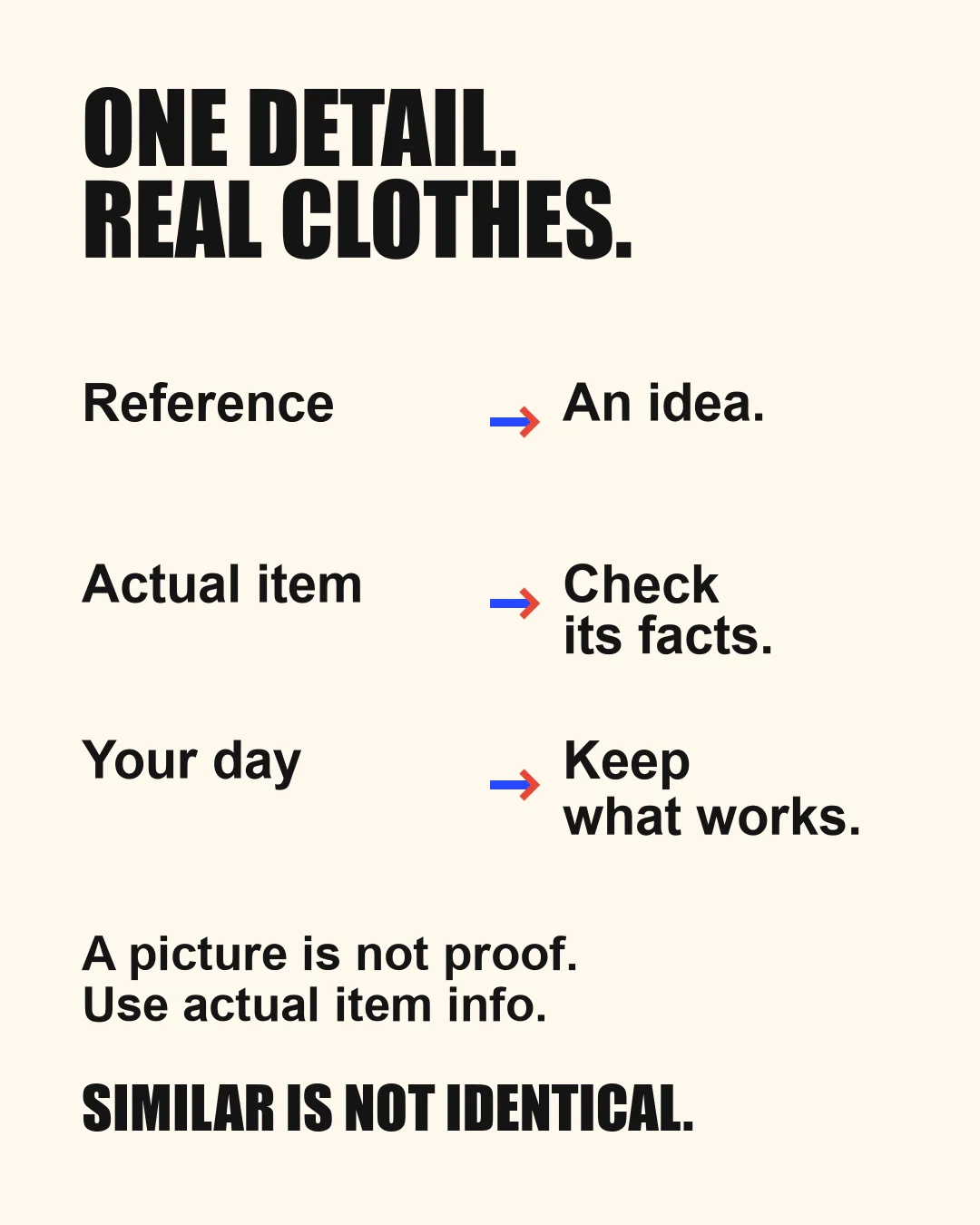
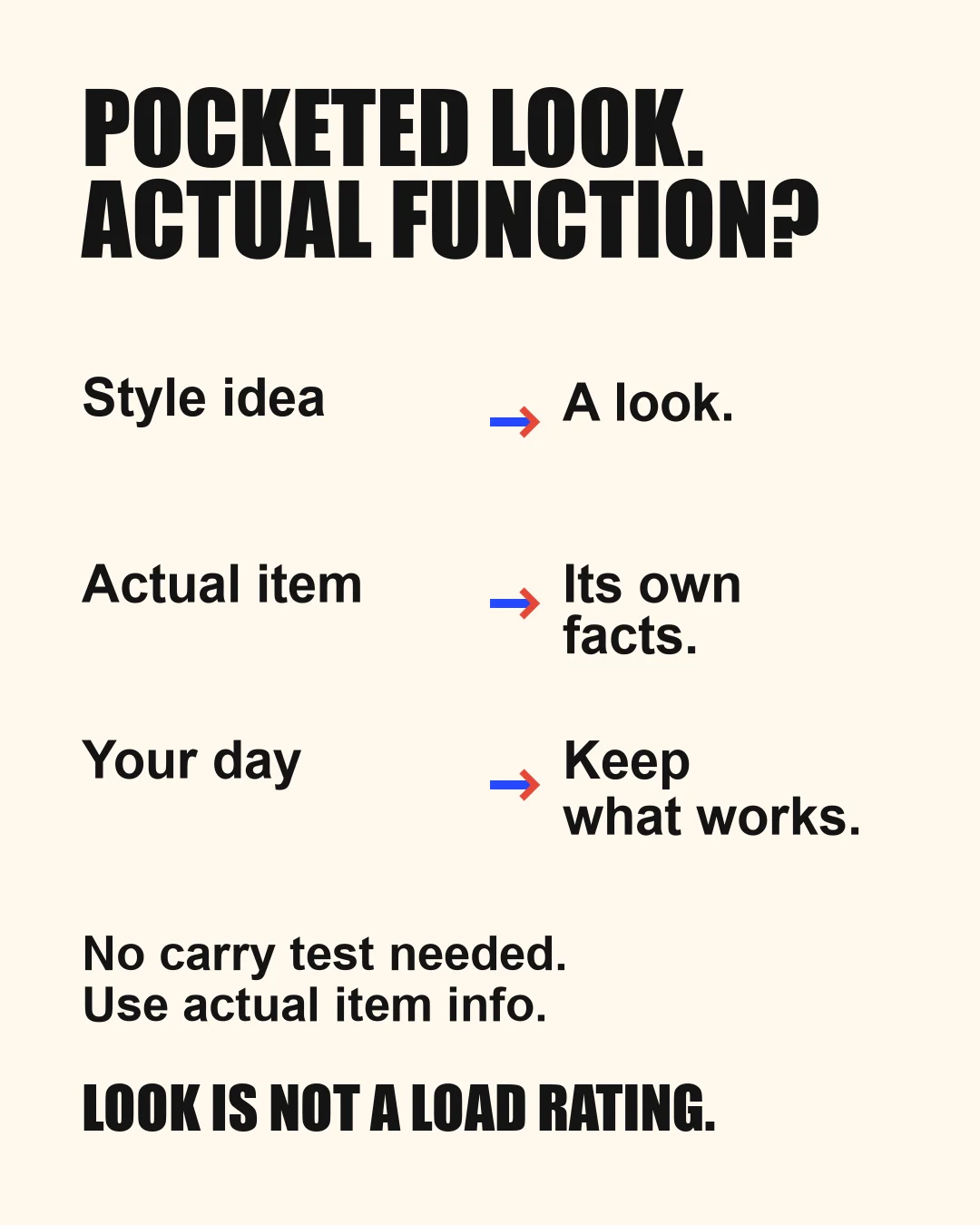
Graphic context — 02-feature-explainer: These paired roles separate a dated style idea, facts about the actual item and ordinary needs. The arrows do not transfer strength, capacity, retention, security, weather resistance or protective properties from a reference image to a garment.
Text equivalent: POCKETED LOOK. ACTUAL FUNCTION? Style idea A look. Actual item Its own facts. Your day Keep what works. No carry test needed. Use actual item info. LOOK IS NOT A LOAD RATING. Pinterest supplies dated Khaki Coded vocabulary, while the V&A supplies selected historical interpretation of pockets and bags serving different purposes. Neither examines a modern item or certifies it as equipment. FTC cleaning-information context answers a different question again. Use information for the actual item and keep important uncertainty explicit. Do not add a load, move essential items, stress-test a pocket or remove stitching to settle a styling choice. Historical tool-carrying, medical and construction passages are not adopted as advice. Four complete primary publisher documents, not independent outfit studies. Pinterest 9 December 2025 published/15 December modified commercial Khaki Coded forecast; V&A historical pocket interpretation, last updated 17 April 2024, with limited surviving records and exhibition dates distinct; WRAP 18 August 2020 page/campaign archived 31 March 2023 existing-clothes aim; undated FTC cleaning-information overview. Whole new retained native bodies read, not underlying books, archives, physical objects, full report/data, laws or cases. No current measured growth, percentages, demographic prescription, tested routine, clinical, career, saving, environmental or legal outcome. No modern capacity, load, security, protection or garment certificate, universal gender norm or wardrobe sufficiency.
Actions in order
Name the actual day
Describe the ordinary activities the clothes need to accommodate: sitting, travelling, moving around, required clothing and the weather you expect. Start with what already matters, rather than a story suggested by the reference.
Include established access and carrying needs without turning them into an experiment. If an existing arrangement serves an important purpose, leave that purpose intact. This exercise does not ask you to move medication, essential equipment, valuables or other necessary items into a new location, or to disclose what you carry.
You can keep the description private and general. You do not need an inventory photograph, a public outfit post or another person’s assessment. The useful question is whether the clothing fits your circumstances, not whether it convinces an audience you are prepared for an adventure.
Pick the part you actually like
Name a feature in plain words: an existing khaki colour, the outline of a familiar pocketed shirt, or the arrangement of pockets on an item you already understand. You do not have to reproduce every element in a reference.
Be precise about the goal. Wanting a utility-inspired appearance is different from needing a new way to carry something. The first can be a styling preference. The second would require information and decisions that a trend picture cannot supply. Do not quietly treat the first as proof of the second.
One feature can be an easy starting point, but it is not a rule against several. A fuller combination can also be valid if it suits your preferences and ordinary needs. You do not need to prove restraint, toughness or authenticity through either choice.
Choose a familiar owned option
Consider a serviceable item you already know how to use in its ordinary intended form. Read the information that belongs to that actual item. Similar-looking flaps, fastenings or fabric in a photograph do not establish identical construction, intended use or care.
If you do not know what a feature is intended to do, keep that uncertainty explicit. Do not pull at it, remove stitching, cut a seam, attach another pocket or improvise an alteration to make it match the reference. This guide does not provide a sewing, repair, pinning, unstitching or garment-conversion protocol.
No suitable owned item is a complete stopping point. You can retain the idea as a reference and wear familiar clothes instead. The exercise does not recommend a product, retailer, membership, paid service or new outdoor activity.
Keep function separate from the look
Place the optional item within a familiar combination that serves the actual day. Consider ordinary clothing use, necessary layers and access. Do not add a load, redistribute objects or create a carrying test to demonstrate the aesthetic.
A needed bag can stay. So can a necessary coat, uniform or protective item, even if it obscures some of the pocket detail. An outfit is not incomplete because its practical parts do not appear in the reference image. Necessary fastenings still need to do their normal job.
Keeping a bag is not an instruction to leave every pocket unused. An item you already understand may have an ordinary purpose that remains appropriate for your day. This guide does not assess that purpose or introduce a new loading pattern. The distinction is between liking the appearance and assuming an unverified extra function.
Treat an unknown capacity or storage property as unknown. This article supplies no weight limit, retention test, security assurance, weatherproofing claim or equipment certification. A style label, a historical example and cleaning information answer different questions from those properties of a particular item.
You can decide without a photograph. If you choose a private reference picture, lighting, pose, lens, distance and editing affect appearance. A photo is not a fitting, a comfort assessment, a load rating or proof that belongings will remain secure. There is no required before-and-after image or public upload.
Finish with a descriptive choice
The answer might be: I like the existing shirt and will keep my usual bag; the necessary coat hides the detail and is still the right layer; or this idea does not suit today. A short explanation is enough.
There is no requirement to find a job for every pocket or make the reference more extreme. Repeatedly adding and removing objects to obtain a particular silhouette is not the goal of this exercise. Keep the clothing decision separate from any actual storage decision that needs its own information.
Stop when you have a usable answer. No timer, wear frequency, audience reaction or resemblance score defines success. Return to the idea only if your interests or circumstances make that useful.
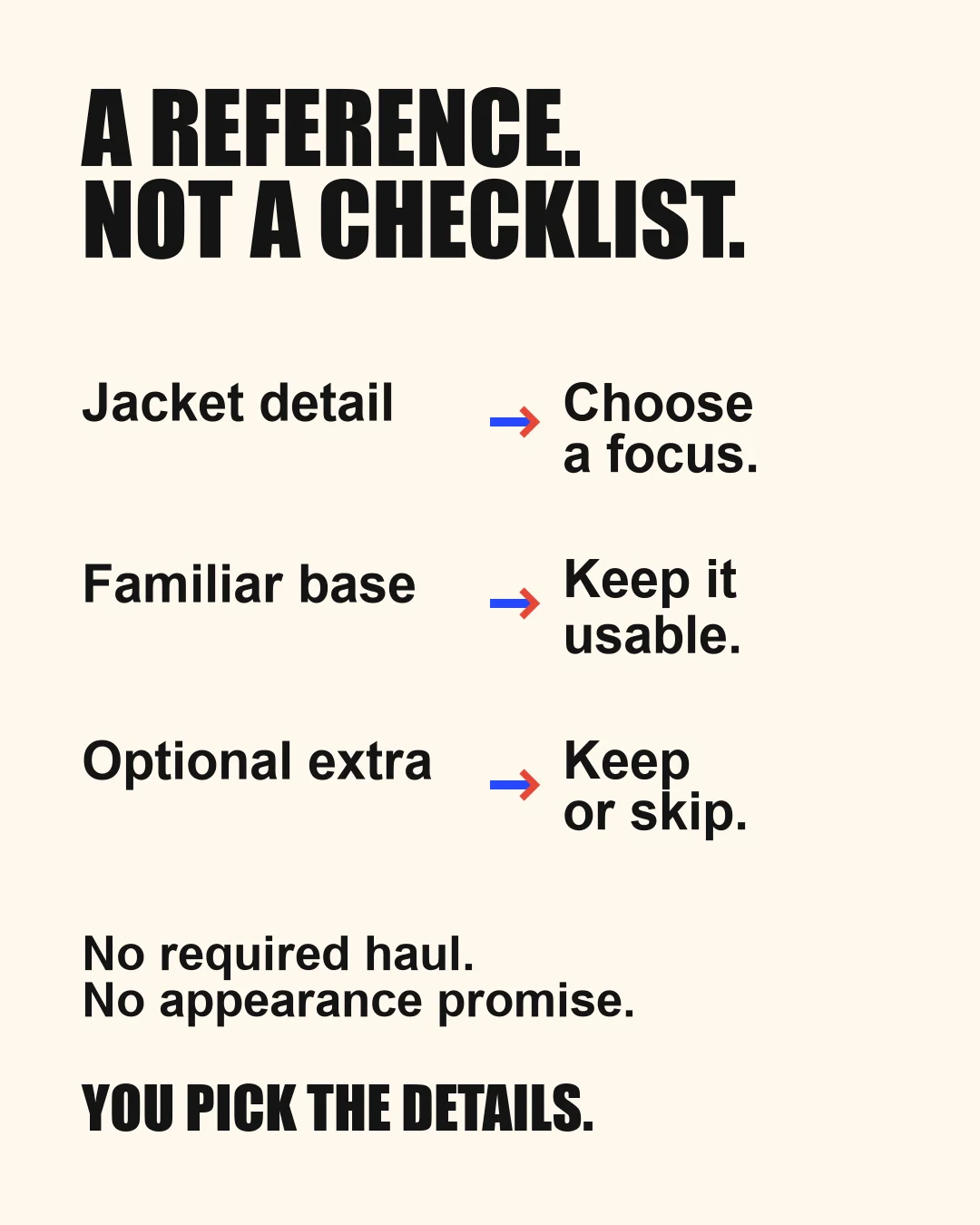
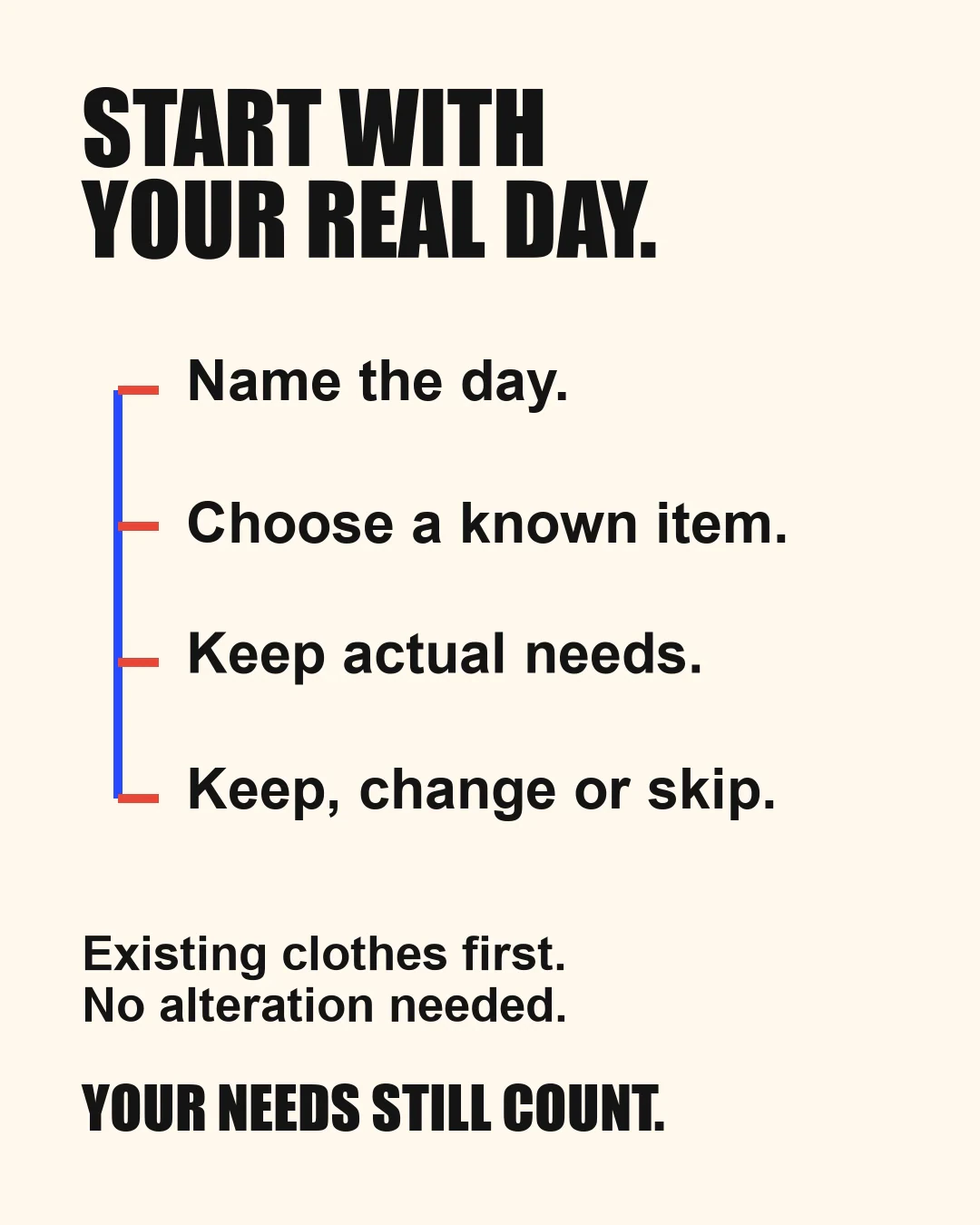
Graphic context — 03-routine-infographic: This original optional sequence starts with actual ordinary needs and a familiar owned item, retains essential functions and ends with a descriptive choice. It is not a tested routine, garment inspection or experiment with pocket loading or storage.
Text equivalent: START WITH YOUR REAL DAY. Name the day. Choose a known item. Keep actual needs. Keep, change or skip. Existing clothes first. No alteration needed. YOUR NEEDS STILL COUNT. Consider ordinary clothing use without creating a carry, capacity, security or stress test. Required coverage, access, movement, weather, uniform, protection and fastenings remain necessary. Keep established arrangements for necessary items and any applicable existing procedures. Do not cut, sew, pin, unstitch, repair or convert a fragile heirloom to copy the reference. Stop or choose something else if an item is damaged, uncomfortable, unsuitable or importantly uncertain. No score, price, timer or measured benefit is encoded. Four complete primary publisher documents, not independent outfit studies. Pinterest 9 December 2025 published/15 December modified commercial Khaki Coded forecast; V&A historical pocket interpretation, last updated 17 April 2024, with limited surviving records and exhibition dates distinct; WRAP 18 August 2020 page/campaign archived 31 March 2023 existing-clothes aim; undated FTC cleaning-information overview. Whole new retained native bodies read, not underlying books, archives, physical objects, full report/data, laws or cases. No current measured growth, percentages, demographic prescription, tested routine, clinical, career, saving, environmental or legal outcome. No modern capacity, load, security, protection or garment certificate, universal gender norm or wardrobe sufficiency.
A fictional shirt and a bag that stays
Consider Samira, an invented example rather than a participant or observed case. Samira already owns a serviceable pocketed shirt and likes how it looks with familiar trousers. Her ordinary bag is part of an arrangement she wants to keep for the day. She wears the shirt without assigning extra jobs to its pockets.
Keeping the bag does not cancel the styling choice. It answers a different question. Samira can like the shirt’s outline without claiming that its pockets have replaced the bag, created extra usable capacity or made the day more efficient.
Now change the conditions. The weather calls for a suitable outer layer that covers much of the shirt. Keeping that layer is a valid answer, even when the reference becomes less visible. Alternatively, Samira may prefer several utility-inspired details she already owns. Starting with one was a convenience, not a limit imposed on every outfit.
A final alternative matters: the available item is uncertain, unsuitable or uncomfortable, or there is no item Samira wants to use. She leaves the idea aside. None of these fictional choices predicts compliments, confidence, saving, safety, storage security or a change in other people’s behaviour.
Graphic context — 04-practical-support: These invented alternatives distinguish a liked suitable shirt, a necessary bag and the absence of a suitable item. They are not observations, ranked outcomes or equal benefits. Fictional Samira can keep the shirt and the bag because the choices answer different questions.
Text equivalent: POCKETED LOOK. BAG STILL HERE. Liked shirt Keep if liked. Needed bag Keep that bag. No suitable item Skip the idea. Invented alternatives. No wardrobe guarantee. DIFFERENT JOBS CAN COEXIST. Keeping a bag does not mean that all pockets must remain unused, nor that every person needs a bag. The diagram offers no new carrying arrangement or evaluation of ordinary understood pocket use. A necessary coat can cover the detail, several suitable details can be liked, and no suitable item can mean skipping. Historical complementary uses do not establish modern storage security or capacity. No buying obligation, equipment certificate, clinical, confidence, social, financial or environmental outcome follows. Four complete primary publisher documents, not independent outfit studies. Pinterest 9 December 2025 published/15 December modified commercial Khaki Coded forecast; V&A historical pocket interpretation, last updated 17 April 2024, with limited surviving records and exhibition dates distinct; WRAP 18 August 2020 page/campaign archived 31 March 2023 existing-clothes aim; undated FTC cleaning-information overview. Whole new retained native bodies read, not underlying books, archives, physical objects, full report/data, laws or cases. No current measured growth, percentages, demographic prescription, tested routine, clinical, career, saving, environmental or legal outcome. No modern capacity, load, security, protection or garment certificate, universal gender norm or wardrobe sufficiency.
Costs, risks and stop criteria
If a suitable owned item exists, no new purchase is required for this exercise. That does not mean every choice has zero total cost. Clothes may have prior purchase and normal care costs, your attention takes time, and separately chosen professional advice can use resources. No fixed price, amount saved or environmental effect is promised.
Stop using an item for this exercise if it is damaged, uncomfortable, unsuitable or importantly uncertain. Choose something else rather than forcing a detail, stress-testing a pocket or improvising a repair. Actual maker information or an appropriate garment professional may help with an item-specific uncertainty separately; no such professional has approved the clothes discussed here.
Do not trade essential clothing or established carrying needs for a picture. Required coverage, movement, access, fastenings, uniform and protection stay relevant. This guide does not replace existing instructions or procedures for work, travel, care or an activity. It does not establish that ordinary clothing is appropriate equipment for a different environment.
An optional style idea can also become unhelpful if it turns into repeated appearance checking or pressure to buy a complete identity. Put the exercise aside if that happens. Persistent appearance worries that interfere with everyday life deserve suitable qualified support; extending a clothing exercise is not a treatment. This is a boundary, not a diagnosis.
You do not need to disclose possessions, recruit someone to judge an outfit, contact a creator or purchase approval. Your actual comfort with the exercise and existing personal boundaries matter. Choosing not to engage is allowed.
How to assess the result
Ask whether you can name the feature you liked, the actual item you chose and the day it needs to serve. Also ask whether essential clothing functions and established arrangements remain intact. Those are descriptive questions about a choice, not tests of attractiveness, preparedness or personal worth.
A pocketed item with a bag can be a useful answer. So can several suitable details, a necessary outer layer that hides the reference, or no change at all. The amount you carry does not measure how successfully you have followed a styling label.
Revisit the choice when the activity, weather, item condition or your preferences change. A trend name does not create a duty to update your wardrobe, and owning an item does not create a duty to wear it. A picture that interested you can remain just that.
The sources have distinct roles: a forecast supplies vocabulary, a museum interprets historical clothing, an archived campaign states an aim, and an apparel overview explains cleaning information. None tests this original sequence, inspects a modern garment or demonstrates a clinical, social, financial, environmental or storage benefit. The ordered choices and fictional alternatives are editorial applications within those limits.
Myth or Real?

Claim
Social paraphrase: Bags and pockets are an either-or choice.
Verdict
FALSE
Facts
They can serve different purposes. The V&A historical account describes pockets and bags coexisting.
Historical examples reject an absolute either-or claim, not a carry guarantee or a universal need for a bag.
An archived AskReddit question asks whether larger pockets would change a reason to carry a handbag. It discovers the practical topic. This card explicitly reframes an absolute either-or claim for editorial examination; it is not a quotation or a belief attributed to the questioner. Gender wording, forum comments, anecdotes, brands, votes and clinical or political speculation are not evidence or advice. The Victoria and Albert Museum historical account describes pockets and bags coexisting for different purposes. Its page was last updated on 17 April 2024; exhibition dates in 2021–2022 are distinct. This historical counterexample rejects an absolute either-or relationship. It does not rate a modern garment or assess pocket strength, capacity, security, comfort, care or protective performance. The underlying book, archives and physical objects were not independently inspected. Pinterest’s forecast, published in December 2025, supplies pocketed styling vocabulary only. It is not evidence of current growth, actual gear capacity or this guide’s effectiveness. FALSE does not mean everyone needs a bag, every pocket should stay empty, or an established appropriate use must change. Keep actual clothing needs, needed items and existing suitable arrangements first. No loading, carry, stress or security test, purchase, contact, photo or garment construction is required. Historical medical, crime, tool-carrying and DIY details are excluded. Complete source roles and limits remain adjacent; no professional garment approval or clinical outcome is claimed.
Takeaway
Keep actual needs first. A pocketed appearance does not require abandoning an established suitable arrangement.
Sources
Claim discussion: Archived original pockets-versus-handbag question.
Evidence: Women’s tie-on pockets; Pinterest Predicts: forecast for 2026, Khaki Coded.
Checked 2026-10-26. Scope: Nonclinical ordinary clothing choices. No modern capacity, security, load, care, comfort or protection certificate, universal bag requirement, new carry test, compulsory purchase or construction.


Sources
- S1 — Pinterest, forecast for 2026. Published 9 December 2025 and modified 15 December 2025 in retained native metadata. The whole original native body was read, including Khaki Coded. Commercial platform forecast context only; percentages, demographic prescriptions and equipment or desert-condition implications are not adopted. Linked full report and underlying data were not read or reproduced. Pinterest forecast.
- S2 — V&A, Women’s tie-on pockets. Page states last updated 17 April 2024; the linked exhibition dates are separate. Whole retained native body read, including its discussion of pockets and bags serving different purposes and its limits on surviving historical evidence. Historical accounts, quotations and object examples are not modern carrying, medical, security or construction advice. The underlying book, archives and physical objects were not independently examined. Museum institutional and shop context is not a recommendation. V&A pocket history.
- S3 — WRAP, Love Your Clothes. Page dated 18 August 2020; campaign archived 31 March 2023. Whole retained native body read. Existing-clothes aim only, with campaign and partner context; no active programme, universal wardrobe sufficiency, saving or environmental result claimed. Linked reports and data were not examined. Archived campaign.
- S4 — FTC, Apparel and Labeling. Undated overview, accessed 26 October 2026. Whole retained native body read, with cleaning information separated from linked case, news and business-guide listings. Underlying laws, cases and guides were not read or applied as legal advice. No garment inspection, load rating, security or protection certificate, or care method is supplied. Apparel overview.
No sponsorship, affiliate links, product ranking or qualified clinical or garment review is claimed. These are four publisher roles, not four independent outfit studies.
FAQ
Common questions
Does a pocketed look mean I should stop using a bag?
No. A liked detail does not require changing an established suitable arrangement. The V&A historical account describes pockets and bags serving different purposes; it does not assess modern carrying capacity or mean everyone needs a bag.
Does Khaki Coded mean adventure-ready clothing?
The dated forecast supplies styling vocabulary. It does not certify your garment for a journey, protective purpose, load or security function. This guide keeps actual needs and established procedures unchanged.
Do I need cargo trousers or a new vest?
No purchase is required. Start with suitable items already owned, keep the functions your day needs and skip the idea if no appropriate option exists. More than one liked detail is also allowed.
Topic hubs
Tags