

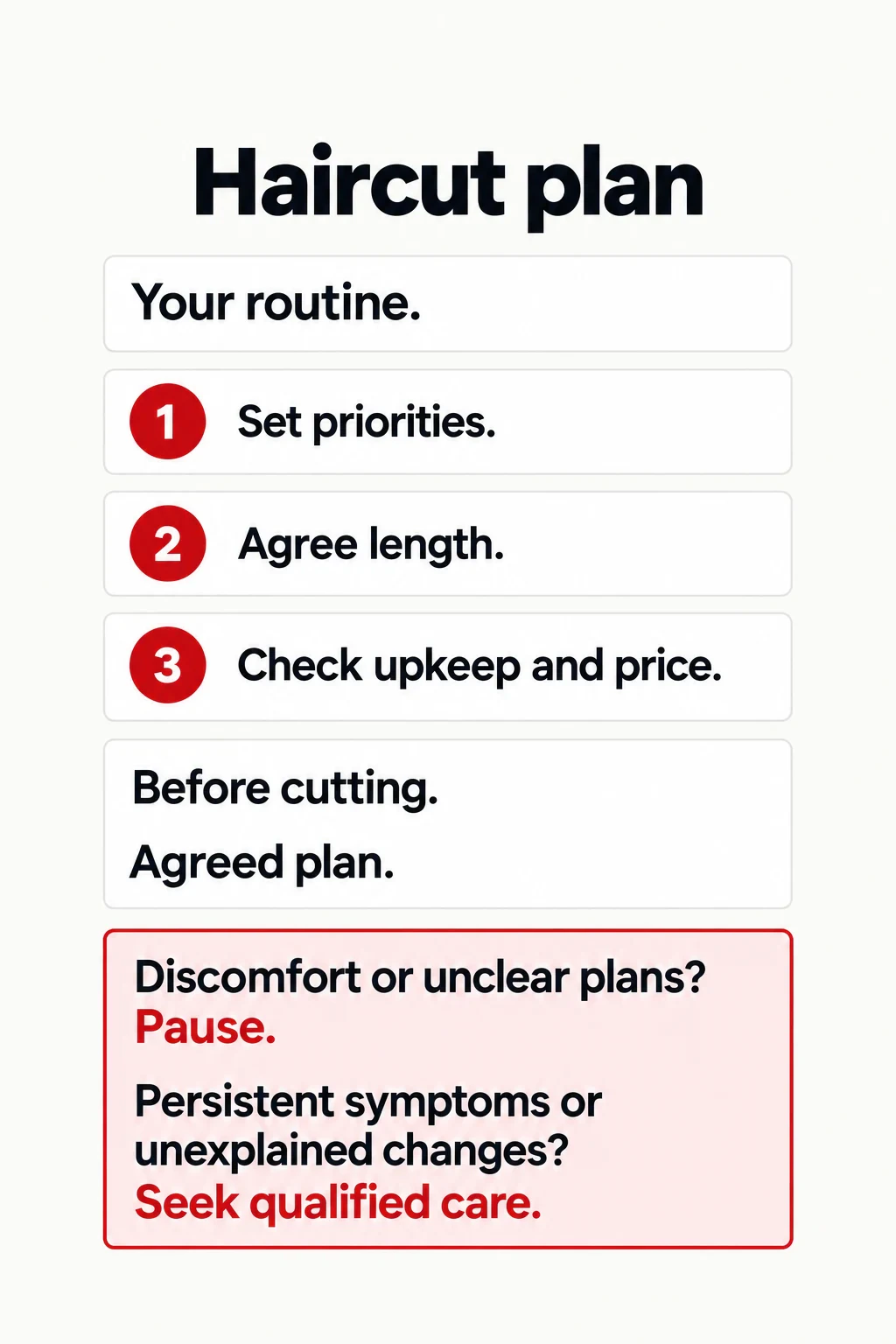
A useful haircut consultation ends with an agreement you can explain: what will change, what will stay, how the result is likely to behave in your usual routine, and what you are agreeing to pay for. A photograph can start that conversation. It cannot settle all four questions by itself.
You do not need a more attractive face, a different hair texture, or a collection of salon vocabulary to take part. Bring a preference, a practical constraint, and permission to ask for clarification. A successful appointment can include choosing a smaller change or deciding to wait.
Who this is for
This guide is for adults preparing for an ordinary haircut with a barber or hairdresser, especially when a previous result was difficult to describe or maintain. It covers consultation and decision making, rather than instructions for cutting your own hair, chemical services, extensions, or treatment for hair loss or scalp disease.
The supporting sources are professional training documents and practical salon guidance. Historical Skills England material describes establishing expectations and using consultation aids; SQA’s 2021 assessment strategy includes communication and professional boundaries. These show what those documents teach, rather than proving that a particular conversation guarantees satisfaction. The older Skills England version is retired, and neither document establishes today’s licensing rules everywhere. Skills England, version 1.1, SQA assessment strategy.
Milady sells professional education, and Great Clips operates salons. Their commercial interests are relevant when reading advice about products and repeat visits. Their consultation questions can be useful without making either company your recommended provider. There are no affiliate links, sponsored placements, or personal haircut test results in this article.
Before you start
Write down what bothers you in a normal week. Perhaps the front falls into your eyes, the sides are awkward under headphones, or the haircut only looks familiar after a long styling session. Be specific about the experience rather than describing your head or face as a problem.
Then identify something you want to keep: enough length for tying back, coverage around the ears, a familiar parting, or the ability to leave the house without a heated tool. A request to preserve a feature is as useful as a request to remove one. Say which point matters most if the preferences conflict.
If you use reference photographs, choose images for identifiable features. You might like one person’s outline and another person’s longer fringe. Make that distinction aloud; otherwise the stylist has to guess which detail you mean. An old photograph of your own hair can also help explain what worked, provided you describe the routine that produced it.
Images have limits. Lighting, angle, styling, extensions, filters, and editing may change what appears achievable. A photograph usually cannot establish how a cut feels, how long its styling took, or what it does after washing. A reference photo is not a diagnosis. If you share a comparison of your own, similar lighting, angle, distance, and styling conditions make the comparison easier to interpret. You never need to provide a photograph you are uncomfortable sharing.
Before booking a substantial change, ask whether the appointment includes time for a consultation and whether consultation alone carries a charge. Explain any communication or access needs that affect the conversation or appointment. Written notes, a quieter explanation, or a pause before agreement can be useful arrangements to request; availability needs confirming with the actual provider.
Actions in order
1. Describe your ordinary routine first
Tell the stylist what happens on a usual morning: whether you air-dry, which tools you already use, how much time you want to spend, and whether you tie back or cover your hair. Mention relevant work, sport, or equipment constraints without assuming the same cut will suit every situation.
Milady’s consultation training discusses daily styling time, tool comfort, and hair characteristics. Use those topics to make your own limits clear. You do not have to adopt its sales suggestions or agree to a new product routine. Milady consultation guidance.
For example, “I like this outline, but I usually air-dry and need the front out of my eyes” gives the stylist more to work with than “make it look exactly like this.” A routine you will actually follow is a more useful starting condition than an ambitious routine you expect to abandon.
2. Translate the photo into a few decisions
Point to a feature and ask what it would mean on your actual hair. The questions below are examples to adapt, rather than a script everyone must complete.
| Feature you notice | Question to settle before cutting |
|---|---|
| Length around the face | Where would that section sit when worn in my usual way? |
| A short-looking side | What length and amount of exposed ear are we agreeing on? |
| Movement or separation | Is that mainly the cut, styling, or both in this image? |
| A neat outline | What changes first as it grows, and what upkeep would you expect? |
| An easy-looking finish | Can we discuss the result with the tools and time I already use? |
Ask which feature needs adaptation and why. Natural texture, growth patterns, existing length, and previous work can affect a proposal. That is a practical discussion, not a ranking of hair types or a rule that a particular face must be disguised.
If the explanation is unclear, ask for a demonstration of the proposed outline or a simpler description. Different people use style names differently. Agreement on visible boundaries and everyday behaviour is more informative than agreeing on a fashionable label alone.
3. Agree on length in a shared way
“Just a trim” leaves the amount open to interpretation. Ask the stylist to show the proposed amount and where the finished sections are intended to sit. Confirm whether the explanation refers to wet, stretched, dried, or styled hair where that distinction affects your understanding.
State any limit directly: keep enough length to tie back, do not expose more of an area than agreed, or check again before shortening a particular section. These are requests to settle together, not promises that every combination of preferences is technically possible. Ask what can be achieved while respecting the priority you named.
Do this before the relevant cutting starts. A preview or demonstration can help a conversation, but it is not an exact simulation of the finished haircut. Once length has been removed, it cannot be put back by changing your mind. A smaller agreed change may therefore make sense when uncertainty remains.
4. Separate the haircut from the salon finish
Ask what part of the proposed result depends on styling. A cut and a polished salon finish can be different purchases and different ongoing commitments. If the look depends on a tool or product you do not want to use, discuss an alternative before accepting the cut.
Request an explanation or demonstration using an approach you can manage. You can ask what an optional product contributes without buying it. If you already own something suitable, ask whether it can serve the intended purpose; do not assume a particular branded purchase is essential because it appears beside the reference image.
Great Clips suggests asking about styling, grow-out, and repeat visits. Those questions are useful prompts, but its article does not establish a universal maintenance interval. Ask how the proposed shape is expected to change between your own appointments. Great Clips consultation questions.
5. Confirm scope, price, and the next check
Before proceeding, confirm the agreed cut, included finish, and quoted price. Ask whether washing, a longer consultation, additional styling, or another proposed service changes the charge or appointment time. Prices vary by provider and service, so this guide supplies no invented local price range.
Also ask what maintenance would involve if you choose the style: the likely type of follow-up service, its quoted cost, and whether a longer gap changes the proposal. An estimate is still an estimate. It should help you decide whether the ongoing commitment fits your available money and time, rather than pressure you into booking immediately.
If you need a moment to decide, say so before work begins. Confirm the plan again if the proposed service changes during the conversation. Consent to one cut is not an instruction to add every treatment or product discussed.
A short note to bring with you
Here is an invented example of a consultation note, not a customer result or a promised styling time:
- Priority and boundary: Keep enough length to tie back. The front falling into my eyes is the inconvenience I want to discuss; show me the proposed front length before cutting.
- Reference and routine: I like the softer outline in this photo, but I usually air-dry and do not want to add a heated tool. Which part of that outline depends on styling?
- Decision still to settle: Explain the likely grow-out, included finish, total quote, and upkeep before I choose. If keeping tie-back length conflicts with the photo, preserve the length and discuss an alternative.
Your note can be shorter. Its purpose is to reveal a conflict while there is still time to choose, rather than lock the stylist into an unworkable instruction. Ask them to describe the agreed plan back to you before the cut begins.
Costs, risks and stop criteria
Consider the whole routine, including appointment travel, styling time, supplies you actually choose, and future visits. You can decline an optional purchase, ask for a lower-maintenance alternative, or postpone the change. None of those choices makes your current hair inadequate.
Observation, discussion, a temporary change in parting or styling, and a smaller proposed cut come before a larger commitment when that order helps you decide. Temporary styling is an option to discuss, not a guarantee of the same result after cutting. Avoid treating “hair grows” as a promise that an unwanted change will disappear on a predictable personal schedule.
Pause if you cannot explain the agreed length, the stylist cannot clarify a major uncertainty, the proposed upkeep exceeds what you are willing to do, or the quote and service scope remain unclear. Raise discomfort immediately during an appointment. You do not need to endure pain or irritation to obtain a particular appearance.
A consultation is also not a medical diagnosis. SQA’s assessment strategy explicitly covers professional limits and avoiding naming specific conditions when referring a client. If you have persistent pain, irritation, or unexplained changes in your hair or scalp, seek an appropriately qualified healthcare professional rather than asking a haircut to solve the problem. This article does not recommend a drug, medical device, clinical procedure, or scalp treatment. SQA, consultation knowledge areas on page 9.
Myth or Real?

Claim
Social paraphrase: Reference photos can help explain a haircut preference.
Verdict
REAL
Facts
A picture can be a conversation aid when you explain the details and discuss how they apply to your actual hair and routine.
Professional training and practical guidance support this use, not exact reproduction, a validated protocol or guaranteed satisfaction.
An archived public post recommends showing reference photos and then discussing liked details, styling and maintenance. Its author describes being a hairdresser; that credential and any customer outcome are not independently verified. The narrow claim is consistent with a retired Skills England standard listing visual aids for consultation. Milady asks stylists to discuss length, tools, time and whether a proposal translates to the person’s hair. These are training and commercial guidance, not trials showing that photos reliably improve satisfaction. A picture may omit styling effort, filtering, angle, extensions or other context. It cannot guarantee an identical cut or replace agreement about actual hair, preserved length, upkeep and the quote. You may decline a photo you do not want to share, choose a smaller change or wait. The original post already includes consultation; its advice is not treated as a universal promise or evidence that a client must know professional jargon. The whole optional consultation reminder is not a validated protocol. Persistent pain, irritation or unexplained hair/scalp changes need appropriately qualified healthcare advice. Two primary documents are reused from the four-publisher article set; the social link adds no factual authority or fresh demand.
Takeaway
Agree details, limits, upkeep and the actual service scope before cutting; a smaller change or waiting remains possible.
Sources
Claim discussion: Archived r/Hair: Advice from a hairdresser: just show them the reference..
Evidence: Skills England: Hair professional ST0213 version1.1, retired; Milady: Smart Strategies for Successful Client Consultations.
Checked 2026-10-20. Scope: Ordinary adult haircut consultation only. Retired training and commercial guidance are not trials or current licensing law. No exact photo replication, diagnosis, medical treatment, compulsory product or guaranteed result.
How to assess the result
Return to the concern you brought, rather than comparing every detail with an edited photograph. Can you manage the front, wear the relevant equipment comfortably, or complete your chosen routine within the time you allowed? Check under your usual conditions when you have a reason to assess it; constant photographs and repeated mirror checks are unnecessary.
If something is unclear before leaving, ask for the styling explanation again. If a concern appears later, describe the specific section and circumstance when contacting the provider. Ask what an assessment or adjustment would involve and whether it carries a charge before agreeing to further work. Do not assume another large cut is the right correction before discussing the cause of the difficulty.
Keep a short note of what was agreed and what worked in practice. A future consultation can then start with a real observation: the length was manageable, the front needed more styling than expected, or a particular outline was comfortable. A useful result is a choice that fits your preferences and routine. It does not need to reproduce another person’s hair or establish a new appearance standard.


Sources
- Skills England: Hair professional, ST0213 version 1.1. Retired version, used only for historical consultation and communication teaching; current qualification and licensing claims excluded.
- SQA: Assessment Strategy, SVQ Hairdressing at SCQF level 6. Actual document cover identifies version 3, approved 13 October 2021; consultation unit and professional boundaries, especially page 9.
- Milady: Smart Strategies for Successful Client Consultations. Commercial education guidance, undated; haircut questions only, with sales and clinical claims excluded.
- Great Clips: The best questions to ask your hairstylist to get your perfect haircut. 20 May 2024; commercial salon guidance used for maintenance questions, without adopting its outcome or health claims.
FAQ
Common questions
Does a photo settle the whole haircut plan?
A photograph can start that conversation. It cannot settle all four questions by itself.
Can I choose a smaller change or wait?
A successful appointment can include choosing a smaller change or deciding to wait.
Must I share a photo I am uncomfortable sharing?
You never need to provide a photograph you are uncomfortable sharing.
Topic hubs
Tags


