

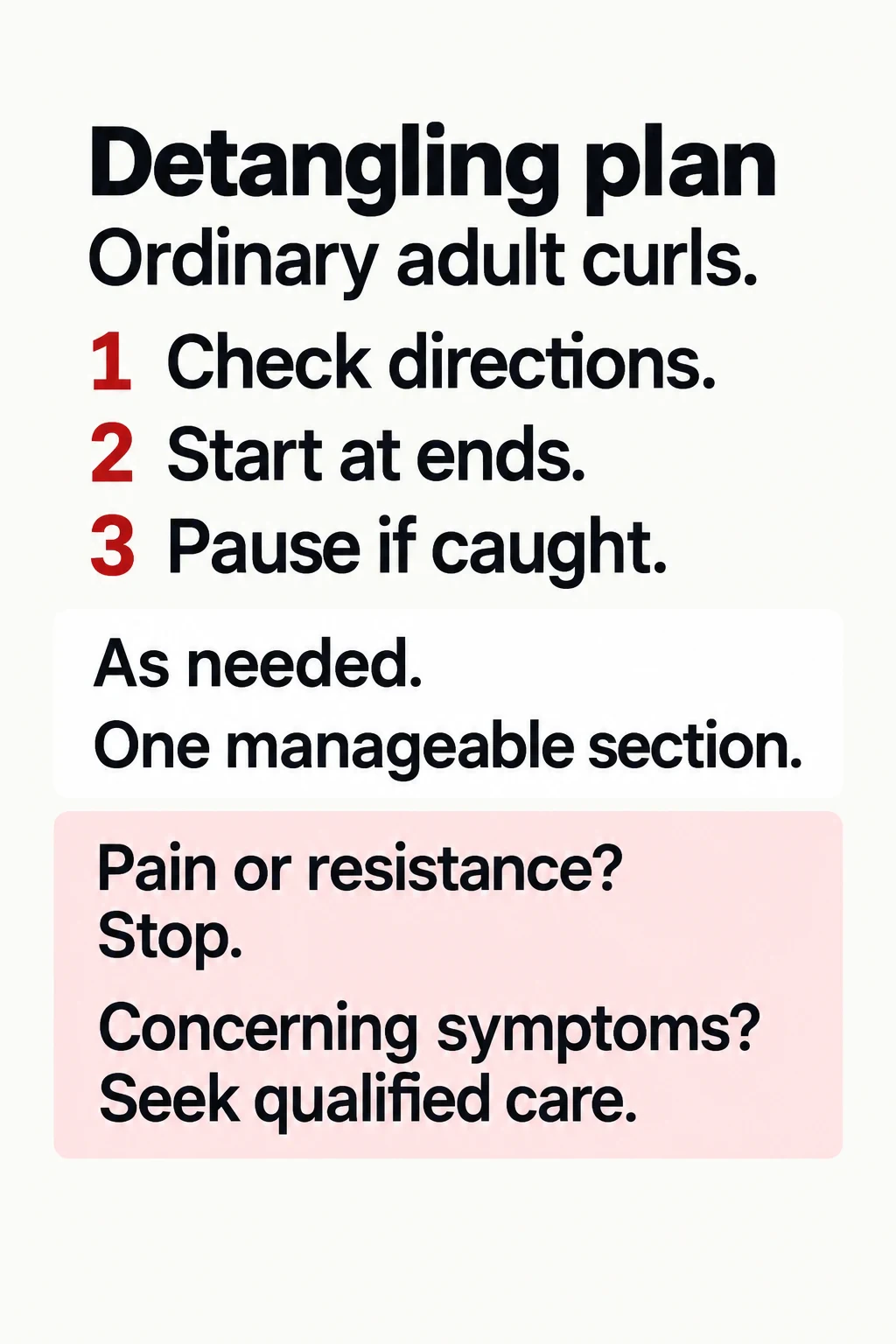
Start with a manageable section, a suitable tool and the instructions for the conditioner or detangling product you actually use. If a knot resists gentle work, more force is not a useful success target. Pause, check the method and get suitable help when the problem exceeds ordinary personal care.
This guide concerns everyday adult curly- or coily-hair grooming. It does not promise a measured reduction in breakage, diagnose hair loss or treat a scalp condition. The practical aim is a routine you can follow without forcing a tool through resistance or turning curl appearance into a judgment about yourself.
Who this is for
You might be working through ordinary tangles between washes, changing an uncomfortable brushing habit or checking whether a particular brush suits the way you use it. Hair length, density, pattern, previous processing and the products already present can differ. A product category or curl label alone does not tell you every detail of the routine that will suit you.
The guide excludes severe matting, extensions or specialist attachments needing their own instructions, medical devices, chemical services and treatment for a hair or scalp disorder. Do not transfer a general routine to those situations. A suitable hair professional can assess grooming difficulties; persistent pain, scalp symptoms or concerning changes call for appropriate healthcare guidance.
Normal variation in curls, volume and texture does not require correction toward an ideal. There is no attractiveness score or compulsory straightening step here. Success means making a reasonable care decision, including stopping an unsuitable method, rather than achieving a photographed transformation.
The sources also have different roles. The American Academy of Dermatology gives general curly-hair care guidance. Tangle Teezer and Wet Brush describe named tools, while Ouidad offers a commercial detangling guide. The three brands sell related products. These documents are not four independent trials of the complete routine in this article. AAD, Tangle Teezer, Ouidad, Wet Brush.
Before you start
Identify the actual hair and tool conditions
Check whether your tool is intended for the wet or dry conditions in which you plan to use it. The AAD’s curly-hair guidance describes wetting and conditioning for between-wash detangling, with fingers or an appropriate comb or brush, and working in sections. That curly-hair context is more specific than a generic brush advertisement saying it works on wet and dry hair. AAD curly-hair guidance.
A tool’s advertised range does not establish that every technique is suitable for every head of hair. Tangle Teezer’s selected Ultimate Detangler page describes wet-hair use and warns against heat. Wet Brush’s selected Original Detangler page describes wet and dry use. These are statements about those named products, without making other brushes interchangeable or authorising heat styling with either. Tangle Teezer, Wet Brush.
Read the current tool instructions and product packaging. A rinse-out conditioner, leave-in conditioner and detangling spray can have different directions. Do not take an application amount from one product, a waiting time from another and a rinse decision from a third to create a universal recipe.
Keep the setup simple
Use a comfortable position and a work area where you can handle the section without pulling it taut to reach. Keep any tool clean and in a usable condition according to its own care instructions. Check for obvious damaged teeth or bristles rather than assuming that an expensive or familiar brush must be suitable.
You do not need to buy a special collection before trying a sensible adjustment to ordinary care. Existing suitable fingers, comb or brush and a compatible product may be enough for the task at hand. If the instructions or compatibility are unclear, ask the manufacturer or a suitable professional before adding more products.
There is no universal number of sections or required session length in this guide. Choose a portion you can handle gently and allow time to stop. A smaller, understandable task is preferable to rushing through the whole head to meet an invented timer.
Actions in order
1. Choose a method that matches the instructions
For ordinary curly or coily hair, begin with the relevant wet-and-conditioned care context rather than treating dry pulling as something to endure. The AAD describes applying a leave-in conditioner for between-wash detangling. Ouidad’s selected guide describes conditioning wet hair and using sections. Neither makes every conditioner a leave-in or establishes that a particular commercial formula is essential. AAD, Ouidad.
If your hair has been processed, has specialist attachments or needs another care arrangement, follow the relevant instructions and ask for suitable guidance. This article cannot verify an unknown product combination or decide that a symptom is merely a cosmetic inconvenience.
Avoid adding heat or a chemical service to make this routine work. Ordinary detangling does not require improvising a treatment, mixing chemicals or increasing a product’s concentration. A difficult section is a reason to reassess the method rather than automatically escalate it.
2. Work with a manageable section and start near the ends
Ouidad’s guide recommends starting at the ends and moving upward as tangles are loosened. Treat that as a gradual way of approaching the section, without forcing a comb from the roots through a knot below. Keep handling gentle and notice resistance. Ouidad detangling guide.
Use the suitable fingers or tool within its intended conditions. Make a limited pass through the part you can manage; do not keep scraping the same resistant area in pursuit of a perfectly smooth result. The article supplies no required number of strokes or quantified pulling force.
If the tool catches, stop the movement. Recheck where the resistance is, whether the section is manageable and whether the chosen product has been used according to its directions. Continuing with greater pressure is not evidence that a tool or method is working.
3. Distinguish a workable tangle from a problem needing help
A section becoming easier to handle is a practical observation. It does not prove that no strands have broken or measure hair strength, scalp health or future growth. Do not use a single photograph or the number of hairs seen on a brush to diagnose what is happening.
If a knot remains resistant, leave it alone while obtaining appropriate guidance. Do not pull until it hurts, use an improvised cutting method near the skin or assume that a stronger product will resolve severe matting. A hair professional can assess grooming problems that cannot be managed comfortably within ordinary care.
Pain and concerning scalp symptoms should not be normalised as the price of neat curls. Stop an associated method or product and seek suitable healthcare advice for persistent or concerning symptoms. This guide cannot tell you whether a problem is breakage, shedding, a scalp disorder or another condition.
4. Follow the selected product’s finishing steps
Complete the applicable rinse or leave-in directions. An online guide mentioning conditioner before shampooing does not make every rinse-out product appropriate to leave on afterward. Keep the actual packaging and current manufacturer instructions attached to that decision.
Handle the section gently while moving to the rest of the routine. This article adds no mandatory heat step, overnight treatment or guarantee that a named primer will prevent every future knot. If further styling involves different products or tools, check their instructions separately.
Clean and store the detangling tool as its manufacturer directs. The Ultimate Detangler page has its own care and heat cautions; those directions are not a universal cleaning or drying rule for every brush, handle material or attachment. Tangle Teezer product information.
5. Keep the next attempt proportionate
If the approach was comfortable and manageable, note what helped without turning it into a rule for everyone else. You might remember the section size, tool and product directions. An elaborate tracking system, repeated close photographs or daily counting is unnecessary for this ordinary grooming question.
If it was not workable, change one practical element only when its instructions support the change, or ask for help. That could mean clarifying a product’s intended use or trying a more manageable section. It does not require repeatedly washing, buying a new kit or accepting pain as normal.
Costs, risks and stop criteria
Begin with suitable items you already have. If you consider a purchase, check the actual price, size, care conditions and return terms where relevant. This guide gives no current price list, mandatory product recommendation, discount or ranking of brushes.
Manufacturer breakage claims are different from ordinary use instructions. Wet Brush’s page refers to comparative testing and a named marketing claim, but the complete test report was not read for this article. Reviews and an automatically generated review summary do not supply that missing method or establish your expected result. No advertised percentage, pain-free guarantee or “all hair types” outcome is adopted here. Wet Brush product page.
Likewise, claims that a product prevents knots, repairs hair, creates flawless curls or improves hair health need their own evidence. This guide does not convert commercial descriptions into demonstrated outcomes of its complete routine. Product compatibility and ordinary care remain separate from treatment of a condition.
Stop when the method requires force, causes pain, encounters unresolved matting or involves unclear compatibility. Seek suitable hair-care help for a persistent grooming difficulty and qualified healthcare guidance for concerning hair or scalp changes. Do not diagnose the cause from a photograph or assume more detangling is a treatment.
Myth or Real?

Claim
Social paraphrase: Starting gently near the ends is one way to work upward through an ordinary curly-hair section.
Verdict
REAL
Facts
A sectioned, appropriately conditioned routine can use ends-first handling within actual tool and product directions.
Stop a catching tool; force, pain, unresolved matting and unclear compatibility call for reassessment or suitable help.
An archived commenter describes gently working upward from the ends. That narrow handling method is consistent with the selected Ouidad guide, a commercial source that also describes conditioning and sections. AAD guidance supplies the ordinary curly/coily context, including appropriate between-wash wetting, leave-in use and sectioning. Actual tools and products still have their own directions; a rinse-out conditioner is not automatically a leave-in. Neither document establishes that this complete routine produces a measured benefit for every person. The guide makes no damage-free, pain-free, repair, growth or quantified breakage promise. If a tool catches, stop the movement and reassess rather than pull harder. Severe matting, specialist attachments and treatment of scalp or hair disorders are outside this ordinary-care scope. Obtain suitable hair-care guidance for a resistant grooming problem and qualified healthcare advice for persistent or concerning symptoms. The social post supplies a claim to check, not a diagnosis or verified result; its product amounts, trimming inference, commercial recommendations and other treatment suggestions are not adopted. Ouidad sells related products and its guidance is not an independent comparative trial. These two primary documents are reused from the main four-source set, adding no publishers. Appearance in a photograph does not measure breakage or establish health.
Takeaway
Follow actual instructions and keep the task within ordinary grooming rather than chasing a damage-free promise.
Sources
Claim discussion: Archived r/curlyhair: gentle ends-first detangling comment.
Evidence: AAD: 6 curly hair care tips from dermatologists; Ouidad: How to Safely Detangle Curls.
Checked 2026-10-18. Scope: Ordinary adultcurly/coilygrooming only. A boundedmethod, not universalproductrecipe, guaranteedlessbreakage, diagnosis/treatment, severe-mattingprotocol or personalproductrecommendation.
How to assess the result
Consider a fictional example. Someone has an ordinary tangle in one section and a more resistant knot in another. They check that their brush is intended for the chosen wet conditions and follow their leave-in product’s directions. Gentle work from the ends makes the first section manageable. In the second section, the tool keeps catching, so they stop that movement and leave the knot for suitable hair-care guidance.
That is a completed decision, even though the whole head is not detangled. The brush’s wet-and-dry advertising does not provide a reason to pull the resistant section dry, add heat or buy a stronger product. The person has identified what they could handle and what needs help. This invented example is not a product trial or proof of less breakage; pain or concerning scalp changes would require the separate healthcare boundary already described.
A bounded result is a section you have handled under suitable conditions and actual instructions, without needing to force the tool through a knot. It is also reasonable to finish by recognising that a section needs professional help. Neither outcome requires a numerical score for your curls or an appearance transformation.
If you compare photographs for a personal styling preference, remember that lighting, camera angle, product, wetness and arrangement can change apparent definition or volume. A difference in appearance does not measure a reduction in breakage or establish treatment of a health condition. This article includes no real customer trial or before-and-after evidence.
The useful question is whether the method and instructions make the task manageable, with unresolved concerns taken seriously. Keep the decision small and practical. The aim is ordinary care that fits the actual circumstances, without stronger claims than the evidence supports.


Sources
- AAD: 6 curly hair care tips from dermatologists. Selected ordinary detangling and variation guidance; no medical assessment, universal wash schedule or clinical treatment adopted.
- Tangle Teezer: The Ultimate Detangler. Named wet-use tool description, care and heat cautions; commercial performance claims are not independently established here.
- Ouidad: How to Safely Detangle Curls. Commercial wet/conditioned, sectioned and ends-first example; not a universal product recipe or proof of knot prevention.
- Wet Brush: Original Detangler — Frost Black. Named wet/dry product description and testing caveat; full comparative report and individual outcome not established.
FAQ
Common questions
Does manageability prove that no hair broke?
It does not prove that no strands have broken or measure hair strength, scalp health or future growth.
What should I do when a tool catches?
If the tool catches, stop the movement.
Must I buy a special collection?
You do not need to buy a special collection before trying a sensible adjustment to ordinary care.
Topic hubs
Tags


