

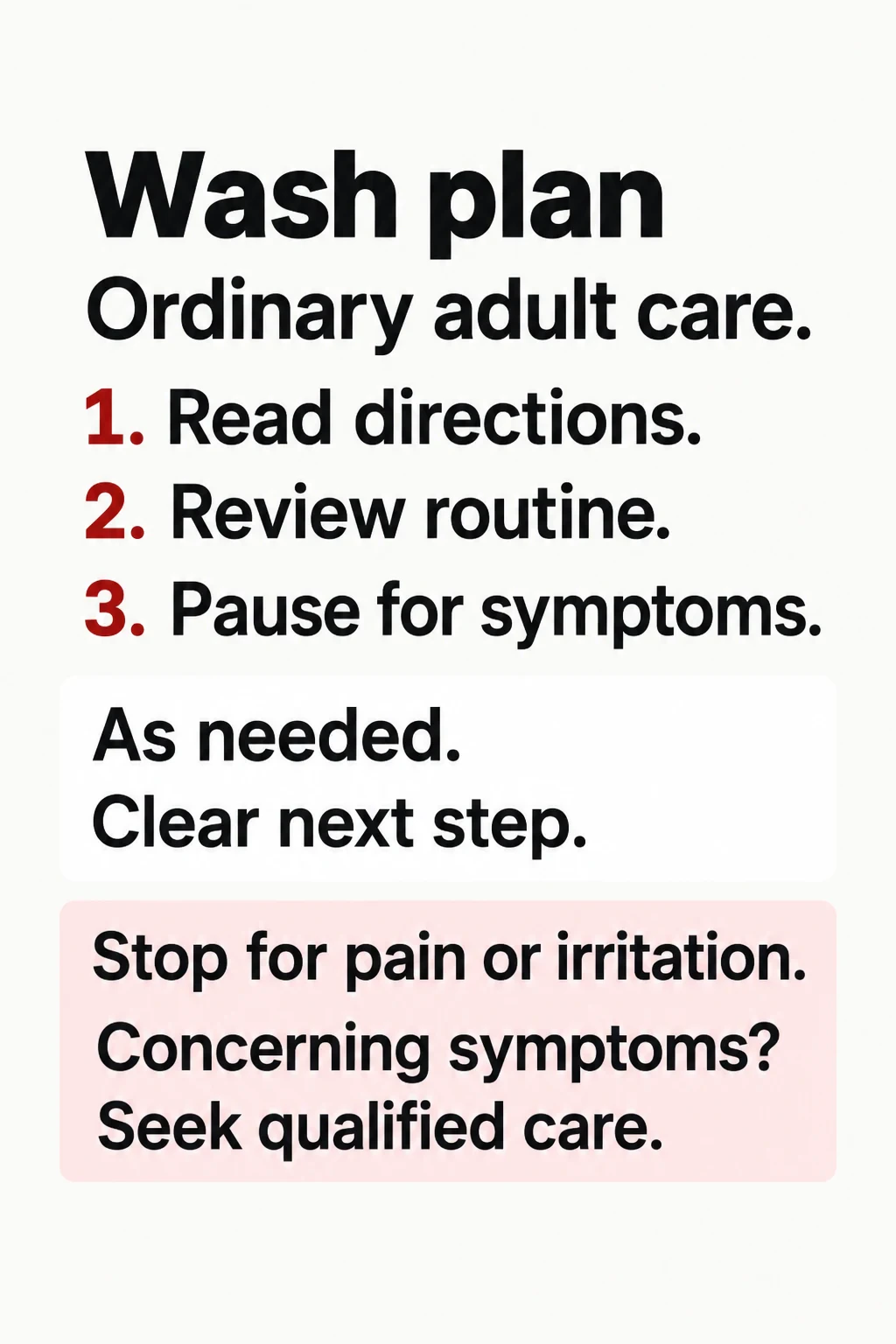
There is no single shampoo schedule that fits every head of hair. Start with how your scalp and hair become oily or dirty, the texture and condition of your lengths, and the directions for the product you actually use. A calendar can help organise a workable routine, but it cannot establish what your scalp needs by itself.
For ordinary care, the useful question is whether your current approach leaves your hair manageable and your scalp comfortable under appropriate product instructions. Washing more often is not a cleanliness achievement, and stretching the gap is not a competition. Neither choice proves better hair growth or a healthier scalp.
Who this is for
This guide concerns adults choosing an ordinary cosmetic shampoo routine. It is not a plan for treating dandruff, hair loss, a scalp disorder, an allergic reaction or a problem after a chemical service. If you already have prescribed or professional care instructions, use those as your starting point rather than changing them to match this article.
Hair texture, length, processing, styling habits, access to washing facilities and personal preferences vary. You can have oily roots and dry-feeling lengths at the same time. That does not mean you must select a single label for your entire head and apply every instruction associated with it.
The goal is a practical next decision: continue a workable routine, clarify how a product should be used, or ask for suitable advice about a problem. You do not need a numerical hair-type score, photographs of every wash or a new set of products to make that decision.
Before you start
Look at the shampoo and conditioner already available to you. Check their names, intended use, directions and warnings on the actual packaging. A rinse-out shampoo, a leave-in product and a medicated shampoo are different products. Instructions for one cannot be transferred to another because their bottles look similar.
Keep three questions separate. How often are you choosing to wash? How are you using the shampoo on that occasion? What care does the length of your hair need afterward? Increasing the amount of shampoo is not the same decision as changing frequency, and neither automatically resolves a problem with application or rinsing.
Use a simple description of the current situation: roots feel oily before the next planned wash; lengths are difficult to manage afterward; or the directions are unclear. Avoid diagnosing a scalp condition from appearance. If the issue is pain, persistent irritation, sores, concerning shedding or another symptom, it belongs in a conversation with a qualified healthcare professional rather than a schedule experiment.
No home test in this guide establishes a cause. A photograph cannot diagnose a scalp condition or explain why it feels uncomfortable. A product label and a general article cannot determine whether a symptom comes from frequency, an ingredient, an underlying condition or something else.
Actions in order
1. Treat professional schedules as examples with a scope
The American Academy of Dermatology links frequency to how oily or dirty hair becomes. Its everyday-care guide says daily shampooing may suit straight hair with an oily scalp; for dry, textured, curly or thick hair it describes washing as needed and gives a two-to-three-week example interval. These are broad categories within professional guidance, not a personal prescription. AAD everyday hair-care guidance
Cleveland Clinic also discusses variation, but its examples are not identical. Its article includes more frequent washing for finer hair, a weekly example for coarse, thick hair, and a separate discussion of tightly curled hair. That variation within and between guides is a reason to retain context, not average the examples into a new rule. The article is expert guidance, not a trial identifying one optimum interval for all readers. Cleveland Clinic frequency guide
An interval that works for a friend is information about their routine. It does not settle yours. You also do not have to wait for a target day when the product instructions, your ordinary care needs or existing professional advice point elsewhere.
2. Check the scalp and lengths as separate practical concerns
The AAD recommends concentrating shampoo on the scalp and varying conditioner placement with hair type. It describes conditioner on the ends for fine or straight hair and along the length for dry or curly hair. Follow the applicable directions for your own product; a general placement example is not permission to ignore a warning or use a rinse-out product as a leave-in. AAD washing and conditioning guidance
If roots and lengths feel different, write down that distinction before changing several things. “Roots oily before the next wash; ends difficult to manage afterward” is more useful than “my hair is wrong.” It identifies the question to clarify without claiming to know the cause.
There is no need to scrub harder, add heat or combine several cleansing products to prove that a wash worked. A large lather, a particular sound or an especially stripped feeling is not a health measurement in this guide.
3. Use the instructions for the exact shampoo
For example, the current OLAPLEX Nº.4 Bond Maintenance Strengthening Shampoo page describes working the product in the hands, applying it to wet hair, lathering and rinsing well, with an eye-contact warning. Its stated texture scope is medium to coarse. Those details describe a named product; they do not establish that everyone needs that product or a daily wash. OLAPLEX current product directions
Bumble and bumble’s Hairdresser’s Invisible Oil Hydrating Shampoo page also describes application to wet hair and thorough rinsing, but supplies its own amount guidance and follow-on conditioner. It specifically directs readers to the received package for the most current ingredient list. Do not turn its amount into a universal dose for every concentrated shampoo, hair length or bottle variant. Bumble and bumble product directions
These two pages are examples of why exact instructions matter. They are not a comparison test, a shopping shortlist or evidence that either product fixes an unsuitable routine. If your packaging and an online description differ, clarify the version with the manufacturer rather than merging the instructions.
4. Make the next ordinary care decision without a challenge
Use what you know about your existing routine and the instructions you have checked. There is no requirement here to delay washing for a set number of days, increase washes to meet a standard or force yourself through discomfort while waiting for an adjustment period.
If you want to reconsider a routine that is merely inconvenient, identify what is inconvenient first. It may be the timing, unclear directions, the way products are combined or a question that needs professional advice. Buying a different shampoo before answering that question can leave the same uncertainty in place.
A brief note is optional. Record enough to describe the practical issue, then get on with your day. Repeated scalp photographs, hair counting and constant mirror checks are not prerequisites for ordinary washing.
5. Keep substitutes and add-ons in their own category
Cleveland Clinic describes dry shampoo as an in-between option and explicitly says it should not completely replace traditional shampoo. That distinction does not establish that dry shampoo is appropriate for you, or that adding it will solve discomfort. Cleveland Clinic guidance on between-wash care
You do not need to add dry shampoo, a clarifier, an oil, a scalp scrub or a treatment to follow this guide. Each additional product brings its own intended use and directions. A photograph, a popular routine or an ingredient trend is not enough to resolve compatibility with your current care.
Costs, risks and stop criteria
Checking existing directions and describing your routine may require no purchase. Washing, drying, detangling and arranging access can take different amounts of time for different people. This guide sets no compulsory wash duration, product quantity, waiting period or spending target. An accessible routine must work with your circumstances as well as the product instructions.
If you choose to buy something, check the actual size, current total price, terms and intended use. A premium price, a salon association or wording such as “strengthening” does not establish that the product is necessary. No price, stock availability, ranking or comparative performance claim is being offered here.
OLAPLEX and Bumble and bumble sell the products described. Their directions are useful primary documents for those products, while their promotional benefits require separate evidence. This guide has not independently tested repair, growth, breakage reduction or a complete routine. Professional organisations and healthcare publishers cited here have not reviewed or endorsed this article or these product choices.
Stop using a routine as a self-directed experiment if it causes irritation or pain, or if uncertainty cannot be resolved from applicable instructions. Seek qualified healthcare advice for persistent or concerning scalp symptoms, unexpected hair changes or a suspected reaction. A hair professional can help clarify ordinary grooming and product-use questions within their expertise; they do not replace a clinician for a possible medical problem.
Avoid replacing an existing treatment plan with ordinary shampoo advice. This article supplies no medicated-product schedule, diagnostic checklist, ingredient-allergy test or advice to change a prescription.
Myth or Real?

Claim
Social paraphrase: Different hair and scalp circumstances can call for different ordinary washing routines.
Verdict
REAL
Facts
Professional guidance uses context such as dirt, oil and hair texture rather than one routine for everyone.
Actual product directions and existing professional care matter; concerning symptoms need suitable qualified advice.
An archived commenter notes that another person’s hair advice may not fit your circumstances. The narrow variation claim agrees with the selected professional guidance. AAD links ordinary washing frequency to dirt, oil and texture; Cleveland Clinic discusses several contexts with differing examples. Those examples should not be averaged into a new rule or used as a personal prescription. The article separates frequency, application and care of the lengths, and uses named manufacturer pages only to show why exact product directions matter. It does not independently test a complete routine, establish an optimal interval or prove healthier growth, repair or less breakage. Actual packaging and any existing professional care remain relevant. Do not force a longer gap, more washing or discomfort to complete a calendar challenge. Persistent or concerning symptoms, suspected reactions and prescribed-care questions require appropriate qualified guidance. The social passage is claim discovery, not verified personal evidence or current trend demand; the thread’s intervals, oil-training theories, product suggestions and treatment recipes are not adopted. AAD and Cleveland Clinic have not reviewed or endorsed this article or the named products. Their documents are reused from the main four-source set and add no publishers.
Takeaway
Clarify your ordinary care question, follow actual instructions and pause a routine that causes pain or irritation.
Sources
Claim discussion: Archived r/Haircare discussion about differing wash routines.
Evidence: AAD: Tips for healthy hair; Cleveland Clinic: How Often Should You Wash Your Hair?.
Checked 2026-10-18. Scope: Ordinary adult cosmetic washing decisions only. No universal interval, diagnosis, treatment, product endorsement or advice to change prescribed care.
How to assess the result
Consider this invented example. Jamie and Rowan normally wash on the same days, but that shared calendar answers very little. Jamie notices oily roots before the next planned wash, with no irritation, and checks the directions for the ordinary shampoo already in use. The next decision concerns current care needs under those instructions, rather than waiting simply to preserve the calendar.
Rowan’s question is different: a new bottle gives different application guidance from the previous product. Rowan clarifies that direction before changing frequency or borrowing Jamie’s amount. Neither person has established an optimum interval, a medical cause or a measured improvement. They have separated a care question from an instruction question.
If either person instead reports persistent itching or pain, the decision changes again: pause the schedule experiment and seek qualified advice. Discomfort is not a required stage in reaching a longer interval. This is a fictional decision example, not a customer account or evidence that a specific routine works.
A useful result is a clear, proportionate decision. Perhaps your current routine remains workable. Perhaps the next step is to ask the manufacturer about instructions, discuss a grooming issue with a suitable professional or seek healthcare advice about symptoms. Having a reason to pause is a valid result.
Do not judge success by reaching the longest interval, producing the most foam or matching another person’s hair. Hair can look different with wetness, styling products, light, camera angle and arrangement. A smoother-looking photograph cannot prove scalp health, reduced breakage or the effectiveness of a wash schedule.
Reconsider the practical question when relevant circumstances change, without turning care into constant monitoring. The aim is a routine you understand and can reasonably use, with unresolved concerns directed to the right person.


Sources
Sources and current product pages checked on 18 October 2026. The two professional documents provide general care guidance; the two manufacturer documents provide named-product directions and commercial context. They are four publisher groups, not four independent trials of this routine.
- American Academy of Dermatology: Tips for healthy hair, updated 12 August 2024.
- Cleveland Clinic: How Often Should You Wash Your Hair?, 29 April 2025.
- OLAPLEX: Nº.4 Bond Maintenance Strengthening Shampoo, current product and application information.
- Bumble and bumble: Hairdresser’s Invisible Oil Hydrating Shampoo, current product directions and package-list notice.
FAQ
Common questions
Does one shampoo schedule fit everyone?
There is no single shampoo schedule that fits every head of hair.
Does changing the amount of shampoo settle frequency?
Increasing the amount of shampoo is not the same decision as changing frequency, and neither automatically resolves a problem with application or rinsing.
Must I buy new products to follow the guide?
You do not need to add dry shampoo, a clarifier, an oil, a scalp scrub or a treatment to follow this guide.
Topic hubs
Tags


