

Reduce avoidable hair-dye reactions by following the current product label, recognizing what a consumer alert test can and cannot show, and acting quickly on warning signs. That is a practical grooming goal, not a verdict on attractiveness or personal value. Normal variation is expected, and the safest plan is the one that remains simple enough to follow without pain, shame, or a constant search for flaws.
This guide is general education, not diagnosis or individualized treatment. It does not prescribe a drug, device, or procedure, and it does not use photographs to diagnose a skin, hair, allergy, circulation, or other medical condition.
Start with your real baseline
Scalp sensitivity, hair porosity, natural color, prior bleaching, gray coverage, curl pattern, and allergy history vary. A shade result on one person does not predict another person’s color or tolerance.
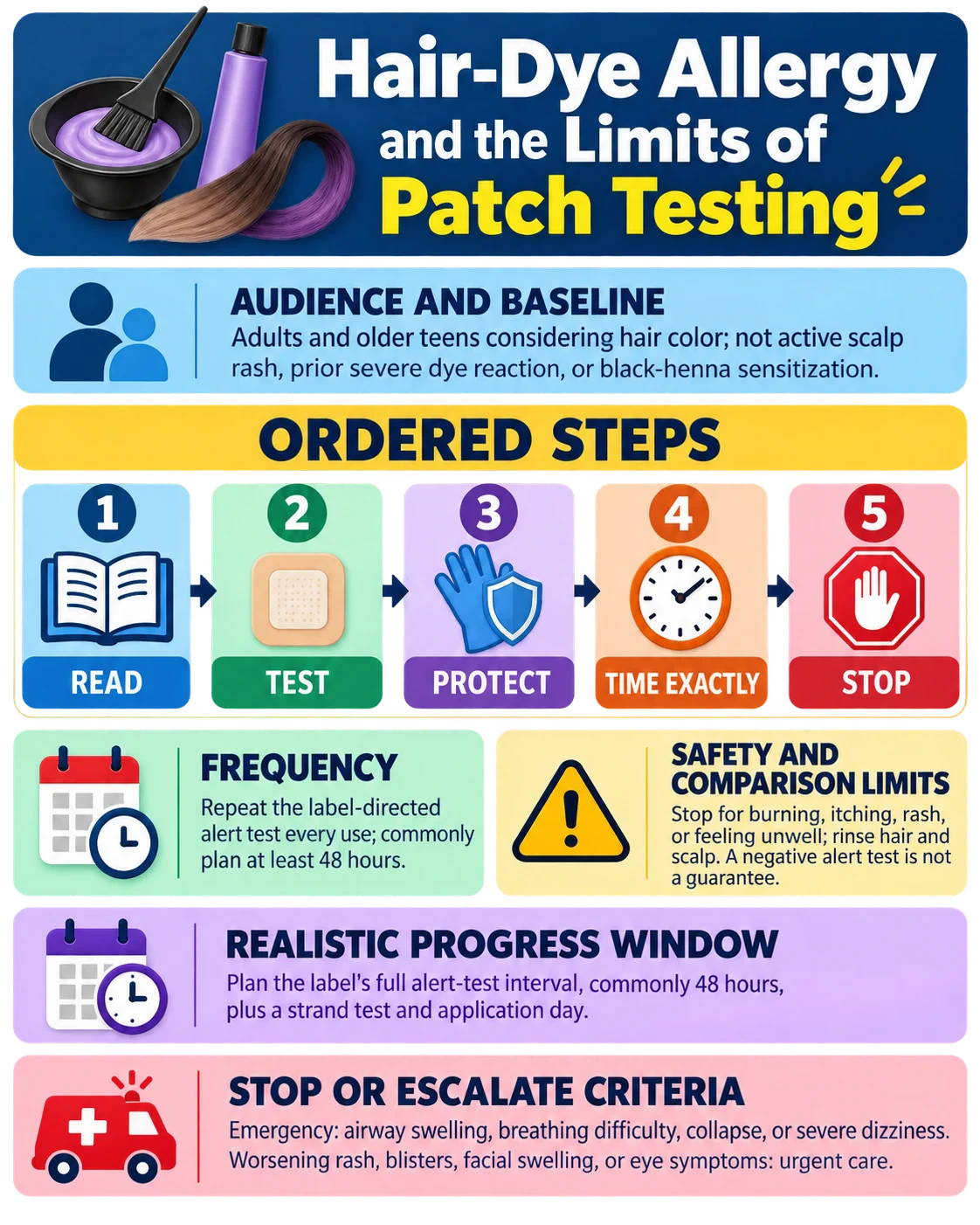
Adults and older teens considering oxidative or direct hair color; not people with an active scalp rash, prior severe dye reaction, black-henna sensitization, or symptoms needing diagnosis.
Before changing anything, record the current routine, the exact symptom or appearance concern, and any recent product, medication, climate, or activity change. That short baseline is more useful than comparing yourself with a highly edited image. If checking has become repetitive or distressing, step away from close-up inspection and talk with someone you trust or a qualified clinician.
What is actually modifiable
Modifiable factors include following the exact label, performing the specified alert and strand tests, glove use, timing, avoiding mixed products, and not dyeing irritated skin. Less-modifiable factors include prior sensitization, eczema tendency, immune response, natural pigment, hair condition, and unpredictable future allergy.
That distinction matters. A routine can reduce avoidable irritation or improve day-to-day presentation, but it cannot promise a new anatomy, erase normal texture, or guarantee a uniform result. The right target is a tolerable process and a meaningful symptom trend, not perfection.

What the evidence supports
Permanent and some semi-permanent dyes can contain sensitizers such as PPD. Allergy can develop after previous uneventful use. A negative consumer alert test does not guarantee that a full application will be safe, because exposure conditions and immune responses differ; it is a screening step, not a medical diagnosis.
FDA guidance says to follow all warnings, perform the instructed skin test every time, wear gloves, avoid mixing products, and never dye eyebrows or eyelashes at home. FDA’s allergen guidance identifies PPD among cosmetic allergens. NHS guidance notes that reactions may take up to 72 hours and lists urgent anaphylaxis signs. European scientific-committee opinions question the predictive safety of consumer self-testing and distinguish it from diagnostic patch testing by a clinician.
Evidence strength is not the same as marketing confidence. Official guidance is strong for safety boundaries and labeled use, while product-to-product claims are often thinner. Laboratory or short clinical studies can explain a mechanism without proving that every person will see the same visible result. When uncertainty is material, this guide says so.
A lower-risk routine
Read the current box before purchase and again before use. Do the exact allergy alert and strand tests on the label at the stated time, even if the brand was tolerated before. Do not apply to scratched, inflamed, or sunburned scalp; wear gloves; keep timing exact; rinse thoroughly; and never combine different dye products. Someone with a prior reaction or black-henna tattoo history should seek professional advice rather than testing by full application.
Use this order:
- Define the single problem you are trying to solve.
- Remove avoidable irritation or pressure before buying more treatment.
- Introduce one reversible change and follow its label or professional instructions.
- Keep the rest of the routine stable long enough to interpret tolerance.
- Escalate to qualified care when the pattern is severe, persistent, unusual, or unsafe for self-treatment.
Doing less is sometimes the more evidence-based choice. Stacking products makes both benefit and harm harder to trace, and discomfort is not a useful proxy for effectiveness.
Time, cost, and realistic progress
Plan at least the label’s full alert-test interval, commonly 48 hours, plus a strand test and application day. Dye is a recurring product or salon cost, but emergency care and dermatitis treatment make shortcuts a false economy. Color maintenance varies by growth and formula; allergy risk is not reduced by familiarity.
Keep the product name and ingredient list, document any reaction, and do not reuse a suspect dye. A dermatologist can perform diagnostic patch testing when appropriate. Switches marketed as natural are not automatically allergen-free.
Progress should be judged by comfort, function, consistency, and the specific concern named at the start. Use the same lighting and ordinary viewing distance if you keep photographs. Daily close-ups mostly measure camera conditions and natural fluctuation.
Stop and get help when needed
Stop immediately for burning, itching, rash, or feeling unwell; rinse hair and scalp with mild shampoo and water. Call emergency services for lip, mouth, tongue, or throat swelling, breathing difficulty, collapse, or severe dizziness. Worsening rash, blistering, facial swelling, eye symptoms, or persistent symptoms needs urgent clinician review.
A dermatologist, allergy clinician, pharmacist, or primary-care professional should review prior reactions, persistent dermatitis, or uncertainty about ingredients. Minors need parent or guardian involvement and conservative professional guidance; home eyebrow or eyelash dyeing is not appropriate.
These boundaries are part of the routine, not an afterthought. A qualified professional can check whether the apparent cosmetic issue is actually dermatitis, infection, allergy, medication effect, inflammatory disease, circulation trouble, or another condition that needs a different plan.
Visual and commercial transparency
Salon lighting, white balance, wet versus dry hair, filters, and retouching change perceived color and shine. Images cannot predict allergy, identify PPD sensitivity, or prove that a formula is safe.
This article has no affiliate links, sponsor, free-product relationship, product ranking, or paid placement. Brand packaging, high prices, salon photography, and social-media popularity are not evidence of safety or superiority. Any cost language is a broad planning range, not a live shopping recommendation.
Practical summary
- Read the current label; 2. Complete the exact alert and strand tests; 3. Apply only to intact scalp with gloves; 4. Keep timing exact and rinse; 5. Stop and escalate any reaction
Frequency: Repeat the label-directed allergy alert test every time; never assume prior tolerance guarantees future safety.
The useful question is not whether a routine creates a perfect image. It is whether the smallest safe change is tolerable, supported, affordable to maintain, and producing a consistent improvement without crossing a stop boundary.
Decision checkpoint
Photograph the box and ingredient panel before use and keep the lot information until the reaction window has passed. That record is more useful than a shade selfie if symptoms occur. It lets a pharmacist, clinician, manufacturer, or regulator identify the exact product without guessing from packaging memory.

Sources
- S01: Cosmetics Safety Q&A: Hair Dyes - U.S. Food and Drug Administration; accessed 2026-08-09.
- S02: Allergens in Cosmetics - U.S. Food and Drug Administration; accessed 2026-08-09.
- S03: Hair dye reactions - National Health Service; accessed 2026-08-09.
- S04: Opinion on sensitivity to hair dyes - consumer self testing - European Commission Scientific Committee on Consumer Products; accessed 2026-08-09.


