

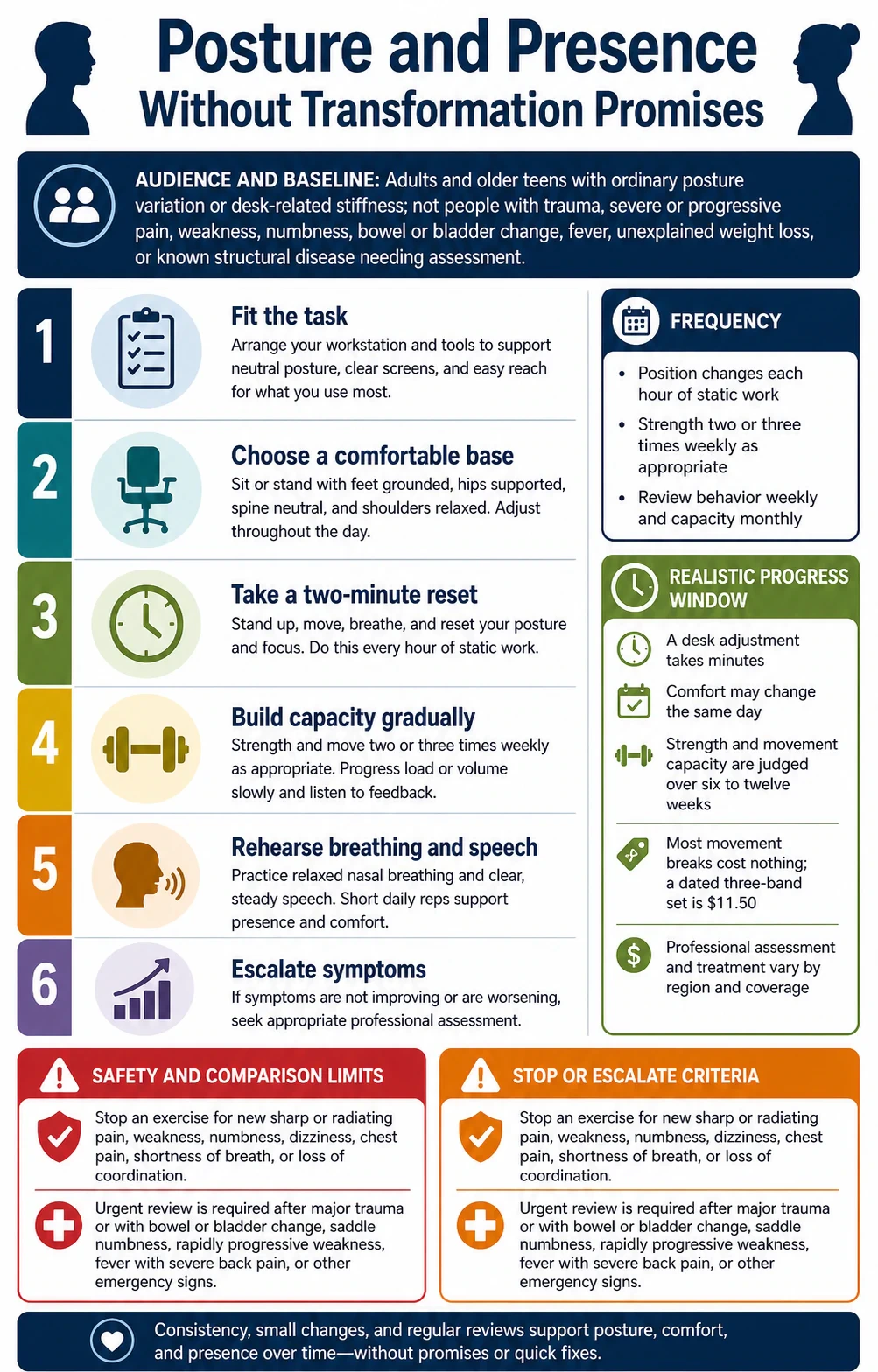
Posture is a position, not a personality test. Rounded shoulders do not prove laziness. An asymmetric stance does not prove damage. Standing rigidly does not make someone more worthy, attractive, competent, or pain-free.
Bodies are built and used differently. Spinal curves, shoulder height, pelvic shape, limb proportions, disability, balance strategies, fatigue, emotion, task, and culture all change how a person sits and stands. The useful goal is not to hold one silhouette all day. It is to move comfortably, meet the task, and use a deliberate stance or speaking cue when it helps.
There is no perfect pose
OSHA offers several neutral workstation reference positions—not one mandatory shape—and says even a good position should change frequently [S01]. NHS guidance likewise states there is no perfect posture and that one particular posture is not a universal cause of low-back pain; staying in the same position for a long time can still aggravate symptoms [S03].
These ideas fit together. A comfortable neutral position can reduce avoidable reach, tension, and fatigue during a task. It is a home base, not a statue. Variety, adjustability, and recovery breaks matter.
A photo cannot diagnose posture, pain, or structural disease. Lens height, focal length, camera tilt, footwear, clothing, breathing phase, floor slope, posed tension, cropping, mirroring, and editing change apparent alignment and proportions. A vertical line drawn on a social-media image is not a medical examination.
Sort the problem before choosing a cue
- Appearance only, no symptoms: use an optional photo or speaking cue, then stop checking.
- Stiff or tired after one task: adjust the task and add position changes before buying equipment.
- Persistent or limiting pain: use gentle tolerable movement and arrange qualified assessment.
- Trauma, progressive weakness, saddle numbness, bowel or bladder change, fever with severe pain, or another emergency pattern: seek urgent care.
This sorts the next action; it does not label a diagnosis.
Fix the task before fixing your body
For desk work, start with the equipment:
- Put the main screen in front of you and reduce glare that makes you crane or twist.
- Support the feet on the floor or a stable footrest.
- Use the backrest and choose either upright or slightly reclined sitting.
- Bring keyboard, mouse, and frequently used objects close enough that shoulders stay relaxed.
- Let forearms be supported and wrists remain relatively straight.
- Change position, stand, or walk briefly before discomfort becomes a long battle.
OSHA’s evaluation checklist emphasizes supported feet and back, relaxed shoulders, close reach, glare control, task variation, and opportunities for microbreaks and alternating positions [S02]. Most changes take minutes and cost nothing: a book under a monitor, a moved mouse, cleared leg space, or a timer.
Do not force the chest up, squeeze shoulder blades all day, flatten every spinal curve, or pull the chin back until the throat is tense. If the “correct” pose hurts or interferes with breathing, it is not a useful working position.
A two-minute movement reset
Once or twice each hour of static work, try this comfortable sequence:
- Look away from the screen and let the eyes focus farther away.
- Stand if able, or change the chair and trunk position.
- Take three easy breaths without lifting the shoulders.
- Turn the head and torso gently within a comfortable range.
- Reach the arms in a direction the task has not used.
- Walk for a minute, or move the legs and ankles while seated.
This is not corrective choreography. It distributes load and interrupts stillness. WHO guidance supports regular physical activity and reducing sedentary behavior across ages and abilities [S04]. Adapt the movements to disability, balance, pregnancy, pain, and available space.
Build capacity, not a camera pose
Two or three times weekly, use ordinary strength and movement practice that covers pushing, pulling, carrying, squatting or sit-to-stand, and walking at an appropriate level. Start with body weight or household objects. Progress duration or resistance gradually and leave recovery time.
An optional resistance band can help with rows, presses, and external-rotation patterns, but it is not a posture cure. A non-latex three-band set was listed at $11.50 on July 19, 2026 [S07]. That price is not an endorsement. A clinician or qualified coach can adapt technique when pain, disability, balance, surgery history, or another condition matters.
Track function over six to twelve weeks: less fatigue during the task, more comfortable position changes, longer walking tolerance, easier carrying, or improved control through a chosen range. Do not use one side-view image as the outcome.
Presence is a communication skill
For a meeting, photo, interview, or performance, try cues that do not require pretending to dominate:
- Put both feet where balance feels reliable, or use your mobility aid normally.
- Let the jaw and shoulders soften.
- Breathe out before speaking.
- Look toward the person or camera rather than repeatedly checking yourself.
- Pause at sentence endings.
- Keep hands visible if that feels natural, without forcing an expansive pose.
These are rehearsal tools, not attractiveness laws. “Power posing” is often sold as a fast route to hormones, confidence, risk tolerance, or status. A controlled study found expansive posing was not superior to neutral posing for anxiety or interoceptive accuracy [S06]. Small posture experiments cannot guarantee real-world authority or erase social context.
For one week, score the behavior rather than the body: Did you take movement breaks on most workdays? Could you speak one answer without rushing? Did the workstation require less reaching? Did symptoms stay stable or improve? Four useful answers matter more than a side-view silhouette.
If a deliberate stance helps you remember to breathe or speak more slowly, use it for that modest purpose. Warmth, clarity, preparation, listening, clothing comfort, room acoustics, culture, disability, and the behavior of other people all shape presence. It is never just shoulder position.
Braces, adjustments, and medical escalation
Posture braces can provide a reminder, but retailer claims do not prove that pulling the shoulders back treats a cause. Long wear can irritate skin, restrict breathing or movement, and substitute passive pressure for capacity. Use a brace only after a clinician explains the indication, fit, duration, stop criteria, and what active plan accompanies it.
Manual therapy may provide short-term symptom relief for some people, but a dramatic adjustment does not permanently “put the spine back.” Imaging is not an appearance audit. NHS guidance notes that common age-related findings occur in people with and without pain and imaging often does not identify the cause of ordinary low-back pain [S03]. A qualified clinician decides when imaging changes care.
Stop an exercise for new sharp or radiating pain, weakness, numbness, dizziness, chest pain, shortness of breath, or loss of coordination. Seek urgent care after major trauma or for bowel or bladder change, saddle numbness, rapidly progressive weakness, fever with severe back pain, or another emergency pattern.
Persistent pain, recurring neurological symptoms, falling, major limitation, or disability-related equipment needs belong with a physical therapist, physician, occupational therapist, or other qualified professional. This guide is general education, not diagnosis.
Time, cost, and maintenance
A workstation change or speaking cue can help comfort or attention the same day. Movement-break consistency takes one to two weeks to establish. Strength and work-capacity changes are better judged over six to twelve weeks. Maintenance is continued variety and an environment that fits the task—not holding a “before” correction forever.
Free options come first. Optional equipment starts around the dated $11.50 band example; desks, chairs, coaching, therapy, and medical care range widely by region and coverage. Ask what problem an expense solves, whether a cheaper setup change does the same job, how long it must be used, and what evidence supports it.
For minors, keep the frame especially conservative: comfortable movement, sports or activity they enjoy, a fitted study area, and adult help for symptoms. Do not sell a growing person a rigid body ideal, corrective device, or promised transformation from photos.
Presence works best when it leaves room to breathe, move, and pay attention to something beyond your own silhouette.


Sources
- S01 — OSHA: Good Working Positions
- S02 — OSHA: Workstation Evaluation Checklist
- S03 — Guy’s and St Thomas’ NHS: Low back pain and posture
- S04 — WHO: Physical activity and sedentary behaviour guidelines
- S05 — PubMed: Trunk postural control systematic review
- S06 — PubMed: Powerful versus neutral posture study
- S07 — Target: dated non-latex resistance-band listing
Sources and price were checked July 19, 2026. No provider or retailer paid for inclusion.


