
Frizz is not one thing and it is not a verdict on whether hair is “good.” A halo of shorter fibers can come from natural curl and new growth, humidity-driven shape change, static, brushing, or breakage. Curl pattern, fiber diameter, density, porosity, gray hair, weather, and prior chemical processing all change the result.
The practical goal is not to force every strand into one glossy sheet. It is to make hair easier to handle with less snapping, less scalp stress, and a finish you like—starting with changes you can reverse at the next wash.
Separate texture from damage
Look for function rather than a filtered surface. Are there many short snapped fibers without a root bulb? Do ends tangle immediately, feel rough, or split? Does styling hurt the scalp? Has breakage increased after bleach, relaxer, permanent color, a smoothing service, or frequent flat ironing?
Photos alone cannot answer those questions. Humidity, wind, wash day, drying stage, curl manipulation, background contrast, shine spray, and editing all change apparent frizz. Damaged fiber is fragile, but not all visible texture is damage [S01].
Sudden patchy loss, widening areas, scalp pain, sores, pus, heavy scale, or scarring needs a dermatologist. Do not assume a product routine is the cause or cure.
The lower-damage wash-and-style routine
Quick triage: If the issue changes mostly with humidity or wash day, start with conditioning and styling hold. If you see snapping and rough ends, reduce friction, heat, tension, and chemical overlap. If the scalp hurts or hair is disappearing from the root in patches, stop treating it as “frizz” and get dermatology care.
Clean the scalp without scrubbing the lengths
Massage shampoo gently into the scalp. Let rinse water carry foam through the lengths rather than rubbing hair into a pile. Frequency should match scalp oil, sweat, product buildup, texture, and comfort; there is no morally correct wash schedule.
Use rinse-out conditioner after shampoo. Conditioner reduces friction and makes detangling easier, but it does not permanently repair a split fiber [S01]. Apply where your hair needs slip, following the label and keeping products off an irritated scalp unless intended for scalp use.
Remove water without rough towel friction
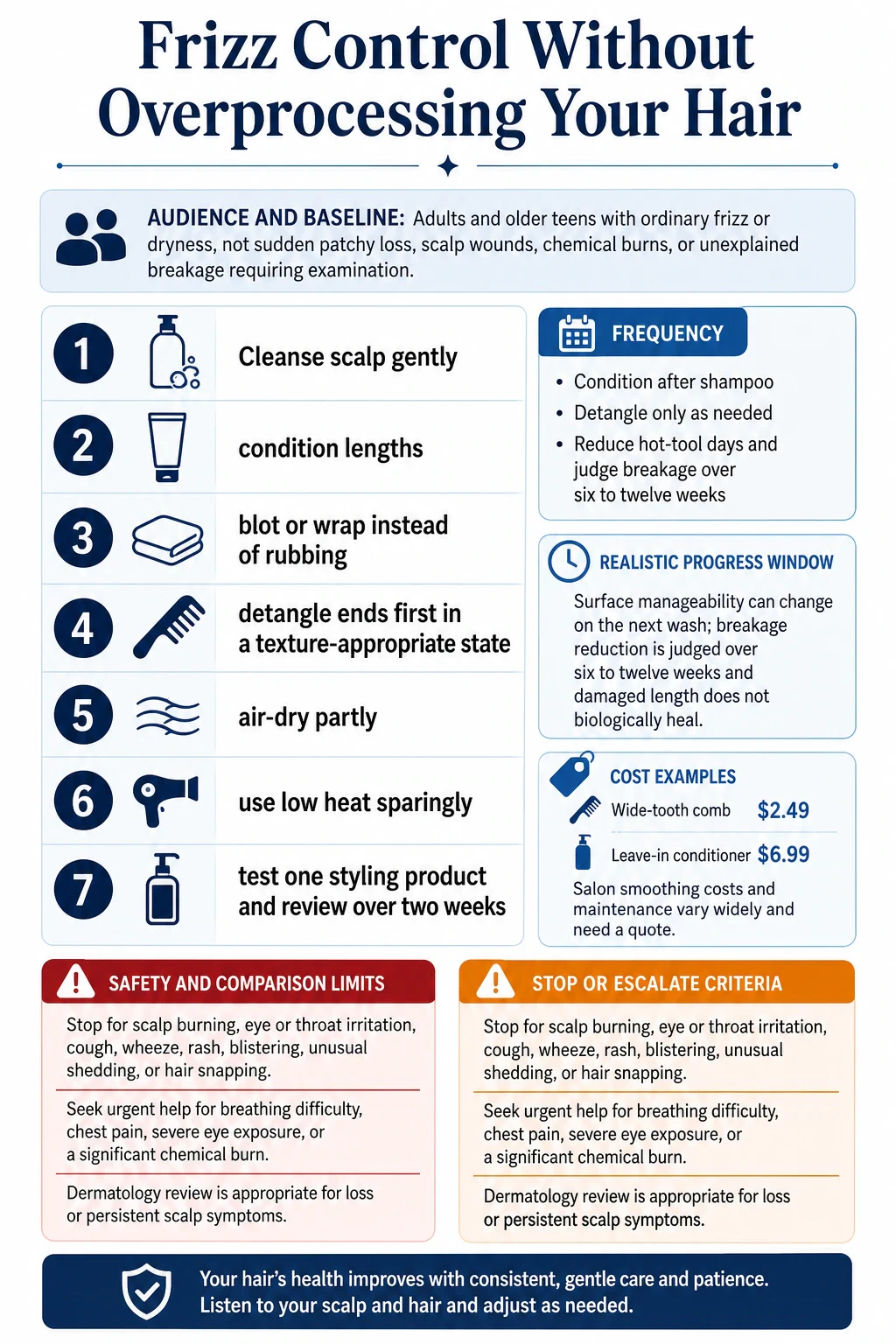
Blot, wrap, or squeeze gently with a towel or T-shirt instead of rubbing. Let hair air-dry partly when practical [S01–S03]. Wet hair can be vulnerable, but detangling advice depends on texture: AAD guidance suggests straight hair dry somewhat before gentle wide-tooth combing, while tightly curled or textured hair may be safer to detangle damp with conditioner and slip [S01].
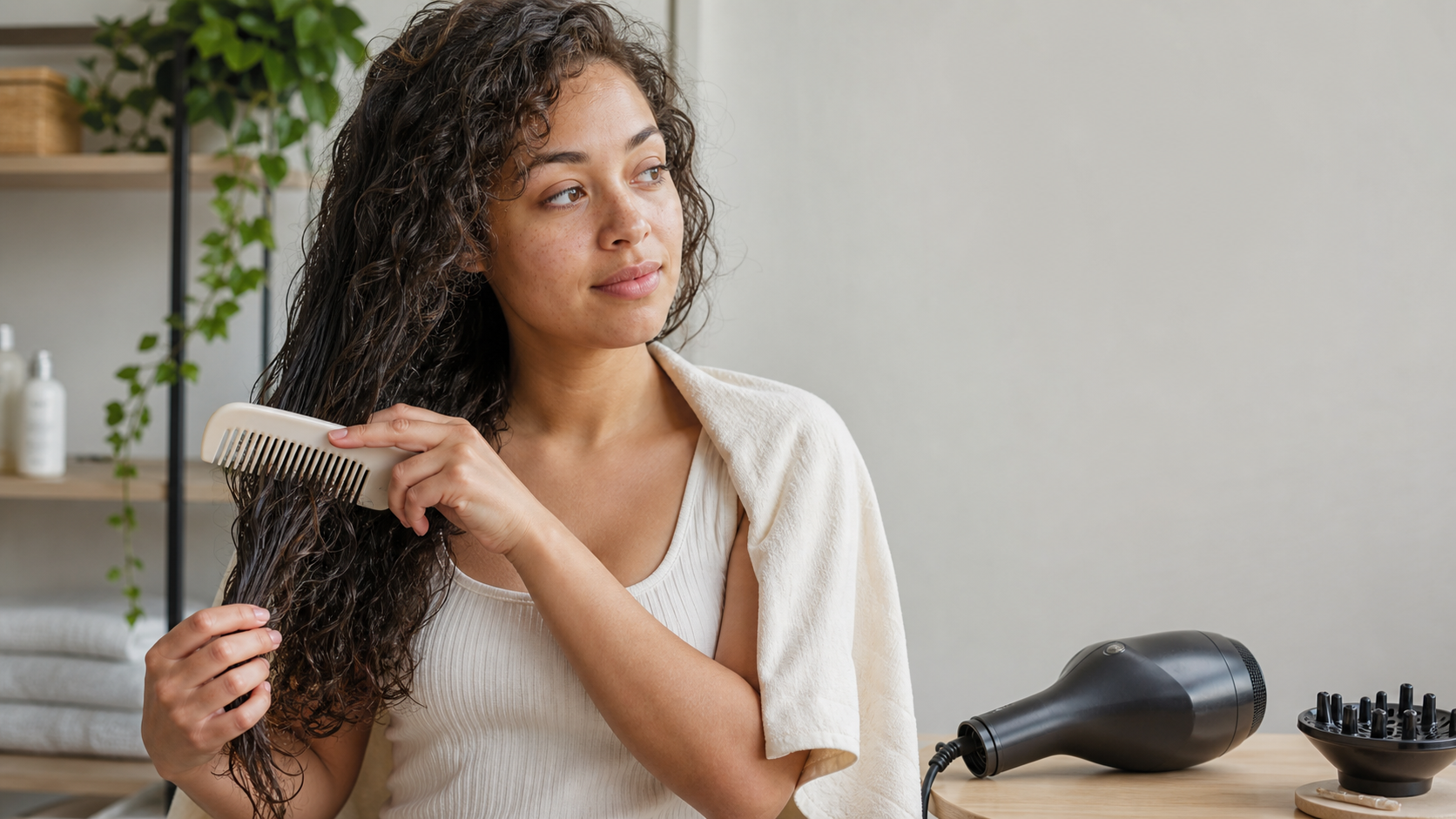
Start at the ends, support the section above the tangle, and work upward. Stop if the tool catches repeatedly. One inexpensive wide-tooth comb is enough; a prestige brush is not required.
Use less heat, less often
When blow-drying, use the lowest setting that gets the job done, keep the tool moving, and increase distance rather than pressing the nozzle against hair. Flat or curling irons should touch fully dry hair, at low or medium heat, for as little time and frequency as practical [S02]. “Heat protectant” does not make unlimited heat harmless.
Track heat days per week. Cutting five hot-tool sessions to one or two is a measurable change; buying five new serums is not.
Add one styling variable
If basic conditioner and technique are not enough, trial one leave-in, cream, gel, or serum. Use a small amount on one section first, follow the label, and judge both appearance and buildup over several washes. Fine straight hair may prefer less product; dense coils may need more slip and hold. Neither is the universal correct routine.
Humectants, oils, silicones, proteins, and film-formers can change feel or style longevity, but labels cannot predict every climate and fiber. Stop for scalp burning, rash, eye irritation, or worsening breakage. Clarify buildup only as needed rather than scrubbing aggressively.
A one-variable two-week test
- Keep wash frequency and chemical services unchanged.
- Condition after each shampoo.
- Replace rubbing with gentle blotting or wrapping.
- Detangle in the state appropriate to your texture, ends first.
- Reduce hot-tool temperature or one heat day.
- Use only one new leave-in or hold product, if any.
- Compare detangling time, snapping, tangles, scalp comfort, and style longevity in similar humidity.
Surface smoothness can change on the next wash. Breakage trends need longer—roughly six to twelve weeks is more informative because damaged length remains until trimmed or grown out. No product biologically resurrects a fractured fiber; temporary coating and conditioning can still be useful.
Costs and maintenance
On July 19, 2026, two ordinary U.S. examples were a $2.49 wide-tooth comb and a $6.99 leave-in conditioner, $9.48 before tax [S05, S06]. These are shelf snapshots, not endorsements. Existing conditioner and a soft old T-shirt may cost nothing extra.
Maintenance is the repeated technique: gentle cleansing, conditioning, careful detangling, lower heat, and tension-aware styles. More products add cost, fragrance exposure, buildup, and troubleshooting. Keep only what gives a repeatable benefit.
Chemical smoothing is a different risk tier
Relaxers, permanent waves, bleaching, and smoothing services alter the fiber and can injure the scalp when misused. FDA warns that many hair-smoothing products release formaldehyde gas when heated; exposure can irritate eyes, nose, lungs, and skin, and formaldehyde is classified as a known human carcinogen [S04]. Not every smoothing product contains or releases it.
Do not buy a formaldehyde-related smoothing system for home use. Before any salon service, ask for the ingredient list and Safety Data Sheet, whether the product contains formaldehyde, formalin, or methylene glycol, what ventilation and training the salon uses, and what alternative does not release formaldehyde when heated [S04]. A refusal to show safety information is a reason to leave.
Stop a service for burning, eye or throat irritation, cough, wheeze, dizziness, nausea, chest pain, rash, or blistering. Get urgent care for breathing difficulty, chest pain, severe eye exposure, or a significant chemical burn. Report adverse reactions to a clinician and the appropriate regulator.
Professional boundaries and minors
A licensed stylist can assess chemical history, strand elasticity, overlap risk, and practical technique, but cannot diagnose medical hair loss. A dermatologist can assess scalp disease, sudden shedding, patchy loss, traction injury, or persistent breakage. Do not use a salon’s before-and-after gallery as safety evidence; lighting, blowout technique, product coating, and editing can create a dramatic temporary finish.
For minors, favor conditioner, low-friction drying, texture-appropriate detangling, loose styles, and little or no heat. Chemical straightening, bleaching, and smoothing require informed adult oversight and a professional safety discussion.
The finish line
Useful frizz control makes hair easier to live with. If some texture remains while tangles, breakage, heat exposure, and styling time improve, the routine is working. Natural curl, coil, wave, and flyaways never need to be erased to make someone presentable.


Sources
- S01 — American Academy of Dermatology: How to stop damaging your hair
- S02 — American Academy of Dermatology: Hair styling without damage
- S03 — American Academy of Dermatology: Tips for healthy hair
- S04 — FDA: Formaldehyde in hair-smoothing products
- S05 — Target: dated wide-tooth comb listing
- S06 — Target: dated leave-in conditioner listing
Sources and prices were checked July 19, 2026. This is general education, not diagnosis or a substitute for individualized professional care.


