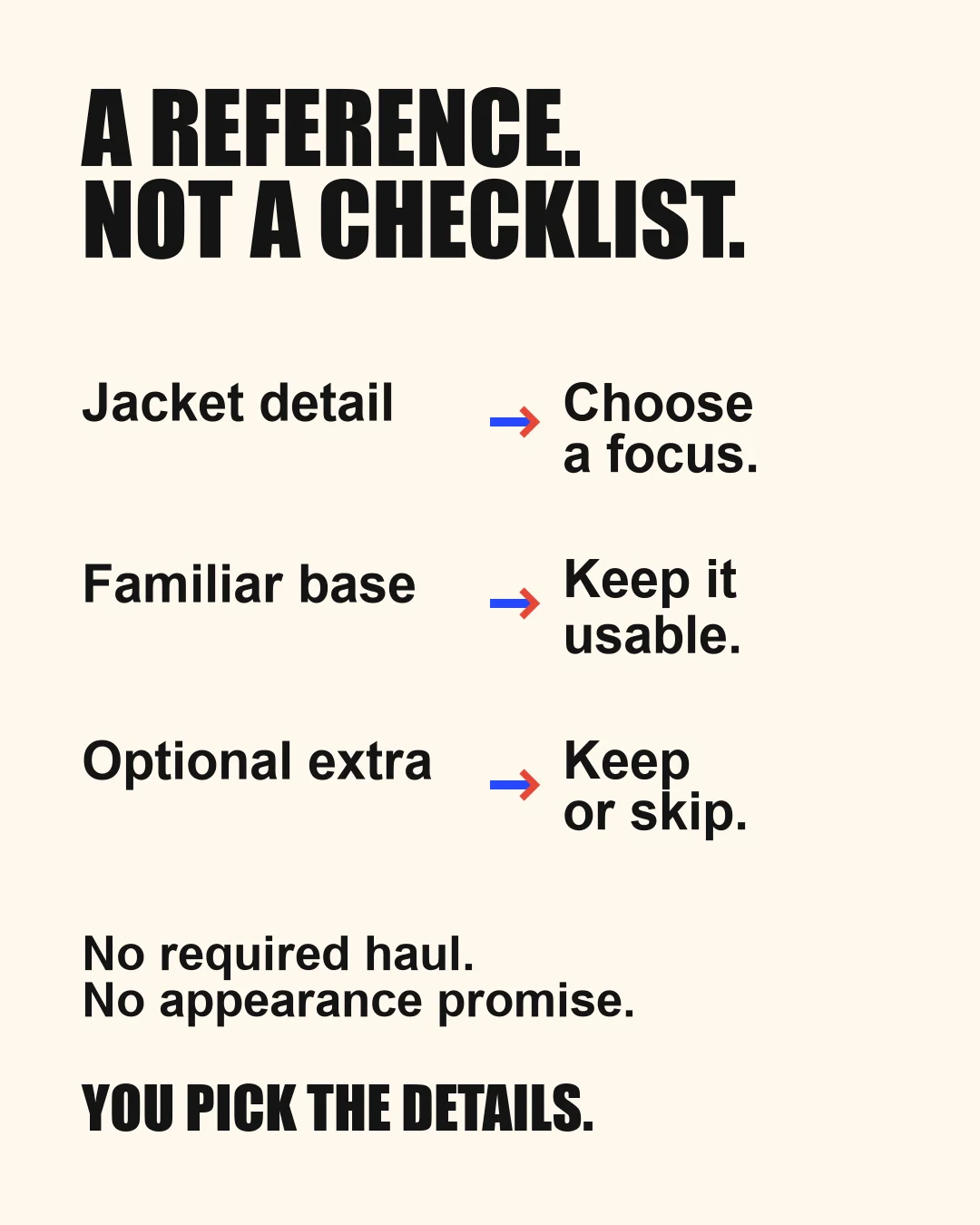

The diamond-patterned top catches your eye. Then the rest of the reference outfit starts looking like a list of things you are missing: matching trousers, different shoes, another layer. Before a liked pattern becomes a wardrobe reset, separate the detail you want from the complete combination being shown.
Argyle can be a starting point for an outfit you already own. Choose a suitable item, keep the clothing your actual day requires, and decide whether you like the result. A full matching set, a new purchase or a particular personal identity is not required for this exercise.
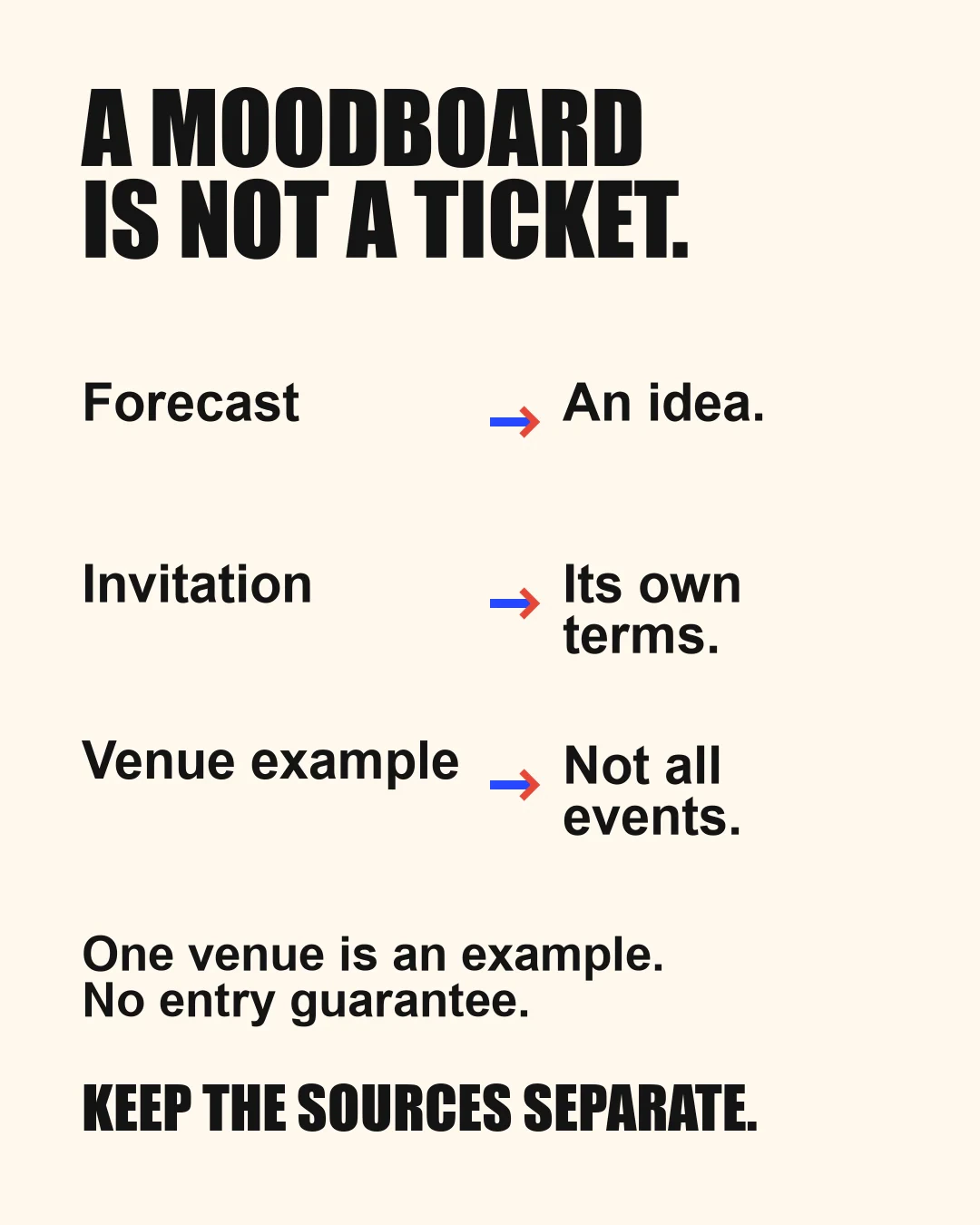
There is a timely commercial reference, rather than proof that everyone is wearing it. An ASOS release dated 9 October 2026 describes an argyle tracksuit within a new collection. That is the retailer describing its own products. It supplies a current styling reference, not independent evidence of popularity, benefits or a need to shop. This guide uses the pattern as an optional idea and leaves the collection itself alone. [S1]
Who this is for
This guide is for someone who likes a diamond-patterned item and wants to consider it among familiar clothes. You might own a suitable piece already. You might have something you enjoy without knowing its exact pattern name. You might decide that the reference is pleasant to look at and unnecessary to reproduce.
No body shape, gender, age, occupation, budget identity or membership in an aesthetic is a condition of entry. The retailer’s description of a menswear collection does not establish who is allowed to enjoy a pattern. It also does not establish how a garment will fit, feel or function for you.
Keep essential coverage, movement, access, weather protection, uniform, protective clothing and fastenings intact. An optional pattern decision does not replace actual occasion requirements or existing care, safety and workplace procedures. Clothing that already serves an important purpose does not become a mistake because it differs from a reference image.
The result here is a descriptive decision: keep a combination, change an optional part, or skip the idea. It is not a test of attractiveness, confidence, sophistication or belonging. This is ordinary clothing guidance, with no clinical intervention or professional inspection of your garment.
Graphic context — 01-article-hero: This original sequence separates liking a pattern from treating a retailer whole look as a shopping list. A suitable owned item is optional, and a complete matching set is not a requirement of this exercise.
Text equivalent: ARGYLE PATTERN. YOUR OWN CLOTHES. Like the pattern. Keep actual needs. Choose or skip. Suitable item owned? No suitable item? Skip. NO MATCHING SET REQUIRED. The rail orders ordinary clothing choices, not improvements, ideal outfits or body rankings. Actual coverage, movement, access, weather, uniform, protection and fastenings remain necessary. A liked already-owned set or several patterns can remain appropriate, and no suitable item can mean skipping. A pattern name cannot establish material, construction, care, fit, comfort or condition. No purchase, public photo, contact, construction or before-and-after benefit is required or established. Four complete primary publisher documents, not independent outfit studies. ASOS own 9 October 2026 commercial collection release, with availability and already-ended event dates distinct; undated Cambridge Dictionary diamond-pattern definition accessed 26 October 2026; WRAP 18 August 2020 page/campaign archived 31 March 2023 existing-clothes aim; undated FTC cleaning-information overview. Whole new retained readable bodies read, not linked products, collection, underlying references, reports/data, laws or cases. No current measured growth, sales, percentages, demographic prescription, tested routine, clinical, career, saving, environmental or legal outcome. No fibre, construction, care, quality, fit, comfort or garment certificate, matching-set obligation or universal wardrobe sufficiency.
Before you start
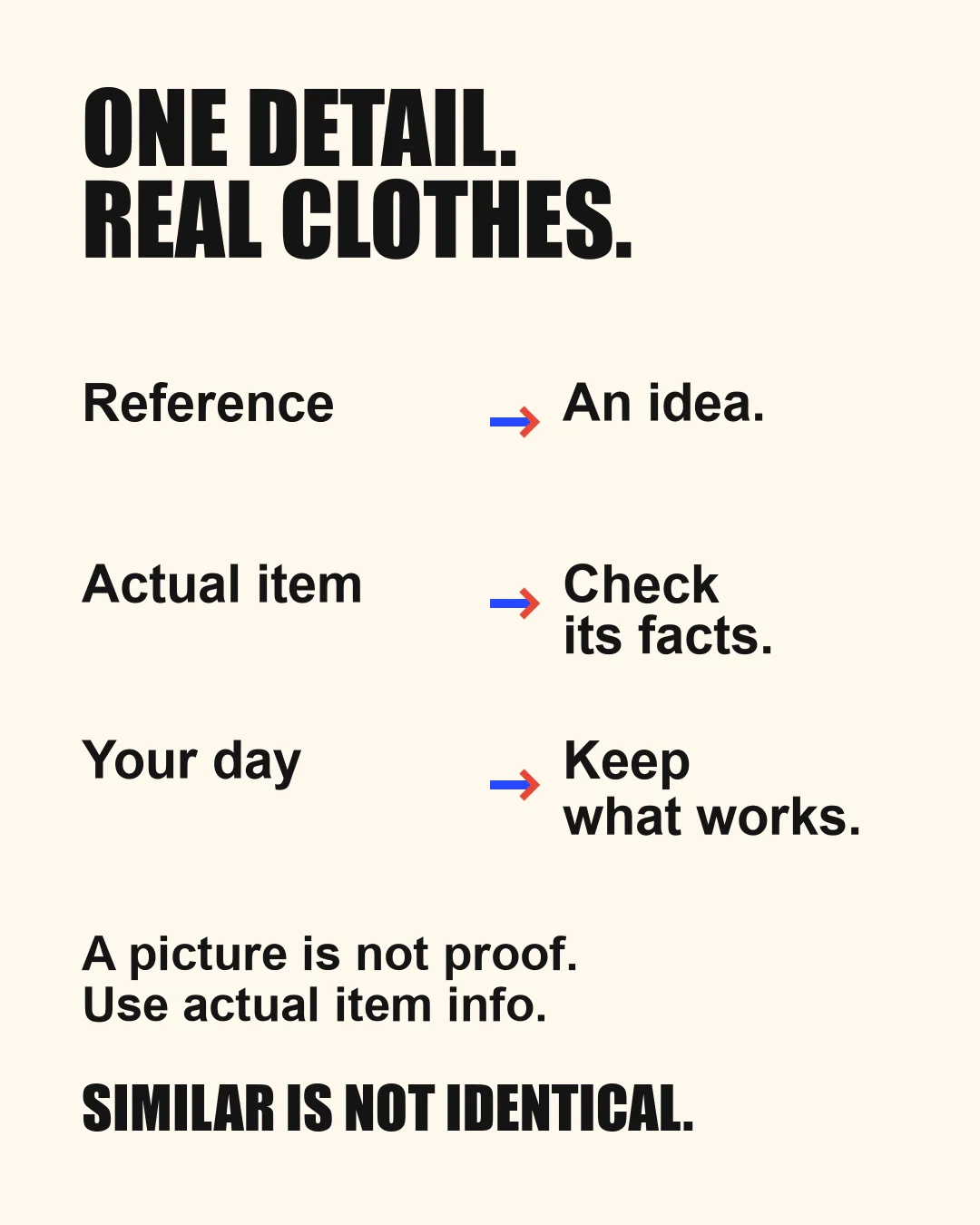
Separate the pattern name, facts about the actual item, and your preference for a particular combination. They answer different questions. Knowing the name can help describe what caught your eye; it cannot answer everything else about the garment.
Cambridge Dictionary defines argyle through a design of differently coloured diamond shapes, used on clothing such as socks or sweaters. That is a vocabulary definition, not a requirement to wear a set. The entry’s examples and related-word lists are not a tested styling method. Its pattern description does not identify the fibre, construction, condition or care needs of an item in your wardrobe. [S2]
Similarly, the ASOS release describes one commercial use of argyle. The collection’s launch dates and event dates are separate from the release’s publication date. No prices, availability promises, sales claims, product recommendations or confidence benefits from that release are adopted here. A shop’s complete look is an example it presents, not an instruction to replace everything around a detail you like. [S1]
For an existing-clothes starting point, WRAP’s Love Your Clothes page describes an aim of valuing and making use of clothes already owned. The page dates from August 2020 and says the campaign was archived in March 2023. This is an archived aim, not a current active programme or proof that everybody has an appropriate item. No saving or environmental result is promised by this guide. [S3]
Keep information about the actual garment separate as well. The FTC apparel overview describes care information in relation to cleaning products. This article supplies no new washing, pressing, repair or alteration instructions. Similar patterns do not establish that two items should receive the same treatment. Unclear material or care information remains unclear; a pattern name does not resolve it. [S4]
Begin with a familiar, serviceable item in its ordinary intended form. Do not cut, sew, pin, dye, attach trim or convert an heirloom to create the reference. If a garment is damaged, uncomfortable, unsuitable or uncertain, omit it from the exercise. There is no requirement to find a substitute or buy a solution.
Graphic context — 02-feature-explainer: These paired roles distinguish a vocabulary definition, information about the actual garment and a personal clothing choice. The arrows do not identify fibre, construction, care, quality or suitability from a pattern name.
Text equivalent: PATTERN NAME. ACTUAL ITEM. Argyle A pattern. Actual item Its own facts. Your choice Keep or skip. Definition only. Not a garment assessment. PATTERN IS NOT A FIBRE. Cambridge supplies a diamond-pattern definition only, while ASOS supplies a dated commercial argyle tracksuit example. Neither evaluates your garment or establishes a matching-set rule. FTC cleaning-information context has a separate role and supplies no new method here. Use actual item information and keep uncertainty explicit. Similar patterns do not transfer material, care instructions or suitability between garments. No authentication, construction, clinical or professional assessment is performed. Four complete primary publisher documents, not independent outfit studies. ASOS own 9 October 2026 commercial collection release, with availability and already-ended event dates distinct; undated Cambridge Dictionary diamond-pattern definition accessed 26 October 2026; WRAP 18 August 2020 page/campaign archived 31 March 2023 existing-clothes aim; undated FTC cleaning-information overview. Whole new retained readable bodies read, not linked products, collection, underlying references, reports/data, laws or cases. No current measured growth, sales, percentages, demographic prescription, tested routine, clinical, career, saving, environmental or legal outcome. No fibre, construction, care, quality, fit, comfort or garment certificate, matching-set obligation or universal wardrobe sufficiency.
Actions in order
Describe what actually caught your eye
Use an ordinary description before making a wardrobe plan. You might like the diamond shapes, the colours within them, the position of the pattern on a familiar top, or the overall combination. These are possible preferences to notice, rather than a checklist you must complete.
Be specific enough to separate the detail from the shopping list around it. “I like this patterned top with clothes I already use” asks a smaller question than “I need that entire outfit.” Neither statement is morally better; the first is simply the bounded exercise this guide offers.
The pattern name is optional vocabulary. You do not have to authenticate a garment, settle a historical argument or prove that every diamond design is argyle before deciding whether you enjoy wearing something you own. If the exact name is uncertain, describe what you can see without turning that description into a material or construction claim.
Choose a suitable owned item
Consider a familiar piece you already understand and normally use. It should remain suitable for the actual day and retain its ordinary clothing functions. A visual resemblance to a reference does not override discomfort, access needs, weather, an actual dress requirement or an established protective arrangement.
Ownership and suitability vary. An old patterned item may no longer be comfortable; a liked piece may need attention outside this guide; an appropriate item may not exist in your wardrobe. Those are reasons to choose another ordinary option or stop, rather than evidence that you need a purchase.
There is no required category of garment. The dictionary’s examples illustrate the word, not a minimum equipment list. You do not need both a patterned upper and lower piece, matching accessories or a new pair of shoes to consider a pattern. This guide does not assess whether a particular garment is suitable for you; use information about the actual item and your existing needs.
Keep the rest grounded in the day
Start with the familiar clothing you would otherwise need. An ordinary coat can stay, even if it covers part of the pattern. A uniform or protective layer can stay, even if it changes the reference’s silhouette. Needed coverage and access do not become optional because a picture shows a different arrangement.
If you want a simple starting point, consider the patterned piece alongside familiar items you already like together. This is a manageable choice to look at, not a rule that every surrounding garment must be plain, neutral or identical in colour. There is no objective pass mark for coordination in this exercise.
Someone else may prefer several patterns or an already owned set. A different preference does not invalidate yours, and yours does not establish a universal formula. The guide offers a way to make your own bounded choice without claiming that a particular arrangement reliably changes other people’s reactions.
Change only an optional part, if useful
If the combination does not suit your preference, you may change an ordinary optional item you already own. You can also return to your original outfit or leave the patterned piece for another day. There is no required number of combinations, deadline or obligation to keep experimenting.
Keep the question tied to the actual choice. “I prefer this with my usual trousers” is a usable description. “This proves I should rebuild my wardrobe” asks for much more than a single preference can establish. A liked reference does not create an urgent gap to fill.
Do not introduce construction, care experiments or an uncomfortable arrangement to make the image work. If the choice depends on altering a garment, resolving uncertain care instructions or assessing an item professionally, leave that separate. Appropriate advice may have its own cost and availability; it is not a service this article provides or a required step to finish the exercise.
Keep, change or skip without a score
End when you have a decision that fits the actual day. You can keep the combination, choose a different familiar option, or skip the pattern. A reference can remain inspiration without becoming a task you must complete.
You may describe what you preferred, what needed to remain unchanged and what you decided. No public photograph, social post, comparison poll or other person’s approval is required. Repeated checking is not a measure of progress, and you do not need to continue until a particular emotion appears.
If you use a private photograph, remember that lighting, pose, lens, distance and editing affect appearance. An image cannot diagnose a person or establish fit, comfort, garment condition or how the clothing serves your day. No before-and-after benefit is demonstrated by taking a picture.
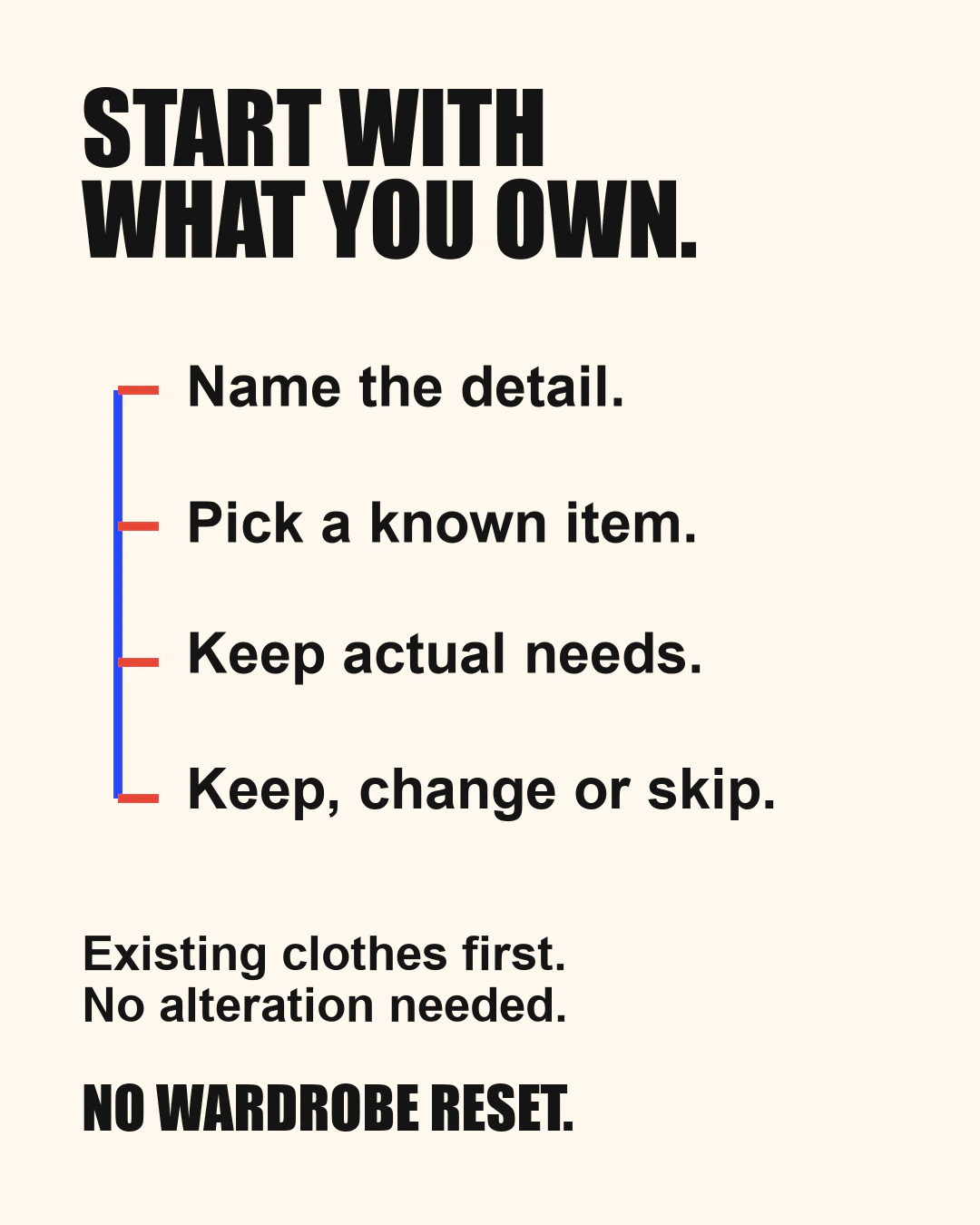
Graphic context — 03-routine-infographic: This original optional sequence begins with a liked detail and a familiar suitable owned item, retains actual clothing functions, and ends with a descriptive choice. It is not a tested routine or a universal pattern-mixing formula.
Text equivalent: START WITH WHAT YOU OWN. Name the detail. Pick a known item. Keep actual needs. Keep, change or skip. Existing clothes first. No alteration needed. NO WARDROBE RESET. The small starting point is not compulsory minimalism. You may prefer several patterns, a suitable set already owned, a partly covered detail or no patterned item. Required clothing functions, actual occasion requirements and existing procedures come first. No cutting, sewing, pinning, dyeing, repair, new care experiment or heirloom conversion is introduced. Stop or change if the item is damaged, uncomfortable, unsuitable or importantly uncertain. No timer, price, wearing dose, confidence or measured benefit is encoded. Four complete primary publisher documents, not independent outfit studies. ASOS own 9 October 2026 commercial collection release, with availability and already-ended event dates distinct; undated Cambridge Dictionary diamond-pattern definition accessed 26 October 2026; WRAP 18 August 2020 page/campaign archived 31 March 2023 existing-clothes aim; undated FTC cleaning-information overview. Whole new retained readable bodies read, not linked products, collection, underlying references, reports/data, laws or cases. No current measured growth, sales, percentages, demographic prescription, tested routine, clinical, career, saving, environmental or legal outcome. No fibre, construction, care, quality, fit, comfort or garment certificate, matching-set obligation or universal wardrobe sufficiency.
A fictional top, familiar trousers and a needed coat
Imagine Jules, a fictional reader with a serviceable diamond-patterned top, familiar trousers and a coat needed for the day’s conditions. Jules likes the pattern but initially treats a retailer’s complete outfit as a list of missing pieces. The practical question becomes whether the top works within the clothes already needed, rather than whether the whole reference can be copied.
Jules leaves the necessary coat and usual arrangements alone. Part of the pattern is covered. That does not make the exercise fail: the actual clothing needs still matter, and visibility of the reference is not a required outcome. Jules may keep the combination or prefer the usual unpatterned top instead.
A different fictional version of Jules already likes a combination with another pattern. That option is not rejected simply for being busier. This exercise does not establish a universal one-pattern limit or prove that every combination works for everyone. A descriptive preference is enough; no rule about other people’s outfits follows.
In another version, the patterned top has uncertain care information or is unsuitable for the day. Jules chooses an ordinary known option and stops. No replacement, wardrobe reset or new care method is required. These alternatives are invented examples of decisions, not observed participants, garment assessments or evidence of an effect.
Graphic context — 04-practical-support: These invented alternatives distinguish a liked suitable top, a necessary coat and the absence of a suitable item. Fictional Jules can keep required layers even when they cover part of a pattern. The rows are not observed outcomes or ranked benefits.
Text equivalent: ARGYLE TOP. COAT CAN STAY. Liked top Keep if liked. Needed coat Keep that coat. No item Skip the idea. Invented alternatives. No wardrobe guarantee. REAL NEEDS COME FIRST. The actual day matters more than making a reference fully visible. A needed coat, coverage, access, movement, uniform, protection and fastenings stay intact. A different fictional choice may retain several patterns or an already-owned matching set. No available suitable item can mean skipping, without a replacement purchase. No wardrobe sufficiency, material-care assessment, clinical, social, confidence, financial or environmental result follows. A private photograph cannot diagnose a person or establish garment function. Four complete primary publisher documents, not independent outfit studies. ASOS own 9 October 2026 commercial collection release, with availability and already-ended event dates distinct; undated Cambridge Dictionary diamond-pattern definition accessed 26 October 2026; WRAP 18 August 2020 page/campaign archived 31 March 2023 existing-clothes aim; undated FTC cleaning-information overview. Whole new retained readable bodies read, not linked products, collection, underlying references, reports/data, laws or cases. No current measured growth, sales, percentages, demographic prescription, tested routine, clinical, career, saving, environmental or legal outcome. No fibre, construction, care, quality, fit, comfort or garment certificate, matching-set obligation or universal wardrobe sufficiency.
Costs, risks and stop criteria
There is no required new purchase when a suitable item is already available. That does not mean clothing has no cost: past purchases, ordinary care, attention and any separately chosen advice can still involve time or money. This guide specifies no price, timer, saving, environmental result or guaranteed amount of effort.
Stop or choose another option if a garment is unsuitable, uncomfortable, damaged or uncertain, or if the combination compromises essential coverage, movement, access, weather protection, uniform, protective clothing or fastening. Do not override an existing requirement to make an aesthetic reference more visible. Important uncertainty is a valid reason to omit an item.
Also stop if an optional clothing choice becomes repetitive checking, pressure to buy or an argument about personal worth. A pattern is not an achievement or a diagnosis. If appearance worries persist and interfere with ordinary life, suitable qualified support is more appropriate than extending this exercise. No diagnosis, treatment or clinical benefit is offered here.
The title’s small starting point is not compulsory minimalism. You may already enjoy more detail, need several functional layers or prefer no patterned item at all. This article does not prescribe a uniform, identify a body type that should wear argyle, or claim that a particular arrangement guarantees comfort, confidence, compliments or social acceptance.
If you already own a matching set that suits the actual occasion and your preferences, keeping it is also an ordinary option. Avoiding a required new purchase does not require breaking up clothes you like together. The distinction is between choosing a suitable combination and assuming a pattern name makes that combination compulsory for everyone.
How to assess the result
Ask whether you can describe the choice without inventing a benefit: what did you like, which actual clothing needs remained first, and did you keep, change or skip the optional item? An unchanged outfit can be a complete answer. You do not need to prove that the pattern is fashionable, that a garment is authentic or that someone else approves.
Return to the idea only if your interests or circumstances make that useful. There is no required wearing schedule, maintenance challenge or deadline for feeling different. A pattern name can help you describe an option; it cannot decide what belongs in your day.
The evidence has distinct roles. A dated retailer release supplies a commercial reference, a dictionary explains vocabulary, an archived campaign describes an existing-clothes aim, and a regulator overview explains cleaning information. None evaluates this routine or certifies your garment. The ordered choices and fictional alternatives are original editorial applications within those limits.
Myth or Real?
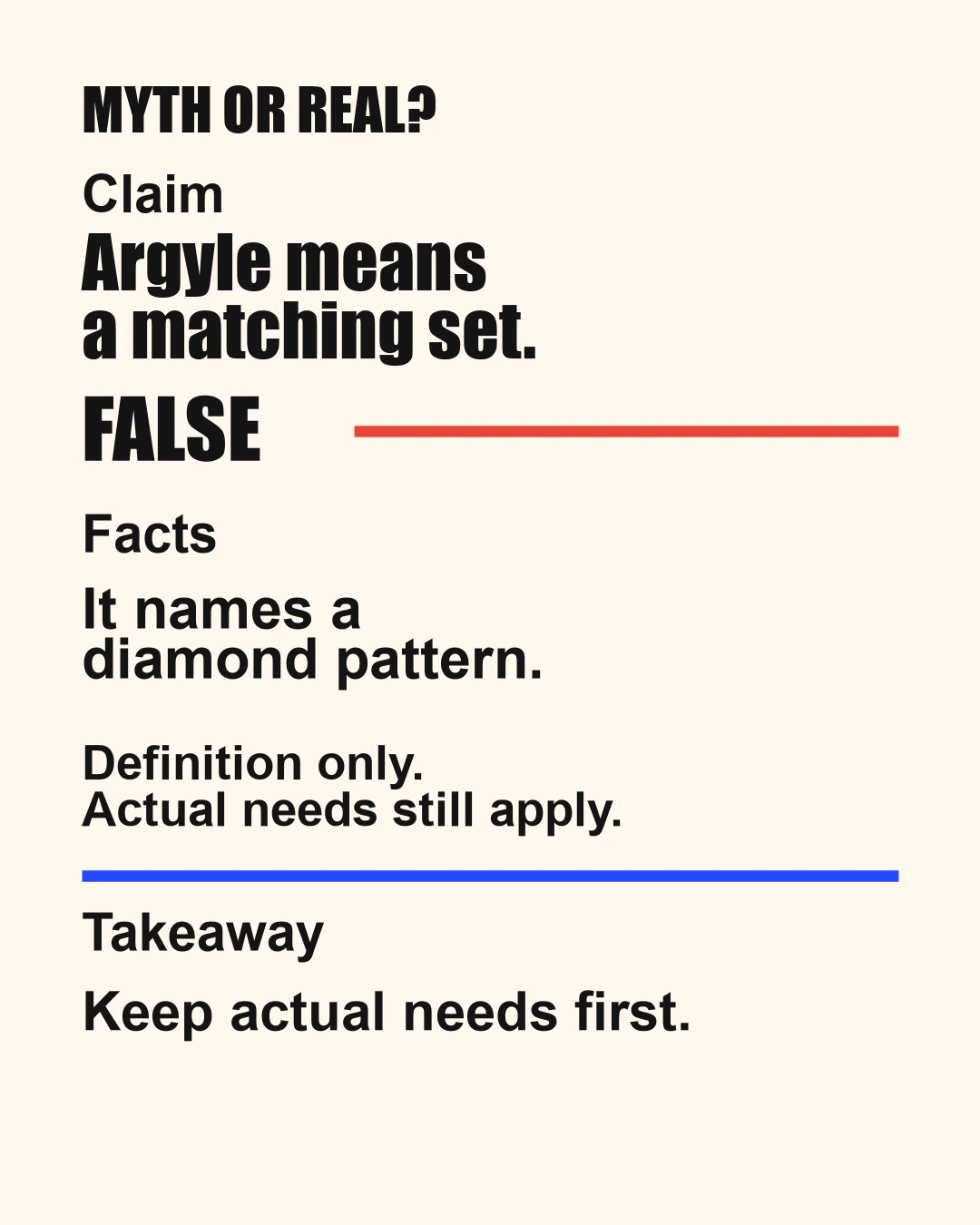
Claim
Social paraphrase: Argyle means a required matching set.
Verdict
FALSE
Facts
Argyle names a diamond pattern used on clothing. A pattern definition is not a requirement for matching pieces.
Definition only, not a universal outfit rule. Actual occasion needs and essential clothing functions still apply.
An archived findfashion question asks for the name of a clothing pattern rather than a particular shirt. It discovers vocabulary uncertainty. This card explicitly reframes a matching-set claim for editorial examination; it is not a quotation or a belief attributed to the questioner. The pictured garment was not identified or authenticated. Comments, brands, purchase requests, votes, construction guesses and related posts are excluded. Cambridge Dictionary’s own undated entry, accessed on 26 October 2026, describes argyle as a diamond pattern used on clothing. That lexical meaning does not require a matching set. Examples, Wikipedia material, corpora, related words, pronunciation and sidebar content are not evidence. The ASOS release dated 9 October 2026 describes an argyle tracksuit as one commercial reference, not the definition of argyle or independent proof of popularity or benefit. Availability and event dates are separate; no product or membership recommendation, price or urgency is adopted. FALSE rejects matching-set as the word’s meaning. It does not forbid a suitable set already owned, several patterns or optional dressing to an actual occasion theme. Necessary clothing functions and actual requirements still apply. The definition does not establish fibre, construction, condition, care, quality, fit or comfort of your item. No new care, alteration, construction, purchase, photo or contact is required. These are distinct publisher roles, not outfit trials or professional garment approval; no current measured growth, clinical or legal outcome is claimed.
Takeaway
Keep actual needs first. Choose a suitable owned combination or skip; a pattern name creates no shopping requirement.
Sources
Claim discussion: Archived original pattern-name question.
Evidence: Meaning of argyle in English; adidas Originals x ASOS present Collection 05, a new take on modern menswear.
Checked 2026-10-26. Scope: Nonclinical ordinary clothing choice. No garmentimage identification, material/care/quality/fit/comfort certificate, universal matching rule, clinical/legal claim, construction or purchase/contact/photo obligation.
Sources
- S1 — ASOS plc, Collection 05 announcement. Dated 9 October 2026 in the retained page and dateline. The whole new retained native main body was read; its argyle tracksuit is commercial styling context only. Publication, availability and event dates are distinct. No prices, sales or popularity claims, promotional urgency, executive quotation, gender prescription, product recommendation or confidence benefit is adopted. Original release.
- S2 — Cambridge Dictionary, argyle. Undated entry, accessed 26 October 2026. The whole retained readable body was read, with the dictionary’s own diamond-pattern definition separated from examples, Wikipedia material, related words, pronunciation and sidebar content. Those surrounding materials are not article evidence. A vocabulary definition is not a garment, material, care or styling certificate. Dictionary entry.
- S3 — WRAP, Love Your Clothes. Page dated 18 August 2020; campaign archived 31 March 2023. Whole retained body read. Existing-clothes aim only, not an active programme, universal wardrobe sufficiency, saving or environmental result. Statistics and linked underlying reports and data are excluded. Archived campaign.
- S4 — FTC, Apparel and Labeling. Undated overview, accessed 26 October 2026. Whole retained body read, with cleaning-information context separated from linked news, cases and business-guide listings. Underlying laws, cases and guides were not read or applied. No legal rule, right, deadline, refund, material identification, new care method or professional garment assessment is supplied. Apparel overview.
These are four publisher roles, not four independent outfit studies. No sponsorship, affiliate link, product ranking, qualified clinical review or professional garment approval is claimed.
FAQ
Common questions
Does argyle mean I need a matching set?
Cambridge Dictionary describes a diamond pattern used on clothing. That definition is not a requirement to wear matching pieces. An ASOS argyle tracksuit is a dated commercial reference, not the meaning of the word or a shopping obligation.
Can I keep a matching set I already own?
Yes, if it suits your preferences, actual occasion and clothing needs. Avoiding a required purchase does not mean breaking up clothes you like together. This guide sets no universal one-pattern or matching rule.
Does the pattern tell me how to care for the item?
A pattern name does not establish fibre, construction, condition or care needs. Use information for the actual item, keep important uncertainty explicit and omit unsuitable items. This guide supplies no new care or alteration method.
Topic hubs
Tags