
The jacket sits neatly in the generated picture. The sleeves end where you hoped, the front closes without a wrinkle, and the outfit suddenly seems settled. Yet you still do not know how that particular jacket would feel when you sit down. The image has answered a visual question while leaving a physical one open.
That distinction matters more than deciding whether a picture looks impressive. Google’s own Shopping help describes its try-on result as an approximation and says it does not establish or guarantee actual garment fit. You can enjoy a visual idea without turning it into a promise about a size, a fabric or your body. You can also leave the feature unused.
This guide offers an ordinary way to separate the picture, the product information and the clothing decision. It requires no upload, new photograph, body measurements, account change or purchase. The aim is to leave with a better named question, including when the honest answer remains unknown.
Who this is for
This is for someone who has encountered a generated clothing preview and wants to keep its role in proportion. Perhaps the colour combination interests you. Perhaps the rendering looks unfamiliar. Perhaps a polished result makes an uncertain item feel already approved. None of those reactions requires changing your body or ordering the garment.
People differ in the clothing they own, the information available to them, sensory preferences, access needs, weather and daily activities. A useful choice for one person may be unsuitable for another. An unfamiliar rendering does not identify a flaw in a person. A photograph cannot diagnose a person, and neither can a generated version of one.
The steps below are editorial decision prompts, not a tested fit protocol, clinical assessment or accuracy benchmark. They do not compare competing tools. You do not have to become interested in virtual try-on, and a suitable outfit you already wear remains an option.
Graphic context — 01-article-hero: This original sequence separates a visual preference from unresolved physical garment fit. It uses Google own feature limitation, without a verdict about every try-on technology or an instruction to use one.
Text equivalent: REAL-LOOKING. FIT STILL OPEN. Like the look. Keep facts apart. Choose or defer. A visualization. No fit guarantee. A PICTURE IS NOT A FIT TEST. Google describes its generated shopping visualization as an approximation that does not determine or guarantee actual fit. A convincing image alone does not establish physical suitability; an unconvincing image alone does not prove the actual garment unsuitable either. Independent reliable knowledge about a garment is not erased. Keeping an idea, deferring or skipping is optional. No new photo, upload, body measurement, account change or purchase is required. No image diagnoses a person or supplies a professional garment assessment. Four complete primary publisher documents, not independent outfit studies. Undated Google Shopping own help accessed 26 October 2026, with settings-update warning, describes generated visualization/approximation and actual-fit limitation; undated ASOS own help distinguishes product/model/size information from conditional Fit Assistant recommendation, not generated try-on. WRAP 18 August 2020 page/campaign archived 31 March 2023 supplies an existing-clothes aim; undated FTC overview supplies cleaning-information context only. Whole four retained native bodies read, not linked policies, reviews, reports/data, laws or cases. No current measured growth, all-tool accuracy, empirical benefit, body diagnosis, size/fit/comfort/availability/privacy/security/legal guarantee, garment certificate or wardrobe sufficiency. No upload, new photo, body measurement, account/setting/contact/purchase action.
Before you start
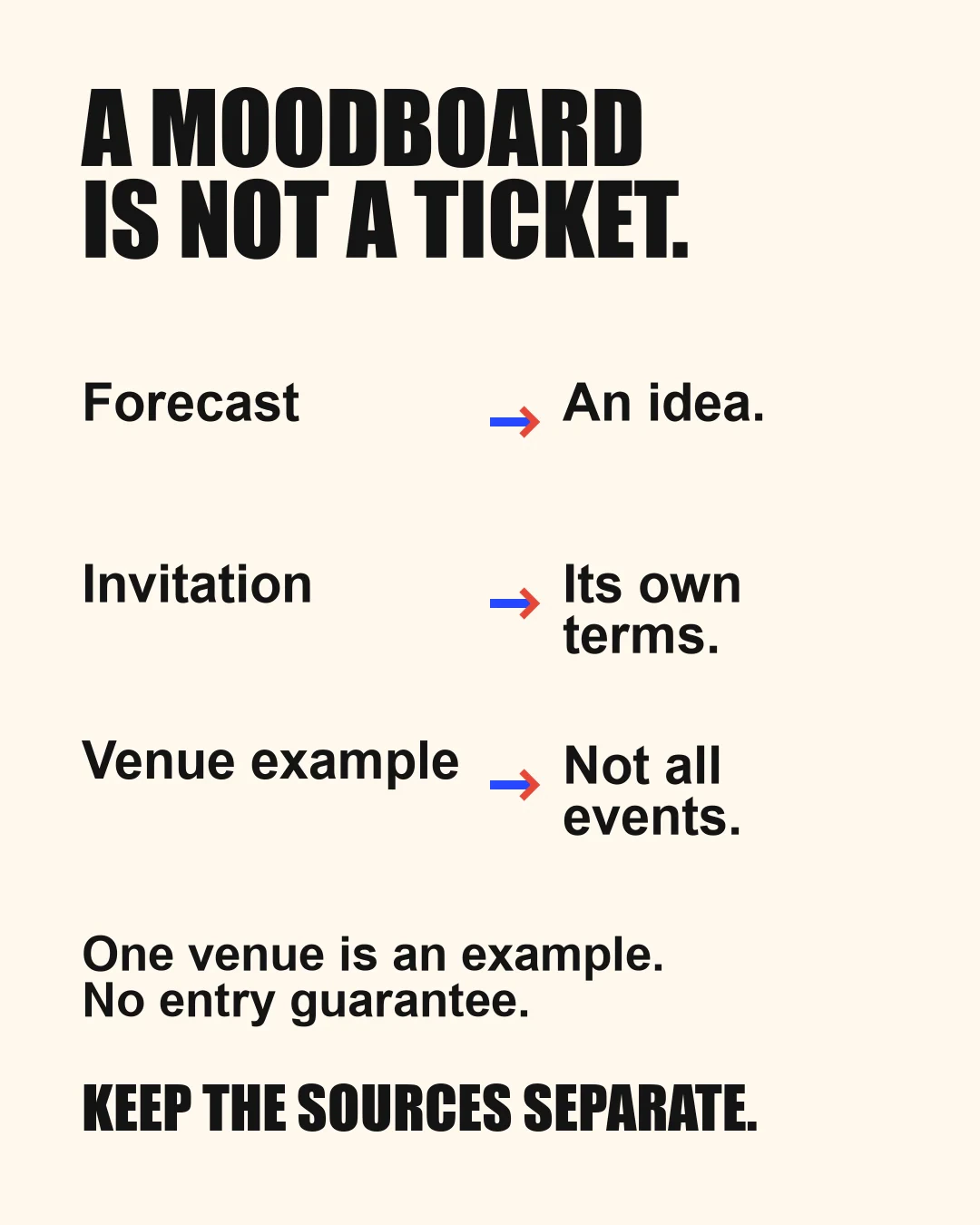
Give the source of each answer a separate job. In Google’s undated help page, accessed October 26, 2026, the generated image is a visualization that may contain mistakes in personal features or clothing details. Its own statement about actual fit is narrower than a verdict on every technology called virtual try-on. The page also warns that settings are being updated. This article does not ask you to follow its setup instructions or change any settings.
ASOS’s own undated sizing help separates model information, a size guide and product details from its conditional Fit Assistant recommendation. That recommendation is a different feature from a generated try-on picture. Its presence does not turn a picture into a physical fitting, and this guide does not ask you to supply the personal information described in that help page. Neither issuer page is an independent comparison of tools.
Two other sources have smaller roles. WRAP’s Love Your Clothes page describes an aim of making more of existing clothing; the campaign was archived on March 31, 2023, and the page is dated August 18, 2020. An archived aim is not proof that you own a suitable alternative or that this guide saves money or resources. The FTC’s apparel overview explains cleaning information. It does not inspect your garment or certify fit, comfort or safety. These are four source roles, not four outfit studies.
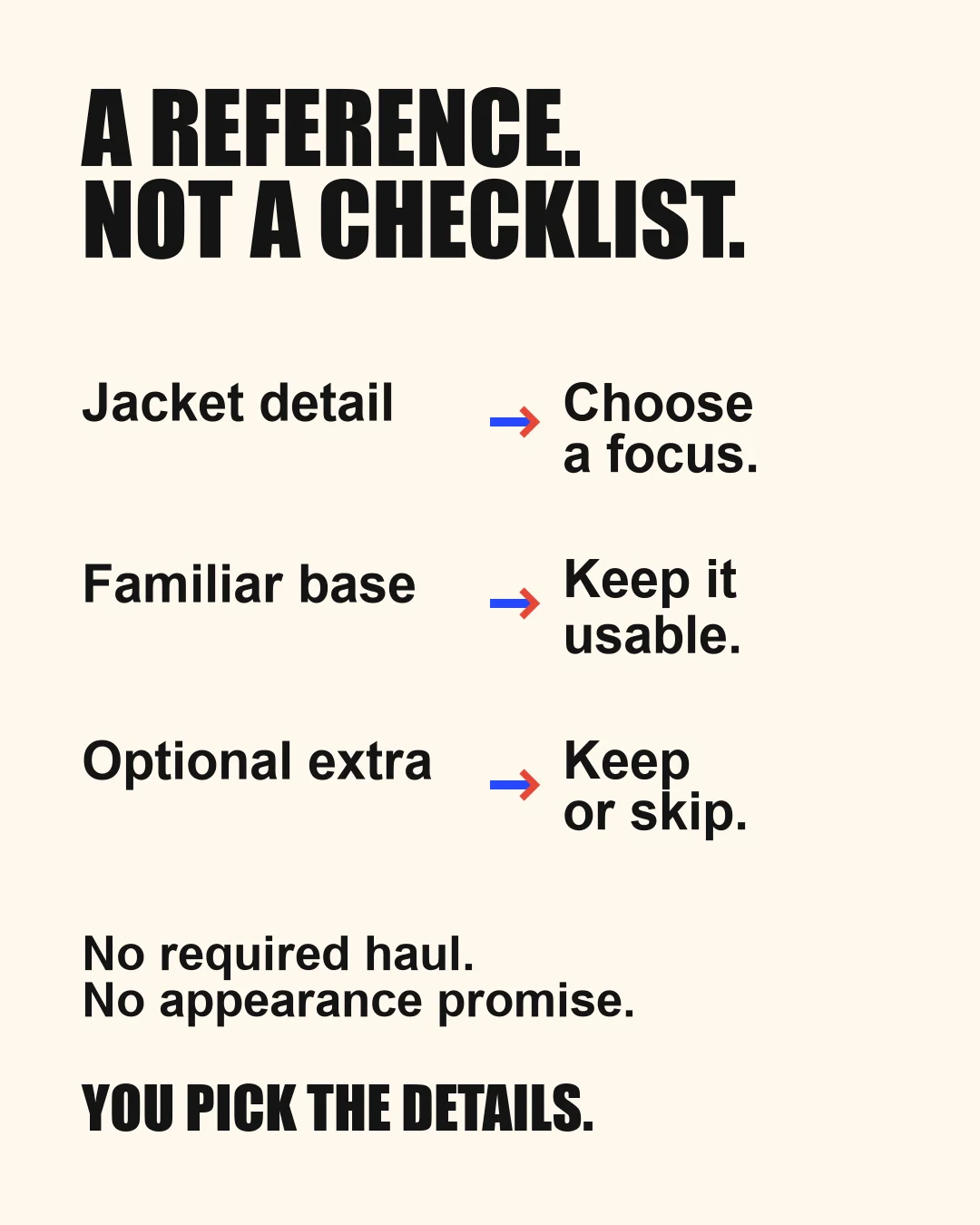
Start with an actual need if you have one: ordinary clothing for the day, an optional style idea or no clothing decision at all. Keep any established requirements for coverage, movement, access, weather, uniforms, fastening and protection. A picture cannot authorize dropping those requirements. There is no need to create an occasion or a missing item just because an image looks complete.
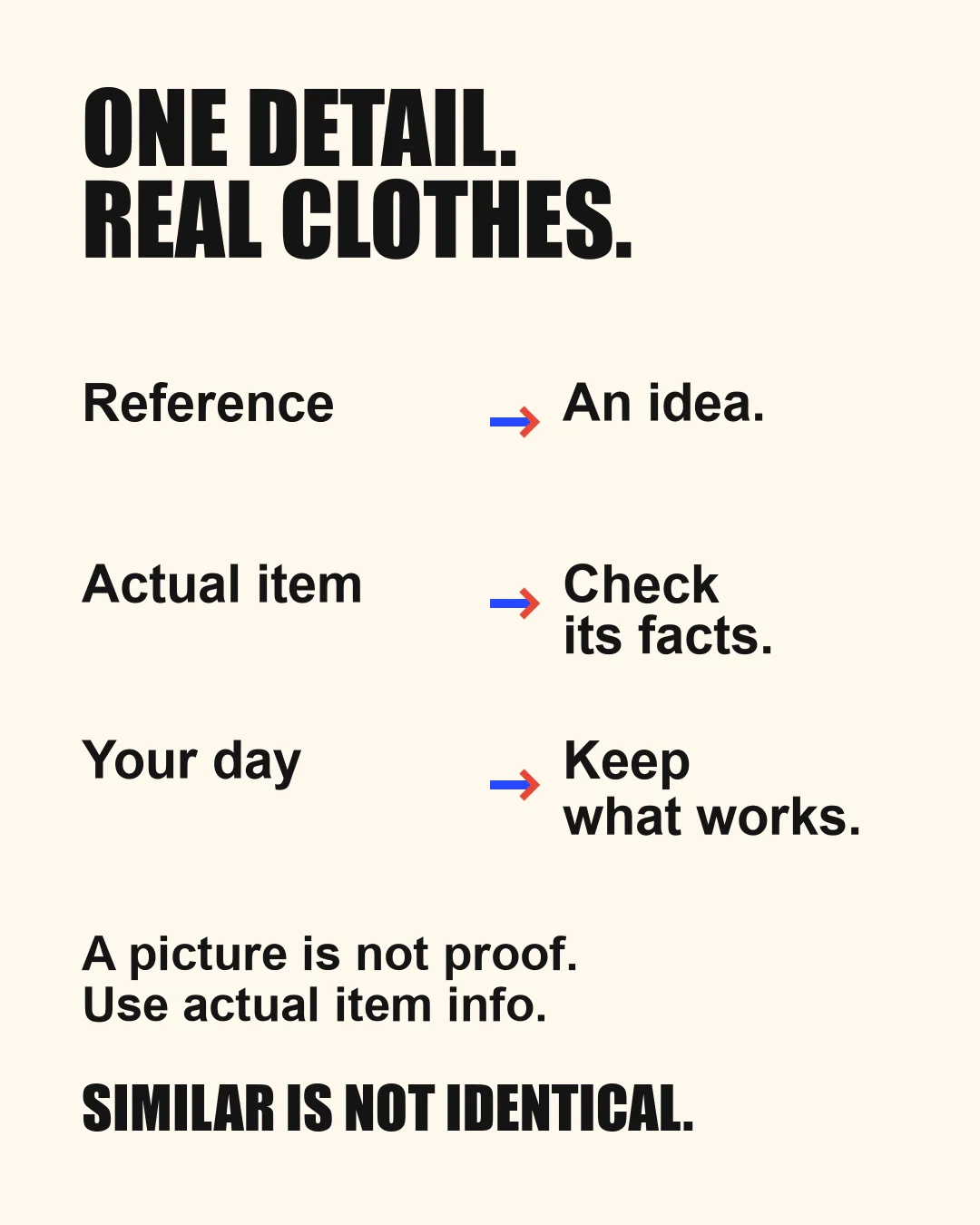
Graphic context — 02-feature-explainer: These pairs distinguish generated visualization, product information and a recommendation. The arrows classify information roles; they do not show equal accuracy, universal availability or three independent confirmations of actual fit.
Text equivalent: THREE SOURCES. DIFFERENT JOBS. Picture Visual idea. Details Product facts. Size tip A suggestion. Own issuer descriptions. No universal accuracy claim. KEEP THE QUESTIONS SEPARATE. The picture role is bounded by Google Shopping own help. Product/model/size information and conditional Fit Assistant recommendation are distinguished by ASOS own help; its assistant is not being presented as generated virtual try-on. Product facts here means the information about the listed item, not independent verification or a fit, comfort, safety or care certificate. No login, height, weight, measurements, purchase history, personal photo, review submission, account action or tool recommendation follows. Missing relevant information can remain unknown. Four complete primary publisher documents, not independent outfit studies. Undated Google Shopping own help accessed 26 October 2026, with settings-update warning, describes generated visualization/approximation and actual-fit limitation; undated ASOS own help distinguishes product/model/size information from conditional Fit Assistant recommendation, not generated try-on. WRAP 18 August 2020 page/campaign archived 31 March 2023 supplies an existing-clothes aim; undated FTC overview supplies cleaning-information context only. Whole four retained native bodies read, not linked policies, reviews, reports/data, laws or cases. No current measured growth, all-tool accuracy, empirical benefit, body diagnosis, size/fit/comfort/availability/privacy/security/legal guarantee, garment certificate or wardrobe sufficiency. No upload, new photo, body measurement, account/setting/contact/purchase action.
Actions in order
1. Name the question the picture prompted
Use a short description of what caught your attention: the dark jacket beside a pale top, a broad collar, a loose outline or a patterned layer. This keeps the interest attached to an idea. It does not require declaring the entire rendering accurate or copying every item in it.
Then distinguish that visual interest from a physical question. Liking the apparent colour pairing differs from knowing whether the real sleeve allows your usual movement. Seeing a closed front differs from knowing how an actual fastening behaves on the actual item. A pleasing outline alone does not settle either issue.
You can describe the question mentally, in an ordinary note or not at all. There is no required checklist to save, score to calculate or image to share. If the preview gives you no useful idea, closing the question is a complete choice. It need not become a project to repair the rendering or improve yourself.
2. Keep the illustration in its stated role
If you already encountered Google’s feature, its own help supplies a useful boundary: a visualization can suggest how something might look without guaranteeing actual fit. That boundary applies even when the image appears convincing. A rough-looking output is not required before you are allowed to keep uncertainty open.
Do not use the picture as an instruction to change your proportions, posture or appearance. Lighting, pose, lens, distance and editing can also alter ordinary photographs; a generated output adds another representation to consider. A difference between two pictures is not a controlled before-and-after result or a verdict about the person pictured.
This does not mean every depicted detail must be wrong. It means the image alone has not established the physical claim you are asking about. You can keep the visual idea while declining to treat the displayed size, drape or body outline as a finding. No repeated generation, comparison gallery or new photograph is needed to make that distinction.
An unconvincing rendering does not establish that the actual garment would be unsuitable either. It leaves a different uncertainty, rather than reversing the picture into a reliable rejection test. You can dislike the image and leave the item undecided, or skip it for your own reasons. You do not need to buy it to settle that distinction.
3. Separate product descriptions from recommendations
For an item you are already considering, notice what information you actually have. A description of fabric, cut or features is information about the listed product. A model wearing a stated size supplies context about that example. A size guide and a conditional recommendation have other roles. They should not be merged into one apparently unanimous approval.
ASOS’s help describes these categories separately. We are using that explanation to clarify categories, not recommending the retailer or its assistant. There is no need here to log in, enter height or weight, provide purchase history, measure yourself or submit a review. Linked privacy terms and individual reviews are outside this article’s evidence.
If relevant information is absent, preserve the gap in your decision. You can say, “I like the pictured shape; I do not know whether the actual item meets my needs.” That sentence is more useful than promoting a generated impression into certainty. You can postpone or decline an optional decision without filling the gap through a purchase.
4. Bring the decision back to the real day
Consider the activities and essential clothing functions that were already relevant before the preview appeared. If you need an established protective layer, a uniform, accessible fastening or weather protection, keep it. The visual appeal of another arrangement does not demonstrate an equivalent function. This guide supplies no new loading, stretching, movement or safety test.
An item you already know in its ordinary intended use may provide a suitable option. If you like a jacket-and-top colour idea, familiar clothing might let you consider that combination without recreating a generated garment. It is also possible that you own nothing appropriate. The archived WRAP aim does not require pretending otherwise.
Keep care separate too. The FTC overview’s cleaning-information context does not let a rendered surface identify fibres or prescribe washing, pressing, repair or alteration. Similar-looking items can leave different unanswered questions. We are not introducing a care method or asking you to repurpose something fragile to match an image. Unresolved item uncertainty is a reason to omit it or obtain suitable advice separately.
5. Choose the smallest useful decision
Your answer may be to keep a colour idea, use a familiar suitable combination, leave the current outfit unchanged or stop considering the item. None requires proving the whole tool useful or useless. A person can like the illustration and still decline the garment; someone else may have independent reasons for a choice that the image did not establish.
Avoid turning this into a demand to remove all uncertainty from clothing. Ordinary choices involve preferences and incomplete information. The point is to keep the origin of your confidence visible, especially when an image makes several open questions feel closed. You do not owe a tool another attempt, and you do not owe an attractive picture a transaction.
There is no schedule for repeating these prompts. Revisit a decision if a real circumstance or relevant information changes. Otherwise, a keep, change, defer or skip answer can stand without more screenshots, body comparisons or checking.
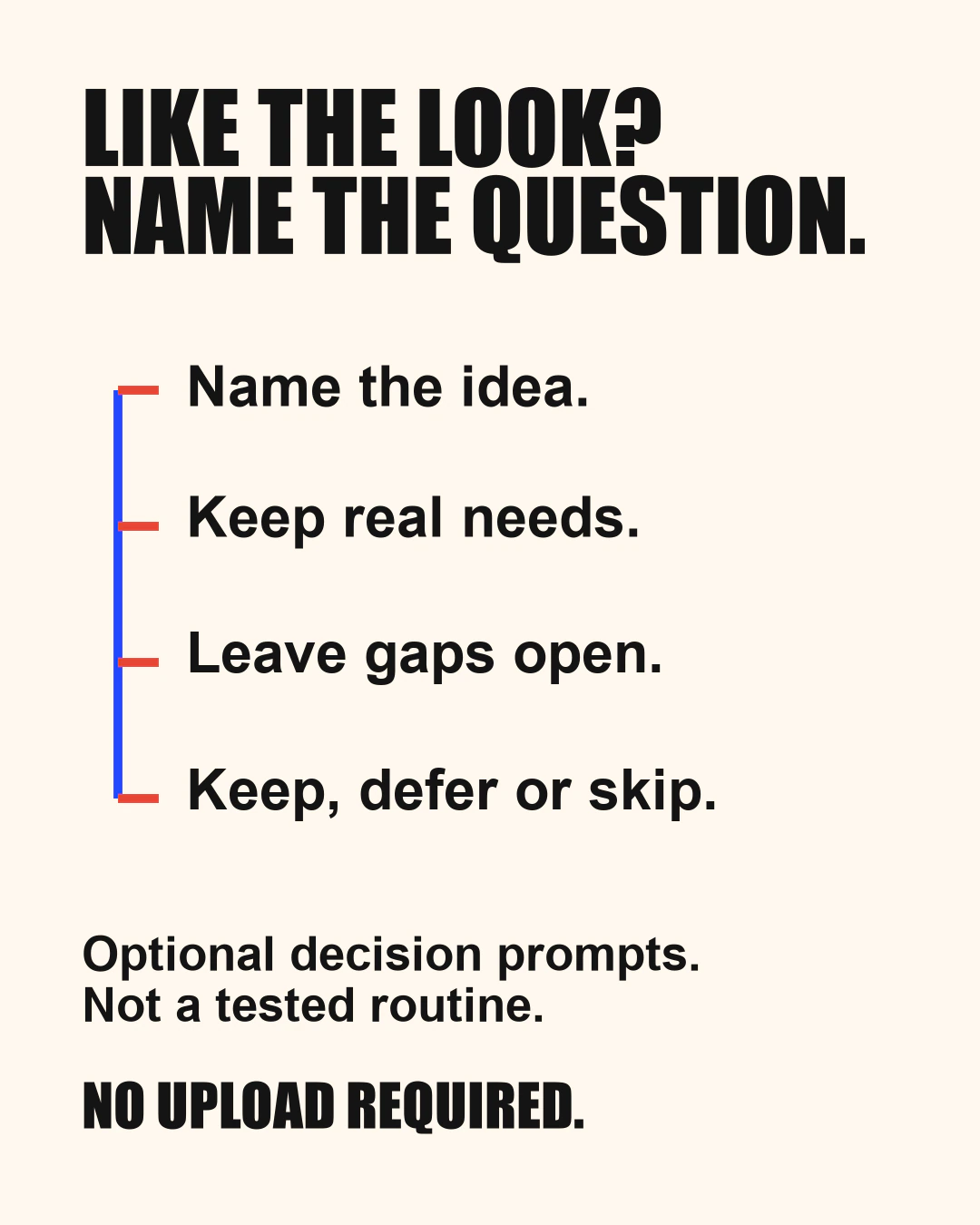
Graphic context — 03-routine-infographic: This original optional sequence keeps visual interest, actual clothing needs and unanswered questions distinct. It offers descriptive choices without claiming a measured improvement in fit, confidence, accuracy or mental health.
Text equivalent: LIKE THE LOOK? NAME THE QUESTION. Name the idea. Keep real needs. Leave gaps open. Keep, defer or skip. Optional decision prompts. Not a tested routine. NO UPLOAD REQUIRED. Actual coverage, movement, access, weather, uniform, protection and fastening requirements and established procedures remain intact. No new physical fit, stretching, loading, movement or safety test is introduced. An ordinary familiar suitable owned option or no action is possible, but ownership and suitability vary. There is no requirement for a generated image, new photograph, upload, body measurement, private disclosure, purchase or repeated checking. No timer, appearance ranking, environmental result, price or saving is encoded. Four complete primary publisher documents, not independent outfit studies. Undated Google Shopping own help accessed 26 October 2026, with settings-update warning, describes generated visualization/approximation and actual-fit limitation; undated ASOS own help distinguishes product/model/size information from conditional Fit Assistant recommendation, not generated try-on. WRAP 18 August 2020 page/campaign archived 31 March 2023 supplies an existing-clothes aim; undated FTC overview supplies cleaning-information context only. Whole four retained native bodies read, not linked policies, reviews, reports/data, laws or cases. No current measured growth, all-tool accuracy, empirical benefit, body diagnosis, size/fit/comfort/availability/privacy/security/legal guarantee, garment certificate or wardrobe sufficiency. No upload, new photo, body measurement, account/setting/contact/purchase action.
A fictional example: the jacket that looked settled
Imagine Morgan, an invented reader, seeing a generated image of a charcoal jacket over a light top. Morgan likes the contrast and initially treats the neatly closed jacket as proof that the item would be comfortable during a seated afternoon. That second conclusion goes beyond the visual preference.
Morgan separates the questions. The contrast is the liked idea. The actual jacket’s physical suitability is unresolved. A product description, if already available, might explain the listed cut or fabric, but it would not be the same as Morgan having experienced that item. A recommendation badge would also remain a recommendation rather than a personal fitting result.
Morgan already owns a familiar dark layer and a suitable pale top. Keeping those clothes for the day is one possible answer. If the familiar layer does not meet the day’s requirements, Morgan retains the established suitable outfit instead. If no alternative exists, Morgan can leave the idea unacted on. None of these choices establishes that the generated jacket is bad or that every preview is inaccurate.
Change the example: Morgan already has reliable experience with the actual jacket and chooses it for reasons independent of the rendering. That is compatible with the guide too. The picture does not erase existing knowledge; it simply should not be credited for physical knowledge it did not supply. Morgan’s story is an illustration, not an observed participant, testimonial or tested intervention.
Graphic context — 04-practical-support: These invented alternatives follow fictional Morgan: liking a colour idea does not resolve the actual jacket fit, and a familiar suitable layer may remain an option. The rows are not observed outcomes, ranked benefits or a universal wardrobe solution.
Text equivalent: JACKET PICTURE. REAL DAY. Liked colour Keep the idea. Real fit Still unknown. Known layer Keep if suitable. Invented alternatives. No wardrobe guarantee. REAL NEEDS COME FIRST. If a familiar layer does not meet the actual day needs, keep an established suitable outfit or skip the idea. No purchase is needed to test the rendering, and an unsatisfactory picture is not a reliable rejection test for the real garment. Reliable existing experience can independently support a clothing choice. Cleaning information remains separate from visual appearance; no rendered surface identifies material or prescribes a care or alteration method. No clinical, confidence, social, financial, environmental or legal outcome is established. Four complete primary publisher documents, not independent outfit studies. Undated Google Shopping own help accessed 26 October 2026, with settings-update warning, describes generated visualization/approximation and actual-fit limitation; undated ASOS own help distinguishes product/model/size information from conditional Fit Assistant recommendation, not generated try-on. WRAP 18 August 2020 page/campaign archived 31 March 2023 supplies an existing-clothes aim; undated FTC overview supplies cleaning-information context only. Whole four retained native bodies read, not linked policies, reviews, reports/data, laws or cases. No current measured growth, all-tool accuracy, empirical benefit, body diagnosis, size/fit/comfort/availability/privacy/security/legal guarantee, garment certificate or wardrobe sufficiency. No upload, new photo, body measurement, account/setting/contact/purchase action.
Costs, risks and stop criteria
No new purchase is required to distinguish a visual idea from an unresolved fit question. That is not a claim of zero total cost: clothing may involve past purchases, ordinary care, time, access constraints or separately chosen professional advice. We have no price range, savings estimate or environmental result to promise. Attention also has a cost, so a decision can be brief without a mandatory timer.
Stop if the exercise starts becoming repeated body comparison, image correction or pressure to buy something to justify the preview. You can leave the entire feature unused. Persistent appearance worries that interfere with daily life deserve qualified support rather than more generated comparisons. This is a nonclinical clothing guide, not diagnosis, treatment or a substitute for such support.
Keep existing safety requirements and important procedures intact. Do not remove necessary layers, alter garments, improvise fastening or run an unfamiliar fit experiment for this article. Damaged, uncomfortable or uncertain items can be left out. If a garment question genuinely needs specialist advice, an appropriate professional or maker may be relevant separately; no professional has inspected or approved an item through this guide.
The issuer sources are commercial descriptions of their own services, not neutral rankings. We recommend no retailer, subscription, app, purchase or membership. We performed no try-on session, body measurement, product test or photo submission for this article. It offers no privacy, consent, security, return-right or legal guarantee, and does not interpret linked policies. Those subjects cannot be settled by the attractive appearance of an output either.
How to assess the result
Look for a clear separation in your own answer: what interested you visually, what the relevant information actually says, and what remains unknown about the real garment. You may now have a suitable ordinary choice, a deferred optional decision or no action. This is a descriptive result, not a validated improvement in confidence, comfort, shopping accuracy or mental health.
It is equally reasonable to decide that the preview added nothing useful. You do not need to establish a universal verdict on AI or defend a style preference. The practical result is simply that a polished picture no longer has to carry questions it has not answered.
Myth or Real?
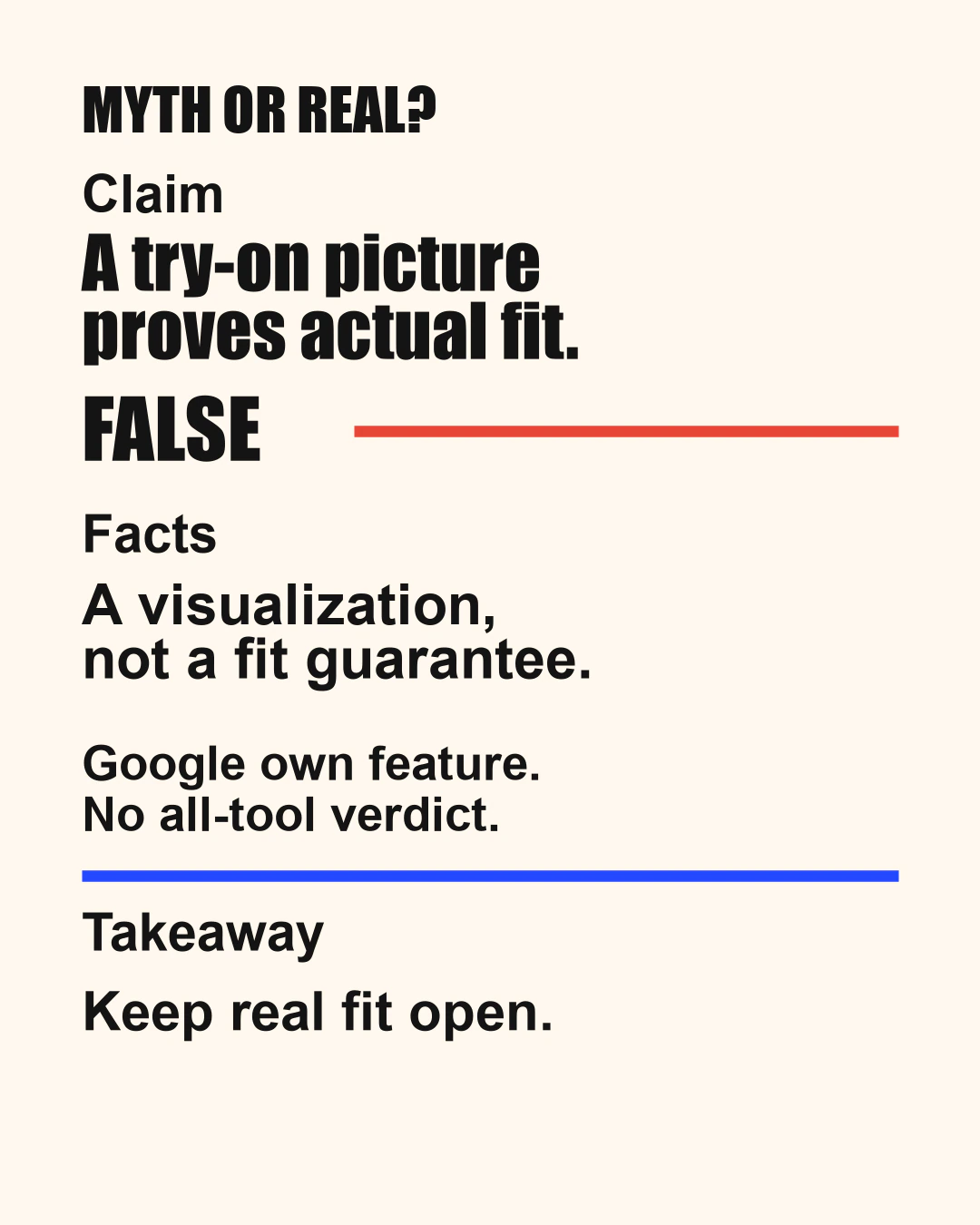
Claim
Social paraphrase: A generated try-on picture alone proves the actual garment will fit.
Verdict
FALSE
Facts
Google describes its generated shopping visualization as an approximation that does not determine or guarantee actual fit.
Google own feature limitation, not a verdict on every tool. ASOS recommendation is a different feature.
An archived ecommerce question asks whether a synthetic clothing preview helps with a buying decision. It discovers uncertainty. This card explicitly reframes a picture-proves-fit proposition for editorial examination, not a quotation or a false belief attributed to the questioner. Anecdotes, comments, app promotions, votes, body assertions and suggested user actions are excluded. Google Shopping own undated help, accessed 26 October 2026, describes its generated visualization as an approximation and says it does not determine or guarantee actual garment fit. Its settings-update warning remains relevant to the scope; setup, photo, account and policy instructions are not adopted. ASOS own undated help, accessed the same date, distinguishes product/model/size information from a conditional Fit Assistant recommendation. That recommendation is a different feature, not generated try-on or a physical fitting. These are commercial issuer descriptions, not independent accuracy trials. FALSE rejects the generated picture alone as sufficient proof of actual fit in this bounded context. It does not establish that all tools or depicted details are inaccurate, or that an unconvincing rendering proves a real garment unsuitable. Independent reliable experience with the actual garment remains separate. No image diagnoses a person or supplies a garment, privacy, security or legal certificate. No upload, new photograph, body measurements, personal disclosure, login, account or setting change, contact, review or purchase is required. Full linked policies, reviews, underlying data and benchmarks were not read or executed.
Takeaway
Keep visual interest, product information and unknown physical fit separate; no upload or purchase is required.
Sources
Claim discussion: Archived original virtual clothing preview question.
Evidence: How the Google Try-On tool works; Can you help me find the right size?.
Checked 2026-10-26. Scope: Nonclinical clothing decision. No body diagnosis, all-tool accuracy benchmark, garment certificate or fit, comfort, privacy, security or legal guarantee. No photo, upload, body measurement, account action or purchase required.
Sources
- Google Shopping Help: How the Google Try-On tool works. Undated help accessed October 26, 2026, with a settings-update warning. Own visualization, approximation and actual-fit limitation only. Setup, photo, account and policy instructions are not adopted here; no all-tool benchmark or privacy assessment.
- ASOS Customer Care: Can you help me find the right size?. Undated issuer help accessed October 26, 2026. Distinguishes product/model/size information and conditional Fit Assistant recommendation. Not an independent fit trial or endorsement; linked privacy terms and reviews were not read.
- WRAP: Love Your Clothes. Page dated August 18, 2020; campaign archived March 31, 2023. Existing-clothes aim only, with no statistics or claimed saving, environmental effect or universal wardrobe sufficiency adopted.
- FTC: Apparel and Labeling. Undated overview accessed October 26, 2026. Cleaning-information context only; linked laws, cases and guides are not interpreted or applied. No garment fit, care method, legal right or professional certificate is inferred.
FAQ
Common questions
Does a realistic try-on picture guarantee actual fit?
Google Shopping own help describes its visualization as an approximation and says it does not determine or guarantee actual garment fit. That is a bounded issuer statement, not a measured verdict about every tool or every depicted detail.
Is a size recommendation the same as generated try-on?
ASOS own help distinguishes product/model/size information and a conditional Fit Assistant recommendation. A recommendation, a generated picture and actual physical fit have different roles. This guide asks for no login or personal information.
Do I need to upload a photo or buy the item to use this guide?
No. You can name what interested you, keep actual clothing needs, preserve unknowns and choose, defer or skip. An unconvincing image alone does not prove the real garment unsuitable either; independent reliable experience with an actual item remains separate.
Topic hubs
Tags