
Reduce avoidable breakage and weathering when using dryers, flat irons, or curling tools without promising that heat can be made damage-free. That is a practical grooming goal, not a verdict on attractiveness or personal value. Normal variation is expected, and the safest plan is the one that remains simple enough to follow without pain, shame, or a constant search for flaws.
This guide is general education, not diagnosis or individualized treatment. It does not prescribe a drug, device, or procedure, and it does not use photographs to diagnose a skin, hair, allergy, circulation, or other medical condition.
Start with your real baseline
Diameter, curl pattern, porosity, color treatment, prior damage, density, and humidity response vary. A temperature that appears adequate on one head can be excessive on another, and styled shine is not proof of fiber health.
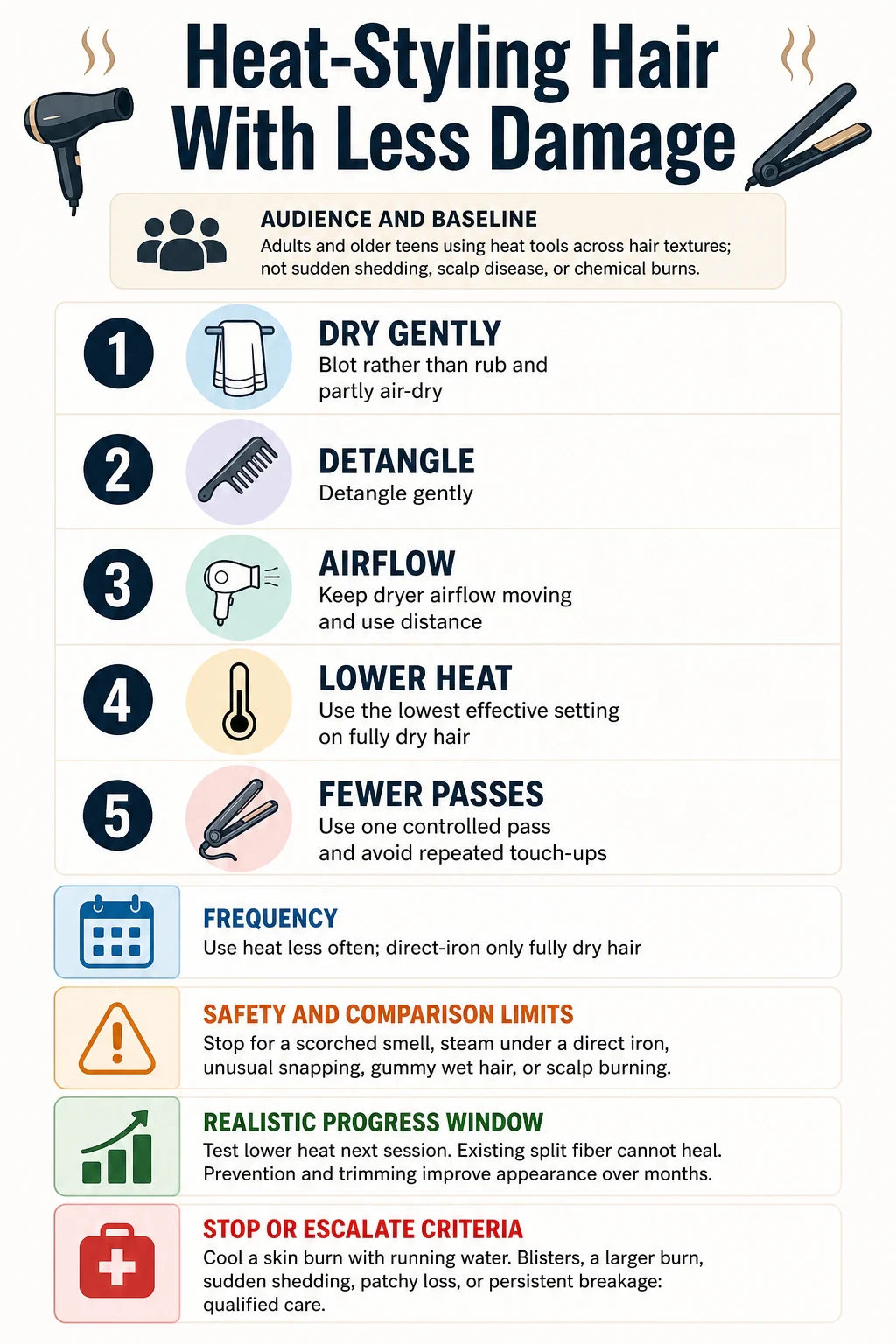
Adults and older teens who use heat tools on straight, wavy, curly, or coily hair; not people seeking diagnosis of sudden shedding, scalp disease, or chemical burns.
Before changing anything, record the current routine, the exact symptom or appearance concern, and any recent product, medication, climate, or activity change. That short baseline is more useful than comparing yourself with a highly edited image. If checking has become repetitive or distressing, step away from close-up inspection and talk with someone you trust or a qualified clinician.
What is actually modifiable
Modifiable factors include temperature, pass count, contact time, moisture at direct-iron use, drying distance, frequency, tension, detangling, conditioning, and tool maintenance. Less-modifiable factors include hair diameter, curl pattern, baseline porosity, previous chemical processing, weather, and the age of each hair fiber.
That distinction matters. A routine can reduce avoidable irritation or improve day-to-day presentation, but it cannot promise a new anatomy, erase normal texture, or guarantee a uniform result. The right target is a tolerable process and a meaningful symptom trend, not perfection.

What the evidence supports
Heat removes water and can change keratin structure and cuticle surfaces. Damage generally rises with higher temperature, longer exposure, repeated passes, and accumulated weathering. Direct irons on damp hair add a specific risk because water inside the shaft can rapidly vaporize. Heat protectants may reduce some damage, but none makes repeated high heat harmless.
AAD guidance recommends partial air-drying, lower or medium heat, less frequent blow-drying, and flat irons only on dry hair. Laboratory studies indexed in PubMed show surface damage increasing with temperature and reduced water retention after thermal treatment. Another study found some polymer pretreatments reduced selected markers of flat-iron damage, but it does not establish a universal consumer product or safe maximum temperature.
Evidence strength is not the same as marketing confidence. Official guidance is strong for safety boundaries and labeled use, while product-to-product claims are often thinner. Laboratory or short clinical studies can explain a mechanism without proving that every person will see the same visible result. When uncertainty is material, this guide says so.
A lower-risk routine
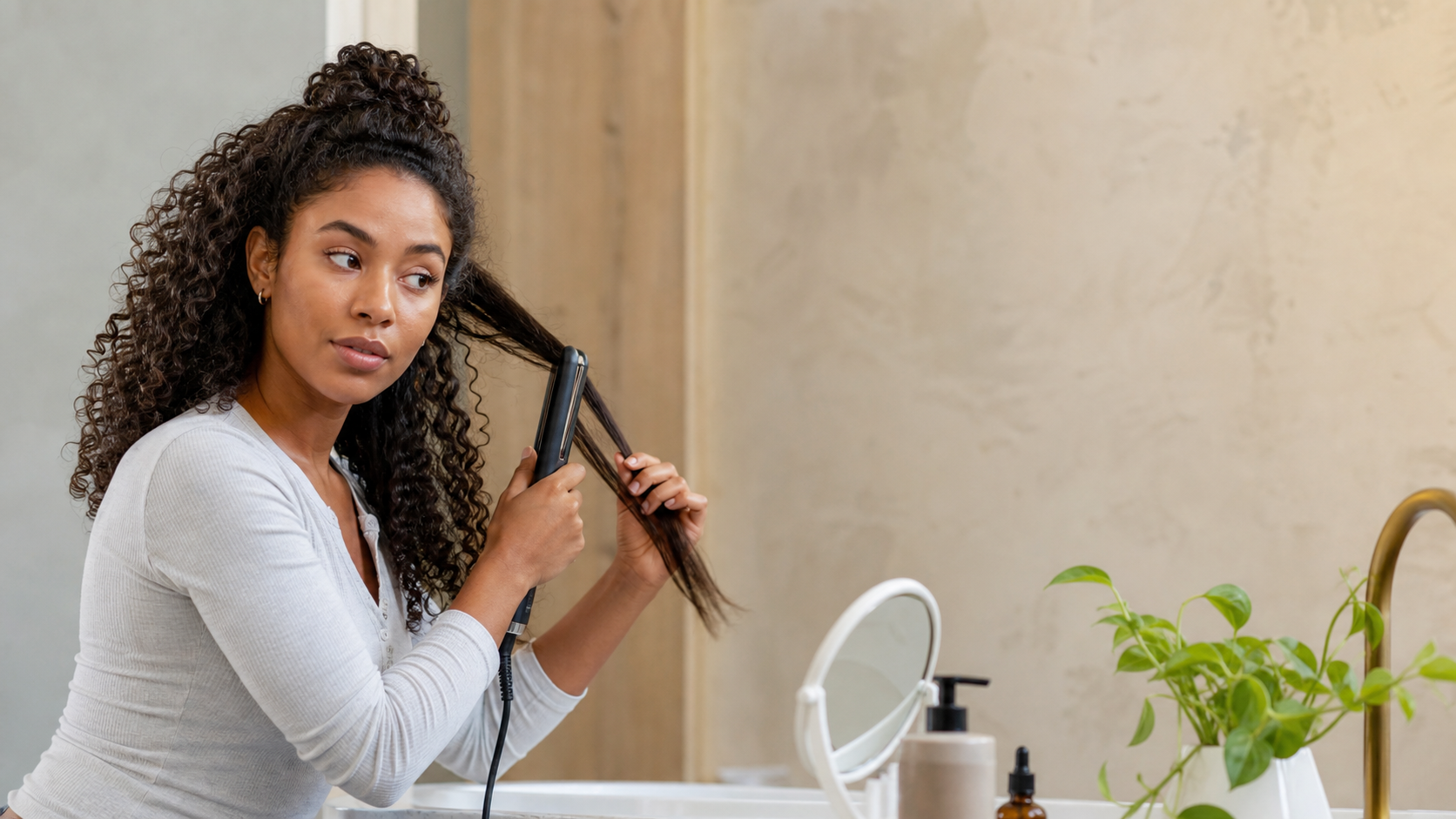
Detangle gently, blot rather than rub, and let hair partly air-dry. Use a dryer with moving airflow and distance before reaching for direct plates. For irons, start at the lowest setting that works with one controlled pass on fully dry hair. Reduce frequency, avoid repeatedly touching up the same section, and use a conditioner or labeled heat-protective product if tolerated. Texture preservation may require less heat, not a hotter tool.
Use this order:
- Define the single problem you are trying to solve.
- Remove avoidable irritation or pressure before buying more treatment.
- Introduce one reversible change and follow its label or professional instructions.
- Keep the rest of the routine stable long enough to interpret tolerance.
- Escalate to qualified care when the pattern is severe, persistent, unusual, or unsafe for self-treatment.
Doing less is sometimes the more evidence-based choice. Stacking products makes both benefit and harm harder to trace, and discomfort is not a useful proxy for effectiveness.
Time, cost, and realistic progress
A lower-heat technique can be tested at the next styling session, but existing split or melted fiber cannot be biologically repaired. Visible improvement comes from preventing new damage and trimming weathered ends over months as hair grows. Costs range from using current tools less often to replacing an unregulated or uneven-heating tool; no expensive device guarantees protection.
Clean tool surfaces, check cords and temperature controls, schedule heat-free days, and record the lowest effective setting. Compare breakage and texture monthly in the same wash and lighting conditions rather than chasing one-day gloss.
Progress should be judged by comfort, function, consistency, and the specific concern named at the start. Use the same lighting and ordinary viewing distance if you keep photographs. Daily close-ups mostly measure camera conditions and natural fluctuation.
Stop and get help when needed
Stop when hair smells scorched, steams under a direct iron, snaps unusually, feels gummy when wet, or the scalp burns. Cool a skin burn with running water and seek medical care for blistering or a larger burn. Sudden shedding, patchy loss, scalp inflammation, or continuing breakage despite stopping heat needs dermatologist review.
A dermatologist should assess persistent breakage with scalp symptoms, patchy loss, sudden shedding, or uncertainty about chemical damage. Minors should use low-risk techniques with adult supervision and avoid high-temperature tools without training.
These boundaries are part of the routine, not an afterthought. A qualified professional can check whether the apparent cosmetic issue is actually dermatitis, infection, allergy, medication effect, inflammatory disease, circulation trouble, or another condition that needs a different plan.
Visual and commercial transparency
Silicones, oil, flash, smoothing filters, straightening tension, humidity, and camera sharpening can change shine and frizz. Images cannot measure protein damage, diagnose hair loss, or prove that a product repaired the cortex.
This article has no affiliate links, sponsor, free-product relationship, product ranking, or paid placement. Brand packaging, high prices, salon photography, and social-media popularity are not evidence of safety or superiority. Any cost language is a broad planning range, not a live shopping recommendation.
Practical summary
- Blot and partly air-dry; 2. Detangle gently; 3. Use moving airflow first; 4. Direct-iron only fully dry hair at the lowest effective heat; 5. Limit passes and frequency
Frequency: Use heat less often when possible; do not repeatedly pass direct irons over the same section.
The useful question is not whether a routine creates a perfect image. It is whether the smallest safe change is tolerable, supported, affordable to maintain, and producing a consistent improvement without crossing a stop boundary.
Decision checkpoint
Set a one-pass rule for a test section: fully dry hair, the lowest plausible heat, steady movement, and no repeated clamping to force a glassy finish. If one pass does not give the desired shape, reconsider section size, drying technique, or the style itself before automatically increasing temperature.

Sources
- S01: Hair styling without damage - American Academy of Dermatology; accessed 2026-08-09.
- S02: Tips for healthy hair - American Academy of Dermatology; accessed 2026-08-09.
- S03: Hair shaft damage from heat and drying time of hair dryer - Annals of Dermatology via PubMed; accessed 2026-08-09.
- S04: The effect of various cosmetic pretreatments on protecting hair from thermal damage by hot flat ironing - Journal of Cosmetic Science via PubMed; accessed 2026-08-09.


