

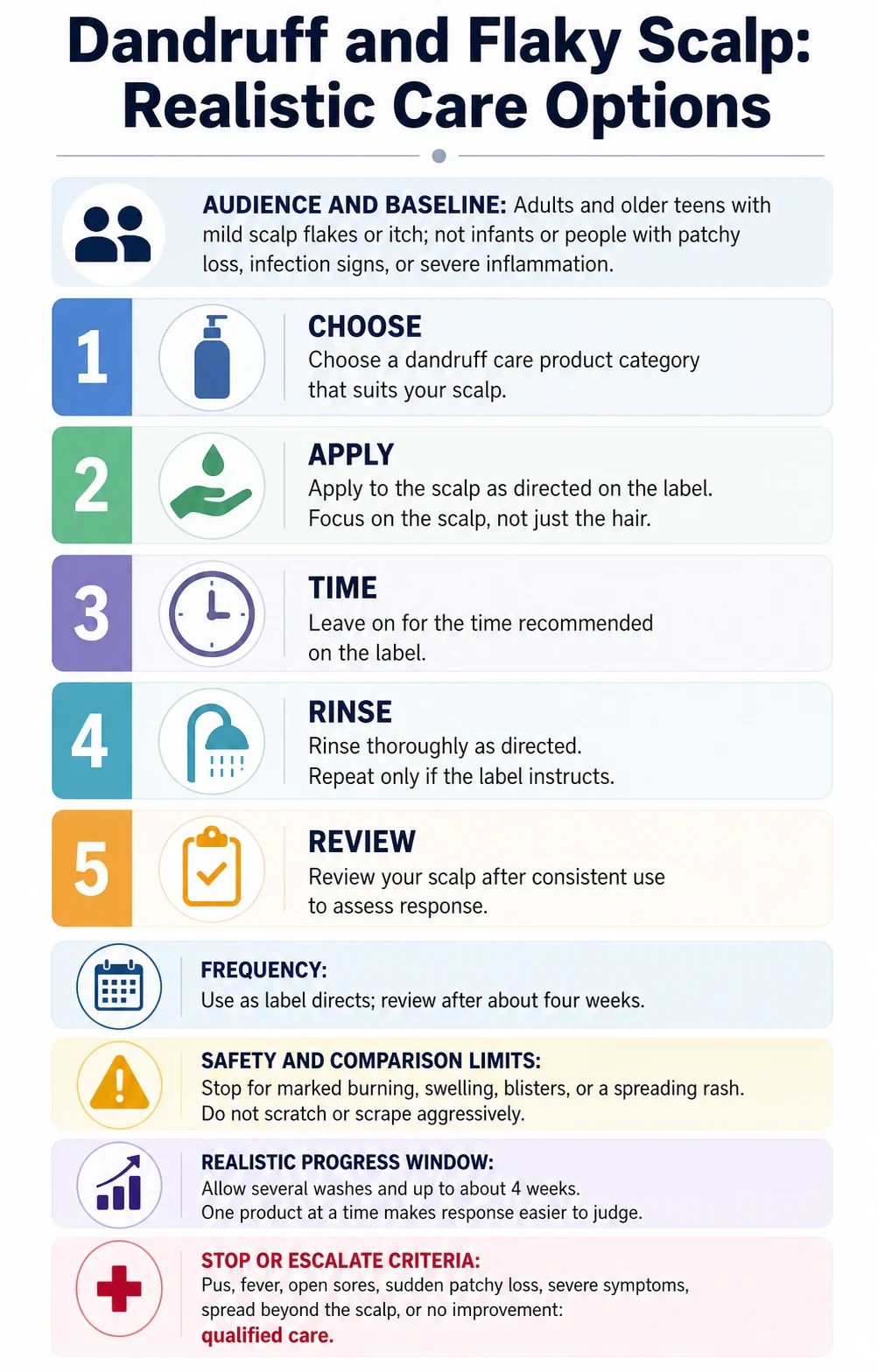
Reduce ordinary scalp flaking and itch with a label-led routine while recognizing that several different conditions can look flaky and need different care. That is a practical grooming goal, not a verdict on attractiveness or personal value. Normal variation is expected, and the safest plan is the one that remains simple enough to follow without pain, shame, or a constant search for flaws.
This guide is general education, not diagnosis or individualized treatment. It does not prescribe a drug, device, or procedure, and it does not use photographs to diagnose a skin, hair, allergy, circulation, or other medical condition.
Start with your real baseline
Scalp oil, wash frequency, curl pattern, hairstyle, climate, sweat, and product buildup vary. Visible flakes do not prove poor hygiene, and a photo cannot distinguish dandruff from psoriasis, eczema, contact dermatitis, or scalp infection.
Adults and older teens with mild scalp flakes or itch who are considering an over-the-counter shampoo; not infants, people with patchy hair loss, severe inflammation, infection signs, or an established diagnosis needing treatment changes.
Before changing anything, record the current routine, the exact symptom or appearance concern, and any recent product, medication, climate, or activity change. That short baseline is more useful than comparing yourself with a highly edited image. If checking has become repetitive or distressing, step away from close-up inspection and talk with someone you trust or a qualified clinician.
What is actually modifiable
Modifiable factors include shampoo selection, contact time, rinse quality, styling-product exposure, wash schedule, scratching, and whether a trigger product is stopped. Less-modifiable factors include skin-barrier tendency, immune status, hair texture, chronic inflammatory conditions, and medication or disease effects.
That distinction matters. A routine can reduce avoidable irritation or improve day-to-day presentation, but it cannot promise a new anatomy, erase normal texture, or guarantee a uniform result. The right target is a tolerable process and a meaningful symptom trend, not perfection.

What the evidence supports
Dandruff shampoos use different active ingredients and are not interchangeable for every scalp. Some target yeast, some loosen scale, and some reduce other aspects of flaking. Leaving a product on only as the label directs matters; using more often or longer can increase irritation without guaranteeing faster control.
AAD guidance recommends matching shampoo use to hair type and following the directed contact time. NHS guidance suggests giving an anti-dandruff shampoo about a month while watching for severe itch, redness, swelling, or spread beyond the scalp. A Cochrane review found topical ketoconazole and ciclopirox more effective than placebo for seborrhoeic dermatitis, but many studies were short and evidence quality varied. DermNet reinforces that diagnosis matters when the pattern is persistent or atypical.
Evidence strength is not the same as marketing confidence. Official guidance is strong for safety boundaries and labeled use, while product-to-product claims are often thinner. Laboratory or short clinical studies can explain a mechanism without proving that every person will see the same visible result. When uncertainty is material, this guide says so.
A lower-risk routine
Choose one labeled anti-dandruff shampoo and follow its directions for frequency and contact time. Apply to the scalp rather than coating only the hair lengths, rinse thoroughly, and use a compatible conditioner on lengths if needed. For curly or coily hair, a lower shampoo frequency may reduce dryness, but the active still needs correct scalp contact. Avoid aggressive scraping, nail scratching, and cycling several medicated products at once.
Use this order:
- Define the single problem you are trying to solve.
- Remove avoidable irritation or pressure before buying more treatment.
- Introduce one reversible change and follow its label or professional instructions.
- Keep the rest of the routine stable long enough to interpret tolerance.
- Escalate to qualified care when the pattern is severe, persistent, unusual, or unsafe for self-treatment.
Doing less is sometimes the more evidence-based choice. Stacking products makes both benefit and harm harder to trace, and discomfort is not a useful proxy for effectiveness.
Time, cost, and realistic progress
A first trial generally takes several washes and up to about four weeks. One shampoo is a recurring low-to-moderate drugstore cost; adding multiple specialty products makes the experiment harder to interpret. Maintenance may be less frequent once control improves, but recurrence is common.
Record the active ingredient and frequency, not just the brand. Keep scratching low, rinse well, and reassess after four weeks. If one properly used product fails, a pharmacist or dermatologist can help identify a different mechanism or a different diagnosis.
Progress should be judged by comfort, function, consistency, and the specific concern named at the start. Use the same lighting and ordinary viewing distance if you keep photographs. Daily close-ups mostly measure camera conditions and natural fluctuation.
Stop and get help when needed
Stop a shampoo that causes marked burning, swelling, blistering, or a spreading rash. Seek prompt care for pus, fever, painful swelling, open sores, sudden patchy hair loss, or a child with a suspected scalp infection. See a clinician if symptoms remain after a consistent month, are severe, or affect the face or body.
Qualified review is appropriate for persistent, severe, inflamed, painful, spreading, or hair-loss-associated symptoms and for immunocompromised people. Minors should use conservative label-led care with adult oversight and professional assessment when the pattern is unclear.
These boundaries are part of the routine, not an afterthought. A qualified professional can check whether the apparent cosmetic issue is actually dermatitis, infection, allergy, medication effect, inflammatory disease, circulation trouble, or another condition that needs a different plan.
Visual and commercial transparency
Dark clothing, flash, close macro views, recent brushing, dry shampoo, and image sharpening can exaggerate flakes. Images cannot diagnose seborrhoeic dermatitis, psoriasis, eczema, ringworm, or contact allergy.
This article has no affiliate links, sponsor, free-product relationship, product ranking, or paid placement. Brand packaging, high prices, salon photography, and social-media popularity are not evidence of safety or superiority. Any cost language is a broad planning range, not a live shopping recommendation.
Practical summary
- Choose one labeled dandruff shampoo; 2. Apply to scalp; 3. Leave on only as directed; 4. Rinse thoroughly; 5. Reassess after a consistent month
Frequency: Use as the product label or clinician directs; review response after about four weeks.
The useful question is not whether a routine creates a perfect image. It is whether the smallest safe change is tolerable, supported, affordable to maintain, and producing a consistent improvement without crossing a stop boundary.
Decision checkpoint
Keep the bottle’s active ingredient in the log. Two shampoos with different brand names may use the same mechanism, while two products that look similar may need different contact times. Recording the active, schedule, and response prevents accidental duplication and gives a pharmacist or dermatologist something concrete to review.

Sources
- S01: How to treat dandruff - American Academy of Dermatology; accessed 2026-08-09.
- S02: Dandruff - National Health Service; accessed 2026-08-09.
- S03: Antifungal treatments applied to the skin to treat seborrhoeic dermatitis - Cochrane; accessed 2026-08-09.
- S04: Seborrhoeic dermatitis - DermNet; accessed 2026-08-09.


