
Use a small, tolerable over-the-counter routine for mild acne while protecting the skin barrier and knowing when self-care is no longer the right level of treatment. That is a practical grooming goal, not a verdict on attractiveness or personal value. Normal variation is expected, and the safest plan is the one that remains simple enough to follow without pain, shame, or a constant search for flaws.
This guide is general education, not diagnosis or individualized treatment. It does not prescribe a drug, device, or procedure, and it does not use photographs to diagnose a skin, hair, allergy, circulation, or other medical condition.
Start with your real baseline
Oil production, lesion type, post-inflammatory color change, sensitivity, and healing speed vary. Texture and pores remain normal, and progress photos can exaggerate changes through lighting, makeup, lens distance, and editing.
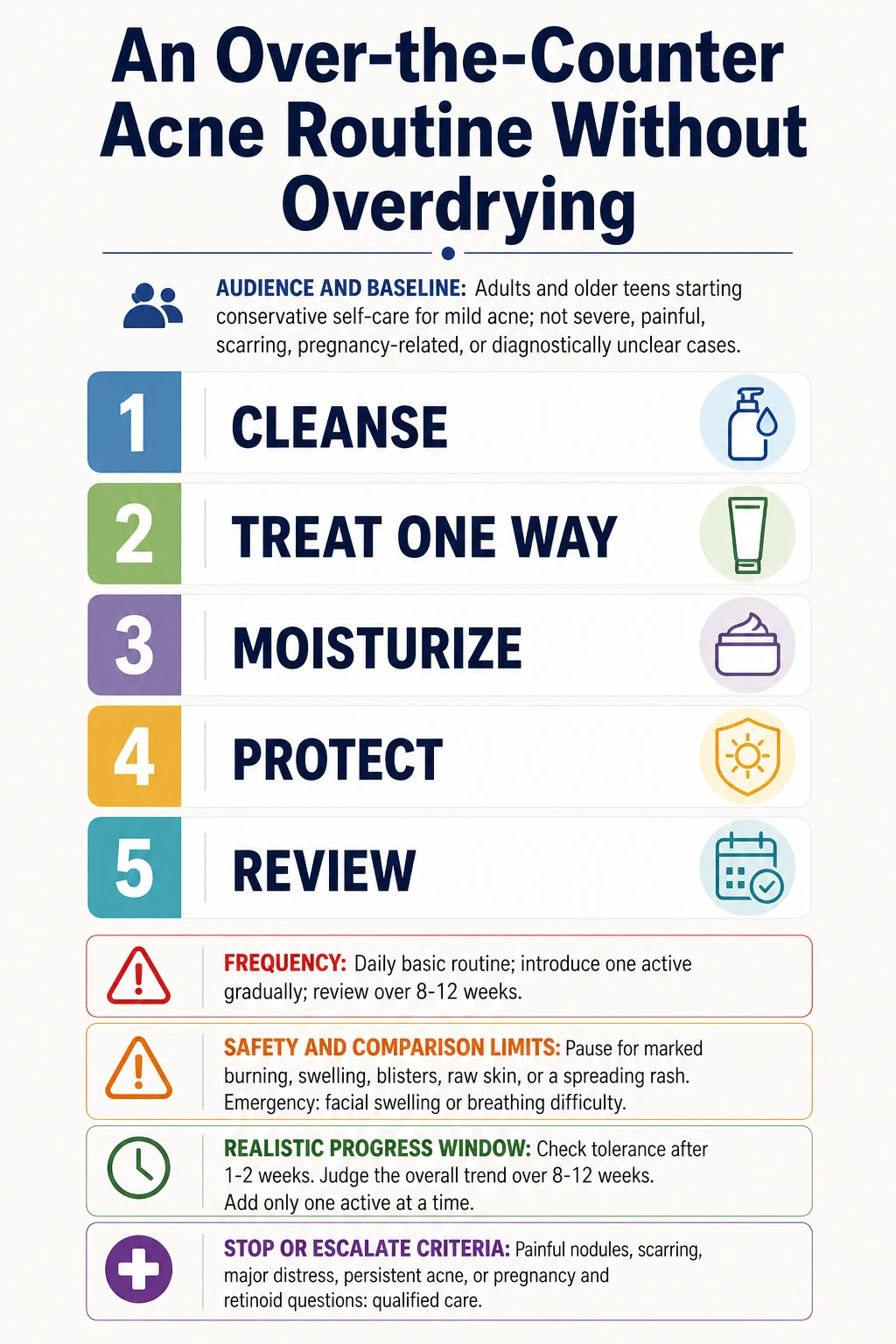
Adults and older teens with mild comedonal or inflammatory acne who want a conservative starting routine; not people with severe pain, nodules, rapid scarring, pregnancy-related medication questions, or a need for diagnosis.
Before changing anything, record the current routine, the exact symptom or appearance concern, and any recent product, medication, climate, or activity change. That short baseline is more useful than comparing yourself with a highly edited image. If checking has become repetitive or distressing, step away from close-up inspection and talk with someone you trust or a qualified clinician.
What is actually modifiable
Modifiable factors include cleanser harshness, active selection, frequency, moisturizer use, picking, sunscreen, and how many products are introduced at once. Less-modifiable factors include genetics, hormones, baseline pigmentation, tendency to scar, medication effects, and medical conditions.
That distinction matters. A routine can reduce avoidable irritation or improve day-to-day presentation, but it cannot promise a new anatomy, erase normal texture, or guarantee a uniform result. The right target is a tolerable process and a meaningful symptom trend, not perfection.

What the evidence supports
Benzoyl peroxide reduces acne-associated bacteria, salicylic acid helps open clogged pores, and topical retinoids alter follicular plugging. Each can irritate. More tingling, peeling, or redness is not evidence of better treatment; barrier damage can make a routine harder to continue.
AAD guidance supports benzoyl peroxide, salicylic acid, azelaic acid, and retinoids for selected acne patterns and explains that moisturizers can improve tolerability. NICE recommends structured first-line combinations and warns about irritation, photosensitivity, and fabric bleaching. Cochrane reviews find benefit for some topical options but also emphasize uncertainty and variable evidence quality. This is enough to justify a cautious routine, not a promise of clear skin.
Evidence strength is not the same as marketing confidence. Official guidance is strong for safety boundaries and labeled use, while product-to-product claims are often thinner. Laboratory or short clinical studies can explain a mechanism without proving that every person will see the same visible result. When uncertainty is material, this guide says so.
A lower-risk routine
Begin with a gentle cleanser, one active, a non-comedogenic moisturizer, and broad-spectrum sunscreen. Pick one main active based on the dominant concern instead of layering acids, scrubs, and retinoids. Start less often than the label maximum if skin is sensitive, then increase only if comfortable. Use a pea-sized amount where a label or clinician directs it, avoid picking, and keep hair and heavy occlusive products off acne-prone areas when they clearly worsen breakouts.
Use this order:
- Define the single problem you are trying to solve.
- Remove avoidable irritation or pressure before buying more treatment.
- Introduce one reversible change and follow its label or professional instructions.
- Keep the rest of the routine stable long enough to interpret tolerance.
- Escalate to qualified care when the pattern is severe, persistent, unusual, or unsafe for self-treatment.
Doing less is sometimes the more evidence-based choice. Stacking products makes both benefit and harm harder to trace, and discomfort is not a useful proxy for effectiveness.
Time, cost, and realistic progress
Acne care is measured in weeks, not overnight. A simple cleanser-active-moisturizer-sunscreen routine is a modest recurring drugstore cost, but wasted product rises quickly when several actives are started together. Review tolerance after one to two weeks and overall trend over roughly eight to twelve weeks unless symptoms demand earlier care.
Change one variable at a time, keep frequency stable, and compare in the same lighting no more than weekly. Continue moisturizer and sunscreen even when lesions improve. Maintenance may be simpler than the starting routine; escalating product count is not a progress signal.
Progress should be judged by comfort, function, consistency, and the specific concern named at the start. Use the same lighting and ordinary viewing distance if you keep photographs. Daily close-ups mostly measure camera conditions and natural fluctuation.
Stop and get help when needed
Pause the new active for marked burning, swelling, blistering, raw skin, or a spreading rash. Urgent symptoms such as facial swelling or breathing difficulty need emergency care. Painful nodules, scarring, major mental-health impact, persistent acne after a consistent trial, or uncertainty about pregnancy and retinoids requires qualified medical review.
A dermatologist or primary-care clinician should review severe, painful, scarring, persistent, or diagnostically unclear acne and treatment questions involving pregnancy, prescription drugs, or significant adverse effects. Minors need conservative routines and parent or guardian involvement for treatment decisions.
These boundaries are part of the routine, not an afterthought. A qualified professional can check whether the apparent cosmetic issue is actually dermatitis, infection, allergy, medication effect, inflammatory disease, circulation trouble, or another condition that needs a different plan.
Visual and commercial transparency
Makeup, concealer, color grading, sharpening, front lighting, and close macro lenses can alter apparent redness and texture. A photograph cannot grade acne severity, distinguish every rash, or prove that a product caused improvement.
This article has no affiliate links, sponsor, free-product relationship, product ranking, or paid placement. Brand packaging, high prices, salon photography, and social-media popularity are not evidence of safety or superiority. Any cost language is a broad planning range, not a live shopping recommendation.
Practical summary
- Gentle cleanse; 2. Apply one selected OTC active as directed; 3. Moisturize; 4. Use broad-spectrum sunscreen in the morning; 5. Reassess tolerance before adding anything
Frequency: Cleanse once or twice daily; introduce the active at a tolerable frequency; review trend over eight to twelve weeks.
The useful question is not whether a routine creates a perfect image. It is whether the smallest safe change is tolerable, supported, affordable to maintain, and producing a consistent improvement without crossing a stop boundary.
Decision checkpoint
Use an irritation budget: if tightness, peeling, or burning is increasing, do not add a second active to chase faster results. Reduce frequency or pause the new product, keep cleansing and moisturizing gentle, and restart only after the barrier feels settled. The routine that can be followed for eight weeks is more informative than an aggressive three-day experiment.

Sources
- S01: Acne: Diagnosis and treatment - American Academy of Dermatology; accessed 2026-08-09.
- S02: Moisturizer: Why you may need it if you have acne - American Academy of Dermatology; accessed 2026-08-09.
- S03: Acne vulgaris: management - Recommendations - National Institute for Health and Care Excellence; accessed 2026-08-09.
- S04: Topical benzoyl peroxide for acne - Cochrane; accessed 2026-08-09.


