The spots are the first thing you notice. They can also become the only thing you notice: a patterned shirt turns into an imagined kind of fabric, an imagined feeling against the skin, and an entire outfit that supposedly belongs with it. None of those extra answers arrives with the pattern name.
A leopard-inspired surface can be an optional part of an outfit. It cannot, by appearance alone, tell you what a particular garment is made from, how it was constructed, or whether it suits your actual day. Start with the clothes you understand and the things you need them to do. The pattern can remain an idea rather than an instruction to acquire something.
Who this is for
This guide is for ordinary interest in wearing a leopard-patterned item you already own, or deciding that the idea does not belong in today’s outfit. It is not a guide to identifying animal materials, authenticating a garment, interpreting legal labeling duties, or assessing an item from a photograph. No purchase, new photograph, physical test or conversation with a seller is required.
You might have a familiar patterned overshirt, several patterned clothes, or none. You might prefer the pattern in a whole outfit, a small area, or nowhere at all. Those are different choices, not different levels of competence. No particular age, gender, body shape, income or social identity is assumed to belong with the motif.
The practical question is modest: can an already understood option meet the day’s clothing requirements while leaving room for a detail you like? A valid answer can be yes, no, or not enough information. The last answer does not need to be converted into a shopping task.
An editorial reference is not a fabric specification
British Vogue’s shopping and styling article by Joy Montgomery uses leopard print as an outfit reference. Its visible dateline reads 11 November 2025; the retained page metadata records an earlier 3 February 2023 publication and an 11 November 2025 modification. The dates describe different parts of that page’s history. Neither establishes a new October 2026 surge in use. [S1]
Here the editorial supplies vocabulary and a styling context only. Its quotations, celebrity examples, brands, prices, product links and claims about looking a certain way are not evidence for this guide’s choices. There is no requirement to copy an archive image, agree that a print is a neutral, or treat an editor’s preference as a universal matching rule.
Graphic context — 01-article-hero: This original optional sequence keeps a leopard-pattern reference separate from material information and the actual clothing job. Necessary clothing stays necessary, and an unchanged outfit or skipping remains available.
Text equivalent: LIKE THE SPOTS. KEEP REAL NEEDS. Name the look. Keep real needs. Choose or skip. Pattern is an idea. Material stays separate. KEEP QUESTIONS SEPARATE. An editorial pattern reference does not identify a reader’s item, its fibre, construction, care, condition, fit, comfort, quality or protection. Known suitable owned choices may be considered without a new physical inspection or material test. No purchase, photograph, upload, contact, account action, washing, repair or alteration is requested. Essential coverage, movement, access, fastening, weather layers, uniforms, protection and established care or procedures remain first. A valid full patterned outfit is allowed; this is not compulsory minimalism or an identity rule. Four complete primary publisher documents, not independent outfit studies. British Vogue Joy Montgomery commercial styling vocabulary only: visible 11 November 2025 date, native publication 3 February 2023 and modification 11 November 2025 distinct. No current growth, popularity, universal neutral rule, products, prices, celebrity, body or psychological recommendation adopted. The V&A-contributed Google Arts & Culture catalog describes one historical coat with woven imitation markings and listed silk and linen medium; 1785–1790 is an object date, not page publication or an identification of a modern garment. WRAP page dated 18 August 2020 records the campaign archive on 31 March 2023 and supplies an existing-clothes aim. FTC overview native publication 31 October 2018 and modification 4 March 2025 supplies cleaning-information context only. Whole four new native bodies and date fields read; linked products, archives, portraits, reports, data, laws, cases and physical items were not inspected. No universal fibre, manufacturing, animal-material-free, quality, care, fit, comfort, safety or protection certificate, tested routine benefit or compulsory purchase, test, photo, contact, new care or alteration. Actual requirements and established procedures remain first.
Before you start
Keep three questions separate: what catches your eye, what you actually know about the item, and what the day requires. The first can be answered by preference. The second may remain incomplete. The third includes the ordinary requirements that already apply, whether or not you add a pattern.
A historical coat makes the distinction concrete
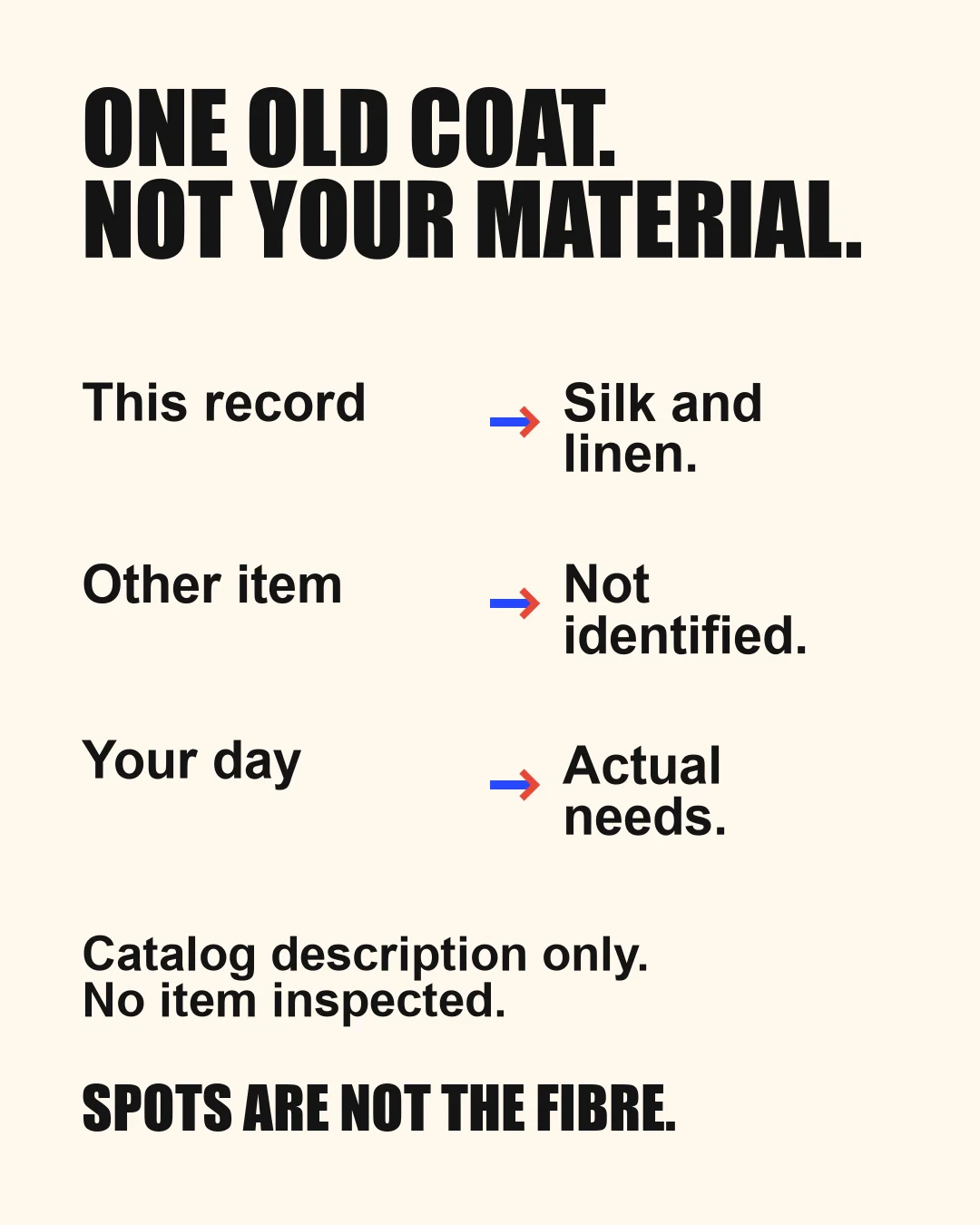
The Victoria and Albert Museum’s contributed catalog record, hosted on Google Arts & Culture, describes one coat dated 1785–1790. Its imitation leopard markings are described as woven with black and white silk into turquoise velvet; the listed medium is silk and linen. That is a specific historical catalog description, not an identification of anything in your wardrobe. The object’s date is not a publication date for the web page. [S2]
The record matters because a spotted appearance and a material description are separate pieces of information. It also gives a reason to avoid assuming that the everyday expression leopard print identifies one production method: this particular museum example is described as woven. That does not tell us whether another item is printed, knitted, woven or made in some other way.
We have read the contributed record, not inspected the coat, its fibers, a linked portrait or the underlying collection archive. It supplies no modern care method, strength finding, comfort finding or authentication technique. Do not turn a museum counterexample into a way to diagnose an unfamiliar item at home.
Nor does the museum example establish that every leopard-patterned item is free of animal material. It is one catalog description, not a universal guarantee, a way to authenticate a claim, or a reason to ignore information relevant to your own requirements. If that distinction matters and remains unresolved, leave the optional item out without conducting a test.
Begin with ordinary knowledge, not a new test
Use information you already understand about a familiar option. A description of its appearance belongs in a different sentence from any item-specific material information. If that information is missing or unclear, keep the uncertainty visible. You do not need to settle it by rubbing, pulling, smelling, heating, wetting, washing or otherwise testing a garment.
This guide does not recommend an animal material or a substitute, certify a claim on a label, or investigate an item’s history. Questions that matter to an existing requirement may need appropriate item-specific advice through a suitable separate route. Until then, a different understood option or skipping the optional detail is available.
WRAP’s Love Your Clothes page describes a campaign that aimed to help people value and use clothes they already had. The page is dated 18 August 2020 and says the campaign was archived on 31 March 2023. That historical aim supports considering existing clothes here; it is not an active campaign invitation, a promise that every wardrobe is sufficient, or a measured saving or environmental outcome from this routine. [S3]
Graphic context — 02-feature-explainer: The first pair refers only to one V&A-contributed historical coat record hosted on Google Arts & Culture. The other pairs keep a reader’s unidentified item and original actual-day choice separate from that catalog description.
Text equivalent: ONE OLD COAT. NOT YOUR MATERIAL. This record Silk and linen. Other item Not identified. Your day Actual needs. Catalog description only. No item inspected. SPOTS ARE NOT THE FIBRE. The contributed record describes a coat dated 1785–1790, with imitation leopard markings woven with black and white silk into turquoise velvet, and lists its medium as silk and linen. The object creation range is not the undated web page’s publication. We read the record, not the physical coat, underlying archive, linked portrait or a reader’s garment. One historical description is not a universal silk, printed, woven or animal-material-free guarantee. It does not authenticate any modern item, establish a manufacturing method for it, or supply care, quality, fit, comfort, safety or protective performance. Google hosting is not a second independent museum or study. Four complete primary publisher documents, not independent outfit studies. British Vogue Joy Montgomery commercial styling vocabulary only: visible 11 November 2025 date, native publication 3 February 2023 and modification 11 November 2025 distinct. No current growth, popularity, universal neutral rule, products, prices, celebrity, body or psychological recommendation adopted. The V&A-contributed Google Arts & Culture catalog describes one historical coat with woven imitation markings and listed silk and linen medium; 1785–1790 is an object date, not page publication or an identification of a modern garment. WRAP page dated 18 August 2020 records the campaign archive on 31 March 2023 and supplies an existing-clothes aim. FTC overview native publication 31 October 2018 and modification 4 March 2025 supplies cleaning-information context only. Whole four new native bodies and date fields read; linked products, archives, portraits, reports, data, laws, cases and physical items were not inspected. No universal fibre, manufacturing, animal-material-free, quality, care, fit, comfort, safety or protection certificate, tested routine benefit or compulsory purchase, test, photo, contact, new care or alteration. Actual requirements and established procedures remain first.
Actions in order
These are optional planning prompts, not a test of clothing knowledge or a checklist every outfit must pass. Stop once you have a suitable ordinary choice. There is no daily record, photograph, score or fixed number of patterned pieces to maintain.
1. Name the actual clothing job
Begin with the day rather than the motif. Think about the activities and conditions you already expect: required coverage, movement, access, weather layers, a uniform or established protective clothing. Keep necessary fastening and other essential functions intact. The guide does not replace any workplace, activity or safety procedure.
You might simply need a familiar everyday layer over clothes already chosen. Or the real requirement might be a particular outer layer that has no spots at all. Giving the job a plain description prevents an optional visual idea from quietly becoming the main requirement.
Do not invent a new activity to justify an item, remove a necessary layer so a detail can be seen, or interpret a fashion description as protective performance. A leopard-inspired surface is not evidence of weather resistance, strength, security, warmth or suitability for a particular task.
2. Describe the pattern without filling in the material
Use a sentence such as, “I like this spotted pattern on the overshirt.” That identifies the detail you are considering. It does not need to become, “Therefore it is this fiber,” or, “Therefore it will behave like that other garment.”
Two items can look related while the information you have about them differs. One can be familiar and understood; another can remain uncertain. Conversely, different-looking clothes can each have their own useful item information. Neither resemblance nor contrast supplies missing details about a particular garment.
The point is not to become suspicious of every pattern name. It is to stop asking the name to do a material description’s work. Appearance remains relevant to preference, while the unanswered material question stays unanswered.
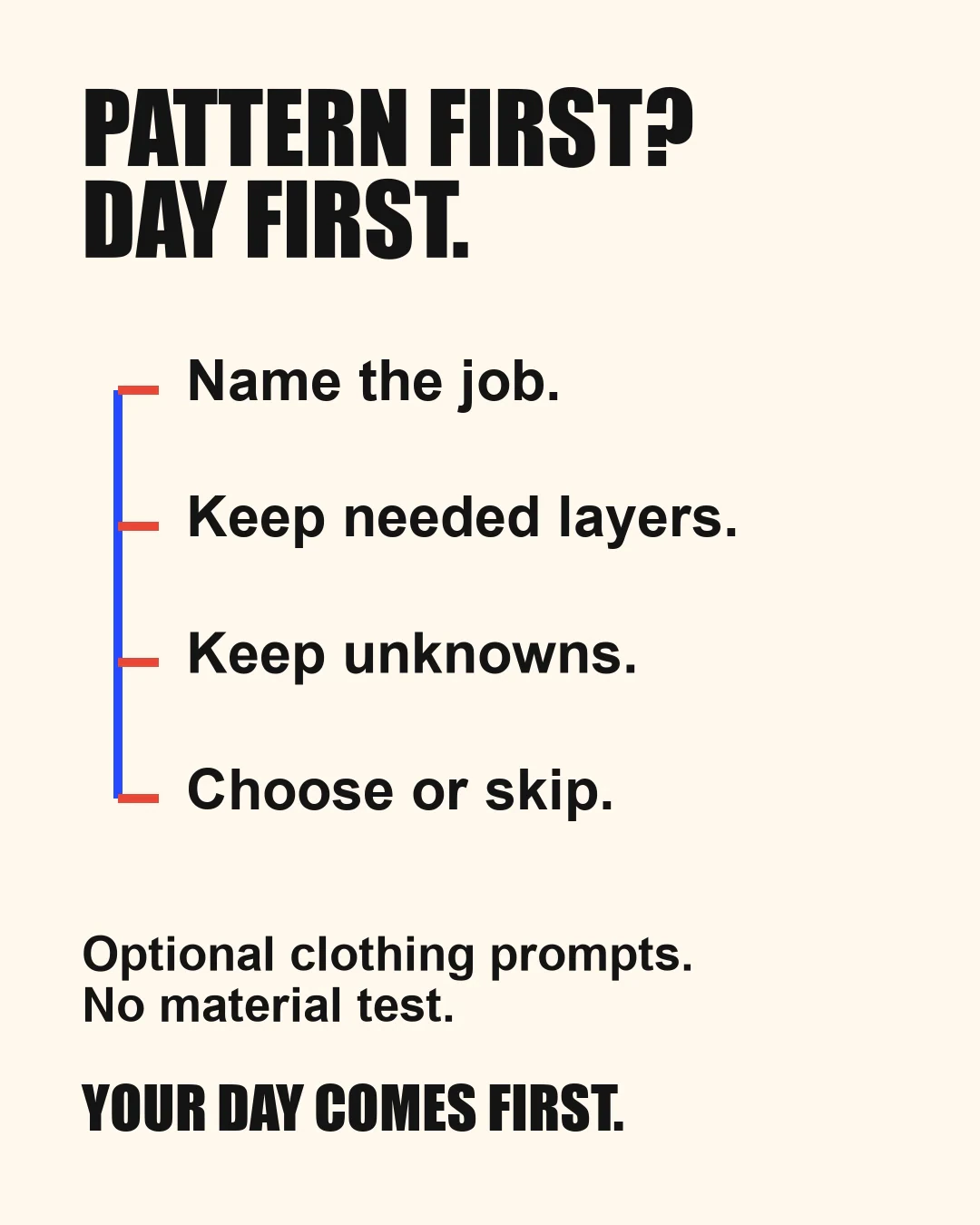
Graphic context — 03-routine-infographic: These original prompts begin with the actual activity and already understood suitable options, if available. A material question can remain unresolved without creating an inspection, testing or shopping task.
Text equivalent: PATTERN FIRST? DAY FIRST. Name the job. Keep needed layers. Keep unknowns. Choose or skip. Optional clothing prompts. No material test. YOUR DAY COMES FIRST. Keep needed layers means retain actual coverage, movement, access, fastening, weather, uniform and protective requirements even when the pattern is hidden. Known information does not become permanent approval after an important change, and this guide does not waive a required review or established procedure. Leave out an uncertain optional item and seek appropriate item-specific advice separately when necessary. No rubbing, pulling, smell, heat, water, washing, stress, loading, fit or material-identification experiment is introduced. No timer, wardrobe count, saving, environmental result or tested styling benefit is claimed. Four complete primary publisher documents, not independent outfit studies. British Vogue Joy Montgomery commercial styling vocabulary only: visible 11 November 2025 date, native publication 3 February 2023 and modification 11 November 2025 distinct. No current growth, popularity, universal neutral rule, products, prices, celebrity, body or psychological recommendation adopted. The V&A-contributed Google Arts & Culture catalog describes one historical coat with woven imitation markings and listed silk and linen medium; 1785–1790 is an object date, not page publication or an identification of a modern garment. WRAP page dated 18 August 2020 records the campaign archive on 31 March 2023 and supplies an existing-clothes aim. FTC overview native publication 31 October 2018 and modification 4 March 2025 supplies cleaning-information context only. Whole four new native bodies and date fields read; linked products, archives, portraits, reports, data, laws, cases and physical items were not inspected. No universal fibre, manufacturing, animal-material-free, quality, care, fit, comfort, safety or protection certificate, tested routine benefit or compulsory purchase, test, photo, contact, new care or alteration. Actual requirements and established procedures remain first.
3. Keep the suitable base, then consider the detail
Retain an outfit or set of clothes that already meets the actual requirements, if you have one. Consider the patterned option only where it is independently suitable. A needed plain coat can remain over a patterned layer, even if that hides most of the motif. There is no obligation to make the reference visible to other people.
You do not need to limit yourself to one patterned item if several familiar options work for your circumstances and preferences. Nor do you need a matching set, a neutral companion, or a particular shoe because an editorial showed one. Any real occasion requirements still apply; optional styling advice does not override them.
If no suitable owned option is available, the result can be leaving out the pattern. That is an ordinary boundary, not proof that you need a replacement wardrobe. This guide makes no claim about how much clothing you own or what resources you can access.
4. Use a fictional alternative to see the decision
Nadia is an invented example, not a participant, customer or observed case. She likes a familiar leopard-patterned overshirt for an ordinary visit. She already understands its ordinary use and the clothes beneath it meet the coverage she needs. She keeps a necessary unpatterned outer coat because the day’s conditions have not changed just because she likes the spots.
In a different version, an unfamiliar patterned jacket is available but Nadia lacks information important to her intended use. The resemblance to her overshirt does not answer the question. She leaves that optional jacket out; she does not run a material test or infer that it has the same construction or care needs.
A third version is equally valid: several familiar patterned clothes already work together for Nadia’s actual occasion, and she likes wearing them. This guide does not forbid that choice. The boundary concerns unsupported material inference, not a rule that a restrained outfit is always better.
In a final version she has no suitable patterned item and keeps an understood unpatterned outfit. No version demonstrates a typical result, a care recommendation, a financial saving or a reason that another person should make the same choice.
5. Finish the choice without inventing a certificate
A useful stopping sentence is specific: “I kept the needed coat and used the familiar overshirt,” or, “I left the unfamiliar option out because an important question remained.” Those sentences describe what you decided. They do not authenticate an item or prove its material, condition, quality, fit, comfort or safety.
You can keep liking the visual reference after deciding against a particular option. Equally, you can wear a suitable familiar option without deciding that leopard print is a neutral, a statement, timeless or necessary. You do not owe an outfit an identity story.
Graphic context — 04-practical-support: The rows summarize fictional Nadia alternatives: a necessary unpatterned coat stays, an unfamiliar patterned jacket remains unresolved, and several familiar suitable patterned clothes can be a valid choice.
Text equivalent: FAMILIAR LAYER. UNKNOWN ITEM. Needed coat Keep it. Unknown item Leave it. More pattern Your choice. Invented alternatives. No item finding. CHOOSE FOR YOUR DAY. Nadia is invented, not a participant, customer or observed case. The unknown jacket is not identified by resemblance to the familiar overshirt or the museum example; missing information does not declare it defective or prove its fibre. The multiple-pattern alternative counters compulsory restraint without requiring a matching set, neutral companion or full patterned wardrobe. If no suitable owned item is available, no change or skipping is allowed. Actual needs and established care or procedures stay first. No animal-material recommendation, physical test, purchase, contact, photograph, new care, construction, body or identity ranking, or claimed clinical, financial, environmental or legal outcome follows. Four complete primary publisher documents, not independent outfit studies. British Vogue Joy Montgomery commercial styling vocabulary only: visible 11 November 2025 date, native publication 3 February 2023 and modification 11 November 2025 distinct. No current growth, popularity, universal neutral rule, products, prices, celebrity, body or psychological recommendation adopted. The V&A-contributed Google Arts & Culture catalog describes one historical coat with woven imitation markings and listed silk and linen medium; 1785–1790 is an object date, not page publication or an identification of a modern garment. WRAP page dated 18 August 2020 records the campaign archive on 31 March 2023 and supplies an existing-clothes aim. FTC overview native publication 31 October 2018 and modification 4 March 2025 supplies cleaning-information context only. Whole four new native bodies and date fields read; linked products, archives, portraits, reports, data, laws, cases and physical items were not inspected. No universal fibre, manufacturing, animal-material-free, quality, care, fit, comfort, safety or protection certificate, tested routine benefit or compulsory purchase, test, photo, contact, new care or alteration. Actual requirements and established procedures remain first.
Costs, risks and stop criteria
Considering owned clothes does not require a new purchase. That is narrower than saying the process or wardrobe has no cost. Time, storage, established care, previous spending, access to suitable clothes and any separately needed advice vary. There is no price estimate, savings calculation, deadline or environmental benefit promised here.
Leave established care attached to the actual item
The FTC’s apparel overview explains cleaning information as a distinct subject. Its retained native metadata records an October 2018 publication and a March 2025 modification, separate from the dates of linked cases and other listings. Here it is background for keeping item-specific cleaning information separate from a pattern description. [S4]
This article supplies no new washing, sanitizing, pressing, repair, storage, dyeing or alteration protocol. Do not copy care from a museum record, an editorial outfit, a similarly patterned item or a guessed fiber. Existing instructions and any relevant established procedures remain in place. Linked laws, cases and business guides have not been read or interpreted as personal legal advice.
Stop when the optional detail competes with something necessary
Leave out an option that is unfamiliar, uncomfortable, damaged or unsuitable for what you need it to do. Do not compromise coverage, movement, access, fastening, weather needs, a uniform or required protection to retain the reference. If a consequential question needs appropriate advice, this guide does not settle it or ask you to continue while it is unresolved.
Do not cut, sew, pin, unstitch or adapt an item to make the idea work. No new loading, stress, fit, material-identification or care experiment is part of the routine. It is acceptable to stop at planning, use an understood alternative or make no change.
Keep a photograph within its limits
Lighting, pose, lens, distance and editing can change how a surface appears in an image. A photograph cannot diagnose a person or certify an item’s material, construction, fit, comfort, care needs, condition or protective function. No new picture, upload, body measurement, comparison image or outside opinion is needed for this guide.
If appearance checking is taking over ordinary life or causing persistent distress, step away from the optional styling task and seek suitable qualified support. This is a nonclinical clothing guide, not a diagnosis, treatment, body assessment or professionally reviewed textile inspection.
How to assess the result
Ask whether you can describe the actual clothing job, the optional detail, the information you already had, any important uncertainty, and the choice you made. Those are planning observations. They do not reveal another person’s taste, status, personality, material preferences or reasons for dressing a certain way.
There is no benefit score to calculate. The sources offer an editorial reference, one historical catalog description, an archived campaign aim and a cleaning-information overview. They are four publisher roles, not four outfit studies or evidence that this routine improves confidence, mood, comfort, spending, environmental impact or daily performance.
The museum’s silk markings need not turn your spotted item into silk. An editorial’s outfit need not become your shopping list. Your necessary clothes can stay necessary, and an unresolved material question can remain unresolved. Enjoy the pattern if a suitable option fits your own circumstances; otherwise, let the idea stay an idea.
Myth or Real?

Claim
Social paraphrase: A leopard pattern means the item is animal fur.
Verdict
FALSE
Facts
One V&A-contributed historical coat record describes imitation markings woven in silk and lists silk and linen as the medium.
One catalog example only. It identifies no other item and does not guarantee every patterned item is free of animal material.
An original animal-pattern question already separates print and pattern from skin or fur. It supplies discovery only. This card editorially reframes a universal material proposition, not a quotation or false belief attributed to the author. Comments, popularity claims, brands, prices, anecdotes, body opinions and votes are excluded. The V&A-contributed Google Arts & Culture record describes one coat with imitation leopard markings woven in silk into turquoise velvet and lists silk and linen as its medium. The 1785–1790 range dates the object, not the undated page accessed 26 October 2026. We read the record, not the physical coat, archive or linked portrait. Vogue supplies separate commercial styling vocabulary; its visible November 2025 date differs from native February 2023 publication and November 2025 modification. Quotes, products, prices, celebrity, neutrality and growth claims are not adopted. FALSE rejects pattern alone as sufficient proof of animal fur; it does not guarantee every patterned item is free of animal material or identify another garment. Two publisher roles are not independent outfit studies or material tests. Actual requirements, known suitability, important changes, established care and procedures remain first. No material test, inspection, photograph, upload, contact, purchase, new care, repair or alteration is requested.
Takeaway
Separate the pattern from material information. Keep consequential unknowns explicit or omit the optional item.
Sources
Claim discussion: Original animal-pattern inspiration question.
Evidence: Coat, Unknown, 1785/1790; 9 Ways To Wear Leopard Print In 2025, Inspired By The Archives.
Checked 2026-10-26. Scope: Nonclinical pattern/material distinction, not item authentication, universal animal-material-free guarantee, manufacturing, care, quality, fit, comfort, safety or protection certificate. No test/photo/contact/purchase/new care.


Sources
- S1 — British Vogue, Joy Montgomery, 9 Ways To Wear Leopard Print In 2025, Inspired By The Archives. Visible 11 November 2025 date; native publication 3 February 2023 and modification 11 November 2025. Commercial styling vocabulary only, accessed 26 October 2026. Quotes, products, prices, celebrity and psychological claims excluded. https://www.vogue.co.uk/fashion/article/how-to-wear-leopard-print
- S2 — Victoria and Albert Museum contributed record, Coat, Unknown, hosted on Google Arts & Culture. Undated page, accessed 26 October 2026; 1785–1790 is the object’s creation range. One catalog description of woven imitation markings and listed medium, not inspection or a modern item certificate. https://artsandculture.google.com/asset/coat-unknown/SAEU5s1VzheTow?hl=en
- S3 — WRAP, Love Your Clothes. Page dated 18 August 2020; campaign archived 31 March 2023. Historical existing-clothes aim only; statistics and underlying reports not adopted. https://www.wrap.ngo/resources/guide/textiles/love-your-clothes
- S4 — FTC, Apparel and Labeling. Native publication 31 October 2018; modification 4 March 2025. Cleaning-information overview only; no linked law, case or business-guide interpretation. https://www.ftc.gov/news-events/topics/tools-consumers/apparel-labeling
FAQ
Common questions
Does a leopard pattern mean animal fur?
Pattern alone is insufficient. One historical V&A-contributed catalog record describes imitation leopard markings woven in silk. That does not identify another garment or guarantee every patterned item is free of animal material.
Do I need to test or buy something?
No new material test, physical inspection, photograph, contact or purchase is part of these prompts. Consider familiar suitable owned options if available; an unchanged outfit or skipping remains valid.
Can I wear several patterned items?
Several familiar suitable options can be a valid choice when they meet actual requirements and preferences. This guide imposes no matching-set, neutral-companion or compulsory-minimalism rule.
Topic hubs
Tags