“Pre-loved” can sound like someone has already answered the important questions about a garment. For your ordinary day, it has not.
The word may explain a description. It does not tell you whether a particular coat meets an actual requirement, whether an unfamiliar shirt is suitable for an activity or what care information belongs to an item. Those questions remain separate even when the description is friendly.
You can be interested in previously used clothes without turning that interest into an obligation to shop, donate or prove anything about your wardrobe. This guide starts with clothes already familiar to you, if a suitable option is available. It helps you keep a word, an important unknown and a practical clothing choice in their proper places.
Who this is for
This is for ordinary interest in clothing descriptions and familiar owned choices. It is not a buying guide, a professional inspection, a hygiene assessment or a way to identify a garment from a photograph. People have different clothes, resources, preferences, requirements and access to information. You do not need a second-hand item to consider the distinction, and nobody’s background or worth is being ranked.
Cambridge Dictionary defines pre-loved as not new and previously used, especially as a selling expression that avoids “second-hand.” That gives the word a meaning. It does not inspect the thing to which somebody applies it or establish a complete record of its use. We use the dictionary’s own definition, not its example sentence, related vocabulary or sidebar material. [S2]
Oxfam GB’s own Second Hand September 2026 page supplies a recent campaign reference using this vocabulary. The campaign year is not the page’s publication date, and September has already passed at this article’s October access date. We are not inviting you to join a current challenge or recommending a shop, donation, clear-out or product. The campaign’s environmental, financial and other outcome claims are not findings about your clothes or this guide. [S1]
These sources have different jobs. A dictionary can explain a term; a campaign can promote an idea. Neither role, by itself, answers an individual item question. Enjoying an older garment, preferring a familiar newer one or leaving the whole subject alone can each be an ordinary choice.
Graphic context — 01-article-hero: This original optional sequence separates a previously-used description from the information needed for a particular clothing choice. The actual activity and essential clothing functions stay first, and no change remains available.
Text equivalent: PRE-LOVED. STILL A QUESTION. Read the word. Keep real needs. Choose or skip. A label is a description. Not an item check. KEEP QUESTIONS SPECIFIC. Cambridge explains the word pre-loved as previously used rather than new, particularly in selling language. The definition does not inspect an item or verify a complete history, condition, material, cleanliness, fit, comfort, care or safety. No negative item finding follows from missing information either. Familiarity is not permanent approval when an activity, requirement or relevant condition changes. Keep required coverage, movement, access, fastening, weather, uniform, protection, established care and procedures. No inspection, smell, stress, loading, washing, photo, contact, purchase, donation or alteration is requested. Four complete primary publisher documents, not independent outfit studies. Cambridge own undated pre-loved definition explains previous use and selling language, accessed 26 October 2026. Oxfam GB own Second Hand September 2026 page supplies campaign vocabulary, not a publication date, current October challenge or impact finding; September has ended. WRAP page dated 18 August 2020 records the campaign archive on 31 March 2023 and supplies an existing-clothes aim. FTC overview has native publication 31 October 2018 and modification 4 March 2025 metadata, separate from case dates, and supplies cleaning-information context only. Whole four native bodies read; linked reports, data, products, policies, laws, cases and actual garments or former owners were not inspected or investigated. No current growth, quality, cleanliness, full history, material, fit, comfort, care, safety or authenticity certificate, clinical result or compulsory purchase, donation, discard, test, contact, photo, new care, repair or alteration. Actual needs, established care and procedures remain first.
Before you start
Name an activity that already matters: the workday you expect, an established appointment, a familiar outing or time at home. Keep the clothing functions and requirements that belong to it. Coverage, movement, access, fastening, weather needs, uniform and protective equipment do not become optional because a label sounds appealing. Follow established procedures and actual applicable instructions.
You do not have to gather a collection, take photographs or ask someone for an item’s story. This is not a history investigation. If you already know an owned option is suitable for the actual occasion, that information may be useful. If important suitability or item information is uncertain, the uncertainty stays visible. An unfamiliar, uncomfortable, damaged or otherwise unsuitable item can be left out.
WRAP’s Love Your Clothes page describes a campaign aim of valuing clothes and making more of what people already have. The page is dated August 2020 and records that the campaign was archived in March 2023. We use the archived aim only, not a current programme, a guarantee that everyone owns enough clothes or a quantified saving from this exercise. [S3]
Care information is a separate issue. The FTC’s apparel overview explains cleaning information associated with clothing. We do not use it to infer a cleaning method from “pre-loved,” or to prescribe sanitizing, laundering, stain removal, repair or alteration. Established item instructions and appropriate advice remain separate from an aesthetic or sales description. No linked laws, cases or business guides are being applied as personal legal advice. [S4]
You are not being asked to inspect, smell, stress, load, wash or otherwise test a garment for this guide. No purchase, donation, discard, account action, contact, measurement or new photo is required. If an important item question needs appropriate advice, seek it separately or omit the item from this optional choice.
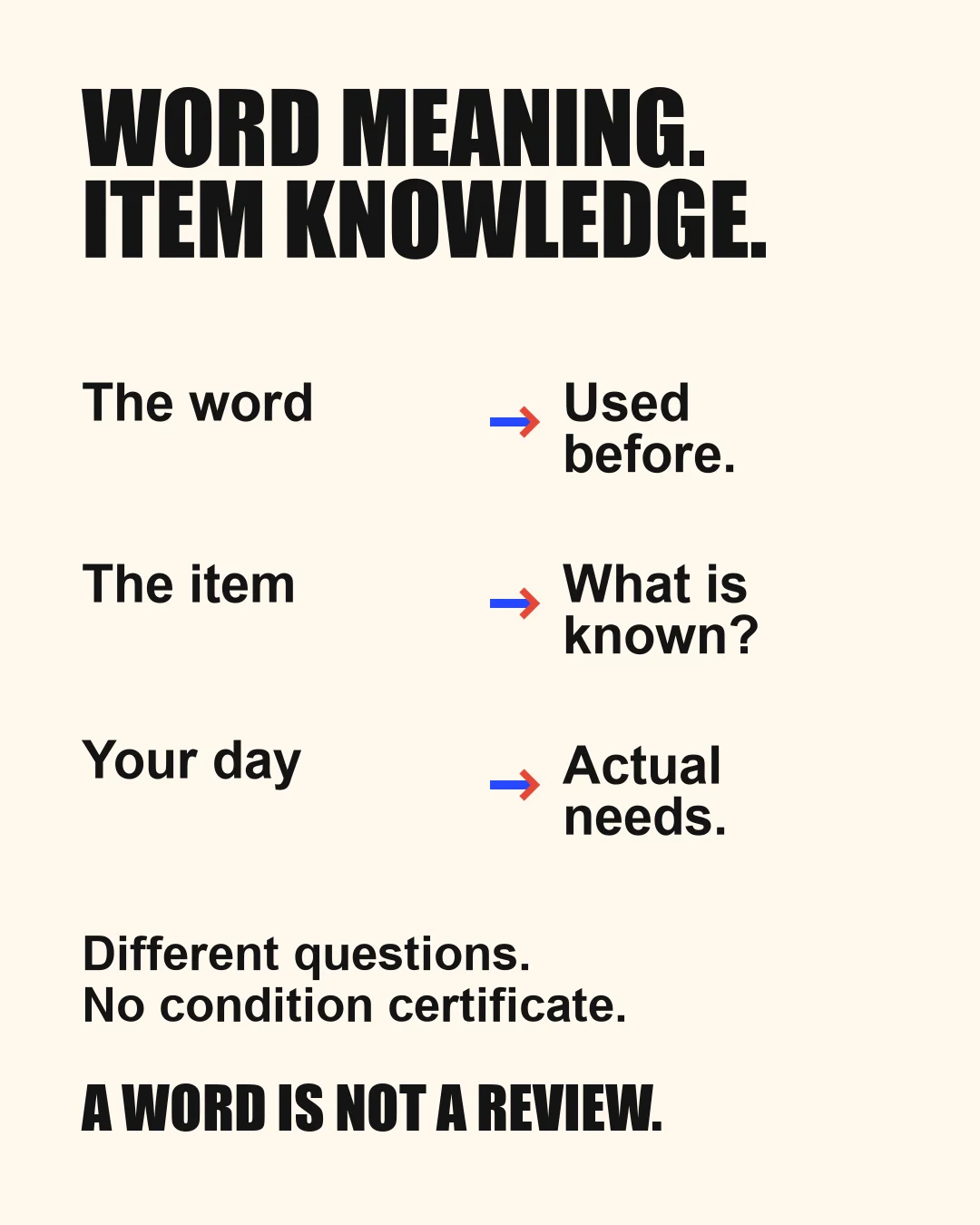
Graphic context — 02-feature-explainer: These pairs distinguish a lexical definition, item information and an original practical clothing decision. They are source-role and question distinctions, not a condition scale, authenticity judgement or inspection procedure.
Text equivalent: WORD MEANING. ITEM KNOWLEDGE. The word Used before. The item What is known? Your day Actual needs. Different questions. No condition certificate. A WORD IS NOT A REVIEW. Cambridge own undated definition, accessed 26 October 2026, gives previous use and a selling context; it does not verify the thing described. Oxfam GB own Second Hand September 2026 page supplies campaign vocabulary only, with no publication date established and September already ended. Campaign statistics, impact, history, celebrity anecdotes, shopping and donation suggestions are excluded. The dictionary and campaign are not independent item-condition studies. No amount of wear, quality, cleanliness, material, comfort, fit, care, full history or safety is certified by these diagrams. Four complete primary publisher documents, not independent outfit studies. Cambridge own undated pre-loved definition explains previous use and selling language, accessed 26 October 2026. Oxfam GB own Second Hand September 2026 page supplies campaign vocabulary, not a publication date, current October challenge or impact finding; September has ended. WRAP page dated 18 August 2020 records the campaign archive on 31 March 2023 and supplies an existing-clothes aim. FTC overview has native publication 31 October 2018 and modification 4 March 2025 metadata, separate from case dates, and supplies cleaning-information context only. Whole four native bodies read; linked reports, data, products, policies, laws, cases and actual garments or former owners were not inspected or investigated. No current growth, quality, cleanliness, full history, material, fit, comfort, care, safety or authenticity certificate, clinical result or compulsory purchase, donation, discard, test, contact, photo, new care, repair or alteration. Actual needs, established care and procedures remain first.
Actions in order
1. Translate the word without expanding its promise
When you encounter “pre-loved,” keep the definition small: previously used rather than new. Do not silently add “therefore well made,” “therefore comfortable” or “therefore ready for my particular activity.” Those are different statements, and the word itself has not supplied the information needed to make them. [S2]
The same restraint applies to a remembered description of something you already own. A pleasant phrase can stay a phrase. You do not need to challenge another person, obtain a private history or settle how affectionately an item was treated. The dictionary explains usage; it does not reconstruct a garment’s life or verify a particular claim made about it.
Try replacing a broad conclusion with a bounded description. “This was described as pre-loved” tells you how it was presented. “This is my familiar coat” identifies an owned option. Neither needs to become “this description has certified all the information I need.” Keeping the sentence modest can leave room for what is known and what is not.
2. Name the actual clothing job
Before following the story of an item, return to the job your clothes need to do. Perhaps a familiar coat belongs to the ordinary weather arrangement you already use, or an established uniform is required for an activity. Keep those conditions intact. The word in a caption cannot replace an actual requirement or an existing procedure.
Here is an original fictional example. Leila has a familiar coat that is suitable for the day already planned. A different jacket has been described as pre-loved, but Leila does not have the information needed to use it for that particular day. The description does not make the jacket an equivalent substitute. Leila can keep the familiar coat without making a judgement about the other item’s worth.
This example does not declare the jacket defective, worthless or unusable in every setting. It leaves an unanswered question unanswered. There is no need to run a new physical test, purchase a replacement or arrange a conversation merely to complete the example. The actual day’s requirements remain the basis for the choice.
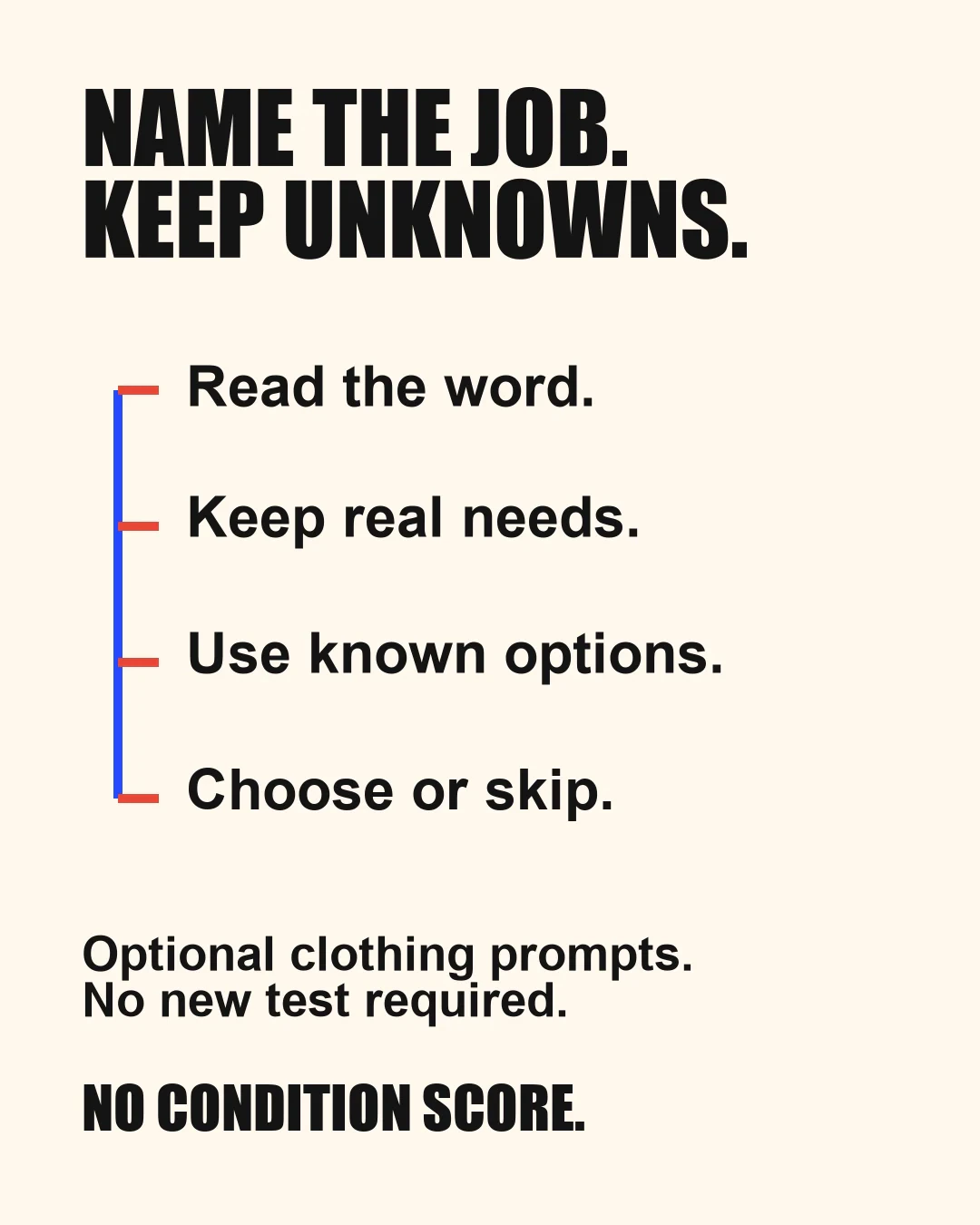
Graphic context — 03-routine-infographic: These original prompts use ordinary information already understood about a familiar suitable option, if available. An important unknown remains explicit, and the choice can end with an unchanged outfit or skipping.
Text equivalent: NAME THE JOB. KEEP UNKNOWNS. Read the word. Keep real needs. Use known options. Choose or skip. Optional clothing prompts. No new test required. NO CONDITION SCORE. Known options means ordinary information, not a new garment inspection, authenticity inquiry, fit, hygiene, stress, loading, smell, washing or care test. Previous familiarity does not waive an actual changed requirement or required review. An uncertain or unsuitable optional item can be omitted and appropriate item advice obtained separately when necessary. No shopping, donation, discard, photo, measurement, previous-owner contact, account action, repair or alteration task is introduced. There is no wardrobe count, deadline, price, moral ranking, clinical review, saving, environmental result or tested benefit. Four complete primary publisher documents, not independent outfit studies. Cambridge own undated pre-loved definition explains previous use and selling language, accessed 26 October 2026. Oxfam GB own Second Hand September 2026 page supplies campaign vocabulary, not a publication date, current October challenge or impact finding; September has ended. WRAP page dated 18 August 2020 records the campaign archive on 31 March 2023 and supplies an existing-clothes aim. FTC overview has native publication 31 October 2018 and modification 4 March 2025 metadata, separate from case dates, and supplies cleaning-information context only. Whole four native bodies read; linked reports, data, products, policies, laws, cases and actual garments or former owners were not inspected or investigated. No current growth, quality, cleanliness, full history, material, fit, comfort, care, safety or authenticity certificate, clinical result or compulsory purchase, donation, discard, test, contact, photo, new care, repair or alteration. Actual needs, established care and procedures remain first.
3. Separate ordinary knowledge from an unknown
There is a difference between information already established through ordinary use and information you wish a label provided. You may already have a familiar outfit that serves an activity. Another item may be unfamiliar, unsuitable for the occasion or missing important information. Do not put both into one category simply because they share a word.
Leila also remembers a shirt that came from another person. Its previous use does not supply missing care information or settle whether Leila wants it for the occasion. The guide does not ask Leila to identify its material, infer how it was cleaned or investigate its former owner. An understood current outfit can remain the choice while the shirt stays out of this exercise.
When you cannot answer a relevant question, avoid replacing it with a story about careful previous ownership. You are allowed to say “I do not know that about this item.” That sentence does not require embarrassment or a public explanation. It is more precise than giving a general label the job of answering several unrelated questions.
Likewise, knowing something about one garment does not transfer the same information to a similar-looking one. A shared description does not establish shared construction, material, care, comfort or suitability. This article supplies no method for identifying those properties; it keeps a broad word from being mistaken for that method.
4. Keep the option without creating an obligation
A suitable familiar previously used item can remain a perfectly ordinary option when you want it. Nothing here asks you to avoid one because of its description. Equally, you do not have to add one to an outfit to show that you understood the idea. The decision can be about actual clothes rather than performing an identity or meeting a quota.
Consider another fictional alternative. Leila has an outfit made entirely of familiar previously used pieces and already knows it is suitable for the actual occasion. Leila enjoys wearing it. Choosing that outfit is consistent with this guide. We are not setting a rule that only one such item may be worn, or treating a coordinated choice as a problem to undo.
Or Leila has no suitable option of that kind for the day. The existing understood outfit stays. That is not a failed challenge, and the prompts have not created a shopping or donation task. Ownership, access, needs and preferences vary; a general campaign reference is not a personal wardrobe inventory.
Familiar does not mean permanently approved. If the activity, an applicable requirement or an item’s relevant condition has changed, yesterday’s ordinary knowledge may no longer answer today’s question. Do not use this guide to waive a required review, instruction or protective arrangement. Keep the changed question explicit and follow the established route, or omit the optional item.
5. Finish with a decision you can describe
You might keep an established outfit, choose a familiar suitable item, change an optional idea or skip the exercise. State what you actually decided: “I kept the coat I understand for this activity.” You do not need a quality score, a story about the former owner or a declaration about the moral standing of a wardrobe.
The result may also be an explicit limit: “This label does not answer my question.” That is useful as a description of information, without pretending that the garment itself has been examined. Do not turn the prompt into a checklist for grading another person’s choices, spending or appearance.
Where an actual requirement or an item-specific issue matters, use the appropriate established route for that issue. This article does not assess your particular uniform, protective clothing, event, garment or care situation. A general description cannot settle important uncertainty merely by being repeated more confidently.
Graphic context — 04-practical-support: The rows describe fictional Leila alternatives: an understood needed coat stays, a jacket with missing relevant information stays unresolved, and a familiar suitable fully previously-used outfit can remain a choice.
Text equivalent: FAMILIAR COAT. UNANSWERED LABEL. Needed coat Keep it. Unknown item Leave it. Used outfit Your choice. Invented alternatives. No item finding. KEEP OR SKIP. The label does not make the jacket an equivalent substitute for the coat. Missing information does not declare the jacket defective, worthless or unsuitable for every setting. The fully previously-used outfit is a valid counterexample to compulsory restraint when already familiar, suitable and wanted. These are invented choices, not participants, testimonials, garment inspections or quality findings. Keep actual requirements and established care first; no physical test, cleaning, repair, alteration, purchase, donation, discard, private-history inquiry or claimed clinical, financial, environmental or legal outcome follows. Four complete primary publisher documents, not independent outfit studies. Cambridge own undated pre-loved definition explains previous use and selling language, accessed 26 October 2026. Oxfam GB own Second Hand September 2026 page supplies campaign vocabulary, not a publication date, current October challenge or impact finding; September has ended. WRAP page dated 18 August 2020 records the campaign archive on 31 March 2023 and supplies an existing-clothes aim. FTC overview has native publication 31 October 2018 and modification 4 March 2025 metadata, separate from case dates, and supplies cleaning-information context only. Whole four native bodies read; linked reports, data, products, policies, laws, cases and actual garments or former owners were not inspected or investigated. No current growth, quality, cleanliness, full history, material, fit, comfort, care, safety or authenticity certificate, clinical result or compulsory purchase, donation, discard, test, contact, photo, new care, repair or alteration. Actual needs, established care and procedures remain first.
Costs, risks and stop criteria
Considering the distinction requires no new purchase or donation. That does not make clothing costless. Past spending, care, storage, time, attention, access and appropriate advice can all matter. We give no price estimate, saving calculation, environmental result or promise about how long clothes will last. There is no wardrobe total, completion deadline or shopping schedule to satisfy.
Stop if the exercise becomes pressure to acquire a more interesting story, give away useful clothes, disclose another person’s circumstances or remove an essential layer. You do not owe anyone a demonstration that your clothing is sufficiently second-hand, sufficiently new or sufficiently anything else. Keep the arrangement you understand when the prompts add nothing useful.
An uncertain item can remain omitted. Do not resolve the uncertainty by trying a cleaning, sanitizing, repair, cutting, pinning or alteration method from this article; none is supplied. Keep established care information and applicable instructions in place, with appropriate item advice obtained separately when needed. A label is not a reason to invent a method.
Persistent appearance worries that interfere with daily life deserve qualified support rather than another wardrobe challenge. This is not diagnosis or treatment. A photograph cannot diagnose a person. Lighting, pose, lens, distance and editing can affect appearance; an image does not certify a garment’s material, cleanliness, condition, fit, comfort, protection or care needs. No new photograph is requested.
The evidence is limited to four distinct roles: a dictionary definition, Oxfam’s own campaign context, WRAP’s archived aim and FTC cleaning-information context. These are not four outfit studies or a trial of the original prompts. We claim no measured trend increase, clinical effect, financial saving, environmental benefit, legal entitlement or universal judgement about previously used clothes.
How to assess the result
Can you separate the meaning of the label from the information needed for your activity? Perhaps you identified an important unknown, kept a familiar coat, selected a suitable owned outfit or decided not to change anything. Those are concrete decisions. They do not certify an item’s condition, its entire history or the outcome of using it.
Revisit the choice when the real activity, item information or applicable requirement changes. A campaign headline does not require another round of checking. You have not tested the effectiveness of these prompts or proved that one source of clothing is always better; you have kept a general word from doing the work of an individual answer.
The label can stay friendly. The important questions can stay specific.
Myth or Real?

Claim
Social paraphrase: Pre-loved means that an item has barely been worn.
Verdict
FALSE
Facts
Cambridge defines pre-loved as previously used rather than new. The definition does not specify a degree of wear.
Lexical meaning only. The campaign has a separate role; no actual item condition or history is verified.
An archived original question asks how readers understand pre-loved wording. It supplies discovery only. This card explicitly reframes a barely-worn word-meaning proposition, not a quotation or false belief attributed to the questioner. Comments, seller condition grades, anecdotes, brands, prices, sales outcomes, inspection and photo advice, refund claims and votes are excluded. Cambridge own undated definition, accessed 26 October 2026, describes previously used rather than new and notes a selling context. It does not specify a degree of wear. Oxfam GB own Second Hand September 2026 page supplies campaign vocabulary only, not an inspection or condition grade. No publication field was found, and September has ended at the October access date. Statistics, water and impact claims, history, celebrity remarks, shopping, donation and partner suggestions are not adopted. FALSE rejects barely-worn as the word meaning; it does not establish how much any item has been used, whether a label is accurate, or whether a garment is good, poor, clean, suitable or defective. Missing information also does not prove a negative condition. A lexical definition and a campaign role are not independent outfit studies or a garment review. Actual activity, required clothing functions, known information, relevant changes and established care/procedures remain first. No purchase, donation, discard, photograph, contact, account action, inspection, smell, stress, washing, repair or alteration task is required. Linked reports/data and actual items or former owners were not inspected or investigated.
Takeaway
Keep the word separate from item information. Missing proof does not declare an item defective.
Sources
Claim discussion: Archived original pre-loved label-perception question.
Evidence: Meaning of pre-loved in English; Second Hand September2026.
Checked 2026-10-26. Scope: Nonclinical lexical distinction, no condition, cleanliness, quality, authenticity, history, material, fit, care or safety certificate. No inspection, physical test, purchase, donation, photo or contact.


Sources
- S2 — Cambridge Dictionary, Pre-loved. Undated entry, accessed 26 October 2026. Own definition of previous use, including its selling context. Examples, related vocabulary, translations, pronunciation and sidebar material are excluded. A definition does not verify a particular item’s history, condition or suitability.
- S1 — Oxfam GB, Second Hand September 2026. Undated campaign page accessed 26 October 2026; no native publication or modification field found. The campaign year is not a publication date, and September has ended. Own campaign/vocabulary context only. Statistics, impact claims, historical firsts, celebrity remarks, shopping, donation and partner recommendations are not adopted. The linked State of Style report and data were not read.
- S3 — WRAP, Love Your Clothes. Page dated 18 August 2020, with a campaign archive notice dated 31 March 2023. Existing-clothes aim only, not a current programme, wardrobe guarantee or quantified result. Underlying reports and data were not read.
- S4 — FTC, Apparel and Labeling. Overview accessed 26 October 2026. Native publication metadata is 31 October 2018 and modification metadata is 4 March 2025; linked case dates are separate. Opening cleaning-information context only, with no new cleaning method or personal legal interpretation. Linked laws, cases and business guides were not read or applied.
Whole retained readable bodies of these four sources were reviewed. No garments, former owners, linked products, underlying reports, data, laws or cases were independently inspected or investigated. Leila’s alternatives and the prompts are original editorial illustrations, not observed cases, professional item review or a promise that everyone owns a suitable option.
FAQ
Common questions
Does pre-loved mean barely worn?
Cambridge definition describes previous use rather than newness, not a specified degree of wear. The word does not establish any actual item condition, quality, cleanliness or suitability.
Do I need to buy or donate something?
These prompts require neither. Start with an actual activity and familiar suitable owned choices if available. An unchanged outfit or skipping remains valid when there is no suitable option.
Does familiarity replace a required current review?
No. A changed activity, item condition or applicable requirement can leave old information insufficient. Preserve required instructions, protective arrangements and established review procedures.
Topic hubs
Tags