
Keep necessary hand hygiene while reducing dryness and irritant exposure, without treating persistent hand eczema as a simple cosmetic problem. That is a practical grooming goal, not a verdict on attractiveness or personal value. Normal variation is expected, and the safest plan is the one that remains simple enough to follow without pain, shame, or a constant search for flaws.
This guide is general education, not diagnosis or individualized treatment. It does not prescribe a drug, device, or procedure, and it does not use photographs to diagnose a skin, hair, allergy, circulation, or other medical condition.
Start with your real baseline
Hand thickness, pigment, callusing, nail shape, oil production, eczema tendency, occupation, and climate vary. Frequent washing can dry anyone’s skin; visible lines and knuckles are normal anatomy, not neglect.
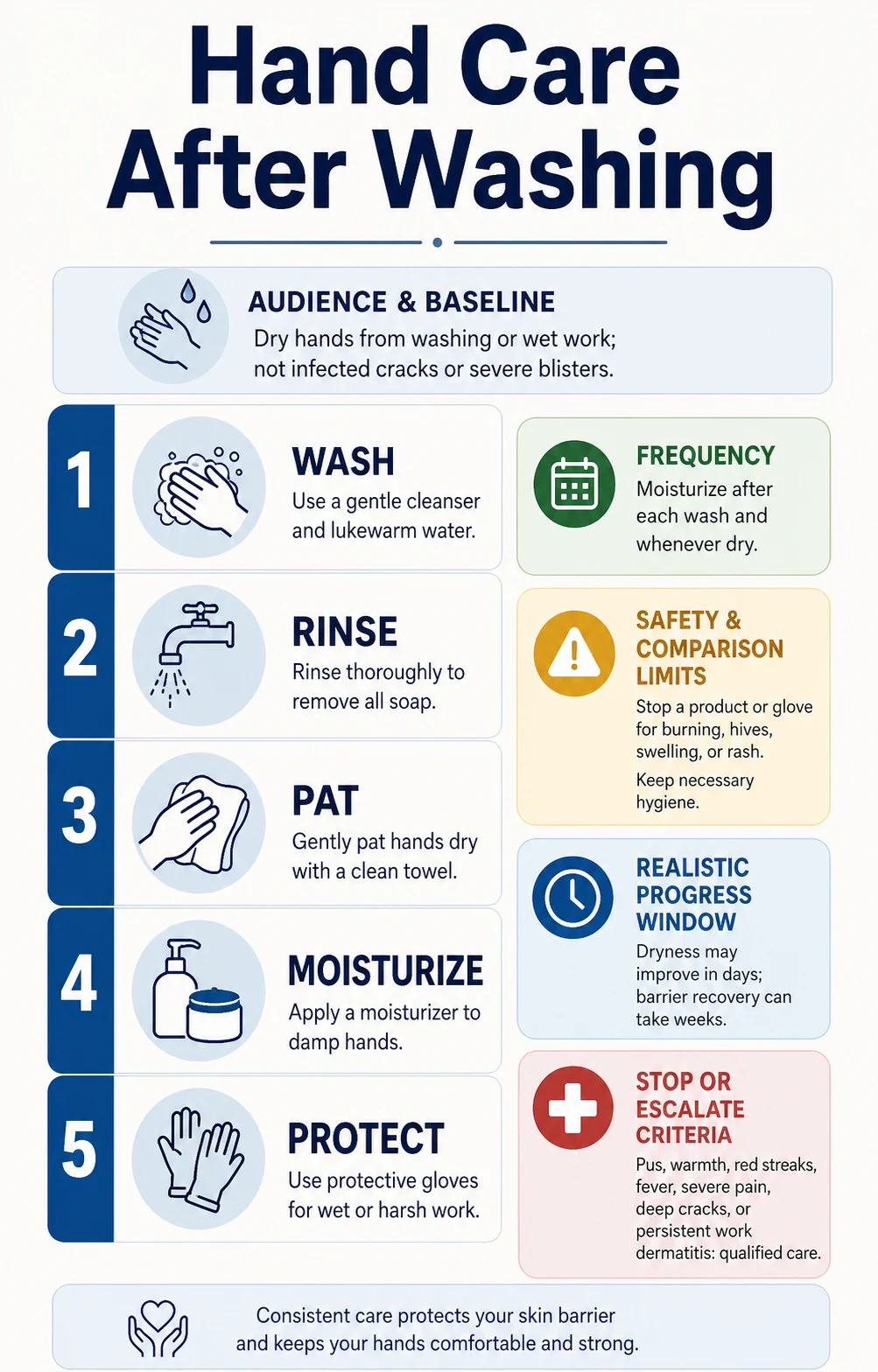
Adults and older teens whose hands feel dry or tight from frequent washing, sanitizer, wet work, or cleaning; not people with deep infected cracks, severe blistering, occupational chemical exposure needing formal controls, or a condition requiring diagnosis.
Before changing anything, record the current routine, the exact symptom or appearance concern, and any recent product, medication, climate, or activity change. That short baseline is more useful than comparing yourself with a highly edited image. If checking has become repetitive or distressing, step away from close-up inspection and talk with someone you trust or a qualified clinician.
What is actually modifiable
Modifiable factors include water temperature, cleanser amount, drying method, moisturizer timing, fragrance exposure, wet-work duration, glove selection, and ring removal. Less-modifiable factors include atopic tendency, contact allergy, job requirements, climate, age, diabetes, and other medical conditions.
That distinction matters. A routine can reduce avoidable irritation or improve day-to-day presentation, but it cannot promise a new anatomy, erase normal texture, or guarantee a uniform result. The right target is a tolerable process and a meaningful symptom trend, not perfection.

What the evidence supports
Repeated water, soap, detergent, solvent, and glove occlusion can remove lipids and disrupt the hand barrier. Moisturizer applied to slightly damp skin reduces water loss. Gloves reduce contact only when they match the task; trapped sweat, leaks, latex, or chemicals that permeate a glove can worsen dermatitis.
AAD guidance recommends fragrance-free cream or ointment after washing and recognizes that hand eczema can resemble ordinary dryness. CDC guidance for healthcare workers says alcohol-based hand sanitizer is often less drying than soap and water in appropriate clinical situations and that compatible lotions can reduce dryness. DermNet recommends emollients after washing and task-appropriate gloves, with cotton liners for prolonged wet work. NHS contact-dermatitis guidance supports trigger avoidance and professional review when symptoms persist.
Evidence strength is not the same as marketing confidence. Official guidance is strong for safety boundaries and labeled use, while product-to-product claims are often thinner. Laboratory or short clinical studies can explain a mechanism without proving that every person will see the same visible result. When uncertainty is material, this guide says so.
A lower-risk routine
Keep required hygiene: wash when indicated with lukewarm water and a gentle fragrance-free cleanser, rinse fully, and pat dry. Apply a cream or ointment while skin is slightly damp. For dishes, cleaning, or chemical work, use task-appropriate waterproof gloves for the shortest practical time; add cotton liners if sweat is a problem. Remove rings before wet work and moisturize again afterward.
Use this order:
- Define the single problem you are trying to solve.
- Remove avoidable irritation or pressure before buying more treatment.
- Introduce one reversible change and follow its label or professional instructions.
- Keep the rest of the routine stable long enough to interpret tolerance.
- Escalate to qualified care when the pattern is severe, persistent, unusual, or unsafe for self-treatment.
Doing less is sometimes the more evidence-based choice. Stacking products makes both benefit and harm harder to trace, and discomfort is not a useful proxy for effectiveness.
Time, cost, and realistic progress
Simple dryness may feel better within days, but a damaged barrier often needs weeks of consistent protection. A fragrance-free cream or ointment is a modest recurring cost; compatible workplace products and proper gloves may require employer or occupational-health support.
Place moisturizer at sinks and workstations, refill before it runs out, and track tasks that precede flares. Wash reusable gloves as directed and replace damaged pairs. Continue hygiene; the goal is to make it gentler, not skip it.
Progress should be judged by comfort, function, consistency, and the specific concern named at the start. Use the same lighting and ordinary viewing distance if you keep photographs. Daily close-ups mostly measure camera conditions and natural fluctuation.
Stop and get help when needed
Stop a product or glove that triggers rapid burning, hives, swelling, or a spreading rash. Seek prompt care for pus, increasing warmth, red streaking, fever, severe pain, or deep cracks that will not close. Persistent itchy, blistered, thickened, or work-related dermatitis needs clinician or occupational-health review and may require patch testing.
A dermatologist, primary-care clinician, or occupational-health professional should review persistent, painful, blistering, infected, or work-triggered hand disease. Minors need conservative fragrance-free care and adult help with cleaning chemicals and gloves.
These boundaries are part of the routine, not an afterthought. A qualified professional can check whether the apparent cosmetic issue is actually dermatitis, infection, allergy, medication effect, inflammatory disease, circulation trouble, or another condition that needs a different plan.
Visual and commercial transparency
Water, glycerin, studio oil, hand pose, flash, smoothing, and close macro lenses can hide or exaggerate cracking and redness. Images cannot distinguish irritant dermatitis, allergic dermatitis, infection, psoriasis, or eczema.
This article has no affiliate links, sponsor, free-product relationship, product ranking, or paid placement. Brand packaging, high prices, salon photography, and social-media popularity are not evidence of safety or superiority. Any cost language is a broad planning range, not a live shopping recommendation.
Practical summary
- Wash with lukewarm water and gentle cleanser; 2. Rinse and pat dry; 3. Moisturize damp skin; 4. Use task-matched gloves for wet or chemical work; 5. Escalate persistent dermatitis
Frequency: Moisturize after each wash and whenever dry; use gloves only for the task and remove them when no longer needed.
The useful question is not whether a routine creates a perfect image. It is whether the smallest safe change is tolerable, supported, affordable to maintain, and producing a consistent improvement without crossing a stop boundary.
Decision checkpoint
Pair the trigger with the repair: moisturizer at each sink, cotton liners beside waterproof gloves, and a replacement pair where chemical work happens. If the protective step is stored elsewhere, it will be skipped under time pressure. Making the safer action physically convenient is part of the treatment plan.

Sources
- S01: Dry skin relief from handwashing - American Academy of Dermatology; accessed 2026-08-09.
- S02: Dry, scaly, and painful hands could be hand eczema - American Academy of Dermatology; accessed 2026-08-09.
- S03: Clinical Safety: Hand Hygiene for Healthcare Workers - Centers for Disease Control and Prevention; accessed 2026-08-09.
- S04: Hand dermatitis - DermNet; accessed 2026-08-09.
- S05: Contact dermatitis - National Health Service; accessed 2026-08-09.


