
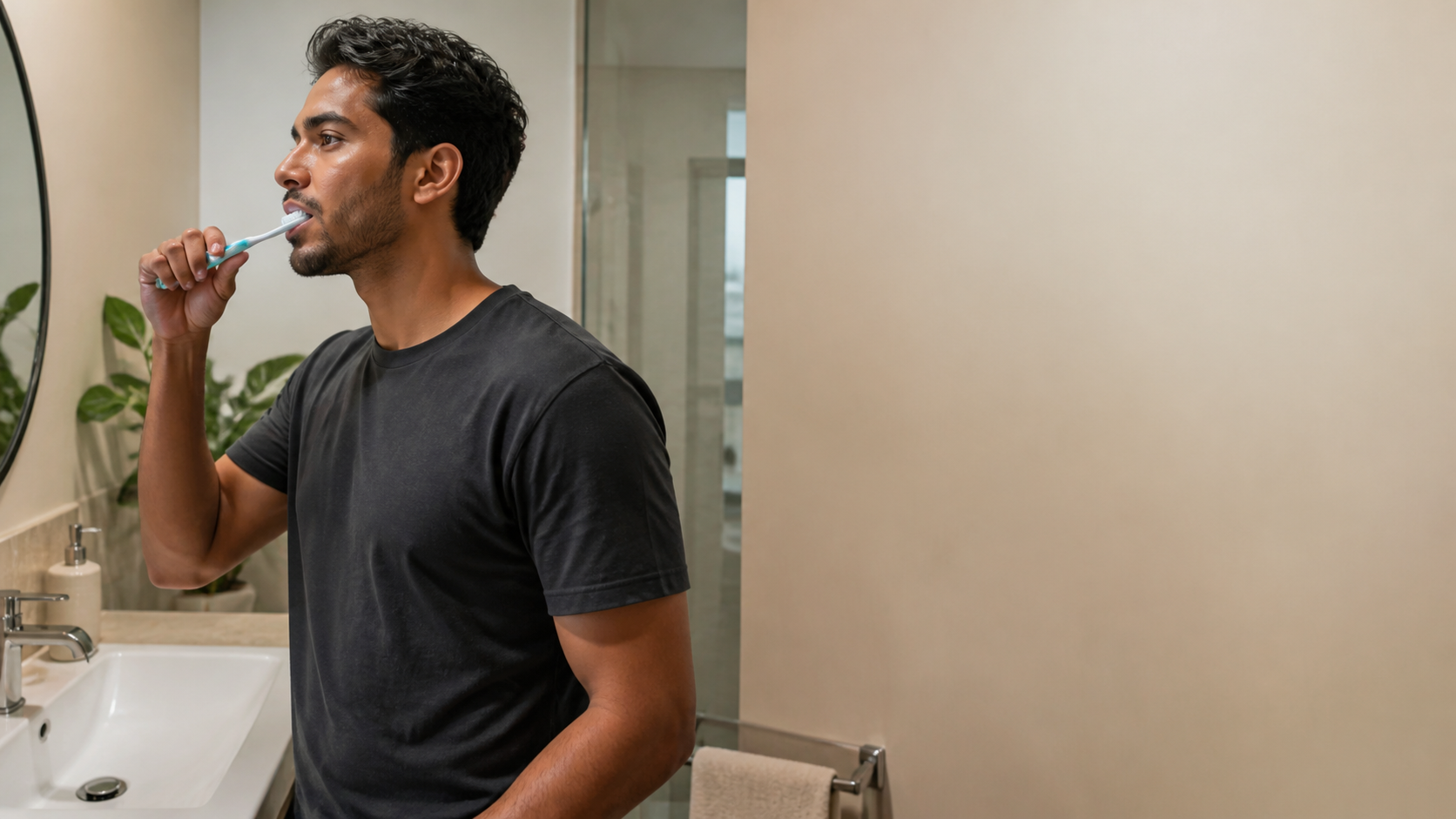
Clean teeth and gums consistently without treating pressure, hard bristles, whitening abrasiveness, or repeated scrubbing as evidence of a better routine. That is a practical care goal, not a verdict on attractiveness or personal value. Normal variation is expected, and the safest plan is the one that remains simple enough to follow without pain, shame, or constant flaw-checking.
This guide is general education, not diagnosis or individualized treatment. It does not prescribe a drug, device, or procedure, and it does not use photographs to diagnose a skin, hair, ear, nose, dental, allergy, infection, or other medical condition.
Start with your real baseline
Tooth shade, enamel translucency, spacing, gum contour, recession risk, saliva, dexterity, orthodontic work, and sensitivity vary. Healthy teeth are not necessarily paper white, and a close flash photograph cannot measure plaque, erosion, decay, or gum health.
Adults and older teens building a basic home oral-care routine; not people with severe tooth pain, facial swelling, uncontrolled bleeding, dental trauma, a loose adult tooth, a spreading infection, or individualized post-surgical instructions.
Before changing anything, record the current routine, the exact practical concern, and any recent product, medication, climate, facility, or activity change. That baseline is more useful than comparison with an edited close-up. If checking has become repetitive or distressing, step away from magnification and discuss it with someone you trust or a qualified professional.
What is actually modifiable
Modifiable factors include brush softness, pressure, angle, duration, fluoride toothpaste, interdental tool fit, sugary drink frequency, smoking, and check-up attendance. Less-modifiable factors include anatomy, restorations, braces, dry-mouth conditions, gum-disease history, enamel defects, disability, and medication effects.
This distinction keeps the goal realistic. A routine can reduce avoidable irritation and improve day-to-day grooming, but it cannot promise new anatomy, erase normal texture, or guarantee one uniform result. The target is a tolerable process and a meaningful comfort or function trend, not perfection.

What the evidence supports
Plaque is a bacterial film that accumulates on and between teeth. Fluoride toothpaste strengthens the tooth surface against decay, while mechanical cleaning removes plaque. More pressure is not necessarily more cleaning: aggressive scrubbing and harder bristles can abrade gums, and toothbrushes do not clean tight spaces between teeth well enough on their own.
ADA guidance recommends two minutes of brushing twice daily with fluoride toothpaste and a soft-bristle brush, noting that soft bristles reduce gingival abrasion risk. Its home-care guidance supports daily interdental cleaning while acknowledging technique and evidence limitations. ADA dental-erosion guidance says excessive aggressive brushing can contribute to abrasion but normal gentle brushing with a soft brush and low-abrasion fluoride toothpaste is unlikely to cause erosive wear. NIDCR guidance reinforces gentle small motions, gumline angling, fluoride, daily interdental cleaning, and professional review.
Evidence strength is not the same as marketing confidence. Official guidance is useful for safety boundaries and ordinary technique, while brand-to-brand claims are often thinner. A mechanism does not prove that every person will see the same visible result. When uncertainty is material, this guide says so.
A lower-risk routine
Use a soft-bristle manual or powered brush that reaches all areas. Apply fluoride toothpaste, angle bristles toward the gumline, and use gentle short or circular movements across outer, inner, and chewing surfaces for about two minutes total. Spit after brushing and follow local dental guidance about rinsing. Once daily, clean between teeth with floss, an interdental brush, or another correctly sized device that can be used without snapping or forcing it into the gums. Replace a worn brush and ask a dentist or hygienist to personalize technique around braces, implants, recession, or limited dexterity.
Use this order:
- Define one practical problem rather than chasing a total transformation.
- Remove avoidable irritation, force, or exposure before buying more products.
- Introduce one reversible change and follow its label or professional instructions.
- Keep the rest of the routine stable long enough to interpret tolerance.
- Escalate when the pattern is painful, persistent, unusual, or unsafe for self-care.
Doing less is sometimes the more evidence-based choice. Stacking products or repeating a technique harder makes both benefit and harm difficult to trace, and discomfort is not a useful proxy for effectiveness.
Time, cost, and realistic progress
The core routine takes about two minutes twice daily plus a few minutes for interdental cleaning. A soft brush, fluoride toothpaste, and simple interdental tool are low recurring costs. Powered brushes, whitening systems, and premium pastes are optional and do not replace technique or professional care.
Replace a brush about every three to four months or sooner when bristles are matted or frayed. Track tenderness, bleeding, sensitivity, and whether bristles splay quickly; early splaying can indicate excess pressure. Keep routine check-ups on the interval a dentist recommends and change one technique variable at a time.
Progress should be judged by comfort, function, consistency, and the concern named at the start. If you keep photographs, use the same lighting and an ordinary viewing distance. Daily close-ups mostly measure camera conditions and normal fluctuation.
Stop and get help when needed
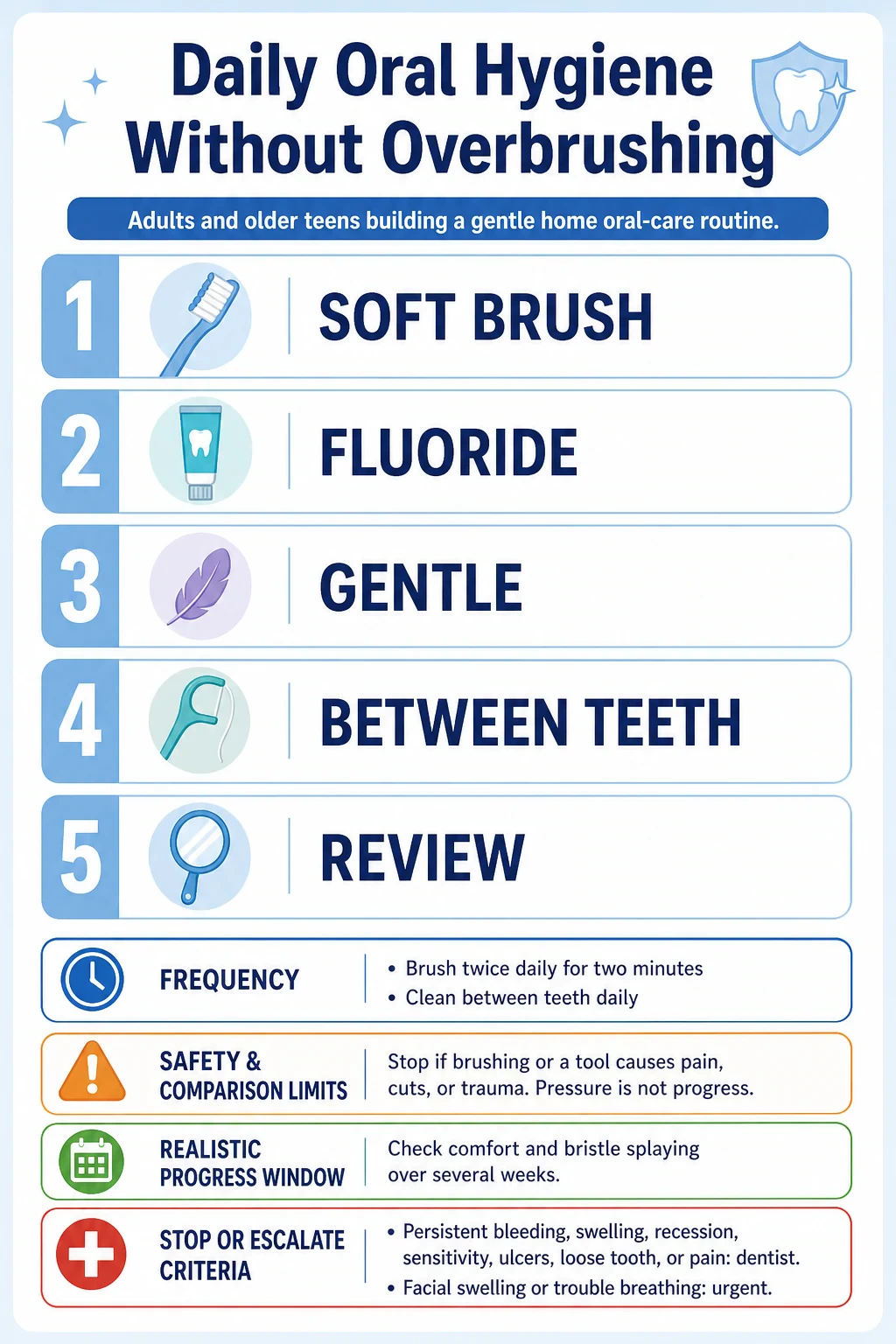
Stop forceful brushing or an ill-fitting interdental tool that causes sharp pain, cuts, or repeated trauma. Arrange dental review for persistent bleeding, painful or swollen gums, new recession, ongoing sensitivity, ulcers or red patches, a loose tooth, bad taste, or pain that affects sleep or eating. Seek urgent dental or medical care for facial swelling, fever with dental pain, uncontrolled bleeding, trauma, or difficulty breathing or swallowing.
A dentist or dental hygienist should personalize technique for persistent bleeding, recession, sensitivity, braces, implants, dentures, dry mouth, gum disease, disability, or repeated difficulty cleaning between teeth. Children need age-appropriate toothpaste amounts and caregiver supervision; this adult and older-teen guide does not replace pediatric advice.
These boundaries are part of the routine, not an afterthought. A qualified professional can determine whether an apparent grooming issue is actually an infection, allergy, inflammatory condition, structural problem, medication effect, or another condition that needs a different plan.
Visual and commercial transparency
Flash, whitening filters, dehydration, lipstick, camera white balance, plaque-disclosing dye, and close magnification can alter apparent shade and gum color. Images cannot diagnose cavities, erosion, gingivitis, recession, infection, or the cause of bleeding.
This article has no affiliate links, sponsor, free-product relationship, product ranking, retailer recommendation, or paid placement. Premium packaging, high prices, salon photography, and social-media popularity are not evidence of safety or superiority. Any cost language is a broad planning range, not a live shopping recommendation.
Practical summary
- Use a soft brush and fluoride toothpaste; 2. Brush gently for two minutes; 3. Reach every surface and the gumline; 4. Clean between teeth daily; 5. Review persistent bleeding or pain
Frequency: Brush twice daily for about two minutes and clean between teeth once daily using a tolerated, correctly sized method.
The useful question is not whether a routine creates a perfect image. It is whether the smallest safe change is tolerable, supported, affordable to maintain, and producing a consistent improvement without crossing a stop boundary.
Decision checkpoint
Let the bristles report the pressure. If a new soft brush splays early, or the gumline is repeatedly sore after cleaning, do not compensate by brushing longer. Reduce force, slow the motion, and ask a dental professional to check technique if tenderness, bleeding, recession, or sensitivity persists.

Sources
- S01: Toothbrushes - American Dental Association; accessed 2026-08-10.
- S02: Home Oral Care - American Dental Association; accessed 2026-08-10.
- S03: Dental Erosion - American Dental Association; accessed 2026-08-10.
- S04: Oral Hygiene - National Institute of Dental and Craniofacial Research; accessed 2026-08-10.


