
Reduce ordinary pressure-related hard skin without cutting into healthy tissue, while making diabetes, circulation, neuropathy, infection, and severe pain clear stop points for self-treatment. That is a practical grooming goal, not a verdict on attractiveness or personal value. Normal variation is expected, and the safest plan is the one that remains simple enough to follow without pain, shame, or a constant search for flaws.
This guide is general education, not diagnosis or individualized treatment. It does not prescribe a drug, device, or procedure, and it does not use photographs to diagnose a skin, hair, allergy, circulation, or other medical condition.
Start with your real baseline
Foot shape, toe alignment, skin thickness, gait, activity, footwear needs, and callus pattern vary. Some thickening is protective; perfectly smooth soles are not a health goal.
Adults and older teens with mild corns or calluses from friction or pressure; not people with diabetes, poor circulation, reduced sensation, open wounds, infection, severe pain, or uncertainty about the diagnosis.
Before changing anything, record the current routine, the exact symptom or appearance concern, and any recent product, medication, climate, or activity change. That short baseline is more useful than comparing yourself with a highly edited image. If checking has become repetitive or distressing, step away from close-up inspection and talk with someone you trust or a qualified clinician.
What is actually modifiable
Modifiable factors include shoe fit, pressure points, socks, activity load, moisturizing, gentle filing, padding, and nail length. Less-modifiable factors include bone shape, arthritis, gait, neuropathy, circulation, diabetes, scar tissue, and structural deformity.
That distinction matters. A routine can reduce avoidable irritation or improve day-to-day presentation, but it cannot promise a new anatomy, erase normal texture, or guarantee a uniform result. The right target is a tolerable process and a meaningful symptom trend, not perfection.

What the evidence supports
Corns and calluses form where repeated pressure or friction stimulates protective thickening. Removing the pressure is more durable than aggressively removing skin. Cutting, razors, and over-filing can cause bleeding and infection; acid products can injure surrounding skin and are especially risky when sensation or circulation is impaired.
AAD guidance recommends brief soaking, gentle pumice use, moisturizer, padding, and better-fitting shoes while warning against removing too much skin. NHS guidance explicitly says not to cut corns or calluses and tells people with diabetes, heart disease, or circulation problems not to self-treat. AAD diabetes guidance recommends professional care for foot calluses because thick skin can break down into wounds. Regional NHS diabetic-foot guidance links neuropathy and reduced blood supply to higher injury risk.
Evidence strength is not the same as marketing confidence. Official guidance is strong for safety boundaries and labeled use, while product-to-product claims are often thinner. Laboratory or short clinical studies can explain a mechanism without proving that every person will see the same visible result. When uncertainty is material, this guide says so.
A lower-risk routine
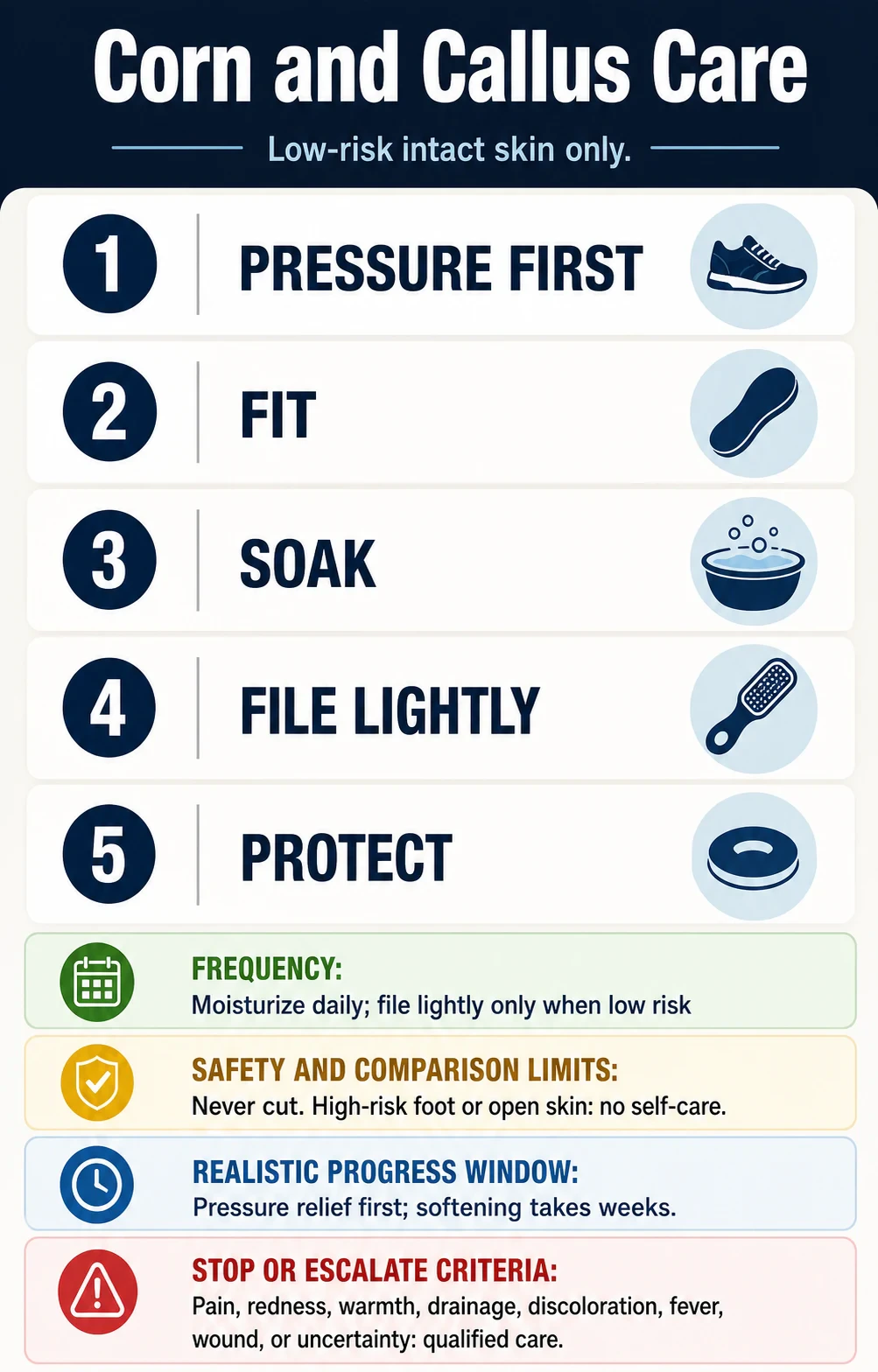
First identify and reduce the pressure: check shoe width and toe room, inspect seams, and use appropriate socks or padding. If sensation and circulation are normal and the skin is closed, soak briefly and use a pumice stone or foot file gently, stopping well before tenderness. Apply moisturizer to dry hard skin but not between toes if moisture collects there. Never cut, shave, or dig at a corn.
Use this order:
- Define the single problem you are trying to solve.
- Remove avoidable irritation or pressure before buying more treatment.
- Introduce one reversible change and follow its label or professional instructions.
- Keep the rest of the routine stable long enough to interpret tolerance.
- Escalate to qualified care when the pattern is severe, persistent, unusual, or unsafe for self-treatment.
Doing less is sometimes the more evidence-based choice. Stacking products makes both benefit and harm harder to trace, and discomfort is not a useful proxy for effectiveness.
Time, cost, and realistic progress
Pressure reduction may improve discomfort quickly, while thick skin softens gradually over weeks. A basic file, moisturizer, and shoe padding are low-cost items, but replacing poorly fitting shoes or seeing a podiatrist costs more. Repeated aggressive removal creates expense and injury without fixing the pressure source.
Inspect feet regularly, keep tools clean and personal, file lightly rather than to bare skin, moisturize consistently, and replace footwear or padding that recreates the pressure point. Recurrence means the mechanical cause still matters.
Progress should be judged by comfort, function, consistency, and the specific concern named at the start. Use the same lighting and ordinary viewing distance if you keep photographs. Daily close-ups mostly measure camera conditions and natural fluctuation.
Stop and get help when needed
Do not self-treat if you have diabetes, poor circulation, neuropathy, immune suppression, an open wound, bleeding, infection, or uncertainty about the lesion. Seek prompt care for spreading redness, warmth, swelling, drainage, discoloration, fever, severe pain, or a wound that does not heal. Sudden pain or a suspected wart needs diagnosis.
A podiatrist, dermatologist, or clinician should review severe, recurrent, painful, bleeding, infected, or diagnostically unclear lesions and all self-care decisions when diabetes, poor circulation, or reduced sensation is present. Minors need adult oversight and no cutting or acid corn removers.
These boundaries are part of the routine, not an afterthought. A qualified professional can check whether the apparent cosmetic issue is actually dermatitis, infection, allergy, medication effect, inflammatory disease, circulation trouble, or another condition that needs a different plan.
Visual and commercial transparency
Wet skin, oil, pedicure tools, lighting, whitening filters, and close macro lenses can make hard skin appear better or worse. Images cannot distinguish every corn, callus, wart, ulcer, infection, or circulation problem.
This article has no affiliate links, sponsor, free-product relationship, product ranking, or paid placement. Brand packaging, high prices, salon photography, and social-media popularity are not evidence of safety or superiority. Any cost language is a broad planning range, not a live shopping recommendation.
Practical summary
- Remove the pressure source; 2. Soak closed healthy skin briefly; 3. File gently; 4. Moisturize and pad; 5. Never cut and escalate risk conditions
Frequency: File lightly only as needed on intact skin; moisturize daily and review footwear pressure regularly.
The useful question is not whether a routine creates a perfect image. It is whether the smallest safe change is tolerable, supported, affordable to maintain, and producing a consistent improvement without crossing a stop boundary.
Decision checkpoint
Use a pressure check before a skin-removal check. Inspect the shoe seam, toe box, insole wear, and the activity that precedes pain. If the same spot thickens again after gentle care, that recurrence is evidence that pressure remains; it is not permission to file deeper.

Sources
- S01: How to treat corns and calluses - American Academy of Dermatology; accessed 2026-08-09.
- S02: Corns and calluses - National Health Service; accessed 2026-08-09.
- S03: Dermatologist-recommended skin care for people with diabetes - American Academy of Dermatology; accessed 2026-08-09.
- S04: Diabetic foot care - NHS Sussex Integrated Care System; accessed 2026-08-09.


