

Natural teeth are not printer paper. Healthy shade varies with enamel translucency, the warmer dentin underneath, age, genetics, stain exposure, hydration, and previous dental work. A yellow-ivory tooth can be healthy; a very white tooth can still have decay or gum disease. Whitening is an elective color change, not a hygiene score or a measure of anyone’s worth.
The safest decision starts with a simple question: are you trying to remove surface stain, chemically lighten natural tooth structure, or make mismatched dental work look uniform? Those are different jobs. Only natural teeth bleach. Crowns, veneers, tooth-colored fillings, implants, and dentures keep their existing shade [S01, S04].
Before whitening, check the baseline
Ordinary oral care comes first: brush twice daily with fluoride toothpaste, clean between teeth, limit tobacco, and get routine dental cleaning when due. That can remove plaque and some external stain, but it will not rewrite your natural dentin color.
Book a dental exam before bleaching if you have untreated cavities, gum disease, cracked teeth, exposed roots, strong sensitivity, significant erosion, recent dental work, or one tooth that suddenly darkened. A dark tooth after trauma can have a different cause from coffee stain. An image cannot diagnose it.
If you have visible crowns or fillings, ask how whitening natural teeth could affect the color match. Replacing sound restorations for color alone removes tooth structure and adds cost and maintenance. That irreversible step belongs after you know the achievable natural-tooth shade and have discussed alternatives.
Options in reversible-first order
| Option | What it can reasonably do | Main tradeoff |
|---|---|---|
| Stable hygiene and professional cleaning when due | Reduce plaque and some external stain | Does not bleach intrinsic tooth color |
| Label-directed OTC peroxide strips | Modestly lighten susceptible natural teeth over a course | Fit varies; temporary sensitivity or gum irritation can occur |
| Dentist-supervised home trays | Add diagnosis, custom fit, and a managed concentration | Higher cost and still requires days or weeks |
| In-office bleaching | Produce a faster supervised color change | Higher cost; faster is not proven universally better long-term |
| Replacing sound restorations for shade alone | Change restoration color | Irreversible tooth work, future replacement burden, and substantial cost |
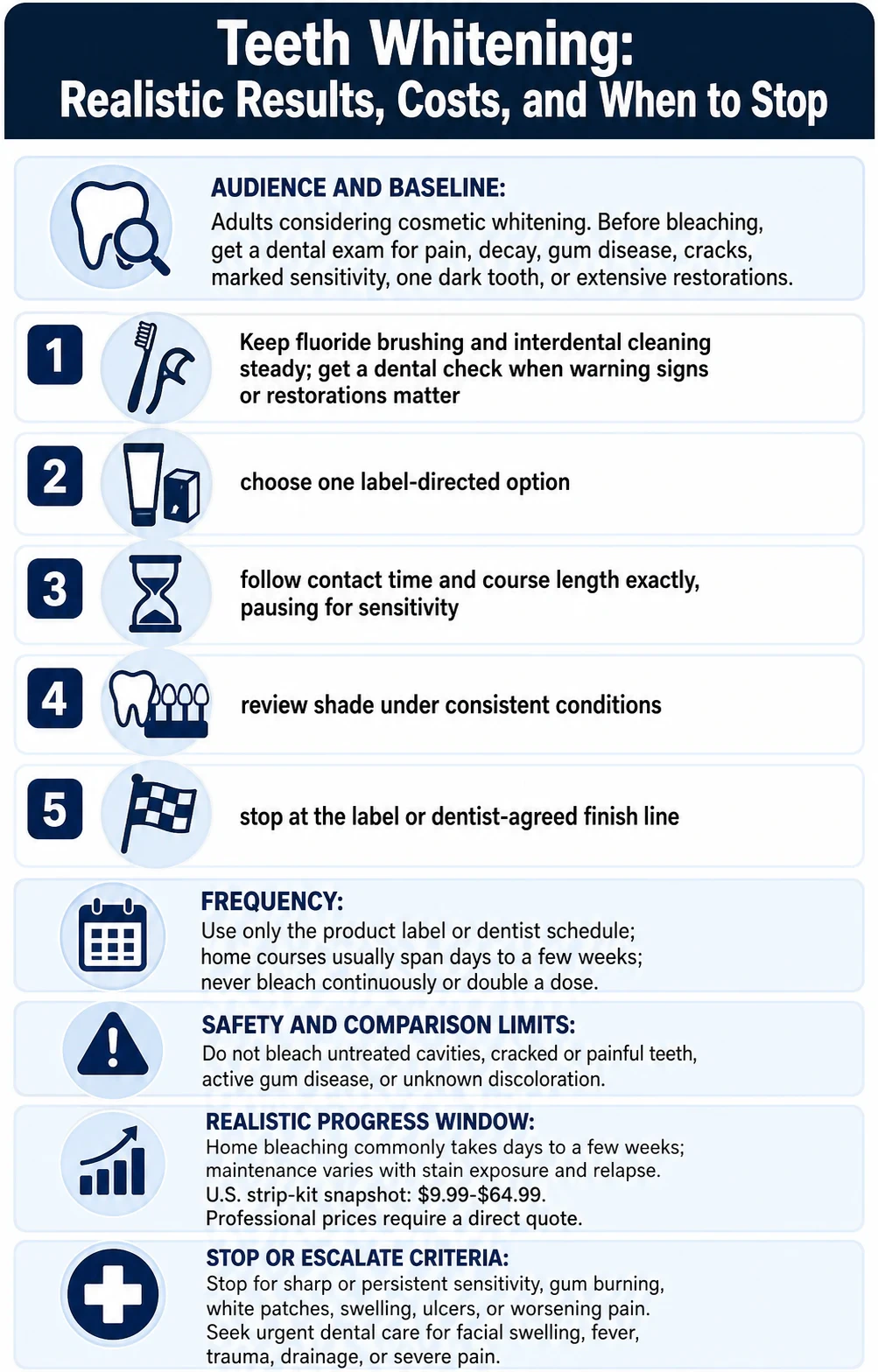
1. Keep hygiene steady and reduce new stain
Use a soft toothbrush and fluoride toothpaste; do not scrub harder to “polish” teeth white. Whitening toothpastes mainly remove external stain with abrasives and may not change intrinsic color much [S01]. Reduce frequent tobacco exposure and rinse with water after strongly staining drinks if practical. Do not turn coffee, tea, or red wine into moral failures—frequency and contact are modifiable exposures, not character traits.
Give a stable routine a couple of weeks before judging shade. If you take photos, use the same neutral room light, camera, distance, exposure, white balance, lip product, cleaning status, and time of day. Warm bathroom bulbs, cool daylight, lipstick, dehydration, phone processing, filters, and selective editing can shift apparent color dramatically.
2. Consider a label-directed OTC product
Peroxide strips can lighten natural teeth. Look for clear ingredient and use instructions; in the United States, an ADA Seal means the manufacturer submitted evidence that the product met ADA requirements for its stated safety and effectiveness claim [S05]. It does not mean the product is best for every mouth.
Follow the label’s contact time, frequency, age limit, and course length exactly. More gel, longer wear, doubling sessions, or running courses back-to-back can increase exposure without guaranteeing a better result. Keep gel off the gums as much as the design allows, wash your hands, and do not sleep in a product unless its instructions explicitly say to.
3. Use dentist-supervised trays when fit or diagnosis matters
A dentist can examine the cause of discoloration and make trays that fit your teeth. Dentist-supplied home treatment usually takes days to a few weeks [S02]. It costs more than a retail kit but adds diagnosis, fit, and a plan for sensitivity, restorations, and maintenance.
4. Treat in-office bleaching as faster, not magical
Office bleaching uses professional isolation and higher-concentration protocols. It may produce a faster visible change, but faster does not automatically mean better or longer lasting. A 2025 systematic review of randomized trials found no clear difference between home and office techniques in shade-guide efficacy or the risk of sensitivity. At-home treatment had lower sensitivity intensity and a different color-instrument result, but the authors rated the evidence low quality [S03].
That is a useful corrective to “one-session transformation” marketing. Technique, concentration, starting shade, type of discoloration, adherence, measurement system, and follow-up all matter.
What results are realistic?
Bleaching can lighten susceptible natural teeth, but no responsible source can promise a particular shade number from a photo. Deep developmental stains, tetracycline-related color, fluorosis, trauma, thin enamel, or a dark non-vital tooth may respond differently and need a dentist-led plan [S01]. Restorations will not follow the change.
Home courses commonly take several days to a few weeks [S02]. Sensitivity can begin early and is often temporary, but “common and temporary” does not mean you must endure sharp pain. Color can relapse as teeth rehydrate and new stains accumulate. Maintenance varies; continuous bleaching is not maintenance.
Sensitivity and gum irritation
Temporary tooth sensitivity and gingival irritation are the most common adverse effects of vital-tooth whitening [S01]. Risk can change with peroxide concentration, contact time, tray fit, existing sensitivity, exposed dentin, and the protocol. The ADA review reports that sensitivity with strips or trays may appear within the first few days and often settles after treatment stops [S01].
Pause and contact a dentist if sensitivity is sharp, persistent, worsening, localized to one tooth, or triggered long after the product is removed. Stop immediately for gum burning, white patches, ulcers, swelling, or bleeding. Do not numb the area and keep bleaching; pain is a safety signal.
Seek urgent dental or medical care for facial swelling, fever, drainage, trauma, severe unremitting pain, trouble swallowing, or breathing difficulty.
Avoid DIY shortcuts
Acidic fruit, vinegar, salt, charcoal, abrasive powders, and household peroxide are not clever substitutes for a tested oral-care product. ADA’s evidence review found inadequate evidence for charcoal whitening and describes abrasion concerns with some DIY mixtures [S01]. Acid and abrasion can change surface appearance while harming enamel or soft tissues.
Likewise, a light sold with a kit is not proof of superior bleaching. Product marketing, influencer photos, customer ratings, and dramatic studio images sit below controlled clinical evidence.
Time, cost, and maintenance
On July 19, 2026, a Target search page showed example whitening-strip kits from $9.99 to $64.99 [S06]. That is a retail snapshot, not a ranking; promotions, package sizes, ingredients, and inventory change. Dentist-supplied trays and office treatment vary widely by exam needs, region, and protocol, so get a written local quote that separates evaluation, treatment, and future maintenance.
Track three things: comfort, whether natural teeth changed under consistent conditions, and whether restorations now look mismatched. Stop at the end of the labeled course or the dentist-agreed target. Reassess before another course, especially if sensitivity occurred.
LooksMaxx has no affiliate relationship with any product, retailer, dental office, or the ADA Seal program. A higher price, a celebrity image, “natural” language, or an LED does not establish better results.
Pregnancy, minors, and professional boundaries
NHS guidance does not recommend whitening during pregnancy or breastfeeding and does not provide it to people 17 or younger; ADA notes pediatric guidance discourages full-arch cosmetic bleaching in primary or mixed dentition [S01, S04]. Laws and exact age rules vary, but the conservative choice is to defer elective bleaching and ask a dentist. Minors should involve a parent or guardian and a pediatric or general dentist.
This guide cannot determine whether your teeth and gums are healthy, why one tooth is dark, whether a restoration will match, or which concentration is suitable. Those are dental decisions.
A sensible finish line
Whitening is successful when a modest color goal is reached without pain, gum injury, or an endless escalation loop. Healthy teeth do not have to match a filtered reference image. If you find yourself checking shade repeatedly, feeling unable to stop, or tying tooth color to social worth, pause the process and talk with someone you trust or a qualified professional before buying another treatment.


Sources
- S01 — American Dental Association: Whitening evidence review
- S02 — ADA MouthHealthy: Teeth Whitening
- S03 — PubMed: 2025 home versus office bleaching meta-analysis
- S04 — NHS: Teeth whitening
- S05 — American Dental Association: Seal of Acceptance
- S06 — Target: dated whitening-strip listings
Evidence and prices were checked July 19, 2026. This is general education, not diagnosis or personalized dental treatment.


